

JD Health Surges Over 40% on HKEX Debut: Unpacking Its Internet Healthcare Strategy and Product Ecosystem

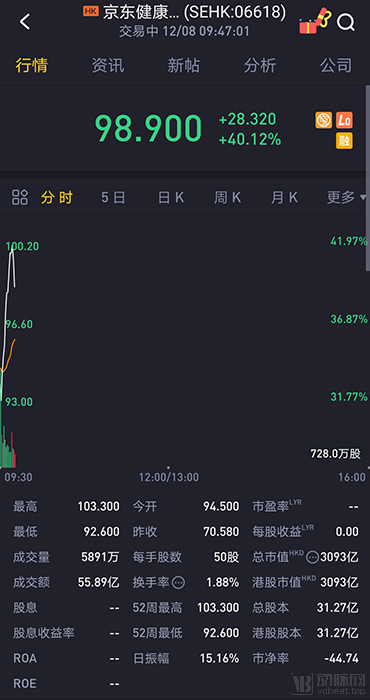
Today, JD Health (HK: 06618) officially listed on the Hong Kong Stock Exchange, with an opening price of HK$94.5, up 33.89% from its IPO price, and rising above HK$100 during trading. As of 9:47 a.m., JD Health’s share price stood at HK$98.9, a 40.12% increase from its IPO price, with a market capitalization of HK$309.3 billion.
JD Health’s HKD-denominated IPO price was set at HK$70.58 per share, at the upper end of its indicative offer range of HK$62.80–HK$70.58 per share. The Hong Kong public offering was oversubscribed by 421.91 times. JD Health’s strong pre-listing performance demonstrates robust investor confidence in the company.
JD Health took only a year and a half to spin off from JD.com and go public, setting more than one record in the process. As the first internet healthcare company to achieve profitability at its IPO, JD Health possesses substantial confidence. According to its prospectus, JD Health’s business is divided into two major segments: retail pharmacy operations and online medical and health services.
The retail pharmacy business comprises three operational models: self-operated stores, online platforms, and an omnichannel layout.
Among the three models, the self-operated business is conducted through JD Pharmacy, leveraging the infrastructure advantages of JD Logistics to establish 11 pharmaceutical warehouses nationwide, with delivery timelines synchronized with those of JD’s self-operated products; the online platform onboards third-party merchants to offer a more diverse product range, complementing JD Pharmacy; as of June 2020, the JD Health platform had over 9,000 merchants; the omni-channel layout refers to JD Health’s collaboration with offline pharmacies across various regions, providing users with same-day, next-day, 30-minute, and 24/7 rapid delivery services to meet urgent medication needs, a model that currently covers more than 200 cities.
In this way, JD Health has established an omni-channel retail network integrating online and offline scenarios, offering a wide range of product categories for user selection while meeting diverse healthcare needs varying in urgency and severity.
Online healthcare services constitute a core component of JD Health’s strategic layout, encompassing online consultations, prescription renewals, chronic disease management, family doctor services, and consumer healthcare, with 24/7 availability. As the primary platform for these services, JD Internet Hospital’s medical team comprised more than 68,000 in-house and external physicians as of September 20, 2020. In the first half of 2020, the JD Health platform handled an average of nearly 90,000 online consultations per day.
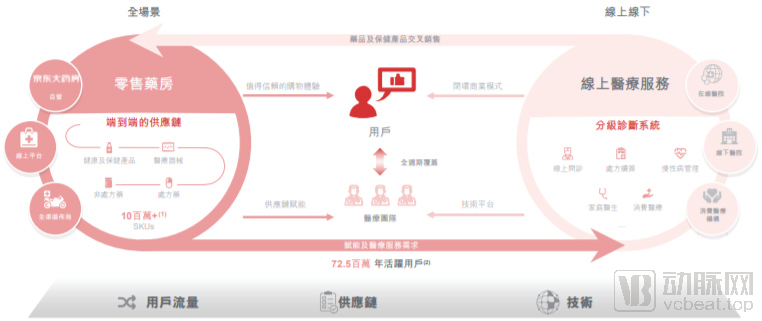
JD Health’s Business Model, Source: Prospectus
In JD Health’s business model, a synergistic effect has been established between its retail pharmacy operations and its online healthcare services. On one hand, customers of the retail pharmacies represent potential high-quality users of healthcare services; on the other hand, users of these healthcare services serve as a significant traffic source that feeds back into the retail pharmacy business and other consumer healthcare offerings.
In terms of the revenue structure of its two business segments, sales of pharmaceutical and health products in JD Health’s retail pharmacy business account for more than 80% of revenue; online medical and healthcare services currently represent a smaller proportion of total revenue, which was not disclosed separately in the prospectus.
Nevertheless, by analyzing JD Health’s revenue data in recent years, we can gain a general understanding of the overall impact of online medical services on its total revenue. According to the prospectus, JD Health’s total revenue from 2017 to 2019 was RMB 5.6 billion, RMB 8.2 billion, and RMB 10.8 billion, respectively, reaching RMB 8.8 billion in the first half of 2020 alone. Its adjusted net profits for 2017–2019 were RMB 209 million, RMB 248 million, and RMB 344 million, respectively, amounting to RMB 371 million in the first half of 2020.
This has also made JD Health the first internet healthcare company to go public while profitable.
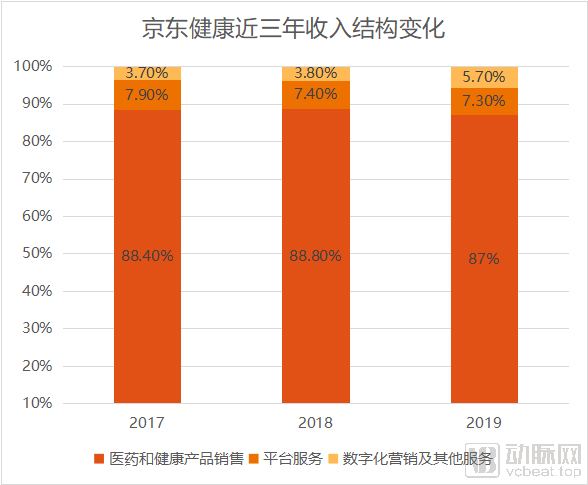
Revenue Structure of JD Health, Data Source: Prospectus, Chart by VCBeat
As JD Health’s revenue and profitability continue to grow, the substantial contribution from pharmaceutical sales has become a focal point of widespread industry discussion.
We believe that, compared with offline medical services, internet healthcare primarily focuses on online consultations and prescription refills for common and chronic diseases, while being unable to conduct examinations, tests, surgeries, and other procedures. For platforms offering both medical services and pharmaceuticals, drugs naturally account for a significant proportion. JD Health, spun off from JD Pharmacy, inherently possesses a strong e-commerce DNA, which serves as the foundation for its profitability and successful IPO. This advantage is unlikely to be overturned in the short term, nor can it be replaced by internet healthcare, a new model still in the exploratory stage. According to JD Health’s prospectus, over 90% of online consultations were free in the first half of 2020. These consultation services are primarily directed at end users, which is one of the reasons for the relatively small scale of its online healthcare service revenue.
Drawing conclusions based solely on revenue structure may be overly one-sided. Therefore, we attempt to analyze JD Health’s strategic layout in internet healthcare from multiple dimensions, while its pharmaceutical supply chain, already a recognized advantage, requires no further elaboration.
VCBeat has compiled key milestones in the development of JD Health from its prospectus and other public documents, dividing its growth trajectory into three phases: the Incubation Phase, the Emergence Phase, and the Rapid Growth Phase.
Incubation Period: This refers to the phase prior to JD Health’s operational spin-off from JD.com. During this stage, after JD.com began operating its healthcare business as an independent unit, it gradually expanded its pharmaceutical e-commerce operations into online consultation services.Hatching Period: This marks the operational spin-off of JD Health from JD.com, during which the company established a new strategy centered on health management and rapidly implemented it.Rapid Growth Period: This year, JD Health has continued to advance its core strategy by sequentially establishing multiple specialized medical centers and chronic disease management centers.
By aligning these stages with the key development milestones of the internet healthcare industry, it becomes evident that JD Health has seized a favorable opportunity and maintained the right pace.
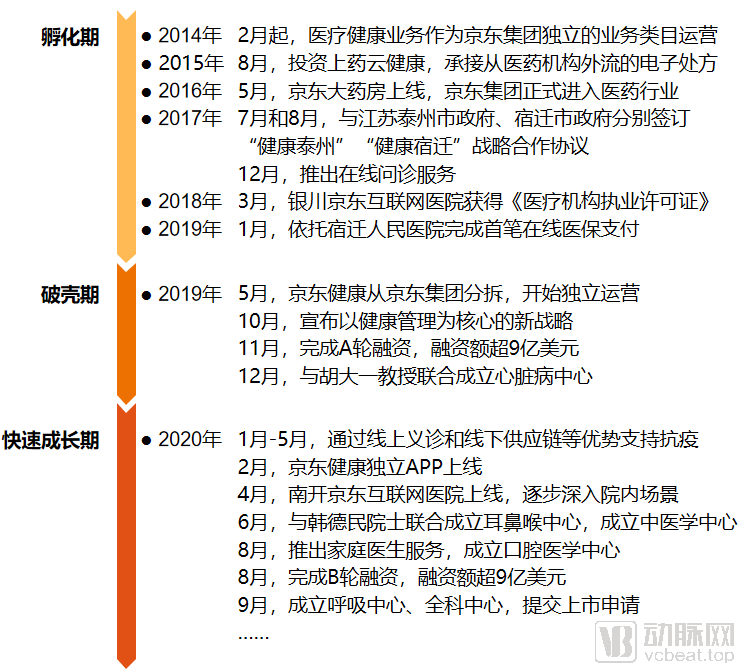
JD Health Milestones. Source: Prospectus, public information. Graphic by VCBeat.
2014 marked the inaugural year of internet healthcare. As tech giants made significant inroads into the medical sector, JD.com chose to enter the market through retail. Starting in 2017, Yinchuan vigorously developed internet hospitals; JD.com launched its online consultation services and established its internet hospital in Yinchuan, thereby capitalizing on the policy dividends available during the industry’s pilot phase.
In 2018, the “Internet + Healthcare” sector and internet hospitals gained clear policy support, significantly boosting industry confidence. In the following year, JD Health was spun off for independent operations, establishing a strategy centered on health management and fully committing to healthcare services.
In 2020, pandemic control measures accelerated the development of internet healthcare by several years. In addition to leveraging free clinics and supply chain advantages to support epidemic prevention and control efforts, JD Health intensively established specialized centers and chronic disease management centers after the outbreak was brought under control. As of September 20, 2020, JD Health had collaborated with leading experts to co-establish 16 specialized centers, including the Heart Center in partnership with Professor Hu Dayi and the Otorhinolaryngology (ENT) Center jointly built with Academician Han Demin.
In an interview with VCBeat, Xin Lijun, CEO of JD Health, stated that the pandemic has led to greater demand and higher expectations from users for health services, prompting JD Health to accelerate its strategic implementation and advance the timeline for various initiatives.
According to data from the VCBeat database, JD Health has been involved in a total of 45 public incidents since it began independent operations, with 20 of these—nearly half—directly related to healthcare services.
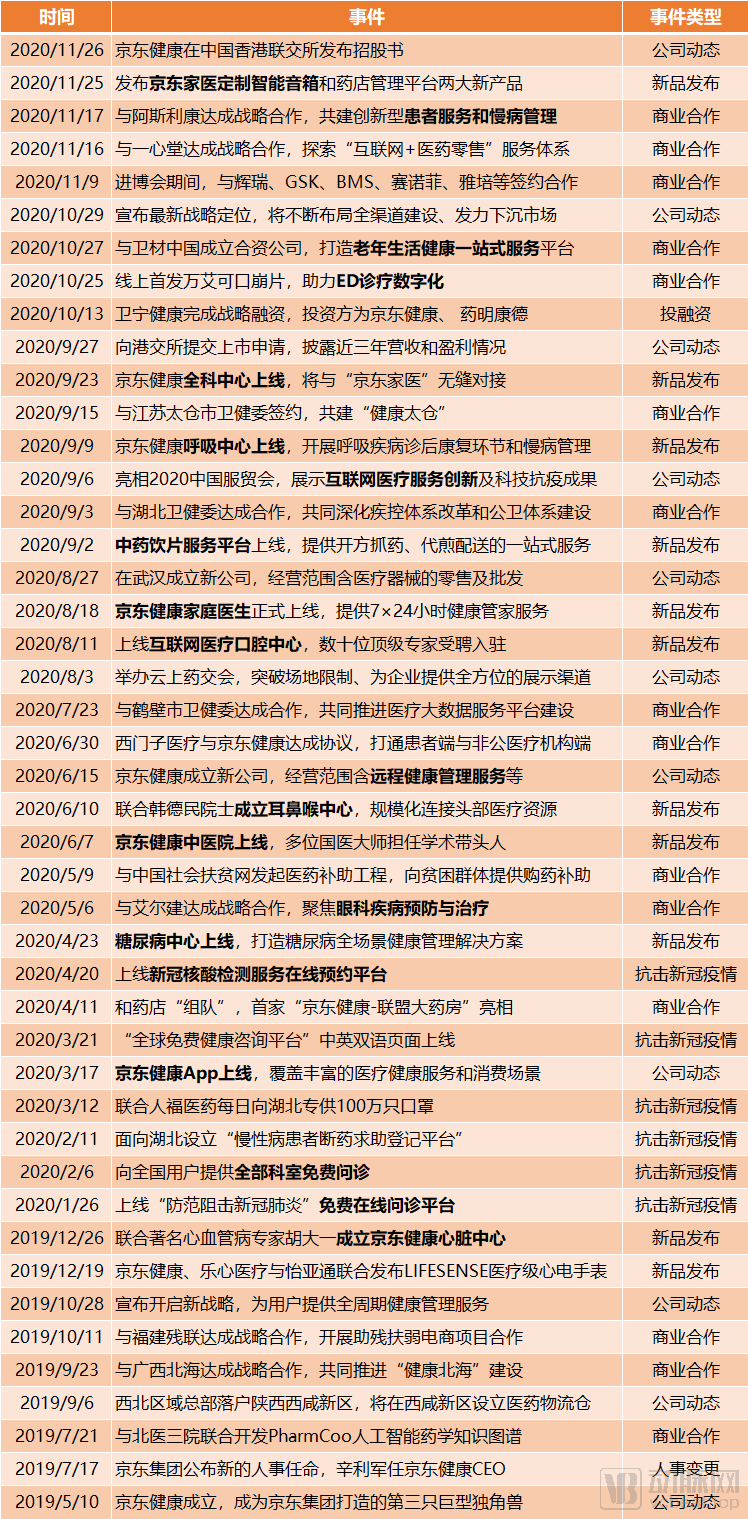
Key Events Since the Establishment of JD Health (**Bolded items are related to medical services**)
Source: Arterial Orange Database, compiled and charted by VCBeat.
We believe that JD Health’s series of intensive new product launches and business collaborations in 2020 exemplify what Xin Lijun described as an “acceleration in strategic implementation.” Therefore, although JD Health entered the internet healthcare sector through pharmaceutical e-commerce, it has intensified and expanded its layout in online medical and health services after navigating the exploratory incubation phase and solidifying its strategy during the breakthrough phase.
Innovation is the core of JD Health. From its origins as a relatively single-focused pharmaceutical e-commerce platform, it has evolved to continuously expand its business models and ecosystem. On the supply side, it strengthens the aggregation of medical and health resources; on the sales side, it intensifies the promotion of healthcare services; and on the product side, it deeply explores the value of medical services.
Continuously Expanding Physician Team
To provide sufficient and high-quality medical and health services, it is essential to ensure an adequate supply of resources, including key components of the healthcare system such as physicians and hospitals.
Regarding physicians, JD Health has adopted a model that combines in-house physicians with external physicians. The prospectus shows that the number of physicians at JD Health has gradually increased over the past three years. As of September 20, 2020, it had 171 in-house physicians and 68,500 external physicians.
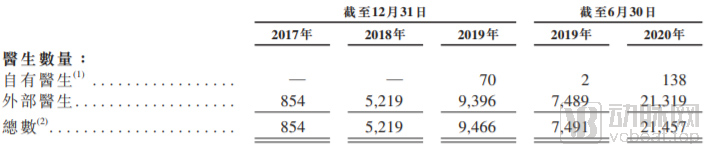
Growth in the Number of JD Health Physicians, Source: Prospectus
Currently, only the physician teams at JD Health and Ping An Good Doctor adopt a hybrid model combining in-house recruitment with external partnerships. What drives this strategy? Insights may be gleaned from a set of data previously disclosed by Xin Lijun in an interview with VCBeat.
In the early stages of the pandemic, JD Health handled an average of over 100,000 consultations per day. The maximum daily consultation volume for a single full-time doctor reached up to 200 patients, whereas partner doctors handled a maximum of only 20 patients. In terms of individual service capacity, full-time doctors far exceeded partner doctors. External doctors provided consultations during their spare time, resulting in lower consultation volumes and no guaranteed timeliness. The advantage of collaborating with external doctors is that the company does not need to incur fixed monthly labor costs; instead, it can simply share revenue with doctors based on the number of consultations conducted.
Therefore, a physician team built through both in-house recruitment and partnerships can leverage the complementary strengths of these two models.
In line with its strategic plan, JD Health will continue to expand its physician team, a trend we have observed from public job postings. Taking JD Health’s listings on BOSS Zhipin as an example, among the current 158 open positions, technical and healthcare-related roles are the most numerous. The healthcare-related positions primarily include physicians, physician assistants, and dietitians.
In addition, JD Health launched its campus recruitment campaign on November 20. The recruitment targeted graduates from the Class of 2021 majoring in medicine, pharmacy, and related fields. Open positions included roles in health management, general practice, and operations, with a total of 200 vacancies. Separate online information sessions were held for internet healthcare and health management tracks.
Talent acquisition and team staffing are the fundamental prerequisites for ensuring service delivery.
Continuously Integrated Healthcare Institution Resources
Integrating resources from medical institutions is also a key strategy for JD Health. By providing smart solutions to medical institutions and health administrative departments, resources are effectively aggregated. According to the prospectus, JD Health opens up its internet hospital infrastructure, supply chain, and technological capabilities to help physical institutions improve their operational processes. Meanwhile, these institutions are integrated into the online platform, offering users end-to-end online and offline services covering testing, diagnosis, treatment, medication, and post-diagnosis care. These collaborations are crucial strategies for integrating medical resources and acquiring users.
For example, in April 2020, the Nankai JD Internet Hospital, jointly established by JD Health and Tianjin Hospital of Integrated Traditional Chinese and Western Medicine (Nankai Hospital), was launched. This marked JD Health’s deep integration into in-hospital medical scenarios, its expansion into specialized domains, and its achievement of a new level of convergence in medical resources. Meanwhile, JD Health has successively signed agreements with cities such as Taizhou and Suqian in Jiangsu Province, and Beihai in Guangxi Zhuang Autonomous Region, to co-build “Healthy Cities.”
It is evident that, in order to deliver richer and higher-quality content for online healthcare services, JD Health is continuously expanding the aggregation of supply-side resources.
Expand Promotion of Medical and Healthcare Services
In the logic of pharmaceutical e-commerce, users exhibit more proactive demand for medications, actively clicking on prominent entry points or conducting searches based on their specific needs. In contrast, this is not the case for medical and health services, particularly health management, as most users currently lack strong proactive demand for such offerings. Therefore, these services require more intensive operations and promotion to raise user awareness and drive adoption.
VCBeat has observed that JD Health’s sales and marketing expenses are increasing in both absolute amount and proportion.
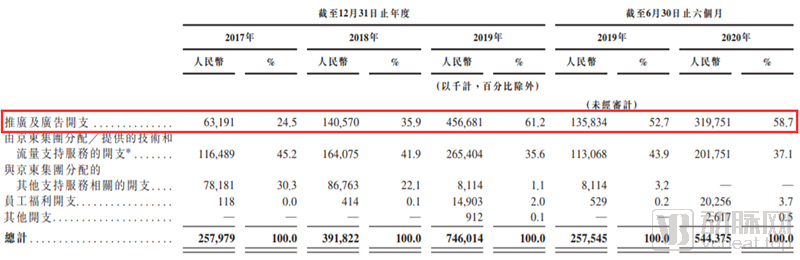
JD Health’s promotional and advertising expenditures, both in absolute amount and as a percentage of total spending, have been gradually increasing. Source: Prospectus
JD Health’s selling and marketing expenses comprise four components: promotion and advertising expenses; expenses for technology and traffic support services provided by JD Group; expenses related to other support services allocated by JD Group; and employee benefit expenses for staff engaged in marketing and business development activities.
Among these, the amount and proportion of spending on promotion and advertising saw the largest increase. In its prospectus, JD Health explained that this was due to the implementation of new business initiatives, such as deploying additional sales personnel to promote online medical and healthcare services, smart solutions, and other value-added services. The company expects these expenditures to remain at a significant level and will continue to carry out brand promotion and marketing activities to attract more new and existing customers to make purchases.
Therefore, while JD Health is increasing the supply of medical and health services, it is also accelerating their delivery to the market, with the most visible manifestation being increased investment in sales.
Independent Apps: Delving Deep into the Value of Medical Services
In February 2020, JD Health launched a standalone app to better accommodate its growing range of services. VCBeat has observed that, with the successive establishment of specialty centers and the launch of family doctor services, significant differences have emerged between the JD Health app and the JD Health section within the main JD app.
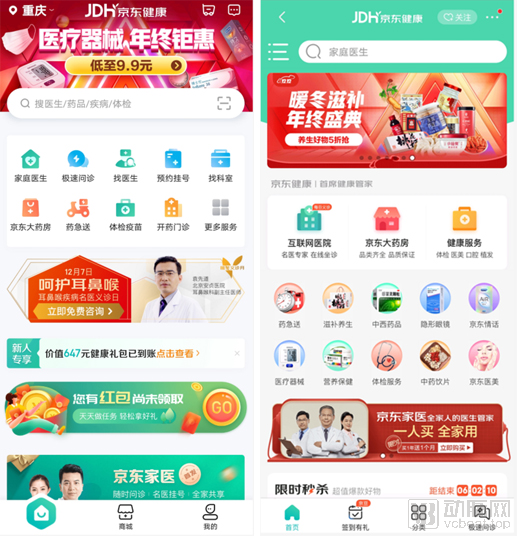
JD Health App homepage (left) and JD Health homepage within the JD App (right)
The JD Health app’s homepage prominently features services such as family doctors, online consultations, and specialty centers, placing greater emphasis on “medical care.” In contrast, the JD Health section within the main JD.com app highlights JD Pharmacy along with drug and health product categories, while internet hospital-related services require an additional click, reflecting a stronger focus on “pharmaceuticals.”
The differences on the product side are primarily driven by two factors: First, JD Health is positioned as an online medical and healthcare platform, which entails more frequent user interactions. A standalone app can better facilitate these interactions while highlighting its medical and healthcare service attributes. For instance, on JD Health’s flagship product, “JD Family Doctor,” users are prompted to download the app to access the service.
Secondly, due to JD Health’s significant advantages in its pharmaceutical supply chain, this segment remains a core business and creates synergies with healthcare services. However, given its more pronounced e-commerce nature, it is primarily featured on the JD.com app.
Looking at the development of internet healthcare, standalone offerings such as light consultations, appointment registration, and purely online chronic disease management are insufficient to sustain long-term corporate growth. Currently, most industry players have adopted an integrated, end-to-end strategy, with internet hospitals and pharmaceutical distribution channels becoming core components. These pharmaceutical channels include self-operated or third-party partnered e-commerce platforms and pharmacies.
JD Health is a typical enterprise that has adopted a chain-style layout. Pharmacy retail and online medical health services are its core businesses, and it can highlight these two types of services in different scenarios, which is indeed a dual-pronged strategy.
According to JD Health’s prospectus, the funds raised from its initial public offering will be allocated across four areas: business expansion, technology research and development, investments, and other operational expenses. Among these, business expansion accounts for the largest share at 40%. The funds designated for business expansion will primarily focus on three aspects: further developing its retail pharmacy business and online healthcare services; strengthening user growth and enhancing engagement; and boosting brand awareness through advertising and marketing campaigns.
Based on this, retail pharmacies and online healthcare services will remain JD Health’s core businesses in the future.
It is not uncommon in the industry to enter the internet healthcare sector through pharmaceutical sales. The buy-and-sell business model is relatively straightforward, making its value easier to understand. While this may not be the ideal business model in the healthcare field and no longer counts as an innovation amid the fierce competition in e-commerce, it effectively addresses companies’ survival challenges. For leading enterprises like JD Health, it even offers promising growth potential. With this solid foundation, JD Health has ample confidence to extend its reach into healthcare services.
Meanwhile, JD Health’s online medical and healthcare services, which have been a strategic focus since 2019, are currently in a phase of rapid growth with significant long-term value. This year, we have witnessed several historic milestones in internet healthcare, making this undoubtedly the optimal time for all companies operating in this sector.
Past innovations and perseverance are gradually bearing fruit, and the industry is poised to usher in a brand-new landscape.