

Static CT Launches, Redefining Industry Standards: NanoVision's CompoundEye 24 Paves the Way for Next-Generation Imaging

Nanovision
X-ray Detector and Static CT Product R&D Provider
"From Movement to Stillness"
Advanced Research-Oriented Multi-Source Static CT
The World's First Clinical Evidence-Based Data Miner
At the 106th Radiological Society of North America (RSNA) Nanovision virtual booth, numerous attendees expressed strong interest in Nanovision’s static CT product, “Compound Eye 24.”
The RSNA attracts approximately 55,000 professionals annually. Radiology-related companies showcase their latest achievements at the event, allowing attendees to learn about the newest products and services in the field of radiology.
Due to the impact of the pandemic, this year's RSNA was held online, marking the first time in over a century that the Radiological Society of North America has hosted the event virtually. Despite the lack of face-to-face interaction, numerous attendees still engaged with one another through screens, sharing the latest advancements and exploring cutting-edge technologies.
From November 29 to December 5 (Central Time, US), Nanovision showcased its latest world-first multi-source static CT technology and product—the “Compound Eye 24” static CT—at the RSNA Annual Meeting, drawing significant attention upon its debut.
In fact, Nanovision showcased its static CT concept and prototype at the 104th and 105th RSNA annual meetings, drawing attention from leading institutions and experts such as Mayo Clinic, Cleveland Clinic, Massachusetts General Hospital of Harvard University, Washington University School of Medicine, and MD Anderson Cancer Center.
Nowadays, static CT is moving from concept to reality, with commercialized static CT systems soon to be launched. Attendees have been actively engaging in discussions with Nanovision regarding potential collaborations and other matters.
So, what are the advantages of Nanovision’s static CT product, “Compound Eye 24”? How is it being promoted? What are Nanovision’s future plans? To address these questions, VCBeat conducted an exclusive interview with Zhang Chaoqi, Global Marketing General Manager at Nanovision.
According to the Health界 article “Market Demand for 28,000 CT Scanners in the Next Five Years: How Will China’s CT Market Be Distributed?”, the mainstream products in China’s CT equipment market are 16-slice, 64-slice, and 128-slice spiral CT scanners. In 2019, 16-slice CT scanners accounted for 45.9% of sales volume, 64-slice CT scanners accounted for 14.5%, and 128-slice CT scanners accounted for 23.6%.
Data shows that traditional spiral CT imaging technology acquires transmission information of X-rays through an object by rotating the slip ring to scan the object from various angles.
With technological advancements, leading imaging manufacturers have developed 512-slice and even 640-slice CT scanners; however, a key factor limiting the development of spiral CT is the maximum acceleration that the X-ray tube rotating around the object can withstand.Nowadays, the mechanical rotational speed of slip rings has nearly reached its limit, and the scanning speed of spiral CT scanners is also approaching its ceiling, making further improvements difficult. In addition, due to the presence of high-speed rotating slip rings, CT systems are less stable and have a higher maintenance rate.
To address this technical challenge, Nanovision proposed a static CT solution. The static CT employs a dual-ring structure composed of photon-counting detectors and scanning X-ray sources, replacing the slip ring with this configuration. It utilizes multiple fixed X-ray sources arranged in a ring that sequentially emit radiation to complete CT scanning and image reconstruction.
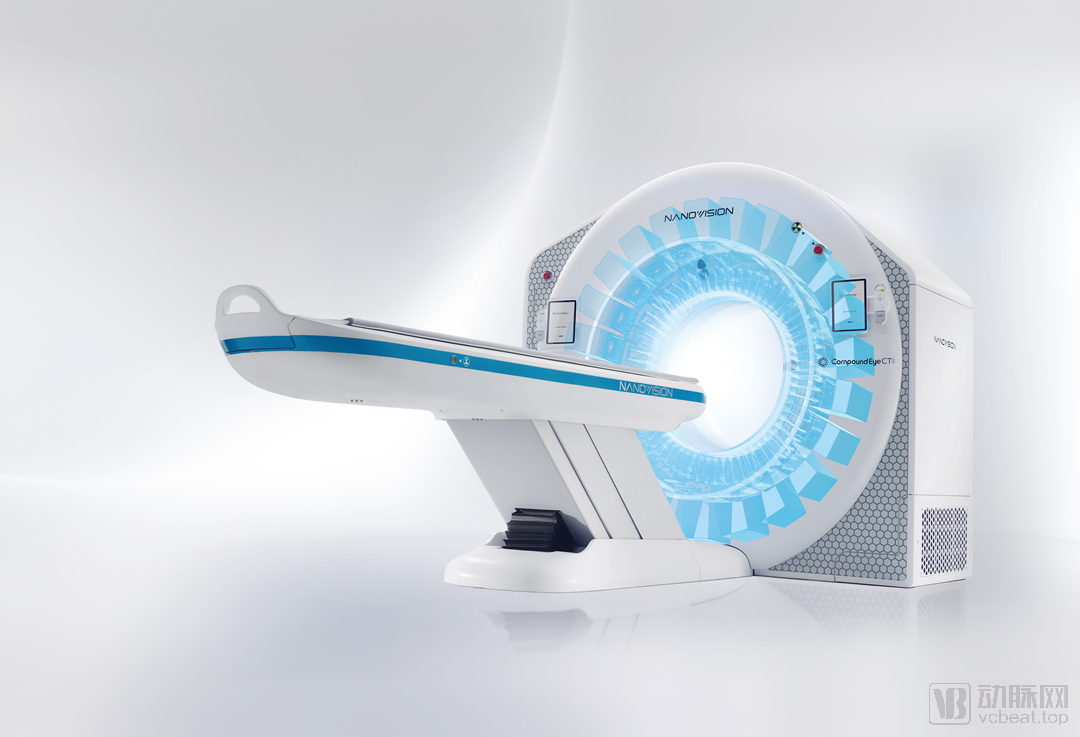
Static CT Compound Eye 24 Product Image
Disruptive structural design endows static CT with multiple advantages,Compared with traditional CT, Nanovision's static CT technology offers a scanning speed more than ten times faster. Thanks to its slip-ring-free design that eliminates the need for rotation, the detectors receive more comprehensive signals, resulting in scan images free of motion artifacts and with greater clarity. Furthermore, since CT radiation dose is positively correlated with scanning time, the significantly reduced scanning time of static CT substantially lowers radiation exposure, thereby enhancing safety.
Nanovision representatives stated at the RSNA conference: “The static CT ‘Compound Eye 24’ utilizes distributed electronic scanning to control X-ray emission positions, enabling simultaneous parallel scanning with multiple X-ray source arrays.”Compared with traditional CT, "Compound Eye 24" has improved64doubles the spatial resolution and enables detailed reconstruction of multiple organs throughout the body.
Currently, the static CT "Compound Eye 24" is applying for a medical device registration certificate.Scheduled for market launch in 2021What is Nanovision's perspective on the CT market? How will it promote its products in the future?
Zhang Chaoqi stated, “In 2019, the market size of CT equipment in China was RMB 15.9 billion. Driven by various factors such as economic growth, policy support, and technological advancements, China’s CT market still holds significant opportunities for future development.”
On one hand, CT imaging has become a crucial tool for clinicians in screening and diagnosing diseases and determining treatment plans. CT scans can be applied to examine various parts of the body, such as the heart, coronary arteries, myocardium, and tumors in different locations. They are also useful for quantitative analysis and efficacy evaluation before and after surgery, providing significant assistance to doctors in clinical practice. Notably, due to the ability of CT equipment to detect various types of pneumonia, sales have surged this year amid the impact of the COVID-19 pandemic. The market has been thoroughly educated, and CT equipment has garnered substantial attention from the government, ensuring its continued rapid development in the future.
On the other hand, China has a low penetration rate of CT equipment, indicating significant room for growth. In 2019, there were 33 CT scanners per million people in the United States and 93 in Japan, whereas China had only 18 per million. Therefore, driven by social progress, economic development, and supportive policies, China’s CT industry is poised for accelerated growth.
According to public data, the installed base of CT equipment in China has continued to grow in recent years, with a compound annual growth rate (CAGR) of 13.3% from 2015 to 2019. The market is expected to maintain a growth rate of over 13% in the next five years.
Coinciding with the rapid growth of the CT equipment market, Nanovision plans to start with top-tier hospitals and gradually expand to grassroots medical institutions. Zhang Chaoqi stated, “Nanovision has been positioned as a global company from the outset. The static CT products developed by Nanovision can be compared with any CT equipment on the market. We firmly believe that all performance indicators of static CT, including temporal resolution and spatial resolution, are superior to those of other CT systems.”
In the market, CT scanners with more than 64 slices are referred to as "super CTs." Since its inception, Nanovision has targeted the ultra-high-end CT market and dedicated itself to the development of super CT systems. Zhang Chaoqi considers the "Compound Eye 24" to be a top-tier super CT. In the future, Nanovision will continue to develop its Compound Eye series, including models such as the Compound Eye 108.
In terms of market promotion, Nanovision does not intend to directly sell the "Compound Eye 24" device, but rather to promote it in the form of solutions. For example, it provides solutions for refined visualization of nervous system vasculature and preoperative assessment of intracranial tumors for neurosurgery or neurology departments, and solutions for ossicle examination for otolaryngology departments...In summary, Nanovision plans to leverage the ultra-high spatial resolution of its “Compound Eye 24” system through scenario-based marketing, enabling physicians to diagnose diseases at an earlier stage and formulate more effective and precise treatment plans based on visualized data.
In terms of overseas markets, Nanovision plans to enter the U.S. market first, gaining market recognition through the superiority of its products.
In fact, the concept of static CT was proposed early on in the industry, and several top-tier companies worldwide have attempted to develop it. However, as of now, only Nanovision has successfully developed a static CT device.
This is because static CT represents an entirely new theoretical framework, and the market lacks the necessary components for static CT systems, requiring all parts to be independently developed from scratch. Over a period of seven years, Nanovision has completed the research and development of key components such as chips, detectors, high-voltage generators, and X-ray tubes, thereby establishing a complete supply chain.
Other companies seeking to develop and manufacture static CT systems must also retrace the path once taken by Nanovision. These seven years of independent R&D have established Nanovision’s “high, wide, and deep” moat.
From its initial single- and dual-slice configurations, spiral CT has evolved over the past half-century to today’s 64- and 128-slice systems. As a new theoretical framework, static CT is poised to follow a similar trajectory, yielding equipment with even higher precision. With static CT still in its early stages, it holds immense potential for future development.
Therefore, Nanovision plans to develop the Compound Eye series, such as Compound Eye 36 and Compound Eye 108, to continuously enhance the temporal and spatial resolution of its static CT systems.
In the future, Nanovision will also build system platforms such as clinical platforms, science and education platforms, teaching platforms, and medical consortium platforms to apply or promote its solutions. In addition, Nanovision will develop technologies such as artificial intelligence to promote the development of static CT.
How Will Static CT Disrupt the Existing CT Market Through Asymmetric Competition? We Shall Wait and See.