

Swisslog Healthcare Files for IPO: Global Leader with Over 15,000 Hospital Logistics Systems Deployed

Swisslog Healthcare
Provider of Medical Automation Solutions
As the momentum behind smart hospital construction continues to build, intelligent in-hospital logistics has gradually become a key focus for hospital administrators. In 2020, China’s intelligent hospital logistics industry maintained the strong growth seen in 2019. On the investment front, financing activity among intelligent logistics companies remained robust; in the first half of the year alone, five hospital-focused intelligent logistics firms secured funding, surpassing the total number of financing deals recorded throughout all of 2019. Amid increasingly fierce domestic competition, VCBeat takes Swisslog Healthcare, a leader in hospital material transport systems, as a case study, analyzing its product portfolio and business model to provide reference insights for industry participants.
Swisslog Healthcare operates four R&D centers and four manufacturing facilities worldwide, with business presence in more than 50 countries and regions. Leveraging over a century of expertise in manufacturing and engineering, the company designs and develops premier automation solutions for hospitals, warehouses, and distribution centers to enhance patient care experiences and improve hospital operational efficiency.
Swisslog’s history dates back to 1900, with the establishment of Sprecher + Schuh AG in the town of Aarau, Switzerland, where its primary focus was on energy-related businesses. In 1951, to expand its global operations, Sprecher + Schuh AG moved beyond Europe and established operational facilities in North America.
After 1980, Sprecher + Schuh AG successively sold its energy business to France’s Alstom Group and the US-based Rockwell/Allen-Bradley, shifting its focus to automation technology. Through a series of mergers and acquisitions, it established automation as its core business. In 1994, Sprecher + Schuh AG was renamed Swisslog and rapidly grew into a global leading provider of automated solutions for the healthcare, warehouse, and distribution center sectors.
Over the years, Swisslog has significantly increased its market share through numerous acquisitions.
In 1999, TransLogic, a U.S.-based company, was acquired. As the pioneer of pneumatic tube logistics transmission systems in North America, TransLogic boasts nearly a century of experience in the research, development, and manufacturing of such systems.
In 2003, Swisslog established its Healthcare division, focusing on intralogistics and pharmacy automation solutions for hospitals. In 2004, Swisslog founded its Chinese subsidiary, Swisslog (Shanghai) Trading Co., Ltd., officially entering the Chinese market, and set up branches in more than 20 countries and regions worldwide, continuously expanding its global influence.
In 2013, Swisslog Healthcare acquired the Italian company Tecnilab, which had over 40 years of experience in the research and development of pharmacy automation. In 2015, the Swisslog Group joined KUKA AG, a world-leading manufacturer of industrial robots. In 2016, China’s Midea Group became the largest shareholder of KUKA AG.
In 2017, Swisslog Healthcare partnered with Savioke to introduce relay autonomous mobile robots into healthcare settings. In 2018, Shanghai Swisslog Healthcare Technology Co., Ltd., jointly owned by Midea Group and KUKA Group with each holding a 50% equity stake, was established to focus on in-hospital logistics and pharmacy automation solutions.
As a well-established European enterprise with over 120 years of history, Swisslog Healthcare operates in more than 50 countries and regions worldwide. Through 12 after-sales service centers and 2,500 employees globally, it provides one-stop technical service support to 3,000 partner hospitals. In China, Swisslog has partnered with 500 hospitals. Among the top 20 hospitals in China, 17 have adopted Swisslog’s medical logistics transmission systems. Worldwide, Swisslog has implemented over 15,000 logistics system projects, ranking first in global market share.
Swisslog Healthcare’s automation solutions are primarily divided into two categories: hospital pharmacy automation solutions and hospital logistics automation solutions.
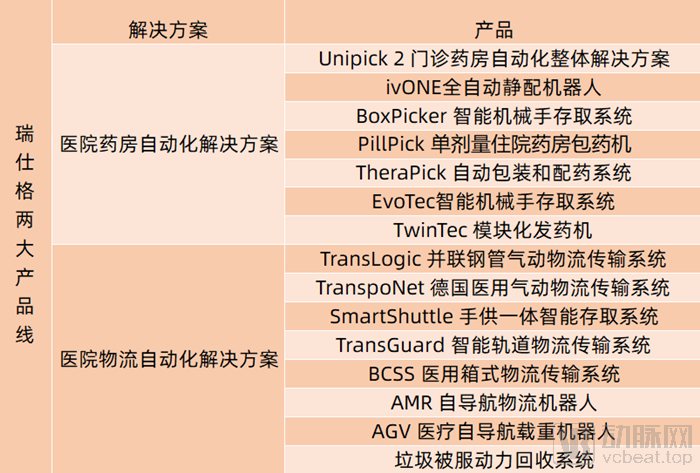
Hospital Pharmacy Automation Solutions:
Swisslog Healthcare’s pharmacy automation product portfolio includes: UniPick, ivONE, BoxPicker, PillPick, and EvoTec.
UniPick 2 Outpatient Pharmacy Automation Total Solution:Swisslog’s outpatient pharmacy automation solution comprises an intelligent controlled substance management system, smart injectable cabinets, automatic basket loaders, automatic dispensing machines, and high-speed dispensing machines. The intelligent medication management system helps pharmacists manage device inventory, maintaining optimal stock levels even during peak dispensing hours. UniPick’s vertically movable medication conveyor belts and automated robotic restocking modules enable efficient and accurate simultaneous dispensing and restocking. The patented dispensing drive enhances dispensing efficiency and accommodates a wider range of medication types, allowing a single unit to dispense boxed, bottled, and irregularly packaged medications concurrently.
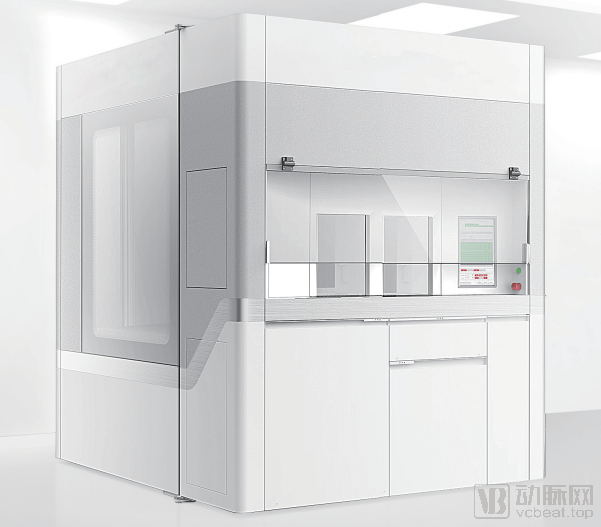
ivONE Fully Automated Intravenous Drug Compounding Robot:The device maintains a Class 100 laminar flow clean environment internally. Operators place medications, IV bags, and syringes according to prompts on the touchscreen. Robotic arms inside the machine automatically pick up various items for high-precision compounding, with weight-based dose verification, ensuring no residue or air bubbles, while supporting concurrent multi-tasking. This equipment not only achieves full automation of patient medication safety with complete traceability throughout the compounding process, but also safeguards healthcare workers and enhances hospital management standards.
BoxPicker Automated Pharmacy Storage and Retrieval System:Suitable for inpatient and retail pharmacies, this system meets ambient, refrigerated, and dual-temperature storage requirements through modular configuration. It provides safe, high-density medication storage, controls medication handling, improves pharmacy workflow efficiency, and accelerates the picking process. By enforcing single-box access control, it minimizes the risk of picking errors. Barcode scanning is employed during both storage and retrieval to ensure accurate and secure medication dispensing.

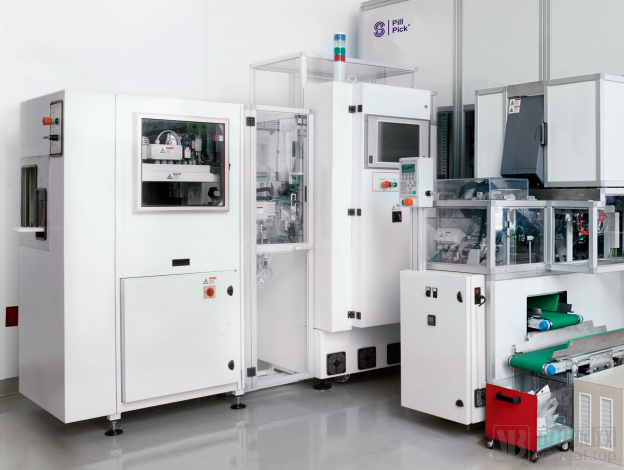
PillPick Automated Medication Packaging and Dispensing System:PillPick is the only pharmacy automation system that provides unit-dose packaging, storage, and dispensing, with a capacity of over 50,000 doses.
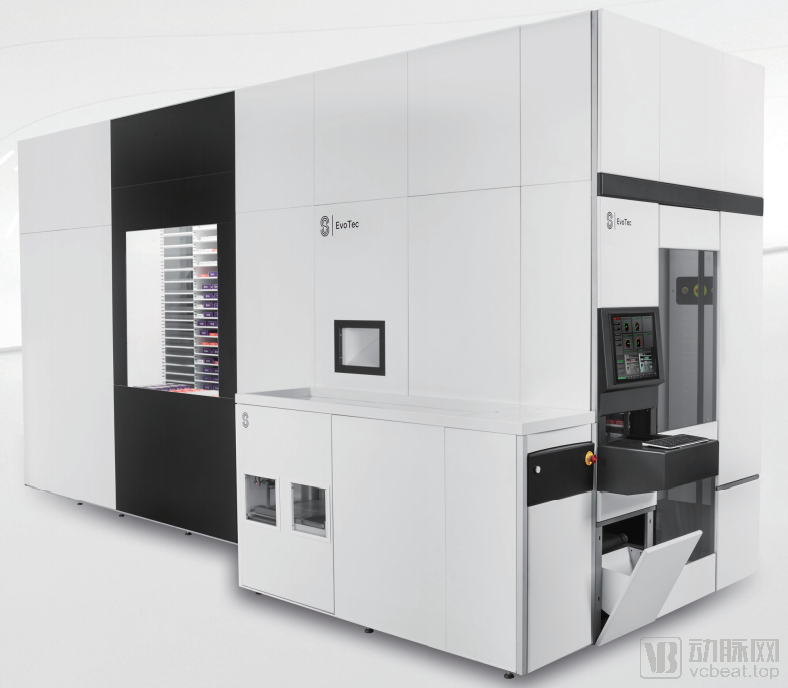
EvoTec Intelligent Robotic Storage and Retrieval System:EvoTec is an intelligent robotic storage and retrieval system that offers high-density storage and rapid access, designed for outpatient pharmacy departments in small to medium-sized community hospitals. This system seamlessly integrates with existing pharmacy infrastructure to maximize space utilization and ensure secure medication storage, while automating accurate restocking and dispensing to minimize waste.
Hospital Logistics Automation Solutions:
In the distribution phase, the four mainstream forms of automated logistics currently include pneumatic tube systems, rail-guided cart systems, medium-sized box-type logistics systems, and AGV (Automated Guided Vehicle) robots. This article provides a brief introduction to Swisslog products based on these four types of automated logistics solutions.
Pneumatic Tube System:Among Swisslog’s extensive product portfolio, the TransLogic parallel steel tube pneumatic logistics transmission system holds a prominent position. Of the top 20 hospitals in the United States for 2019–2020, as recently announced by U.S. News & World Report, 18 have chosen Swisslog Healthcare’s TransLogic parallel steel tube pneumatic logistics transmission system.
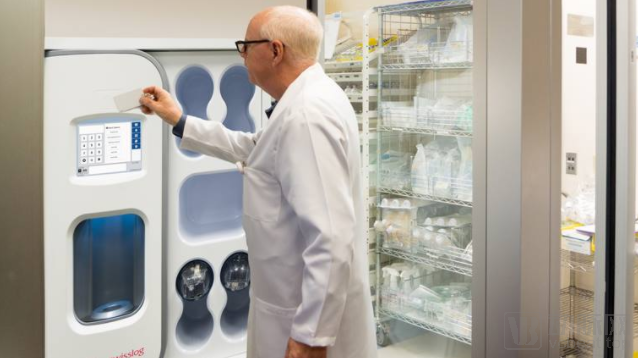
Pharmacists Deliver Medications to Ward Units via Pneumatic Tube Systems
This system features four key characteristics: All stations are equipped with Nexus control panels featuring integrated touchscreen interfaces, which facilitate rapid adoption and enhance efficiency, thereby improving the healthcare worker experience; the system’s access control mechanism provides additional security and assurance for material transport at embedded stations, ensuring that only authorized personnel can operate the workstations and handle transport bottles; the integrated RFID (Radio Frequency Identification) system enables fully automated inventory allocation and tracking of transport bottles, supported by alert messaging and remote arrival indicators; and a variable-speed function allows for reduced transport bottle speeds when handling fragile items.
In addition, the TranspoNet German pneumatic tube system for medical applications effectively complements Swisslog’s product portfolio. This system enables the simultaneous transport of more than three canisters within a single tube, significantly increasing payload capacity and transmission efficiency, making it well-suited for long-distance transportation across different systems and building complexes. The canisters feature a patented leak-proof design to ensure the safe transport of fluid substances, and the system incorporates RFID tracking capabilities, enabling full traceability of transported items and automatic return of empty canisters.
Track Cart:Swisslog Healthcare’s TransGuard intelligent rail logistics transport system enables point-to-point item delivery, with a standard load capacity of 15 kg and a transport volume exceeding 35 liters. The cart’s lid is equipped with RFID functionality to ensure the security of items during sending and receiving. The unit features an electronic identification number, real-time status color coding, and light-effect alerts, while a color smart touchscreen provides functions such as disinfection and encryption.
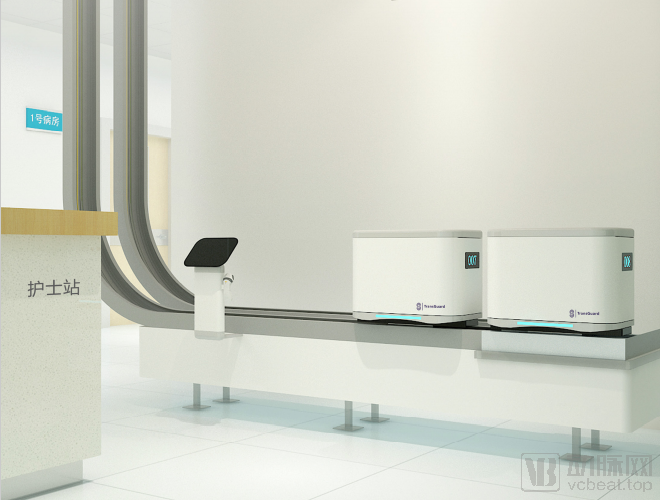
The system control workstation leverages the global network and optoelectronic identification technology to enable real-time location monitoring of automated guided vehicles (AGVs), ensuring full-process visibility. It supports bidirectional data transmission with network servers and features built-in task memory and automatic recovery capabilities, allowing full traceability of information such as goods receipt and dispatch.
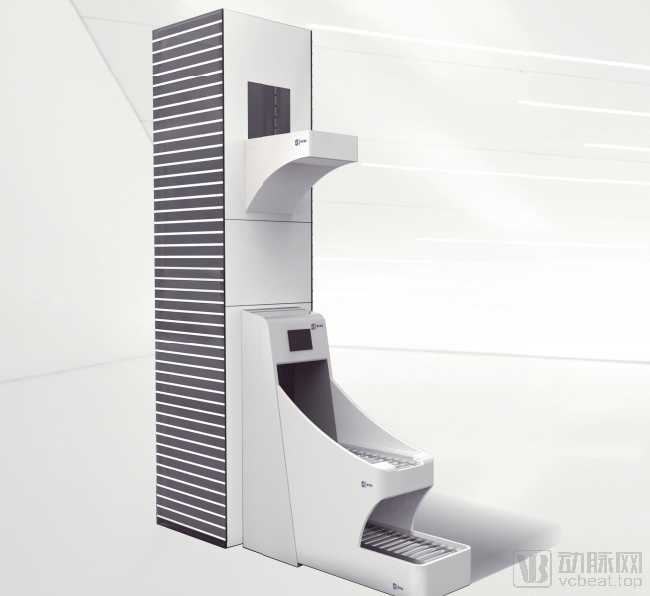
Medium-sized Box Logistics:Swisslog BCSS Medical Case-Based Logistics Transport System uses high-capacity totes as carriers, achieving point-to-point material delivery across the entire hospital by installing horizontal conveyor lines in various functional departments and coordinating with multiple vertical lifts. The conveyor lines are discreetly installed, truly meeting the requirement for "separation of people and goods," ensuring transmission safety and infection control within the hospital. This system can be widely used in nursing stations, central pharmacies, laboratory centers, operating rooms, and logistics centers.
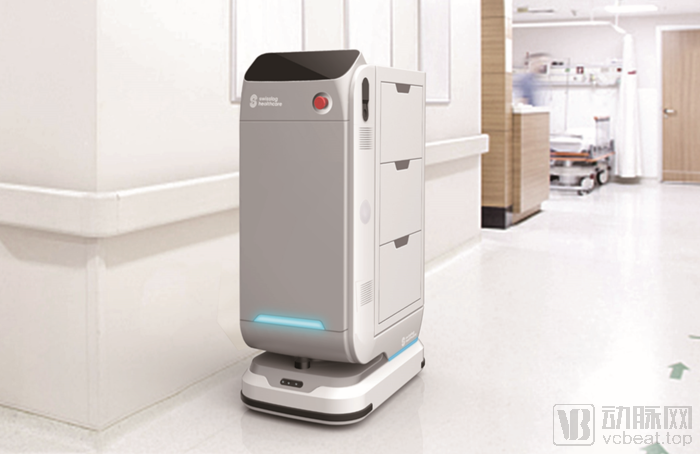
AGV Automated Guided Logistics Robot:Swisslog Healthcare’s AGV medical self-navigating load-carrying robots utilize laser SLAM technology, enabling operation without the need for embedded wires, magnetic strips, magnetic markers, or other structural modifications to the building. The robot control console manages robotic tasks and movement, allowing robots to call, enter, issue commands to, and exit elevators, thereby achieving seamless automated vertical transportation. Charging pads installed on the hospital floor automatically charge the AGV transport vehicles, significantly extending battery life and operational uptime.
In addition, Swisslog has launched autonomous mobile robot (AMR) logistics robots. Relevant information indicates that while AMRs are similar to automated guided vehicles (AGVs), they do not require external infrastructure such as magnetic strips, guide rails, or QR codes. The Swisslog AMR autonomous logistics robot system consists of the hospital information system, the Swisslog process management system, an AMR server, and mobile monitors.
AMR applies automatic navigation control technology. It is a small self-navigating robot capable of autonomously traveling along planned paths. By building visual models using LiDAR and visual sensors, and employing image recognition technology to detect objects such as people, doors, elevators, and carts, it achieves accurate obstacle avoidance. The robot can also navigate autonomously and plan paths automatically, enabling scheduled batch transportation of items. Equipped with multiple safety monitoring systems, it ensures operational safety and optimal travel speed.
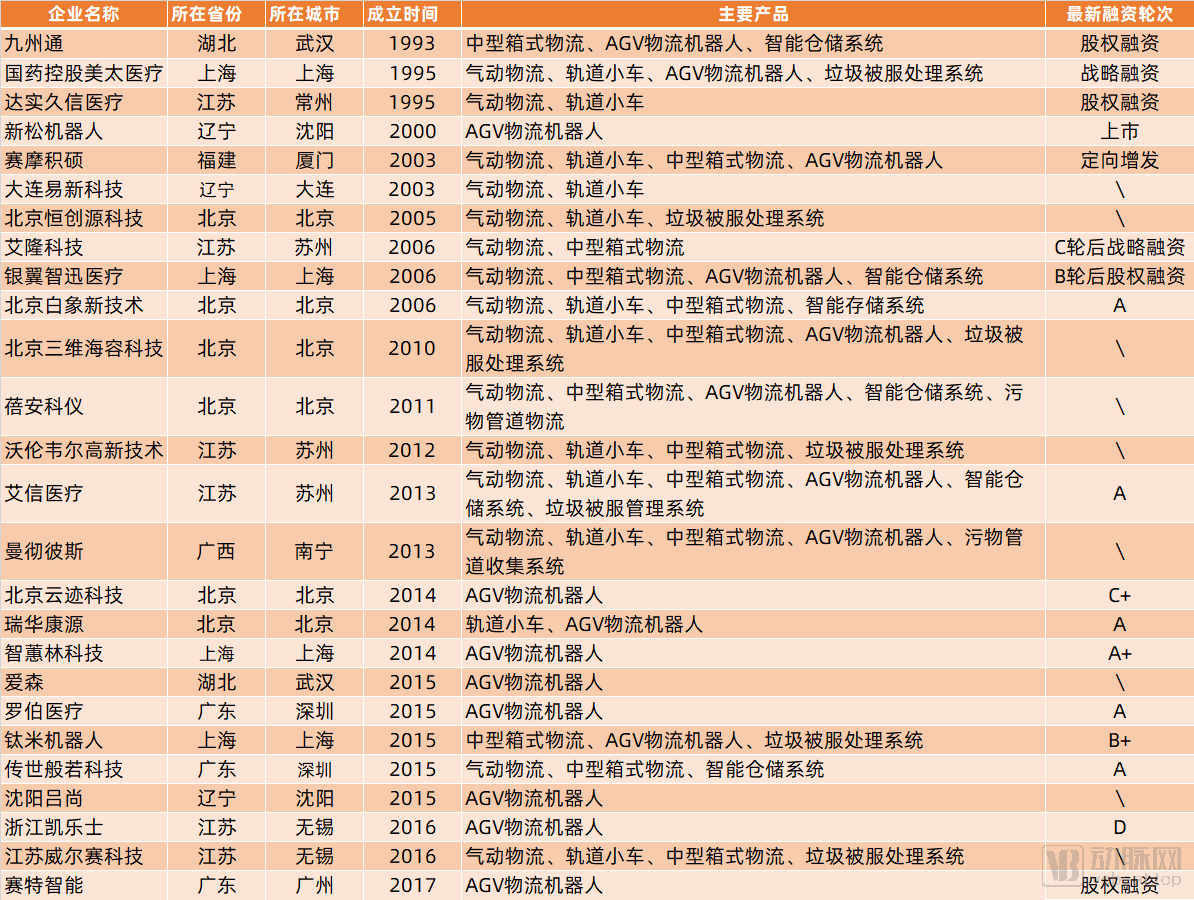
Swisslog Healthcare entered the Chinese market early and has established comprehensive logistics and intelligent warehousing solutions, making it one of the most frequently selected imported products by hospitals in China. In addition to Swisslog Healthcare, other foreign companies specializing in intra-hospital intelligent logistics include Taconic from the Netherlands, Schmid from Austria, Ewhakon from Germany, and Terumo from the United States. Foreign hospital transport technologies emerged as early as the 1970s. Although China started later, its development pace has been remarkable. VCBeat has compiled a list of 26 domestic companies engaged in smart hospital logistics based on publicly available information.
In the 1960s, pneumatic tube transport systems began to be used internationally for the delivery of small items. Pneumatic logistics are generally employed to transmit fragile items such as plasma and glassware, addressing approximately 20% of a hospital’s material transport needs. In the 1980s, track-guided vehicle transport systems were introduced to meet the demand for transporting medium-sized items. Subsequently, hospital logistics robot systems gradually emerged to handle the transport of large or bulk heavy materials.
Compared with the rapid development and comprehensive variety of in-hospital logistics systems abroad, the level of automation in material transport within domestic hospitals is relatively low. It was not until the late 1980s that China introduced its first pneumatic tube logistics system from abroad, yet it did not gain rapid adoption in domestic hospitals at that time. In 2008, the 301 Hospital became the first institution in China to implement a pneumatic logistics system for waste and soiled linen transport, ushering in an era of using logistics systems for such materials. However, as indicated in the table, most domestic enterprises have already entered the field of pneumatic logistics systems. Currently, pneumatic tube system technology has matured and has become the most widely adopted automated logistics system in hospitals.
In 2002, Sun Yat-sen University Cancer Center introduced China’s first rail-guided vehicle (RGV) logistics transport system; in 2012, Nanjing Drum Tower Hospital became the first hospital in China to adopt a box-type logistics transport system.
Automated Guided Vehicle (AGV) automatic navigation systems were introduced to China in 2006. The table shows that most AGV research and development enterprises in China were established after 2010. Although AGVs represent a novel model for logistics transportation, their actual adoption rate in hospitals remains low. One reason is that, in addition to the research, development, and production of the robots themselves, hospital elevators require retrofitting to enable door opening and floor selection via wireless signals. Furthermore, inter-building transportation relies on connecting corridors, resulting in high overall costs.
During the fight against the COVID-19 pandemic, intelligent logistics systems also played a significant role by handling the transportation of items within hospitals, effectively reducing the risks associated with manual transport and improving warehousing and distribution efficiency. This impressive performance has caught the attention of the capital market. According to data collected by VCBeat, in 2019, there were updates on financing information for four companies in the medical intelligent logistics sector, with a total of seven financing events. In the first half of 2020 alone, five companies completed financing.
On March 21, 2020, Yunji Technology, a service robotics company, announced the completion of a new round of financing. This continued the momentum from 2019, when it closed three funding rounds in just three months, setting a strong start for the sector. Three days later, Dasheng Jiuxin completed an equity financing round. Dasheng Jiuxin is a company focused on the research, development, and commercialization of digital clean operating rooms, and established its logistics division in 2001.
In May, Galaxis, a supplier of logistics robots and intelligent equipment as well as a technology service provider, completed a Series D financing round worth hundreds of millions of yuan. Reportedly, the funds will be used to accelerate product iteration and R&D, while also speeding up the expansion of its business layout both domestically and internationally. Within the following month, Saimo Jishuo, a comprehensive solutions provider for smart logistics and warehousing, and Sait Intelligence, a full-scenario solutions provider for intelligent unmanned equipment, also announced the completion of private placements and equity financing, respectively.
The strategic layout of the international smart logistics market has long been underway. With the emergence of innovative domestic enterprises, what does the future hold for China’s smart logistics market? It is believed that capital investment will drive new trends in the market.