

Tai'an Launches 30 Digital Health Service Vehicles for Integrated 'Medical Care, Testing, Pharmacy, and Insurance' Mobile Services
On the morning of December 7, the handover ceremony for Taian City’s Digital Health Service Vehicles was held at the Taishan International Convention and Exhibition Center. WeDoctor Group delivered 30 digital health service vehicles, 1,250 intelligent mobile clinic kits, and 1,250 physician workstations to selected township health centers (community health service centers) in Taian City in a single batch. Going forward, residents of Taian will be able to access integrated “medical care, testing, pharmacy, and insurance” services right at their doorstep. This initiative marks a significant step in Taian City’s comprehensive efforts to build a national demonstration zone for the “Health Community.” Taian is committed to creating a “five-in-one” service model designed to alleviate pressure on large hospitals, enhance the capabilities of primary healthcare institutions, improve supply chain efficiency, promote the integration of basic medical insurance and commercial health insurance, and extend coverage of intelligent medical insurance supervision. Additionally, the city aims to establish a three-tiered “grid-based” digital health service system spanning districts/counties, townships, and villages.
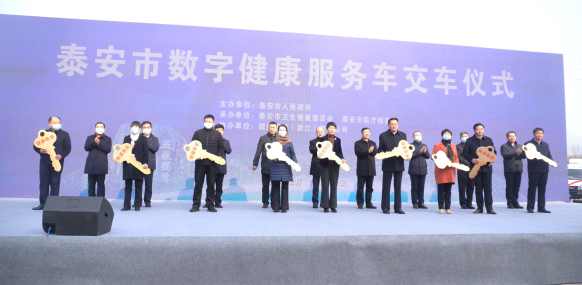
(The vehicle handover ceremony for Tai’an City’s digital health service vehicles, with representatives from all counties, districts, and functional zones of Tai’an receiving the keys on site)
The Digital Health Service Vehicle is equipped with an intelligent examination and testing system, an intelligent diagnosis and treatment system, a medical collaboration system, a cloud-based Hospital Information System (HIS) and health maintenance system, and a pharmaceutical and consumable supply system. It also carries smart devices such as ultrasound scanners and electrocardiogram (ECG) machines. The vehicle can perform 53 specific tests across seven major categories, supports mobile diagnosis and treatment and on-site medication dispensing, and innovatively provides medical insurance settlement services, allowing examination and testing fees to be paid through medical insurance.
The intelligent mobile clinic kit is a portable, smart medical terminal device capable of performing seven types of examinations, including electrocardiogram (ECG), heart rate, and blood pressure monitoring. It facilitates primary care physicians in conducting home visits for health screenings and follow-ups. Both the digital health service vehicle and the intelligent mobile clinic kit support real-time data upload, enabling data sharing with higher-level medical institutions through a digital platform. This implements the model of “primary-level examination and upper-level diagnosis,” addressing the limitations in diagnostic capacity among primary care physicians.
Meanwhile, leveraging internet hospitals and the four-tier service network spanning city, county, township, and village levels, digital health service vehicles have brought expert resources directly to patients’ doorsteps, significantly enhancing primary healthcare capabilities. In particular, the deployment of 1,250 physician workstations will further strengthen the foundation of the medical and health service network, establishing a “grid-based” digital health service system. This system supports primary care institutions in delivering online consultations, remote specialist consultations, two-way referrals, e-prescribing, and medication delivery, as well as public health services and family doctor contract services, thereby creating a closed-loop management system for chronic diseases at the grassroots level.
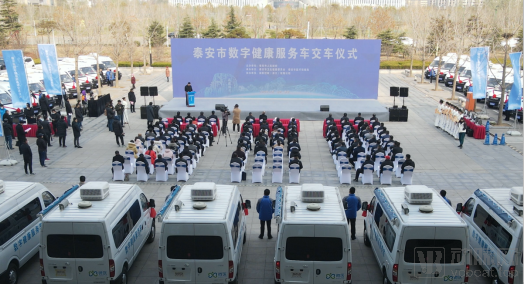
(Tai’an City Digital Health Service Vehicle Handover Ceremony)
In September last year, Tai’an City partnered with the digital health platform WeDoctor to co-establish a “Health Community” and China’s first internet hospital for chronic diseases, pioneering the “Tai’an Model” for end-to-end chronic disease management that integrates “internet + healthcare + medical insurance + pharmaceuticals.” To promote innovative achievements in chronic disease management services and benefit more grassroots populations, WeDoctor has equipped 30 township health centers (community health service centers) across various counties, districts, and functional zones in Tai’an with 30 digital health service vehicles. Additionally, 1,250 smart mobile consultation kits and 1,250 physician workstations have been deployed in 88 townships citywide, aiming to enhance the medical standards, service capacity, and operational efficiency of primary healthcare institutions.
In his speech at the vehicle handover ceremony, Zhang Tao, Deputy Secretary of the Tai’an Municipal Committee of the Communist Party of China and Mayor of Tai’an City, pointed out that the deployment of digital health service vehicles marks a new phase in the strategic cooperation between Tai’an City and WeDoctor Group, and represents a new step forward in building Tai’an’s “Health Community” as a national demonstration zone. He expressed the hope that this initiative would serve as an opportunity to continuously enhance the capacity and quality of medical services across Tai’an City, thereby delivering tangible benefits and greater affordability to its residents.
Liao Jieyuan, Chairman of WeDoctor Group, stated that by leveraging digital health service vehicles, intelligent mobile clinic kits, and physician workstations, the company aims to help grassroots communities establish a three-tier “grid-based” digital health service system comprising large (district/county), medium (township), and small (village) levels. WeDoctor will deepen its cooperation with Tai’an, fully apply next-generation information technologies in the healthcare and pharmaceutical sectors, reshape healthcare management and service models, and create a national benchmark for Digital Health Communities.
It is reported that the Tai’an “Health Community” enhances the convenience, homogenization, and equalization of medical and health management services through the coordinated efforts of the city-level digital medical consortium, county-level digital medical community, and chronic disease medical consortium. At the primary care level, with chronic disease management as the core, the initiative focuses on patients with chronic conditions, particularly those with diabetes and hypertension (“the two diseases”), to deliver integrated medical and health management services that combine offline and online channels, in-hospital and out-of-hospital care, and general practice with specialized care.
Leveraging digital health service vehicles and intelligent mobile clinic kits, the efficiency of public health services and family doctor contract services will be significantly enhanced. Through innovation in service mechanisms, primary healthcare institutions effectively integrate public health, family doctor, and chronic disease management services, fully leveraging the role of primary care physicians as “health gatekeepers.” They provide essential medical and health services—including disease prevention, diagnosis and treatment, and health management—to residents with hypertension and diabetes (“two diseases”) as well as high-risk populations, enabling early detection, diagnosis, and treatment. This approach better controls the growth of medical expenses at the source, promotes resident health, and strengthens the frontline of community-based health protection.