

Hode Biotech Secures Tens of Millions in Series A+ Financing to Advance Cell Therapies for Neurological Disorders

Hopstem Biotechnology
iPSC Cell Therapy Product Developer
Recently,Hopstem Biotechnology Announces Completion of Tens of Millions of Yuan in A+ Round Financing, Invested by Longmen Capital and Huacheng Venture CapitalThe funds will be used for further preclinical research related to cell therapy, GMP manufacturing, quality systems, and clinical trial applications in China and the United States. Hopstem Biotechnology previously secured angel-round financing from Hangjing Kaiyuan Venture Capital, Heli Investment, and Cybernaut, as well as Series A financing led by Data Capital and participated by Ruisheng Investment of Zhongguancun Dongsheng Science Park.
As one of the few domestic cell therapy companies specializing in neurological disorders, Hopstem Biotechnology, founded in 2017, leverages its expertise in neural differentiation of human induced pluripotent stem cells (iPSCs) and embryonic stem cells (ESCs), as well as cell engineering. The company has established a 1,400-square-meter facility for production, R&D, and office operations, featuring cell production workshops with Grade A+B+C cleanroom standards, along with manufacturing processes and quality control systems for clinical-grade cellular products. Hopstem Biotechnology holds multiple independent core patents and proprietary R&D platforms, including methods for inducing differentiation of cerebral cortical cells, preparing highly mature and homogeneous 3D brain organoids, and reprogramming somatic cells into iPSCs. It provides high-quality human-derived neural cells, 3D brain organoids, and supporting kits to research institutions and R&D departments of pharmaceutical companies both in China and abroad. Additionally, the company offers related technical services and collaborates on the development and patent licensing of other iPSC-derived clinical cellular products.
Neurological injury-related diseases include stroke, traumatic brain injury, and spinal cord injury, while neurodegenerative diseases encompass Parkinson’s disease and Alzheimer’s disease. These conditions affect tens of millions of patients worldwide, with several million new cases emerging annually; however, therapeutic options remain severely limited, leaving significant unmet clinical needs. Addressing this market challenge, Hopstem Biotechnology leverages advanced technologies for the directed neural differentiation of pluripotent stem cells, including induced pluripotent stem cells (iPSCs) and embryonic stem cells (ESCs). The company holds substantial advantages in manufacturing processes and quality systems, having established iPSC cell lines and cell banks that comply with FDA submission requirements and are suitable for global commercialization. Furthermore, Hopstem can produce large quantities of human neural precursor cells in vitro with batch-to-batch stability, high purity, and high functionality, offering superior druggability compared to primary-derived neural stem cells.
Currently,Hopstem Biotechnology’s four major investigational products, targeting neurological disorders such as stroke, traumatic brain injury, amyotrophic lateral sclerosis (ALS), spinal cord injury, Parkinson’s disease, autism, and Alzheimer’s disease, are all in the preclinical stage.Dr. Fan Jing, Founder and CEO of Hopstem Biotechnology, revealed: “We expect to submit Investigational New Drug (IND) applications for our first forebrain neural precursor cell therapeutic product, hNPC-01, to China’s National Medical Products Administration (NMPA) and the U.S. Food and Drug Administration (FDA) by the end of 2021. Upon approval, clinical trials are scheduled to commence in early 2022. Other pipeline candidates are expected to enter clinical development sequentially over the next three years.”
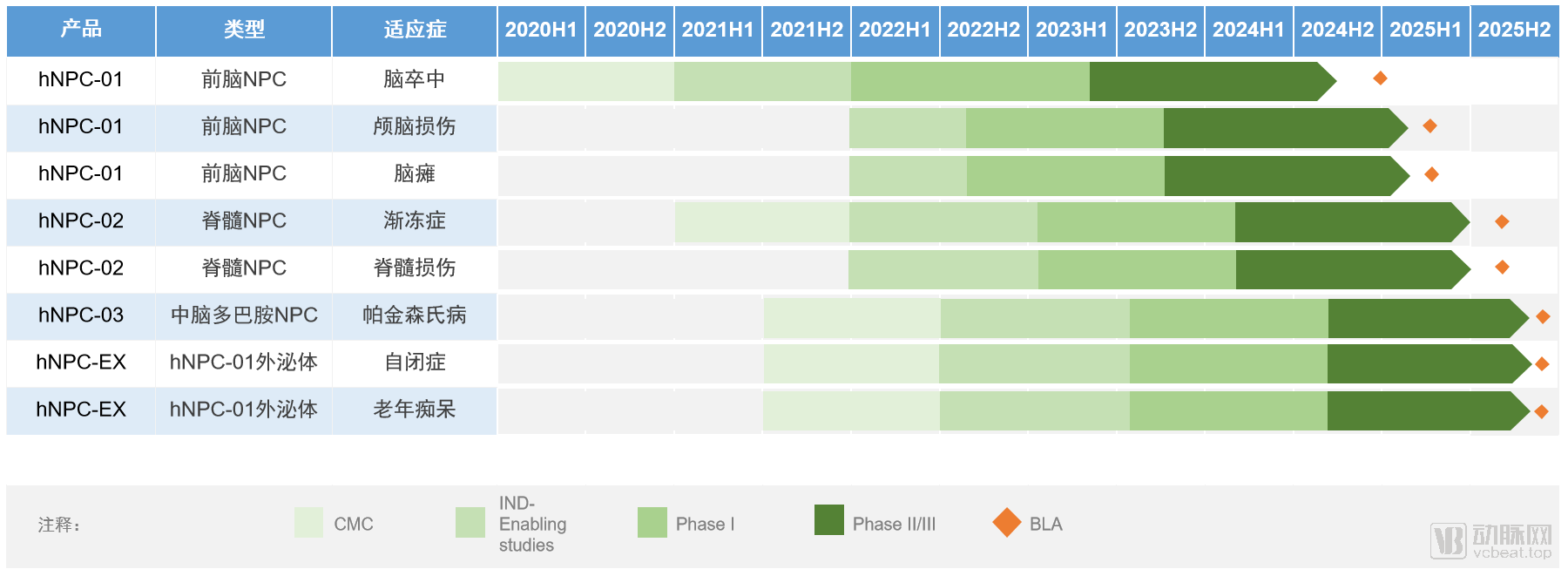
Hopstem Biotechnology: Progress of Pipeline in Development
The nervous system is the most intricate system in the human body, and its disorders are characterized by immense complexity, which has resulted in the lack of effective treatments for the vast majority of neurological diseases to date. A typical scenario involves patients with nerve injury or neurodegenerative diseases, where extensive loss of functional neurons occurs across various brain regions, leading to impairments in motor, language, and cognitive functions. Although existing small-molecule and biologic drugs may offer certain neuroprotective effects during the acute phase of nerve injury or in specific neurodegenerative conditions by targeting distinct disease signaling pathways or molecular targets, they fail to compensate for the functions of neurons that have already undergone substantial death during the stable phase of hemiplegia.
Hopstem Biotechnology’s early mechanistic studies revealed that, following intracranial transplantation in animal stroke models, the hNPC01 cell product can continue to differentiate into various functional neurons (accounting for up to 80%) and glial cells in the forebrain injury regions.These functional neurons can gradually re-establish connections with the existing neural network, and the motor function of the hemiplegic upper limbs in animals receiving the transplant showed significant improvement. These results, along with early pharmacological and safety data from animal studies, have greatly bolstered the team’s confidence in the feasibility of advancing functional cell replacement therapy.
“Neurological disorders and their sequelae afflict tens of millions of patients worldwide, representing a field with immense promise and social value,” Dr. Fan Jing told us. “Our early focus on neurological diseases stems from our aspiration to leverage our technological and industrialization advantages to accelerate the development of stable, safe, and effective iPSC-derived cell therapy products, thereby enabling patients to benefit as soon as possible.”
Currently, in addition to the continuous advancement of its clinical pipeline, Hopstem Biotechnology is also actively collaborating with pharmaceutical companies and research institutions of varying scales both domestically and internationally. Dr. Fan Jing believes that by jointly addressing challenges in drug development and scientific research, fostering continuous team growth, and maintaining innovation and R&D capabilities at the international forefront, the company can continue to deliver greater value to patients and society.
Mr. Wang Haining, Founding Partner of Longmen Capital, stated that damaged neurons in the human central nervous system cannot regenerate or repair themselves following injury or degenerative changes, making neurological disorders among the leading causes of death and disability. With advances in induced pluripotent stem cell (iPSC) technology and directed differentiation techniques, cell therapy for refractory neurological diseases has become increasingly feasible. Currently, there are approximately ten internationally renowned laboratories or institutions with neural differentiation capabilities; however, very few teams can consistently produce clinical-grade, high-purity neural stem cells/neural precursor cells at scale, or generate highly functional neural cell populations that closely resemble the cellular composition of the human brain. The technical barriers in this field are exceptionally high. Through independent research and innovation, Hopstem Biotechnology has established a product development pipeline for various human neural precursor cells and functional neural cells, along with an industrialized manufacturing and quality control system for supporting maturation culture media. Its process and quality control systems are industry-leading.
Ms. Tong Hongmei, CEO of Huacheng Venture Capital, stated: “The team at Hopstem Biotechnology possesses internationally leading iPSC-directed neural differentiation technology with high technical barriers. Preliminary experiments have demonstrated that the differentiated neural precursor cells exhibit significant therapeutic efficacy for neurological injuries such as stroke and traumatic brain injury. Furthermore, this technology offers new directions for addressing long-standing neurological disorders that have plagued the academic community, including Alzheimer’s disease and Parkinson’s disease, thereby holding substantial value from both medical and societal perspectives.”