

Ganjiang New Area, Alibaba Cloud, and Vanke Jiangxi Launch Digital Transformation of Traditional Chinese Medicine with Inauguration of Wanchuang Tech City Phase I
As a gem of China’s cultural heritage, Traditional Chinese Medicine (TCM) embodies the wisdom accumulated over 5,000 years of Chinese civilization and has played an irreplaceable role in the fight against the COVID-19 pandemic and in health management. The Communist Party of China and the Chinese government have always attached great importance to the inheritance and development of TCM techniques and culture, explicitly calling for the revitalization of the traditional TCM industry and the advancement of digitalization in TCM.
Nanchang is a city of heroes. More than 90 years ago, the Nanchang Uprising fired the first shot in the armed resistance against the Kuomintang reactionaries. Today, the spark of digital traditional Chinese medicine (TCM) has once again been ignited first in Nanchang, Jiangxi Province.
On December 9, 2020, the Tianchi Traditional Chinese Medicine (TCM) Big Data Competition and the Inaugural Opening Ceremony of Vanke Wanchuang Science and Technology City were held here. The event was hosted by the Administrative Committee of Ganjiang New Area, organized by the Administrative Committee of China (Nanchang) TCM Science and Technology Innovation City and the Bureau of Innovative Development of Ganjiang New Area, jointly undertaken by Vanke Wanchuang Science and Technology City, Wanruixing Technology, and Alibaba Cloud Computing Co., Ltd., and co-organized by the China Health Information Processing Conference, the Intelligent Diagnosis and Treatment Branch of the China Association of Traditional Chinese Medicine Information, and the Ganjiang New Area Innovation and Entrepreneurship Association.
Located north of the Gan River in Nanchang, Ganjiang New Area is the 18th national-level new area in China, the second in central China, and the only one in Jiangxi Province. It is positioned as a key hub for advanced manufacturing and strategic emerging industries in central China.
The biopharmaceutical industry is a key advantageous sector in Ganjiang New Area. As early as 2017, the Traditional Chinese Medicine (TCM) Science and Technology Innovation City was established in the Jingkai Cluster of Ganjiang New Area. Currently, the new area has initially formed a TCM industrial chain encompassing new drug research and development, proprietary Chinese medicines, chemical pharmaceuticals, and medical device manufacturing. The digitalization of TCM is poised to become the engine driving the next phase of development in Ganjiang New Area.
According to Xiong Yijiang, a member of the Party Working Committee and Deputy Director of the Administrative Committee of Ganjiang New Area, the region has established 12 research and innovation platforms for high-level talent entrepreneurship and 10 national-level technology business incubators and makerspaces. Meanwhile, the New Area is making every effort to build three national-level innovation platforms: the Chinese Academy of Traditional Chinese Medicine Sciences, the Health Industry Research Institute, and the National Technology Innovation Center for Traditional Chinese Medicine Manufacturing Processes and Equipment. These initiatives will help accelerate Ganjiang New Area’s goal of becoming a leading hub for innovative development in traditional Chinese medicine.
Wu Gang, former Deputy Director of the National Administration of Traditional Chinese Medicine and President of the China Association of Traditional Chinese Medicine Information, stated that the state attaches great importance to the digitalization of the TCM industry and the development of traditional Chinese medicine. Since 2005, a total of 32 policies on TCM digitalization have been successively issued. Currently, China is witnessing pronounced trends in population aging and suboptimal health status, leading to substantial demand for TCM in health services. TCM digitalization can make significant contributions in areas such as TCM science popularization, online consultations, and intelligent auxiliary diagnosis, by continuously providing effective solutions and product services to facilitate the digital transformation of TCM.
As the vehicle for implementing the digital traditional Chinese medicine (TCM) industry development strategy in Ganjiang New Area, Vanke Wanchuang Science and Technology City is an industry-innovation integration project. Centered on the core philosophy of empowering industries with technology, it focuses on next-generation information technology, digital healthcare, and creative industries. With the goals of bridging technology and fostering innovative collaboration, and prioritizing the practical application of achieved results, the project integrates advantageous resources including technology, talent, finance, and policy support.
Currently, more than 20 high-quality domestic and international enterprises, including Alibaba Cloud Innovation Center and Shanghai Jiao Tong University’s National Technology Transfer Center, have established operations in Vanke·Wanchuang Tech City. The Vanke·Wanchuang Tech City International Innovation Science and Technology Museum, which brings together advanced international experience, is scheduled to open to the public next year.
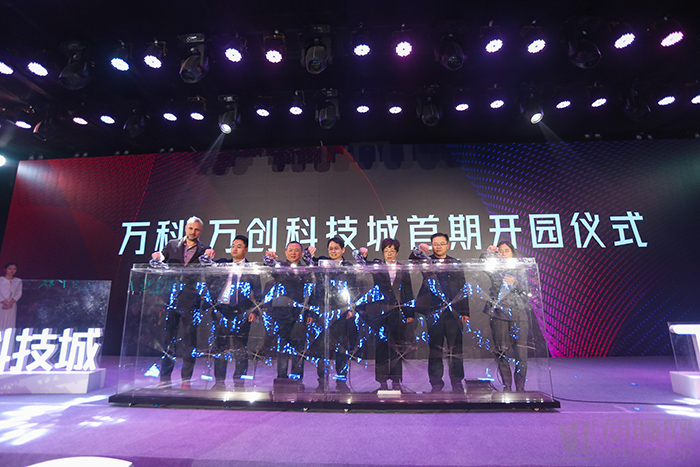
At the subsequent opening ceremony for Phase I of Vanke·Wanchuang Technology City, Xiong Yijiang, Member of the Party Working Committee and Deputy Director of the Management Committee of Ganjiang New Area; Wang Li, Member of the Party Working Committee and Deputy Director of the Management Committee of the Economic Development Cluster of Ganjiang New Area; Xia Gang, Chairman of Jiangxi Vanke Yida Property Investment Co., Ltd.; Liu Renyi, Director of the Innovation and Development Bureau of Ganjiang New Area; Liu Weidong, General Manager of Jiangxi Vanke Yida Property Investment Co., Ltd.; Liu Xiangwen, Vice President of Alibaba Cloud and General Manager of the Marketing and Public Affairs Department; and Mark, Partner at the Dutch design firm INBO, jointly unveiled the park.
In addition, more than 30 technology innovation-oriented institutions and enterprises, including Yirunfa, Yunwu Technology, and Zhaobang Technology, have also completed their entry and signed agreements.
In addition to the opening ceremony and signing ceremonies, the event further showcased the immense potential of digital Traditional Chinese Medicine (TCM) through the on-site release and interpretation of a report on the current state of TCM and the awards ceremony for the Digital TCM Competition.
During the report interpretation session, Qiao Yi, a Senior AI Product Expert at Alibaba DAMO Academy, presented the “Analysis Report on the Current Status and Trends of Digital Applications in Traditional Chinese Medicine.” The report conducted an in-depth study of the current state of digital applications in TCM and offered unique insights into its future development trends.
The Alibaba Cloud Tianchi Competition is a global developer community for AI experts and technology enthusiasts, with a long-standing focus on collaboration between artificial intelligence and life sciences. Since the onset of the COVID-19 pandemic this year, the Tianchi platform has partnered with high-quality resources in the healthcare industry to host multiple pandemic-themed competitions addressing critical challenges in epidemic control. By introducing Alibaba DAMO Academy’s capabilities in big data, cloud computing, and artificial intelligence into the healthcare sector, the platform has provided effective empowerment and contributed to China’s digital anti-pandemic efforts.
Liu Xiangwen, Vice President of Alibaba Cloud and General Manager of the Marketing and Public Affairs Department, delivered a brief summary of the competition. She stated that this Tianchi Competition marks a milestone in the deep integration of AI talent, big data expertise, and China’s unique traditional Chinese medicine (TCM) industry, yielding a portfolio of TCM-focused AI achievements and solutions. While the competition represents an endpoint, it also serves as a starting point for the future. The Alibaba Cloud Innovation Center, already established within the park, will continue to foster innovation and better integrate with the broader ecosystem of Vanke WanChuang Tech City, thereby connecting more digital TCM enterprises and driving industry development.
The “Tianchi Traditional Chinese Medicine Big Data Competition” was launched in October 2020. It featured three tracks: entity recognition from traditional Chinese medicine (TCM) package inserts combined with knowledge graph technology, question generation from TCM literature integrated with natural language processing (NLP) techniques, and AI-driven innovative applications in TCM. The competition explored the most pressing challenges in the digital transformation of traditional Chinese medicine in recent years.

Tianchi Traditional Chinese Medicine Big Data Competition Medal
In addition to awards and certificates, outstanding teams will also share a prize pool totaling up to RMB 300,000. Since its launch, the competition has attracted 4,167 teams from 13 countries and regions around the world.
Over the past two months of exciting competition, outstanding technologies and solutions have emerged in abundance. The Alibaba Cloud Tianchi Big Data Platform provided participants with an advanced big data competition platform, with scoring criteria established by Alibaba Cloud’s data scientists.
Contestants can complete development and debugging online, obtaining real-time rankings of execution results, thereby addressing the drawbacks of traditional competitions where demonstration outcomes are difficult to quantify. By soliciting enterprise solutions to tackle key challenges in the digital transformation of Traditional Chinese Medicine (TCM), the competition track employs cloud-based re-enactment for the semi-finals. A rigorous multi-tiered evaluation by numerous industry experts and judges ultimately determines the final rankings.
| Ranking | Team |
| Champion | Mentougou Team, wodejiafeiyulnano- |
| Runner-up | Xiao Xianxian Nice, CASIS-Unisound, Are You Starving |
| Third Place | Begin with the End in Mind, NewBee, The Answer, Just Take a Look, Top 12, Synecdoche, New York |
Algorithm Competition Ranking
| Ranking | Team |
| Champion | WeDoctor Huatuo Cloud |
| Runner-up | Changzhou Jinmu, Zhenyi Traditional Chinese Medicine |
| Third Place | Wonders Information & Minglue Technology, Shanghai Beiyisi Health Technology, Non-Second World |
Application Competition Rankings
As the champion of this application competition, WeDoctor’s Huatuo Cloud has demonstrated widely recognized advancements in the digitalization of Traditional Chinese Medicine (TCM). Ni Rong, CEO of WeDoctor Huatuo Cloud, shared insights into the platform’s multi-year exploration of TCM digitalization.
He stated that the digitalization of Traditional Chinese Medicine (TCM) urgently needs to focus on three key areas in the future: first, providing physicians with scientific and effective digital tools; second, building an internet platform for industry-wide sharing; and finally, the entire industry should collaborate to establish a “Belt and Road” initiative for TCM, enabling Traditional Chinese Medicine and herbal remedies to be shared globally.
As one of the measures taken by Ganjiang New Area to vigorously develop the traditional Chinese medicine (TCM) industry and accelerate the digital incubation of TCM enterprises, this competition has gathered top talents from China’s TCM sector, achieved remarkable results, introduced many cutting-edge ideas for the digital transformation of the TCM industry, and demonstrated to the market the development potential of digital TCM.
Over the long term, this potential will continuously drive theoretical advancements and capital investment in the comprehensive intelligent transformation of the traditional Chinese medicine (TCM) industry, providing more precise empowerment for the overall development of smart healthcare.
The new era presents unprecedented opportunities for the development of Traditional Chinese Medicine (TCM). “Inheriting the essence, upholding integrity, and fostering innovation” should serve as the fundamental guideline for TCM’s advancement in this new era. However, breaking through the bottlenecks in TCM digitalization and achieving standardization have long remained significant challenges.

Moderated by Wang Xiaoxing, Director of the Editorial Department at VCBeat, a roundtable discussion featured insights from distinguished guests including Xie Ming, former Director of the Graduate School at Beijing University of Chinese Medicine; He Zeyun, Chief of the Nephrology Department at the First Affiliated Hospital of Hunan University of Chinese Medicine; Li Jinghua, Director of the Big Health Intelligent R&D Center at the Institute of Medical Information, China Academy of Chinese Medical Sciences; Ni Rong, CEO of WeDoctor’s Huatuo Cloud; Dong Yushu, Founder of Huiyigu; and Li Song, CEO of Dajia Zhongyi. The participants shared their diverse perspectives on how digital traditional Chinese medicine can “break through” current challenges.
Li Jinghua, Director of the Big Health Intelligent R&D Center at the Institute of Medical Information, China Academy of Chinese Medical Sciences, believes that big data and digital technologies can support traditional Chinese medicine (TCM) by shifting certain professional guidance from person-to-person interactions to internet- or machine-to-person models, thereby addressing the issue of insufficient market supply. This, in turn, will drive the digitalization of TCM practices across China, enabling grassroots levels to access better and more extensive TCM services.
In this process, he believes that two aspects warrant attention. First, Traditional Chinese Medicine (TCM) has a particularly vast market when leveraged with big data. Second, TCM must be supported by specialized technology.
Dong Yushu, founder of Huiyi Valley, believes that the digitalization of Traditional Chinese Medicine (TCM) can be divided into two parts: TCM pharmacy and TCM clinical practice. The digitalization of Chinese herbal medicine mainly includes digitalized cultivation and management, digitalized pharmaceutical manufacturing, and the digitalization of e-commerce for Chinese herbal medicines, thereby achieving full-process digitalization of Chinese herbal medicine. The digitalization of TCM clinical practice is divided into three parts: First, the data collection equipment used in TCM must be digitalized; second, data needs to be standardized for repeated use; and finally, the underlying logic must also be standardized.
Li Song, CEO of Dajia Zhongyi, stated that diagnosis and treatment constitute the core of Traditional Chinese Medicine (TCM), particularly the diagnostic reasoning. The classics accumulated over thousands of years of TCM practice represent a heritage of herbal medicine knowledge passed down through generations of Chinese civilization. By digitizing renowned TCM practitioners’ case studies and integrating them with big data, the internet, and artificial intelligence, this knowledge can be accessed and queried more conveniently, thereby enhancing TCM’s utility for the general public and unlocking greater value from these classical resources.
Li Jinghua, Director of the Big Health Intelligent R&D Center at the Institute of Medical Information, China Academy of Chinese Medical Sciences, stated that the most critical aspect of TCM digitalization is to meet the people’s growing demand for comprehensive health through continuous technological innovation. The TCM digitalization industry should leverage information technology to drive ongoing innovation, thereby addressing challenges and fostering industrial development.
Furthermore, he posits that the standardization of Traditional Chinese Medicine (TCM) falls into two categories. The first pertains to the supportive environment, including management informatization, which is relatively straightforward to standardize. However, standardizing core TCM professional practices presents significant challenges and currently fails to meet the expectations of clinicians. Consequently, it can only serve as a supplementary tool, underscoring the need for intensified research and development within the industry.
He Zeyun, Director of the Department of Nephrology at the First Affiliated Hospital of Hunan University of Chinese Medicine, shared his perspective from a clinical standpoint. He believes that it is difficult to concretely implement TCM standards, as their essence lies in TCM clinics and, within large TCM hospitals, in outpatient departments. While artificial intelligence may be highly beneficial for TCM, its practical implementation should involve communication with clinicians to obtain their feedback.
At the same time, he believes that the industry needs to consider specific product specifications and provide concrete diagnostic frameworks for physicians’ consultations, thereby truly helping doctors address practical clinical challenges.
Ni Rong, CEO of WeDoctor Huatuo Cloud, stated that the standardization of Traditional Chinese Medicine (TCM) is fundamentally similar to that of Western medicine, requiring attention to the “meta” aspects of data units and the “source” of data origins. This is followed by the establishment of a data system specific to TCM terminology. He believes that institutions and policies serve as the fundamental guarantee for the development of undertakings, industries, and technologies. Currently, for TCM digitalization, inheritance, and innovation to achieve breakthroughs, it is crucial that policies and institutional frameworks keep pace with market and technological advancements.