

Weimai Secures $100M Series C+ Financing Led by Baidu Capital to Advance AI-Powered Full-Care Management Platform

Cenova Capital
Investment institutions focused on healthcare and life sciences

Weimai
Digital Health Service Platform Provider

IDG Capital
Venture Capital Institution

Vision Capital
Technology Sector Investment Firm
MPCi
Venture Capital Institutions in High-Tech Startup Fields
On December 14, internet healthcare company Weimai officially announced that it had recently completed its Series C+ financing round, raising $100 million. The round was led by Baidu Capital, with existing investors including IDG Capital, Matrix Partners China, Source Code Capital, Vision Capital, and Cenova Capital continuing to participate. Taihe Capital served as the exclusive financial advisor.
This marks the fifth consecutive year that Weimai has secured capital support since its establishment five years ago. The funds from this round of financing will be used to further accelerate Weimai’s strategic layout for urban expansion, broaden service coverage, and empower more hospitals, departments, and physicians.
An Overview of Weimai’s Investors: Existing Shareholders Remain Committed, While New Investors Bring Fresh Momentum.
Throughout Weimai’s fundraising journey, Vision Capital and Source Code Capital have invested a total of five times, from the angel round to the current round; additionally, Matrix Partners China has invested four times, and Cenova Capital has invested three times. This fully demonstrates investors’ recognition of Weimai’s value.
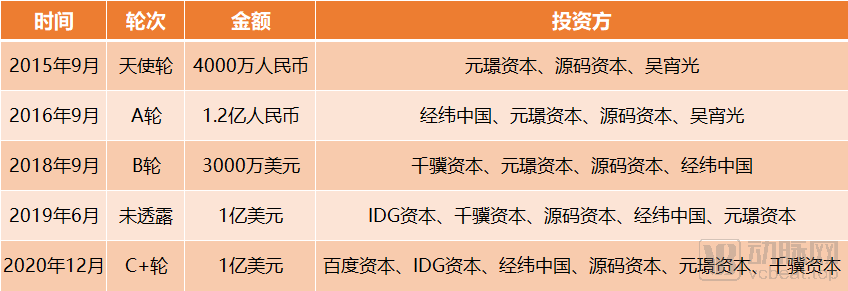
Weimai’s Financing History. Source: Artery Orange Database; Chart compiled by VCBeat.
Shen Xiaoyin, Executive Director of Cenova Capital, stated, “Since its early startup phase, Weimai has been deeply engaged in China’s extensive second- and third-tier cities. Adhering to a city-centric approach, it has continuously explored and practiced ways to empower public hospitals through collaboration, gradually establishing an innovative product system and service standards for patient-centered ‘medical care + health management.’ Cenova Capital firmly believes that Weimai will remain true to its original mission and become a leading operational service provider in China’s healthcare sector.”
Among the investors in this round of financing, Baidu Capital also emerged as a new face.
Wang Yu, Executive Director of Baidu Capital, stated that observations indicate Weimai entered a phase of rapid development last year. Despite the challenges posed by the pandemic this year, its business and operational metrics have continued to grow at a high rate.
Baidu Capital focuses on investing in mid-to-late stage companies. Wang Yu believes that the decision to invest in Weimai was made after a comprehensive assessment of its growth stage. “Weimai has an excellent team that is firmly driving the execution of the company’s strategy and demonstrating strong operational metrics. Based on our judgment, Weimai is a company in the late-mid stage, with a proven business model that is being continuously replicated. This represents the right entry point for Baidu Capital.”
In fact, the global digital health sector has undergone significant changes this year. Internationally, the two giants Teladoc and Livongo merged. In China, one digital health company went public, and multiple digital health platforms secured substantial financing, covering niche areas such as medication for chronic diseases and mental health. The trend of capital flowing toward leading enterprises has become even more pronounced.
Weimai is committed to a localized “Internet + Healthcare” service strategy, partnering deeply with local public hospitals on a city-by-city basis to jointly build an internet hospital service system.
Under this strategy, Weimai has introduced the “SLA” concept (Service-Level Agreement/Multi-tiered Service Grading System). Leveraging tools such as the internet, big data, specialty-specific disease management, and AI, Weimai collaborates with hospitals to deliver a range of services, including streamlined end-to-end outpatient care, online medical consultations, family doctor services, home visits by medical professionals, and innovative closed-loop lifecycle management for specific diseases. These initiatives enhance hospital service efficiency, meet users’ multi-tiered and personalized service needs, and create additional service value for hospitals and physicians, thereby increasing the proportion of their service-based revenue.
In short, Weimai achieves the aforementioned goals through two approaches: “optimizing existing stock” and “expanding incremental growth.”
“Optimizing Existing Assets”: Weimai provides free technical services to help hospitals achieve internet-based transformation, integrating local hospitals and medical resources with the Weimai platform. This enables local users to conveniently complete services such as appointment registration, online consultations, prescription renewals for follow-up visits, result inquiries, and comprehensive payments at local hospitals through the Weimai APP or mini-programs developed for the hospitals.
In terms of “expanding incremental growth,” Weimai integrates with hospitals’ clinical operations, enriches service supply through specialized innovative services, and extends the scope and content of its services.
On October 28 this year, at a press conference held by the State Council Information Office, Mao Qun’an, Director of the Department of Planning and Information under the National Health Commission, stated that through joint efforts from multiple parties, the policy effects promoting the development of “Internet Plus Healthcare” are becoming increasingly evident. Currently, there are 900 internet hospitals across China, and more than 5,500 secondary-level and above hospitals are able to provide online services.
Among the entities accelerating their deployment of internet healthcare services, public hospitals constitute the majority. The pandemic has heightened public hospitals’ awareness of the convenience offered by online services. During the outbreak, a large number of public hospitals launched internet-based medical services, such as online follow-up consultations, e-prescribing, and medication delivery, thereby meeting the medication needs of patients with chronic diseases during this special period.
However, in the long run, public hospitals still need to overcome several hurdles in launching internet-based medical services:
First, the positioning of internet healthcare services remains unclear. Although the pandemic accelerated the launch of numerous online services, such as follow-up consultations and prescription issuance, it is worth reflecting on what value these services bring to hospitals beyond mere convenience for patients. If hospitals cannot derive long-term value, they will struggle to sustain and further develop these services.
Second, in accordance with policy regulations, services provided by medical personnel at different levels are all charged at the price for general outpatient consultation items. This means that online follow-up consultations may lead to reduced revenue, resulting in low enthusiasm among some hospitals and physicians.
Third, internet-based medical services involve coordination among multiple parties, including technical support providers and physician scheduling. Due to insufficient human resources in hospitals, coordination and promotional efforts may not be adequately implemented, resulting in low patient awareness and perceived benefits.
The aforementioned factors are interrelated; mishandling any single link can trigger a negative cycle. Weimai’s collaborative operational model with public hospitals offers solutions to these challenges, particularly through initiatives aimed at “expanding incremental growth.”
Based on Weimai’s collaborative case studies, public hospitals, departments, and physicians continue to focus on core medical and diagnostic services without incurring excessive labor or financial costs. Through operational partnerships with Weimai, public hospitals gain access to professional operational teams and specialized management tools, enabling comprehensive disease management services that span “from in-hospital to out-of-hospital, offline to online, single-visit to full-cycle, and ad-hoc to personalized.” This approach not only improves hospital service efficiency and patient satisfaction but also empowers physicians to better serve patients through appropriate and positive incentive mechanisms.
Empowering departments, covering 30+ specialties and diseases
The “integrated pregnancy and childbirth” service, designed specifically for women in obstetrics and gynecology, is a typical case of innovation. Based on convenient communication, this service covers five major stages: pre-conception, prenatal, delivery, postpartum, and childcare. It includes services such as fertility assessment, online appointment scheduling for prenatal check-ups, remote fetal heart rate monitoring, collaborative delivery assistance, and postpartum recovery. By integrating online and offline services, as well as in-hospital and out-of-hospital care, it reduces the number of hospital visits required for pregnant women, thereby alleviating their burden.
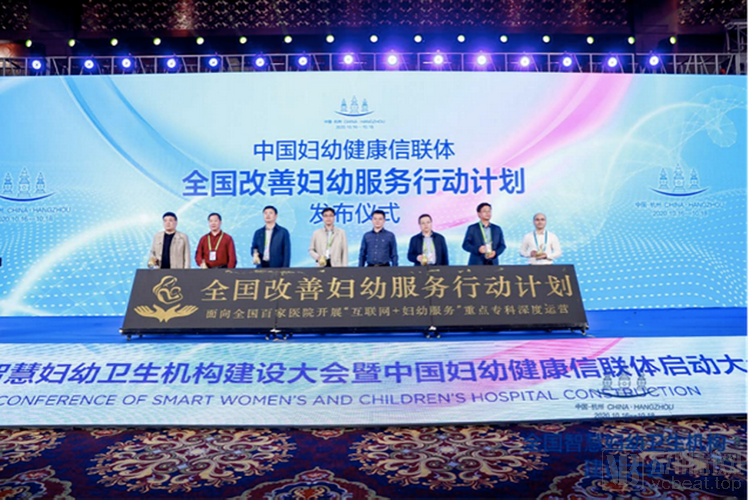
Launch Ceremony of the National Action Plan for Improving Maternal and Child Health Services
On October 17 this year, the National Action Plan for Improving Maternal and Child Health Services was officially launched. Jointly initiated by the China Maternal and Child Health Information Consortium, the Medical and Health Industry Branch of the China Information Association, and Weimai, the plan has established initial partnerships with 100 hospitals across China. It aims to provide free, full-cycle refined management and operational models based on “Internet + Maternal and Child Health Services,” offering hospitals in-depth operational guidance, co-development of key specialties, and implementation solutions.
Weimai’s specialized innovative services have been implemented in hospitals at all levels across China, covering more than 30 specialties and specific diseases, including gynecology, obstetrics, pediatrics, orthopedics, oncology, and chronic disease management, with deep operational deployment in over 100 hospitals. Weimai’s services have demonstrated strong operational effectiveness in Beijing, Shenzhen, Hangzhou, Jinhua, Taizhou, and Shaoxing in Zhejiang Province; Chengdu, Mianyang, and Deyang in Sichuan Province; and Changsha in Hunan Province.
Jia Lin Qiu, Founder and CEO of Weimai, stated that since the beginning of this year, the number of users for SLA services focused on specialty innovation has increased sixfold year-over-year, while the platform’s daily active users (DAU) have more than doubled compared to the same period last year.
Empowering Hospitals, Fostering a Virtuous Cycle Between Doctors and Patients
Taizhou Enze Medical Center was one of the early partner hospitals where Weimai launched its specialty innovation services. Through collaborative practice in recent years, the coverage rate of departments engaged in specialty innovation cooperation at Taizhou Enze Medical Center has now reached 92%. Among these initiatives, the “Integrated Maternity Care” service has benefited thousands of local users, achieving a service satisfaction rate of 98%.
Mianyang Central Hospital is also one of Weimai’s partner hospitals and was among the first batch of internet hospitals in Sichuan Province, as well as the first in Mianyang City. Du Xiaobo, Deputy Director of the hospital, stated in an interview with VCBeat: “Internet hospitals must pursue differentiation—offering what others do not and excelling where others merely participate. They should not be limited to online consultations and prescription delivery but should instead optimize functions and reengineer processes based on people’s pursuit of health and a better quality of life.”
In his view, hospitals define their core scope by diagnostic and treatment services, whereas Weimai can leverage the advantages of an internet platform in traffic management, data operations, service optimization, resource integration, and product innovation.
Over the past year of collaboration, the hospital and Weimai have jointly launched six major specialized innovative services, including integrated maternity care, weight management, post-abortion care, and home-based medical and nursing services. These initiatives have not only enhanced the hospital’s internet healthcare capabilities and fully unlocked the value of physicians, but also met patients’ multi-level needs through diversified services, thereby improving the patient experience and fostering a virtuous cycle among the hospital, doctors, and patients.
Recently, the National Health Commission announced a batch of typical best practices for “Cloud Maternal and Child Health,” with Dongyang Maternity and Child Health Care Hospital in Zhejiang Province featured among them. According to the announcement, Dongyang Maternity and Child Health Care Hospital has leveraged the distinctive advantages of Traditional Chinese Medicine (TCM) by launching a home-based nursing service model that combines online applications with offline service delivery. Nursing staff provide home visits to discharged postpartum mothers and other target populations, offering TCM-appropriate technical services such as postpartum maternal and infant care and pediatric tuina (massage). These services are part of a collaborative project between Weimai and Dongyang Maternity and Child Health Care Hospital.
Currently, the Weimai platform covers 28 provinces and over 160 cities across China, partnering with more than 1,000 public hospitals. It has attracted over 100,000 doctors who provide more than 20,000 service SKUs on the platform, with over 700,000 users seeking medical consultation and treatment daily.
Leveraging five years of accumulated experience, Weimai fully demonstrated the value of its internet healthcare platform in combating the epidemic during this year’s outbreak. As early as January 21, Weimai took the lead nationwide in launching an “Internet + Epidemic Control” free clinic service platform. By March, Weimai had partnered with nearly 30,000 volunteer physicians from more than 1,000 public hospitals across China, providing online consultations to over 2 million patients and reaching more than 75 million users across all digital channels.
According to Qiu Jialin’s plan, Weimai will continuously accelerate the replication of its existing service model to address the needs and pain points of public hospitals.
“Next, we will accelerate our city coverage and the expansion of partner hospitals, continuously replicating our business model,” said Qiu Jialin. The coverage targets remain primarily public hospitals with high outpatient volumes in second- and third-tier cities, before gradually extending to higher-tier cities.
Jia Lin Qiu believes that, affected by the pandemic, hospitals have seen a decline in service volume and physicians’ incomes have dropped. Coupled with policy impacts such as centralized drug procurement and reforms to medical insurance payment methods, even large hospitals are facing significant challenges. Therefore, Weimai will increase its engagement with more large public hospitals and extend its SLA-based services to a broader scope.
Meanwhile, Weimai also plans to extend its scope of cooperation to pharmaceutical and medical device services. This October, Weimai’s self-operated pharmacy opened in Hangzhou, creating a localized healthcare service loop centered on “chronic disease medication and management services.” By leveraging centralized drug procurement, Direct-to-Patient (DTP) models, and platform subsidies, Weimai aims to align chronic disease drug prices with national centralized procurement prices, enabling end-user patients with chronic conditions to purchase reliable, stably supplied, and comprehensively categorized medications at lower costs.
Jia Lin Qiu introduced that this initiative is an exploration by Weimai to empower pharmacies. “Currently, the primary area of collaboration between internet healthcare providers and pharmacies is prescription issuance. We aim to additionally assist pharmacies with user operations and chronic disease management, thereby enhancing their service quality and capabilities.”
After validating the aforementioned model through its self-operated pharmacies, Weimai will collaborate with external pharmacies.
An overview of the current profit models in internet healthcare reveals several primary categories: online consultations, pharmaceutical sales, internet healthcare technology services, and comprehensive service projects. Each approach has its own advantages and disadvantages. Consequently, companies often deploy a combination of these models while focusing on one or two that align with their specific strengths.
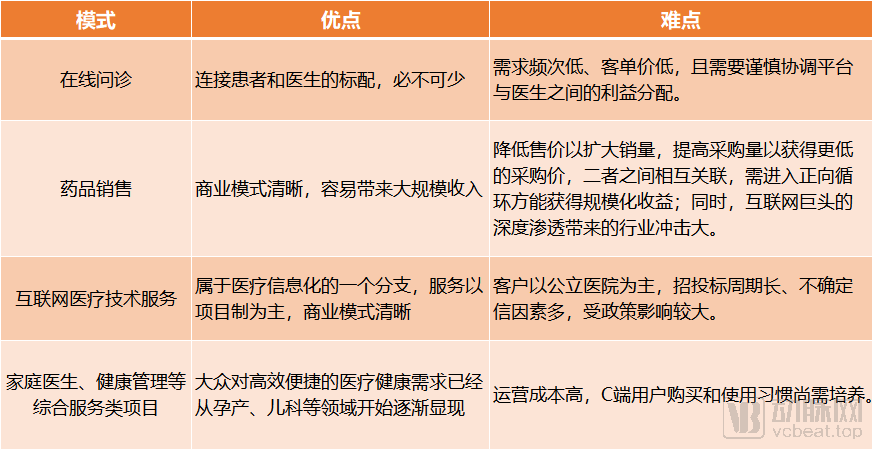 Characteristics of Major Profit Models in Internet Healthcare, Chart Compiled by VCBeat
Clearly, Weimai has chosen to focus on the latter model. “Weimai has taken a different path, and it is a difficult one,” says Wang Yu. He believes that this model requires expanding partnerships with hospitals and implementing localized operations, which poses a significant test of a company’s comprehensive capabilities. However, precisely because of the high barriers and substantial challenges involved, it becomes easier to establish robust competitive moats over time. “The healthcare sector is a long-term track. Corporate development is like rolling a snowball; once it reaches a certain scale, it will roll forward naturally without requiring strenuous effort. As long as Weimai remains steadfast in its course, the snowball will continue to grow larger.”
Wang Yu stated that internet healthcare must ultimately be grounded in service delivery, aiming to improve efficiency and satisfaction for all stakeholders. Although the industry has made considerable efforts in the past, these have not been sufficient. “The pandemic indeed provided significant growth momentum for internet healthcare, but its impact was short-term. If public hospitals’ internet hospitals lack dedicated management personnel as well as specialized mechanisms for benefit distribution and coordination, they will most likely become dispensable in the long run. In summary, following appointment registration and lightweight consultations, Weimai has explored and validated a new direction.”
In Qiu Jialin’s view, although the pandemic has significantly propelled the industry forward, it remains in a very early stage with immense future potential. In the short term, Weimai will continue to replicate and promote its products primarily by cultivating user habits, aiming to provide convenience for patients, benefits for physicians, and incentives for hospitals to sustain their adoption.
“In the long run, internet-based healthcare is an inevitable trend. Users will inevitably demand continuous improvements in experience, with no possibility of regression. It is just like ride-hailing services: people have already formed the habit of using them, and the ride-hailing experience will never revert to its previous state.”