

Yilian Collaborates with Leading Institutions to Launch the First Clinical AI Model for Early Screening of Multiple Sclerosis

Medlinker
Chronic Disease Management Platform Provider
Medlinker, China’s leading chronic disease management platform, has joined forces with The Third Affiliated Hospital of Sun Yat-sen University in Guangzhou, the International Research Center for Pharmaceutical Management at Peking University, the Beijing Health Promotion Association, and Sanofi to co-create the first AI model for early screening of multiple sclerosis (MS) in the clinical field. By automating high-throughput identification of high-risk patients and facilitating timely referrals, this model aims to shorten the time to clinical diagnosis of MS and reduce rates of missed diagnosis.
Recently, a research paper titled “Integration of the Extreme Gradient Boosting model with electronic health records to enable the early diagnosis of multiple sclerosis,” written based on the phase validation results of this model, has been accepted by the 8th Joint ECTRIMS-ACTRIMS Congress and published in the specialty journal Multiple Sclerosis and Related Disorders.
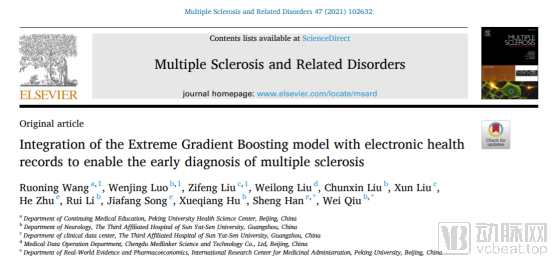
Figure 1: Screenshot of the paper
Multiple sclerosis (MS) is a severe, lifelong, progressive, and disabling demyelinating disease of the central nervous system, characterized by inflammatory and neurodegenerative lesions caused by immune system attacks. A 2013 global epidemiological study estimated that there were over 2.3 million MS patients worldwide, with a prevalence of approximately 200 per 100,000 people in Western countries. The peak age of onset is concentrated between 20 and 40 years, and the disease is more common in women than in men. China currently lacks nationwide epidemiological data, but the estimated prevalence in the country ranges from 1.39 to 5.2 per 100,000 people. With improvements in healthcare conditions, an increasing number of MS cases are likely to be diagnosed, suggesting that the actual epidemiological incidence may be higher.
Pathologically, multiple sclerosis (MS) is characterized by multiple demyelinating lesions in the central nervous system, which may be accompanied by damage to neurons and their axons. Its hallmark features are dissemination in time and space. Due to neurological impairment, MS patients present with a diverse range of clinical manifestations. The most common symptoms include sensory disturbances, motor deficits in the limbs, fatigue, and balance disorders. Other symptoms may include visual impairment, dizziness, diplopia, pain, cognitive impairment, ataxia, and bladder or bowel dysfunction. The lack of specific, typical symptoms among this wide array makes MS highly susceptible to being misdiagnosed as other conditions.
To alleviate and improve the current situation of high rates of missed and misdiagnoses of MS, with the support of the Beijing Health Promotion Association and Sanofi,Medlinker Medical Big Data TeamIn collaboration with multiple Grade A tertiary hospitals across China, through on-site surveys and data mining methods,Proposed the first MS-assisted diagnostic tool,In collaboration with the clinical expert team led by Professor Qiu Wei, a neurology specialist at the Third Affiliated Hospital of Sun Yat-sen University in Guangzhou, and the big data methodology expert team including Director Han Sheng and Researcher Wang Ruoning from the International Research Center for Pharmaceutical Management at Peking University, we conducted extensive discussions. Through effective data governance, rigorous data management, continuous upgrades and iterations, and comparison of multiple modeling approaches, we ultimately selected the XGBoost algorithm based on Bayesian Optimization to develop the AI model prototype, which received unanimous approval from the expert panel. Medlinker and the expert team also conducted independent external testing of the model; the validation results were highly consistent with the model’s performance metrics, thereby confirming the model’s generalizability and robustness in real-world clinical settings.
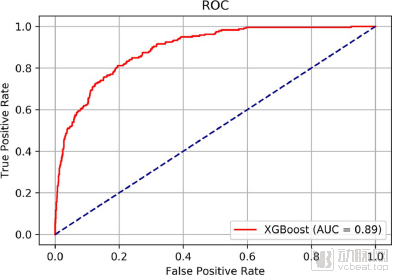
Figure 2: ROC Curve of XGBoost with Five-Fold Cross-Validation on the Training Set
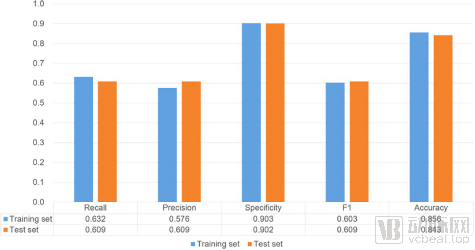
Figure 3: Results across various metrics in the training set and independent test set demonstrate high stability.
In fact, while numerous model theories have been published in academic journals, most have remained at the research stage. This model, however, has truly crossed the threshold into clinical application. Medlinker, in collaboration with Sanofi, the Beijing Health Promotion Association, and a team of experts, will continue to work towards implementing this model in clinical practice. The initiative aims to start with well-known tertiary hospitals across China and gradually extend to primary care institutions, thereby enhancing risk prediction and prevention capabilities for multiple sclerosis (MS) and improving the current state of MS diagnosis and treatment in China.