Artery Network Releases Report on TCM Digitalization: A New Era of Growth Ahead
Traditional Chinese medicine (TCM) is the crystallization of wisdom from China’s 5,000-year civilization and has been continuously driving the development of the country’s pharmaceutical and healthcare sectors. The Communist Party of China and the Chinese government have always attached great importance to the inheritance and development of TCM techniques and culture, explicitly calling for the revitalization of traditional Chinese medicine and pharmacy, and have made comprehensive strategic deployments to this end.
In October 2019, the Central Committee of the Communist Party of China and the State Council issued the “Opinions on Promoting the Inheritance, Innovation, and Development of Traditional Chinese Medicine,” which not only “took the pulse” and “prescribed a remedy” for the development of TCM but also charted the course for its inheritance, innovation, and development in the new era.
Meanwhile, Traditional Chinese Medicine (TCM) played a significant role during the sudden outbreak of the COVID-19 pandemic. TCM was deeply integrated into the treatment of patients with severe and critical COVID-19. Experts developed three versions of TCM diagnosis and treatment protocols for severe and critical cases, recommending four herbal formulas and eight TCM injections. Through precise, multi-pronged interventions, these measures slowed or halted the progression from severe to critical conditions and facilitated the transition of critical cases to moderate ones, thereby increasing the cure rate and reducing the mortality rate. This demonstrates the immense potential inherent in ancient TCM.
However, the traditional Chinese medicine (TCM) industry still has significant room for development. For instance, there is an urgent need to improve the governance system for TCM practices; the foundational infrastructure and talent development for TCM remain relatively weak; the quality of TCM herbal materials is inconsistent; and critical pain points—such as insufficient inheritance, inadequate innovation, and underutilized therapeutic potential—require immediate attention.
Digital technology may well be the panacea for addressing the critical challenges in the inheritance and innovation of Traditional Chinese Medicine (TCM). By applying digital technologies—such as the Internet of Things (IoT), the internet, big data, and artificial intelligence—to various stages including disease prevention, TCM diagnosis and treatment, pharmaceutical services, and post-consultation management, the efficiency of TCM medical services is enhanced, physicians’ diagnostic and therapeutic burdens are reduced, and patients’ healthcare experiences are significantly improved.
To better analyze the current state of the digitalization of Traditional Chinese Medicine (TCM) and explore future innovative models, VCBeat Research Institute, in collaboration with Alibaba Cloud Tianchi and Alibaba DAMO Academy, jointly authored the report “Inheriting the Essence, Upholding Integrity and Fostering Innovation: An Analysis of the Current Status and Trends in Digital TCM Applications.” The following is an excerpt from the report.
In line with the characteristics of Traditional Chinese Medicine (TCM), we can broadly divide TCM into two sectors: TCM clinical practice and TCM pharmaceutical preparation and distribution. Each of these sectors faces several pain points in the process of inheritance and innovation.
In the diagnosis and treatment process, traditional Chinese medicine (TCM) faces pain points such as the difficulty in standardizing diagnostic and therapeutic procedures, the necessity for face-to-face consultations, insufficient informatization in TCM, inadequate decision support for TCM practitioners, and challenges in standardizing TCM education. Digital technologies can significantly improve this situation to a certain extent.
The difficulty in standardizing the TCM diagnosis and treatment process stems from the fact that traditional TCM relies on the “four examinations” (inspection, auscultation/olfaction, inquiry, and palpation). Diagnostic outcomes vary among individuals and place high demands on physicians’ clinical experience. Consequently, different practitioners may arrive at significantly different diagnoses for the same case, making standardization challenging to achieve.
Classic medical cases of renowned and experienced traditional Chinese medicine (TCM) practitioners, organized using big data technologies, can provide references for physicians in developing treatment plans for similar cases. Intelligent devices such as TCM four-diagnostic instruments and TCM-assisted diagnosis and treatment systems, powered by artificial intelligence, automate the manual processes of inspection, auscultation-olfaction, inquiry, and pulse-taking. These systems automatically collect, identify, and analyze patients’ constitutional conditions, providing data support for clinical decision-making, alleviating physicians’ workload, and enhancing treatment accuracy.
Unlike Western medicines, which are predominantly chemically synthesized or biologically manufactured and thus achieve a high degree of standardization, artificially cultivated substitutes for traditional Chinese medicinal (TCM) materials remain scarce. TCM materials still rely heavily on natural resources, and traditional preparation methods—such as prepared slices (Yinpian) and decoctions—are widely used. This creates significant pain points in the inheritance and innovation of TCM, particularly in quality control during cultivation, regulatory oversight and traceability in raw material distribution, and pharmacy operations including dispensing and decoction. Furthermore, due to a shorter development history and relatively lower investment, the technological level of TCM medical devices lags considerably behind that of Western medical devices, indicating substantial room for improvement. Consequently, digital technologies hold significant potential for application and growth within the TCM medicine and device sector.
In the common pharmacy processes of dispensing and decocting traditional Chinese medicine (TCM), traditional TCM pharmacies must dispense medications based on prescriptions, yet they often lack real-time access to classical formulas. Meanwhile, patients face long waiting times for medication pickup, dispensing, and decoction services. Furthermore, standardizing the decoction process is challenging, making it difficult to ensure consistent quality.
Smart pharmacy systems, leveraging internet, Internet of Things (IoT), and big data technologies, can automatically receive physicians’ prescriptions and conduct online prescription reviews by pharmacists or artificial intelligence. Upon approval, the system completes the remaining processes, including herbal dispensing, decoction services, and home delivery, thereby eliminating the hassle of patients waiting in line to pick up their medications. Furthermore, the enhanced standardization of traditional Chinese medicine (TCM) preparation will improve the quality of TCM products.
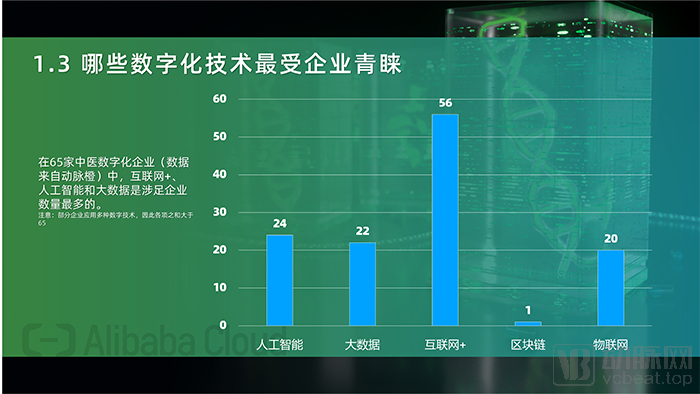
Overall, digital technologies—led by big data, artificial intelligence, Internet Plus cloud computing, the Internet of Things (IoT), and blockchain—can empower Traditional Chinese Medicine (TCM) across all aspects of its practice. An analysis of companies engaged in TCM digitalization, based on data collected by VCBeat, reveals that Internet Plus is currently the most prominent digital technology in the industry.
We believe that the key drivers behind the digitalization of Traditional Chinese Medicine (TCM) primarily include policy, demand, market, and technology.
Policy plays a particularly crucial role, serving as a barometer for industry development. Especially in China, where the “big government” model remains prevalent, government policies often guide the concentration of social resources toward target industries, thereby fostering their growth. In recent years, China has introduced numerous policies to revitalize the development of Traditional Chinese Medicine (TCM).
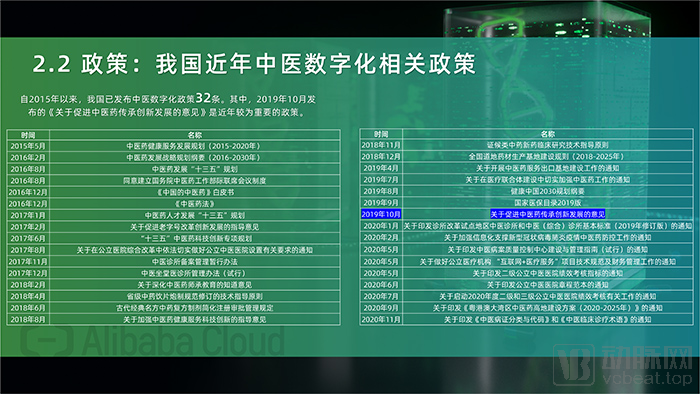
According to statistics, China has issued multiple policies on the digitalization of traditional Chinese medicine (TCM) since 2015. Among these, the “Opinions on Promoting the Inheritance, Innovation, and Development of Traditional Chinese Medicine,” released in October 2019, is a particularly significant policy in recent years. Since its issuance, local governments across the country have successively introduced numerous implementing policies.
For example, Sichuan Province’s “Implementation Opinions on Promoting the Inheritance, Innovation, and Development of Traditional Chinese Medicine” set a target for the comprehensive output value of Sichuan-produced traditional Chinese medicine (TCM) to reach RMB 120 billion by 2022. Gansu Province’s “Several Measures on Promoting the Inheritance, Innovation, and Development of Traditional Chinese Medicine” aimed for the total output value of the entire TCM industry chain to exceed RMB 100 billion by 2022. These policies will significantly promote the development of local TCM characteristic industrial parks, and this report provides a corresponding review of these initiatives.
The remarkable performance of Traditional Chinese Medicine (TCM) in the treatment of COVID-19 demonstrates that TCM offers significantly superior efficacy compared to Western medicine in managing certain conditions, holding immense potential following digital transformation. Meanwhile, given the pronounced trends of population aging and suboptimal health status in China, there is substantial demand for digital TCM solutions within healthcare services.
With the rise in economic development, healthcare expenditure among Chinese residents has been increasing rapidly. Traditional Chinese Medicine (TCM), derived from natural sources, and TCM medical devices, notable for their outstanding therapeutic effects in physical therapy, have gradually gained public favor. Meanwhile, the trend of population aging has become increasingly pronounced, leading to a significant demand for TCM treatments—such as herbal medicine, acupuncture, and tuina massage—that effectively manage chronic diseases and prevent recurrence.
Market size determines the upper limit of industry development; industries lacking sufficient market scale may struggle to generate adequate returns on high upfront R&D investments. Driven by favorable policies, rising living standards, growing demand, and shifts in healthcare policies, the digital traditional Chinese medicine (TCM) market holds immense potential.
According to forecasts, the compound annual growth rate (CAGR) of the traditional Chinese medicine (TCM) industry’s market size is projected to rise to 8.3% over the next five years, with the market size expected to reach RMB 2.2368 trillion by 2023. Meanwhile, there were 47 financing events in the digital TCM sector over the past five years, with total funding amounting to RMB 2.069 billion and USD 100 million. The market potential for TCM digitalization is evidently substantial.
Core technologies serve as the engine of industry development, directly determining whether an industry can grow and at what pace. In recent years, the rapid advancement of digital technologies—such as artificial intelligence, big data, cloud computing, the Internet of Things (IoT), and blockchain—has provided a robust technological impetus for the digital transformation of Traditional Chinese Medicine (TCM).
Digital technologies can play a role throughout the entire process of Traditional Chinese Medicine (TCM) diagnosis and treatment, including health management, consultation, diagnosis and treatment, prescription and dispensing, as well as the cultivation and distribution of medicinal herbs. This report reviews the current status of digital applications across these processes and analyzes representative corporate case studies for reference.
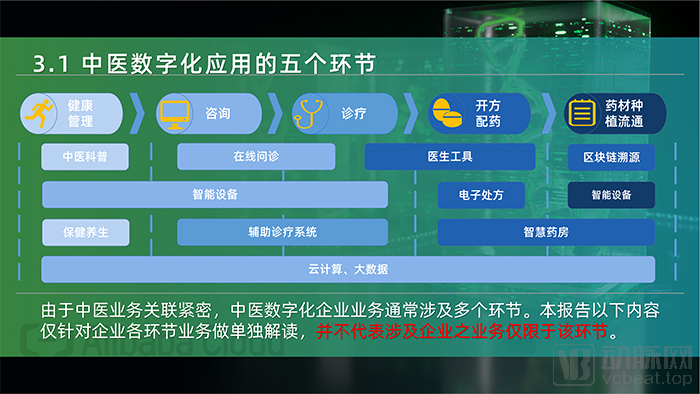
In the health management process, physicians can leverage Internet of Things (IoT) technology to collect physiological data in real time—such as pulse waves, heart rate, electrocardiogram (ECG) signals, and blood pressure readings—through wearable devices like smartwatches and intelligent pulse diagnosis instruments. This data is then evaluated by artificial intelligence. Physicians can manage patients’ health via online platforms, monitoring their health status in real time to prescribe targeted treatments. Patients can also utilize internet technologies to access health management knowledge and engage in online consultations.
The digitization of the consultation phase primarily encompasses online Traditional Chinese Medicine (TCM) consultation platforms. These platforms enable patients to schedule appointments and conduct online consultations from home via PC or mobile devices. By collecting basic patient health information through AI-driven questionnaires or IoT-based wearable devices, these platforms recommend TCM specialists in relevant fields to provide diagnostic and treatment services. Additionally, patients can autonomously select trusted specialists on the platform to receive personalized care according to their preferences.
Digital applications in Traditional Chinese Medicine (TCM) diagnosis and treatment are primarily based on classic medical cases of renowned veteran TCM practitioners, organized using big data technology. These applications provide references for physicians to develop treatment plans for similar cases. Intelligent devices such as TCM four-diagnostic instruments, leveraging Internet of Things (IoT) technology, are integrated with AI-powered TCM auxiliary diagnosis and treatment systems. These systems automate manual processes traditionally involved in the "four examinations" (inspection, auscultation and olfaction, inquiry, and palpation), providing data support for clinical decision-making and enhancing treatment accuracy. Physicians can utilize AI assistance to draft medical records, which are then integrated into local or cloud-based health information systems, enabling big data analytics on relevant clinical data.
The prescription and dispensing process in Traditional Chinese Medicine (TCM) primarily leverages Internet Plus and Internet of Things (IoT) technologies to integrate the physician’s prescribing workflow with the pharmacy’s dispensing operations. Once a physician completes the diagnosis and issues a prescription, the electronic prescription is automatically transmitted via the Internet Plus platform to the digital pharmacy system. Pharmacists conduct online prescription reviews, supported by AI-driven auxiliary auditing based on big data analytics. Upon completion of the review, robots powered by IoT and artificial intelligence handle the remaining steps, including TCM herb retrieval and decoction services, significantly reducing patient wait times for medication pickup. The smart central pharmacy, utilizing IoT technology, ensures standardized preparation and consistent quality of TCM products through precision sensing.
Digital applications in the cultivation and distribution of traditional Chinese medicine (TCM) materials currently rely primarily on technologies such as the Internet of Things (IoT) and big data. These tools enable real-time collection of information across various stages—including planting, harvesting, and processing—thereby transforming the TCM cultivation and distribution sector. By leveraging techniques such as genetic testing to establish comprehensive big data repositories for TCM materials, new methods for safety testing are provided, along with assessment frameworks for quality and safety control.
Furthermore, blockchain, the Internet of Things (IoT), and big data cloud computing platforms can be leveraged to build a quality traceability system covering the entire process. By utilizing IoT, blockchain, and online platforms, herbal medicines and pharmaceutical products can achieve fully automated warehousing throughout the distribution chain, ensuring end-to-end regulatory oversight and traceability.
An analysis of the current state of digital applications in Traditional Chinese Medicine (TCM) reveals that significant advancements in TCM digitization require improvements in several key areas.
First, strengthen the top-level design of digitalization in Traditional Chinese Medicine (TCM) and establish corresponding standards. A dedicated unit within the TCM administrative authority should be established to oversee the comprehensive planning of TCM digitalization. This unit would be solely responsible for developing systematic, implementable TCM digitalization standards and detailed regulations, establishing corresponding quality control standards for digital technologies, and/or creating an evaluation and market access mechanism for TCM-related intelligent technologies, thereby addressing the procurement challenges faced by hospitals and clinics.
Secondly, establish a digitalization alliance for the Traditional Chinese Medicine (TCM) industry to achieve integrated collaboration among industry, academia, research, and government. This includes forming a TCM digitalization industry alliance encompassing these four sectors to transform the current fragmented landscape characterized by small-scale, isolated efforts. Thereby, this will promote the standardization and integrated development of TCM digital technologies, leveraging collective industry strength to accelerate the digital transformation process.
Furthermore, it is necessary to strengthen the complementarity between technologies such as the Internet of Things (IoT) and “Internet Plus Traditional Chinese Medicine (TCM).” This includes enhancing the integration of IoT, 3D printing, and artificial intelligence with the “Internet Plus” model to address its weak points. In addition, it is important to note that the digitalization of TCM should be tailored to specific circumstances rather than applying a one-size-fits-all approach, which would force offline diagnosis and treatment scenarios—originally better suited for in-person care—onto online platforms.
Finally, attention should be paid to the trend of household TCM devices becoming a blue ocean market, and corresponding standards should be established. Household TCM devices are widely recognized for their compact size, ease of operation, and low usage risks, with rapidly growing sales. They may become the "blue ocean" of TCM digitalization in the future. Appropriate industry quality standards should be established in a timely manner to avoid uneven product quality, which could hinder development prospects.
Scan the QR code below to access the full report for free.