

Comprehensive Overview of 10+ AI-Driven Healthcare Solutions Showcased at NVIDIA GTC China 2020
NVIDIA
Artificial Intelligence Computing Service Provider
Data, algorithms, and computing power are widely recognized as the three essential pillars of artificial intelligence (hereinafter referred to as AI), each indispensable. When it comes to computing power, no one can overlook the presence of NVIDIA, the semiconductor giant. Years ago, after unlocking the immense computational potential of GPUs through its CUDA architecture, NVIDIA quickly recognized the vast opportunities in the AI landscape and committed itself wholeheartedly to this field.
NVIDIA has masterfully showcased the brutalist aesthetics of semiconductors across successive generations of its products, with computing power continuously iterating and breaking through barriers. This has provided AI researchers with the long-sought-after solution of high-performance computing at low cost. As a result, AI applications have made significant strides in recent years. It is no exaggeration to say that NVIDIA’s solutions have become one of the most critical “infrastructure” components in the artificial intelligence industry.
As a result, the focus of the GPU Technology Conference (GTC), founded in 2009, has shifted in recent years, gradually evolving into an annual flagship event for sharing AI trends and applications. In 2020, impacted by the COVID-19 pandemic, GTC China was held via online live streaming. According to statistics, this year’s GTC attracted approximately 50,000 registrants.
Amid the global ravages of the COVID-19 pandemic, this year’s GTC placed particular emphasis on AI applications in healthcare. More than ten presentations were shared with a global audience at the conference. In summary, VCBeat (WeChat ID: Vcbeat) categorizes these solutions into four major areas: AI-enabled COVID-19 response, AI-enhanced medical imaging, AI-driven genomics, and leveraging AI to build smart hospitals.
To date, the COVID-19 pandemic has not been effectively controlled in most parts of the world, and is even intensifying in some regions. Kimberly Powell, Vice President of Global Healthcare at NVIDIA, also stated at the GTC China roundtable discussion, “The COVID-19 pandemic is the greatest threat to global public health in the past century, urging the world to leverage all available technologies for pandemic tracking, testing, and the research and development of vaccines and therapies.”

Kimberly Powell, Vice President of Global Healthcare at NVIDIA
Scientists around the world have been conducting non-stop research on the novel coronavirus from the very first second. Among these efforts, discovering and mapping the precise three-dimensional structure of the virus has been a critical component in the global fight against COVID-19. Leveraging powerful computational capabilities, AI can significantly shorten the time required for viral research.
At the main forum on December 15, Bill Dally, Chief Scientist and Senior Vice President of Research at NVIDIA, discussed how the powerful computing capabilities provided by GPUs help address global challenges. The examples of Folding@home and cryoSPARC effectively demonstrate the benefits of GPU-based AI in the healthcare and medical fields.

Bill Dally, Chief Scientist and Senior Vice President of Research at NVIDIA
Folding@home, a globally renowned research project, leverages distributed computing to harness the idle GPU capacity of countless volunteers, contributing 1.5 exaFLOPS (1 exaFLOPS = 1,024 petaFLOPS = 1,024 × 1,024 teraFLOPS) of computational power to coronavirus research, with a total computation time exceeding one month. This approach is approximately 30 times faster than traditional methods.
By leveraging GPU-accelerated computing, CryoSPARC can analyze cryo-electron microscopy images of viruses and generate three-dimensional structures, reducing the time required to reconstruct the structure of the SARS-CoV-2 spike protein to one-twelfth of the original duration—from five months using traditional methods to just 12 days.
At the GTC conference, Li Sai from the School of Life Sciences at Tsinghua University demonstrated how his team leveraged cryo-electron tomography to reconstruct the precise three-dimensional structure of the novel coronavirus. Currently, with the aid of more advanced imaging equipment, the volume of data collected in a single day is several times greater than that collected over the same period five years ago. The computational workload for this process ranges from tens to hundreds of terabytes, imposing extremely high demands on computing power. A few years ago, before GPU acceleration became viable, traditional CPU-based servers were limited to processing only a few terabytes; moreover, image resolution was far inferior to what is achievable today.
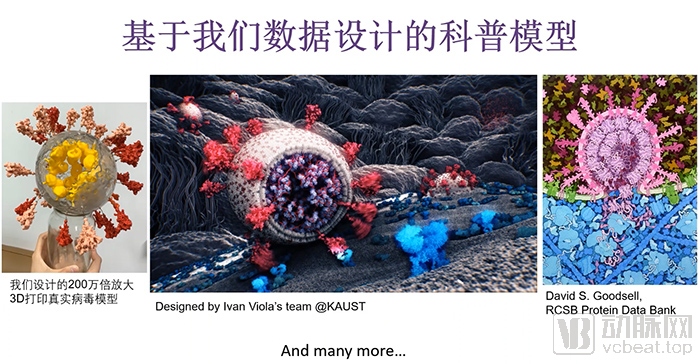
SARS-CoV-2 Science Popularization Model Designed Based on the Work of Professor Li Sai’s Team at the School of Life Sciences, Tsinghua University (Image sourced from video screenshot)
In addition, AI is also helping humanity combat the novel coronavirus through medical imaging and gene sequencing. Kimberly Powell, Global Vice President of NVIDIA’s healthcare business, stated at a roundtable discussion that China holds a relative lead in the genomics sector. Part of this advantage is attributable to GPU-accelerated genomic alignment services. During the COVID-19 pandemic, genomic alignment played its due role, enabling scientists to better understand the transmission and evolution of the virus.
Furthermore, the NVIDIA AI computing platform has also empowered AI-powered medical imaging companies such as Ping An, United Imaging, Infervision, and Shukun to rapidly deploy COVID-19 auxiliary diagnostic systems to thousands of hospitals at the earliest opportunity. This initiative provided crucial technological support to overwhelmed frontline physicians, significantly bolstering efforts in the fight against the pandemic.
Furthermore, in his keynote address, Bill Dally introduced NVIDIA’s newly launched NVIDIA Clara Discovery advanced toolkit. This suite integrates capabilities in medical imaging, radiology, and genomics to facilitate the development of AI applications for the most computationally intensive tasks in healthcare. Equipped with pre-trained AI models and domain-specific frameworks, the toolkit enables researchers to define end-to-end workflows for next-generation drug discovery and development, spanning target identification and compound design. Leveraging recent breakthroughs in natural language processing, researchers can employ biomedical-specific language models to organize, interpret, and activate large-scale datasets, research literature, and existing publications or patents on therapies and other critical real-world data.
Image recognition is currently the most widely applied field of AI, particularly in healthcare. As of December 5, 2020, five domestic companies had obtained Class III medical device certificates from the National Medical Products Administration (NMPA) for their AI-assisted imaging detection systems through the green channel for innovative medical device approval. This marks a new stage in the clinical implementation of AI applications in the field of medical imaging.
At GTC China, numerous companies showcased AI applications in medical imaging. All these solutions leveraged NVIDIA’s product offerings. NVIDIA also provided Clara Imaging to accelerate the development and deployment of artificial intelligence in the field of medical imaging.
This solution is specifically designed for data scientists and researchers, providing them with easy-to-use, domain-optimized tools for creating high-quality labeled datasets, collaborative technologies for training robust AI models, and end-to-end software for scalable and modular AI deployment.
Zhou Shaohua, a researcher and doctoral supervisor at the Institute of Computing Technology, Chinese Academy of Sciences, provided an outlook on the characteristics and trends of AI in medical imaging. He noted that medical imaging AI currently exhibits the following features: high-definition multi-modal imaging, non-standardized and isolated data, long-tail and emergent disease patterns, sparse and noisy annotations, heterogeneous and uneven samples, and complex and diverse tasks. The open-source MONAI+ platform may represent a new option for AI-driven medical imaging development under these new circumstances.
NVIDIA Senior Researcher Li Wenqi further introduced the MONAI+ (Medical Open Network for AI) platform. This is an open-source software platform specifically designed for deep learning in medical imaging, enabling the industry to accelerate the research and development of related applications. As a key promoter of MONAI+, NVIDIA will base its Clara Train entirely on the MONAI+ platform starting from the next version.
Shen Hong, Vice President of AI at Shanghai United Imaging Intelligence Co., Ltd., shared how the United Imaging Frontier Platform integrates the United Imaging uII-AI module library, 3D Slicer, and the Clara platform, enabling physicians to perform annotations and train AI models independently. Compared to the previously used MIMICS training platform, the United Imaging Frontier Platform has significantly reduced the time required for generating pulmonary arterial, venous, and bronchial models from 140 minutes and 60 minutes to 95 minutes and 15 minutes, respectively.
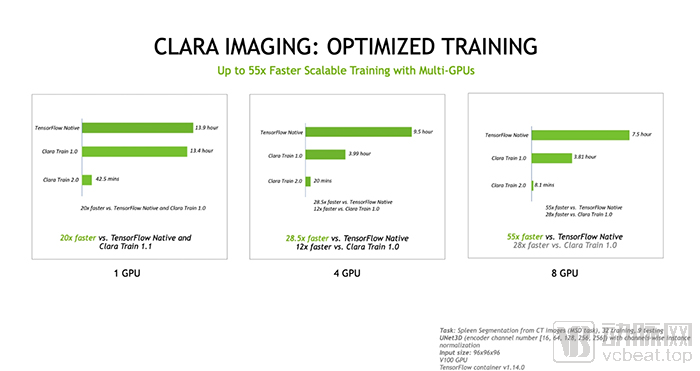
The Upgraded Clara Imaging Platform Delivers Significantly Enhanced Performance (Image Source: Video Screenshot)
NVIDIA R&D Team Manager Xu Daguang explained the new technical features of the Clara Imaging platform. Currently, the upgraded Clara Train 2.0 can significantly reduce the time required for training artificial intelligence models. With single-GPU, 4-GPU, and 8-GPU configurations, Clara Train 2.0 requires only 42.5 minutes, 20 minutes, and 8.1 minutes, respectively, representing a 20x, 28.5x, and 55x improvement in training speed compared to native TensorFlow.
According to his introduction, faster model training, combined with the privacy-preserving multi-source data capabilities provided by federated learning, enabled the Clara Imaging platform to rapidly complete model training for COVID-19 CT images using data from multiple countries during March and April of this year. The platform achieved high accuracy in practical applications, attaining a peak accuracy of 90.8% with its 3D segmentation model.
Wu Dijia, Vice President of R&D at Shanghai United Imaging Intelligence Co., Ltd., further provided an in-depth discussion on how AI empowers three key areas: medical imaging equipment, clinical auxiliary diagnosis, and basic medical research.
In the field of medical imaging equipment, United Imaging’s ACS Intelligent Light Shuttle Imaging is an artificial intelligence technology based on deep learning. It is claimed to be the world’s first second-level MR acceleration technology, bringing whole-body MRI scanning into the era of hundred-second scans. The HYPER-DLR low-dose PET imaging technology, also based on deep learning, can improve image quality by 42% while enabling rapid imaging. Meanwhile, the DELTA low-dose CT imaging technology can increase contrast resolution by 1.6 times while reducing CT scan radiation dose by 80%.
In clinical auxiliary diagnosis, AI can accelerate the reconstruction speed of cardiac cine images by fourfold and reduce the time required for physicians to interpret MRI scans from 20 minutes to approximately one minute. Intelligent coronary artery analysis can improve the efficiency of coronary CT workflows by 70%–80%. Intelligent MR brain structure analysis enables second-level automatic segmentation of 106 brain substructures and generates 3D rendered images, while also performing refined analysis based on brain regions and diseases. The one-stop intelligent CT stroke analysis system helps reduce treatment time and significantly enhances the treatment efficiency and success rate for stroke patients.
Dr. Han Dong, Head of the Neusoft Medical AI Team and Chief Engineer of the Institute of Artificial Intelligence and Clinical Innovation, presented on the application of AI in intelligent scanning workflows. With enhanced GPU computing power, medical imaging equipment can now deploy artificial intelligence technologies such as computer vision, image processing and analysis, and speech recognition. This enables intelligent operation of medical imaging devices, ranging from smart patient positioning, automatic scan region identification, and automated parameter selection and optimization to automatic quality control, thereby delivering a smartphone-like user experience.
Liu Jingjia, CEO of Weishi Medical, introduced an artificial intelligence system for digestive endoscopy validated by randomized controlled trials (RCTs). He stated that physicians urgently need AI assistance during colonoscopies to prevent missed diagnoses of colorectal cancer caused by fatigue, lapses in concentration, or insufficient experience.
According to Liu Jingjia, two randomized controlled trials completed by Sichuan Provincial Hospital and Harvard Medical School in January and June 2020, respectively, confirmed the clinical efficacy of artificial intelligence (AI) in gastroenterology and demonstrated that physicians perform colonoscopies with greater proficiency when assisted by AI. Compared with static image recognition, real-time video-based medical AI applications, such as those used in digestive endoscopy, must address latency across three dimensions: recognition latency, inference latency, and presentation latency. With the continuous improvement of GPU performance, these latencies are steadily decreasing.
In addition to its applications in medical imaging, artificial intelligence is playing an increasingly important role in genomic sequencing analysis. From DNA to RNA, NVIDIA Clara Parabricks can significantly accelerate secondary and tertiary analysis of genomic data.
This solution leverages a software suite specifically designed for high-throughput laboratories located either on-premises or in the cloud, along with a technology stack that enables developers to build robust genomics computing tools. This approach accelerates genomic analysis and empowers research efforts, including those aimed at drug discovery.
Li Chengtao, Founder and CEO of Xingyao Technology, stated in his presentation that traditional new drug development currently faces significant pain points: high investment (averaging $2.6 billion per new drug), long timelines (9–15 years), and high risk (with a clinical-stage success rate of only about 10%). In 2010, the average return on investment (ROI) for new drugs globally was 10.1%, but by 2019, it had declined to 1.8%.
He believes that AI can assist drug R&D teams in the following ways. AI can generate drug candidate molecules with independent intellectual property rights without human intervention, thereby discovering novel structures, through stable and generalizable models. Driven by increased computational power, AI can expand the drug molecular search space from the 10^10 chemical space accessible through manual efforts to the full 10^60 compound space, and shorten the preclinical development timeline from the original 4–7 years to 1–2 years. Finally, AI can also help reduce the cost of drug development.
Xie Dan and Zuo Yuan from QiTan Technology introduced how AI empowers long-read gene sequencing. The company, dedicated to the research, development, and manufacturing of nanopore gene sequencing equipment, has just launched its first prototype sequencer. By leveraging machine learning algorithms to assist in gene sequence translation, the sequencer can stably generate 500 Mbp of gene sequencing data within 8 hours, with an average read length exceeding 10 Kbp. During this process, the use of GPUs has significantly improved inference efficiency, thereby enabling real-time sequence output.
In the realm of smart hospitals, NVIDIA has also sought to empower them with AI. Clara Guardian is NVIDIA’s edge AI solution designed for intelligent hospitals, leveraging video analytics, conversational bots, automatic speech recognition, and natural language processing technologies to assist users.
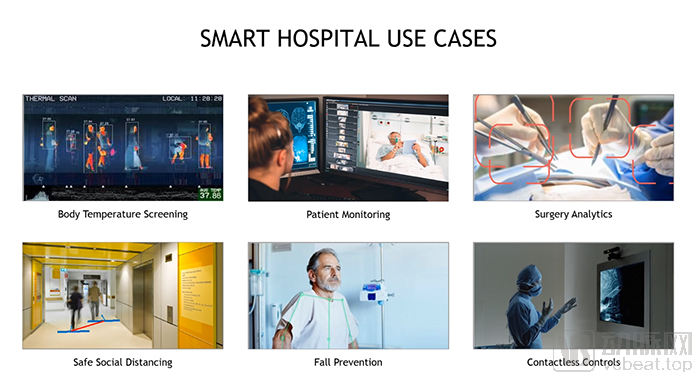
Clara Guardian Can Play a Role in Smart Hospital Applications (Image from Video Screenshot)
NVIDIA Data Scientist Zhang Meng provided an in-depth exploration of Clara Guardian in his presentation. By integrating Internet of Things (IoT) technology, Clara Guardian can enhance the operations and management of healthcare institutions by playing a pivotal role in public safety (temperature screening, personal protective equipment detection, and social distancing compliance), patient care (patient monitoring, fall prevention, and patient engagement), and operational efficiency (operating room workflow automation, surgical analytics, and contactless control).
Undoubtedly, NVIDIA, benefiting from favorable timing, geographic advantages, and strong human resources, has firmly secured a leading position in the AI sector. Leveraging its powerful hardware computing capabilities alongside specialized algorithms, NVIDIA’s green logo has become nearly ubiquitous in the AI field, which is currently synonymous with image recognition, speech recognition, and semantic understanding.
The fervor surrounding AI is merely the beginning; it will only intensify in the future, with more tech giants entering the fray to empower healthcare and medical services through AI. The good news is that we have already seen a growing number of Chinese companies make their debut at GTC. With time, some of these enterprises may well rise to prominence, leveraging hard-core capabilities to achieve “genuine innovation” rather than “innovation with Chinese characteristics,” thereby standing at the pinnacle of the global stage.
Good luck to everyone.