

Cityblock Health: AI-Powered Healthcare for Underserved Communities, Former Alphabet Spinout Valued Over $10 Billion, Files for IPO

Kinnevik
Industry Investment Institutions

Cityblock Health
Healthcare Service Provider

Goldman Sachs Asset Management
Investment Advisory Service Provider

Redpoint Ventures
A venture capital fund originating from Silicon Valley.

Sidewalk Labs
Urban Solutions Provider

Thrive Capital
Venture Capital Firms
Equal access to healthcare for all is one of the hallmarks of an ideal society. The onset of disease not only inflicts physical suffering on patients but also imposes a financial burden, which is particularly severe for low-income populations. When the inability to afford care leads to the distress of low-income patients being unable or afraid to seek medical attention—a sentiment echoed across society—providing professional community-based healthcare services has become a core demand of these groups. Cityblock Health is precisely such a company, dedicated to delivering enhanced healthcare services to low-income communities.

Cityblock Health employees (Image source: Cityblock Health)
Cityblock Health is the third healthcare company launched by Alphabet following its entry into the medical sector through AI systems, after Verily (launched in December 2015) and the newly established DeepMind Health division (launched in February 2016). In 2017, Cityblock Health began to spin off from Alphabet’s Sidewalk Labs. Initially partnering with EmblemHealth, it leveraged a specially curated network of healthcare providers to deliver basic primary care and supportive medical services to patients.
Headquartered in New York, Cityblock Health currently operates clinics primarily in Brooklyn, Queens, Connecticut, Massachusetts, and North Carolina. It mainly serves Medicaid beneficiaries and dual-eligible patients (those enrolled in both Medicare and Medicaid), providing them with primary care, behavioral health, and substance use disorder treatment services at a lower cost.
Upon its establishment in 2017, Cityblock Health secured seed funding from its former parent company, Sidewalk Labs. In early 2018, global venture capital firms Maverick Ventures and Thrive Capital joined the investment consortium, helping Cityblock Health complete a $20.8 million Series A financing round. In April 2019, Cityblock Health announced the completion of a $65 million Series B round, led by new investor Redpoint Ventures, with continued participation from existing investors Sidewalk Labs, Thrive Capital, Maverick Ventures, and Town Hall Ventures. One year later, in July 2020, Cityblock Health rapidly closed a $53.5 million Series B+ round, led by new investors Kinnevik and Goldman Sachs Asset Management. Just three months afterward, Cityblock Health completed a $160 million Series C round, the largest financing amount in its history.
Short funding cycles and large capital amounts are prominent features of Cityblock Health’s financing history. The company completed five rounds of funding in just three years, pushing its total valuation above $1 billion. Behind Cityblock Health’s repeated appeal to investors lies the social and commercial value it has demonstrated.
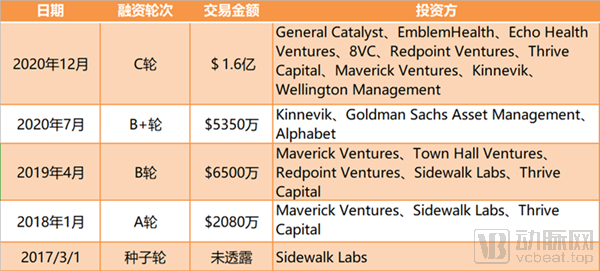
Cityblock Health Financing History (Source: VCBeat)
As is well known, influenced by historical, cultural factors, and the wealth gap, medical resources in the United States are severely unevenly distributed. The concentration of high-quality medical resources among high-income groups—such as the wealthy, elites, and corporate conglomerates—has long been a critical pain point in the U.S. healthcare system. For the vast majority of ordinary people, especially low-income populations, access to medical resources remains extremely limited.
In the United States, individuals with health insurance have the majority of their medical expenses covered by insurance companies, requiring them to pay only a portion out-of-pocket. However, the U.S. is currently the only developed nation without universal health coverage. For those who are uninsured or hold low-cost plans, accessing medical treatment remains a luxury. Issues such as difficulty in obtaining care and high out-of-pocket costs have long plagued ordinary Americans. Moreover, rising insurance premiums have compelled many low- and middle-income individuals to forgo medical care altogether, leaving their health to fate.
In April this year, Barbara Ferrer, Director of the Los Angeles County Department of Public Health in California, USA, stated at a press conference on the COVID-19 pandemic that residents living in low-income communities in Los Angeles County were three times more likely to die from COVID-19 than those in wealthier communities. In communities where more than 30% of households are low-income, the COVID-19 mortality rate was 16.5 per 100,000 people, whereas in communities with less than 10% low-income households, the rate was 5.3 per 100,000. Thus, the link between income disparity and disparities in healthcare access is self-evident.
Amid such a challenging healthcare landscape, it is not the case that all primary care patients are unable to access medical services. Cityblock Health is a company dedicated to providing affordable healthcare services to low-income populations.
Iyah Romm is the co-founder and CEO of Cityblock Health. He studied biology and medicine at Brandeis University and Boston University in the United States. His entire career has been dedicated to public healthcare. Before joining Sidewalk Labs as an entrepreneur-in-residence, Iyah Romm served as Chief Transformation Officer at the Commonwealth Care Alliance (CCA) in Massachusetts for one year. There, he helped manage nearly $1 billion in insurance premiums for low-income populations and assisted tens of thousands of Medicaid and Medicare beneficiaries in accessing care services.
Previously, as Investment Director of the Health Policy Commission, he led a $160 million statewide healthcare transformation investment initiative. There, he also made significant contributions to Massachusetts’ healthcare reform efforts, particularly in advancing the redesign of payment systems and care delivery. In 2016, Iyah Romm was honored as a “Modern Healthcare Person of Excellence” and served as an Affiliate Faculty member at Dr. Atul Gawande’s Ariadne Labs.
Until October 2017, with the support of Sidewalk Labs, he led the spin-off of Cityblock Health from Alphabet and helped Cityblock Health raise over $20 million in Series A financing. Since then, Cityblock Health has partnered with leading healthcare companies and institutions to improve the health of residents in low-income communities.
“We are a technology-driven healthcare services company focused on caring for populations that have been overlooked by innovators and underserved by the healthcare system. We believe we can fundamentally redefine how healthcare is delivered to low-income communities.” Ensuring access to high-quality, affordable healthcare for low-income populations is the ultimate goal of Iyah Romm’s work.

Iyah Romm, Co-founder and CEO of Cityblock Health
Judging from Alphabet’s strategic moves in the healthcare sector in recent years, particularly through its subsidiary Cityblock Health, Alphabet is betting on a future where healthcare becomes increasingly data-structured and AI-driven. DeepMind, an Alphabet subsidiary dedicated to artificial intelligence research, previously provided a application called Streams to four major hospitals in the UK. This application leverages hospital data to generate alert systems that notify physicians of potential patient deterioration. Meanwhile, Calico, another Alphabet subsidiary, is committed to extending human lifespan by focusing on the prevention and treatment of aging and other age-related diseases. The company utilizes AI to process large datasets, thereby automating certain experimental processes. Overall, Alphabet has applied AI across various domains, including disease monitoring, novel data infrastructure, and health insurance.
Distinct from traditional AI healthcare companies, Cityblock Health targets low-income marginalized populations and tailors its service models to their specific characteristics.
“The current model of healthcare delivery is fundamentally unsuited for the majority of people in low-income communities. Today’s hospital-based acute care system is reactive, not proactive. This type of care is expensive and often unnecessary,” said Iyah Romm, Founder and CEO. “By improving people’s health and daily lives through preventive care, we can effectively reduce the likelihood of disease.”
Based on this, Cityblock Health launched a health app called Commons in 2017, a novel care service platform that closely connects care teams with patients. After legally collecting extensive data on Medicare/Medicaid beneficiaries through Commons, Cityblock Health employs artificial intelligence to triage patients according to their risk levels and deliver timely interventions in a semi-automated or fully automated manner. This approach enables the company’s team to efficiently provide coordinated services to each member, ranging from hospital admission alerts to tracking treatment progress, thereby maintaining real-time visibility into each member’s status.
Cityblock operates on a membership model, allowing patients with relevant needs to access services by registering as members. Service offerings include:
1. Physiological Health Care:Cityblock’s care team includes nurses, physicians, and specialists. Available 24/7, the team offers regular physical examinations through online scheduling when needed by members.
2. Mental Health Care:Cityblock Health has professional psychiatrists to treat mental health issues such as anxiety, depression, and insomnia. They can also help patients alleviate the stress associated with chronic diseases.
3. Community Health Partners:Understand users' priorities and needs to help them access appropriate care and services; meet with the care team or communicate with other stakeholders; assist in identifying local resources, such as food, transportation, and housing services.
If users meet the eligibility criteria for government health programs, Cityblock will not charge them any fees; the costs will be covered by the insurance fund.

Cityblock Service Process (Source: Cityblock Health Official Website)
Cityblock Health was founded with the goal of providing healthcare services to low-income populations. As the company has grown and continuously refined its offerings, what Cityblock Health provides now extends far beyond clinical care alone.
Cityblock Health Tailors Service Plans to Individual NeedsSonia, a member of Cityblock Health, was identified as being at high risk for COVID-19 based on the company’s risk prediction algorithms. In response, Cityblock Health’s team of clinicians and nurses promptly conducted a comprehensive assessment of her physical health, work situation, and living conditions. Given that she was experiencing homelessness, the team encouraged her to enroll in Cityblock Health’s short-term isolation program. They first provided her with a new mobile phone and supported her application for permanent housing, ultimately helping her move into a fully furnished apartment. Sonia reported that both her physical health and psychological stress were well managed throughout this process.
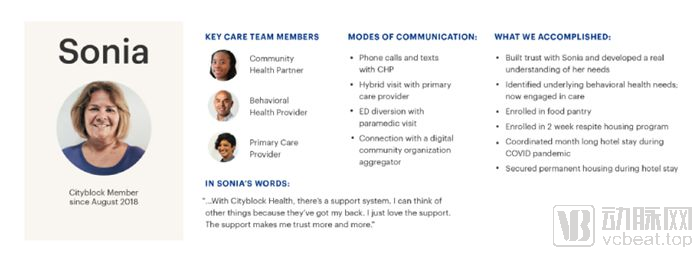
Sonia is a member of Cityblock Health (Source: Cityblock Health official website)
During the COVID-19 pandemic, Cityblock Health also developed an online maternal and infant care service program specifically designed to support couples planning for pregnancy, expectant parents, and new parents. Through online appointments, these individuals can consult with obstetricians, pediatricians, and other specialists.
In addition, the company has assembled a team comprising nurses and online physicians, who promptly dispatch medical personnel to patients’ homes when emergency care is required. Between March and June this year, Cityblock Health saw a 2,000% increase in online visits, addressing healthcare access challenges for a large number of low-income individuals amid the severe pandemic.
Cityblock Health states on its official website that in the coming year, it will leverage newly acquired capital to launch a maternal care program and enhance its online care capabilities, with a long-term goal of expanding its membership base to 10 million within ten years.
For the healthcare industry as a whole: This is the best of times, as continuous advancements in medical technology and disruptive innovations in care models are propelling traditional medicine into the ranks of high-precision, cutting-edge practice. Yet this is also the worst of times, marked by a steadily growing global population, an aging crisis engulfing most countries, pandemic-induced disease burdens, and severe imbalances between regional healthcare demand and supply.
Some view AI in healthcare as a boon, regarding precise, rapid, and efficient medical services as progress for the healthcare industry; others see it as a privilege for the wealthy, where only the affluent can enjoy the fruits of technological advancement, arguing that increasingly sophisticated medical technologies will only exacerbate inequalities in healthcare access.
Will AI in Healthcare Exacerbate Inequalities in Medical Services? The vigorous debate surrounding this question underscores the public’s concern and anxiety regarding the healthcare sector. Perhaps we should consider factors beyond technology alone. At the very least, Cityblock Health’s practice of applying AI to medical services in low-income communities demonstrates that “technological determinism” lacks sufficient persuasiveness. We cannot overlook the advantages of artificial intelligence in shortening patient consultation times and improving efficiency within primary care settings. For low-income communities where medical resources still fail to adequately meet the grassroots population’s healthcare needs, leveraging AI software to replicate the rich clinical experience and theoretical knowledge of human physicians across more “AI doctors” would undoubtedly help alleviate the difficulty of accessing medical care.
Perhaps whether future medical advancements can benefit more marginalized groups, and whether more enterprises like Cityblock Health will emerge to provide healthcare services to low-income populations, is what concerns the general public most.