

LeanTaaS Files for IPO After Raising Over $250 Million to Tackle Healthcare Resource Misallocation with AI

Goldman Sachs Investment Partners
Late-Stage Venture Capital Firms

LeanTaaS
Medical Operations Software Technology Developer
Recently, VCBeat learned that U.S. healthcare IT company LeanTaaS announced it had secured $130 million in Series D financing, led by Insight Partners with participation from Goldman Sachs. Prior to this round, Insight Partners and Goldman Sachs had each participated in LeanTaaS’s previous funding rounds. Since its founding in 2010, LeanTaaS has raised a total of over $250 million.
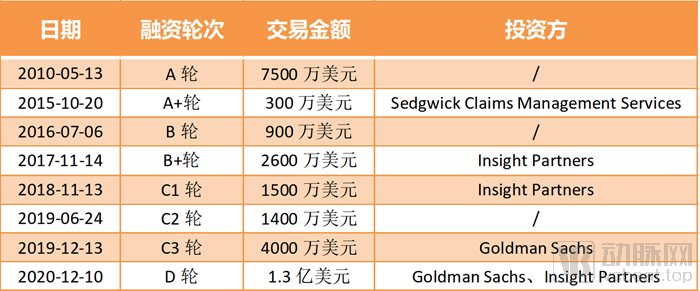
LeanTaaS Funding History (Source: Crunchbase)
LeanTaaS is headquartered in Santa Clara, California, the heart of Silicon Valley. As a healthcare software company, LeanTaaS specializes in predictive analytics through data mining and machine learning, leveraging cloud-based solutions to enhance service levels at healthcare institutions and improve the utilization of medical resources.
LeanTaaS Founder and CEO Mohan Giridharadas is an academic overachiever, holding master’s degrees from three prestigious institutions (an MBA from Stanford University, a Master of Science in Computer Science from the Georgia Institute of Technology, and a Bachelor of Engineering in Electrical Engineering from the Indian Institute of Technology Bombay). Prior to founding LeanTaaS in 2010, Mohan Giridharadas served as a Senior Partner at McKinsey & Company, a world-leading management consulting firm.
During his 18 years at McKinsey & Company, Mohan Giridharadas led operational practices in lean manufacturing and lean services across North America and the Asia-Pacific region. In addition, he has been a member of Stanford University’s Continuing Studies program and an MBA instructor at the Haas School of Business, University of California, Berkeley, where he taught courses on the application of lean principles.
It is worth noting that the management team led by Mohan Giridharadas can be described as an elite group of high-achievers, with members hailing from prestigious universities and possessing extensive industry experience. Sanjeev Agrawal, President and Chief Operating Officer, graduated from the Massachusetts Institute of Technology (MIT). He served as Google’s first Head of Product Marketing and has also worked at McKinsey & Company and Cisco Systems, bringing rich operational expertise to the role.
Chief Financial Officer Lloyd Martin holds a bachelor’s degree and an MBA from Santa Clara University. Prior to joining LeanTaaS, he held senior management positions at Ernst & Young, Google, Trulia, and several venture capital firms. He has over 25 years of experience in finance and operations.
Chief Marketing Officer Niloy Sanyal holds a bachelor’s degree from an Indian Institute of Technology and an MBA from Columbia University. Prior to joining LeanTaaS, he served as Chief Marketing Officer at technology companies Omnicell and GE Digital, and was a Senior Advisor at TPG Capital, bringing 20 years of experience in marketing strategy.
The leadership team’s specialized academic backgrounds and extensive professional experience have injected momentum into LeanTaaS’s positive growth.

LeanTaaS Core Leadership Team (Image source: LeanTaaS official website)
According to LeanTaaS’s data-driven projections, 49% of the U.S. population will be affected by chronic diseases by 2025, and 21% of Americans will be over the age of 65 by 2030. Driven by healthcare reform, population aging, and the annual increase in new cancer cases, demand for medical services continues to grow.
In recent years, U.S. healthcare companies and institutions have invested substantial human, financial, and operational resources in the research and development of cutting-edge medical devices and the construction of basic medical infrastructure, achieving tangible results. However, an awkward reality persists: due to outdated appointment scheduling models in healthcare facilities, these advanced devices are not being fully utilized, and patients are not receiving timely and adequate medical services.
Prolonged patient wait times can lead to the collapse of large clinics or hospital systems. According to a recent survey in the United States, 84% of patients believe that reasonable wait times play a very important role in the healthcare experience. Thirty percent of patients stated that they sometimes cancel their appointments out of necessity, not because their condition no longer requires treatment, but because the wait time for an appointment is too long, forcing them to give up. As many as 20% of patients indicated that they have considered switching healthcare providers due to excessive wait times, only to easily encounter the same issue elsewhere.
The awkward situation between patients and hospitals urgently requires a company that can use complex data optimization methods to match the growing demand for medical services with the operation of existing medical assets (medical staff, inpatient wards, medical equipment). This makes the establishment of LeanTaaS natural and necessary.
Segall, Managing Director at Insight Partners—the investor in LeanTaaS—has pointed out that every minute of idle time in a U.S. hospital operating room translates into a $100 loss for the hospital. The core value proposition of LeanTaaS’s software products lies in leveraging data analytics to drive cost savings. This may well be one of the reasons why Insight Partners has injected capital into LeanTaaS on multiple occasions.
LeanTaaS was founded with the initial aim of designing healthcare software that maximizes benefits for both hospitals and patients. For instance, through online appointments via a mobile app, patients can quickly schedule consultations, infusion therapies, surgeries, and other services. Building on this foundation and leveraging proprietary algorithms, LeanTaaS developed the iQueue system.
In layman's terms, the iQueue system acts as a hospital resource scheduler. This system effectively matches resources such as operating rooms, chemotherapy services, outpatient clinics, imaging equipment, and inpatient beds with patient needs, and improves patient care efficiency while reducing healthcare costs by continuously comparing expected values with actual outcomes.
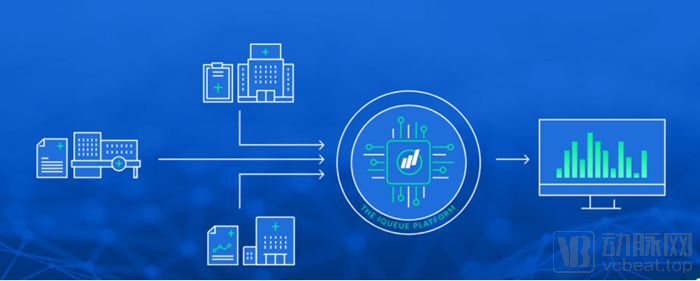
Schematic Diagram of iQueue System Operation (Source: LeanTaaS Official Website)
The iQueue system is widely deployed across various hospital settings, with workflows tailored to specific patient needs. Previously, its flagship products included iQueue for Operating Rooms and iQueue for Infusion Centers.
Impacted by the black swan event of the COVID-19 pandemic in 2020, a large influx of COVID-19 patients and suspected cases flooded hospitals. To allocate existing ward resources more rationally and effectively, LeanTaaS adjusted its product portfolio by adding iQueue for Inpatient Beds.
iQueue Operating Room
iQueue for Operating Rooms aims to enhance surgeon accessibility through actionable metrics. It extracts electronic health record data from vendors such as Epic, Cerner, Meditech, Allscripts, and McKesson, enabling hospitals to schedule more surgeries without increasing the number of operating rooms or extending operating hours, thereby fully leveraging underutilized OR resources.
Data from the LeanTaaS website shows that iQueue for the OR has been implemented in more than 30 health systems, spanning over 160 hospitals. This includes four of the top ten U.S. health systems and more than half of the leading hospitals.
iQueue Infusion Center
iQueue for Infusion Centers reviews daily appointment schedules, chair utilization rates, and staff availability to recommend optimal appointment times for patients. It generates work schedules and assigns clinical staff accordingly, thereby maximizing patient throughput and chair utilization at infusion centers.
Currently, iQueue has been deployed in 180 infusion centers at cancer care institutions across China, including six of the top ten cancer hospitals ranked by U.S. News & World Report, 20 sites within the National Comprehensive Cancer Network (NCCN), and 30 member institutions of the National Cancer Institute (NCI).
Founder Mohan Giridharadas stated that among the 180 deployed infusion centers, iQueue increased patient throughput by 15% to 25% across a resource base of 4,500 chairs, while reducing wait times by up to 50%.
iQueue Ward
During the COVID-19 pandemic, the surging number of infected patients led to a shortage of hospital beds. To address this challenge, LeanTaaS launched iQueue for Inpatient Flow. By conducting in-depth data mining across hospital departments and diverse case types, iQueue generates predictive models of patient trajectories for all admitted individuals. This enables healthcare professionals to manage patient admissions and discharges more easily and efficiently, thereby improving patient throughput.
On one hand, iQueue wards can help more COVID-19 patients receive timely and effective treatment; on the other hand, reducing patient wait times and scheduling appointments during off-peak hours also lower the risk of cross-infection for other patients in the hospital.
After screening similar companies within the industry, VCBeat considers Qventus to be the company most similar to LeanTaaS. To some extent, they are the biggest competitors in the medical software market.
Qventus was founded in early 2012 and, like LeanTaaS, is headquartered in Silicon Valley, USA. Similar to LeanTaaS’s business model, Qventus also provides AI-powered management software for healthcare institutions to help optimize medical services.
Specifically, Qventus provides hospitals with a management software suite that analyzes data such as patient flow, leverages AI for predictive analytics, and offers actionable recommendations. This enables administrators to improve the utilization rates of medical equipment and hospital beds, thereby increasing hospital revenue, while also enhancing patients’ care experience and satisfaction.
For example, after implementing the AI system provided by Qventus, a hospital saw improvements across eight dimensions, while patient satisfaction with the hospital rose from 29th to 3rd place.
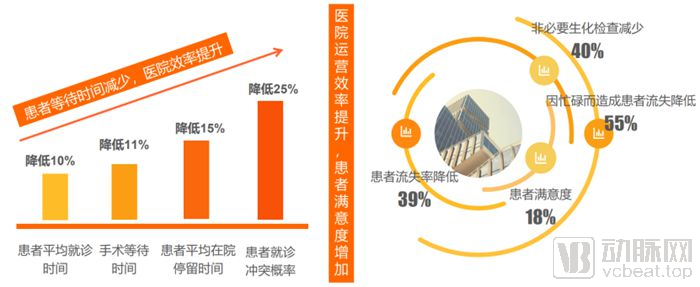
VCBeat Graphic
In addition to competing with Qventus, LeanTaaS faces other competitors in the same space. For instance, Perimatics, a spin-off from the University of Washington, has developed an artificial intelligence system that leverages patient and surgeon data to predict surgical durations. DocuTap has also developed the ClockwiseMD system, which conducts online pre-screening for patients and provides this service to hospitals, helping both patients and hospitals schedule appointment times.