

Synthetic Biology: Unveiling the Value Proposition Behind the 'Third Biological Revolution'
In 2020, when the COVID-19 pandemic swept across the globe, the synthetic biology community rapidly responded to the challenge with advanced technologies, emerging as one of the key forces in developing effective diagnostic measures and researching drugs and vaccines.
From a broader and more profound perspective, in the face of the increasingly prominent constraints that resources and environmental factors have imposed on global economic development in recent years, synthetic biology not only holds significant importance for human health and our understanding of the essence of life, but also demonstrates immense potential and wide-ranging applications in fields such as medicine, energy, materials, agriculture, and the environment.
The path of exploration is always fraught with challenges, and the emergence of any new technology inevitably gives rise to a myriad of questions. Spanning technology to market, and capital to policy, how will synthetic biology influence global economic development and people’s lifestyles? How will it disrupt human cognition and existing technologies, shifting from “creation for knowledge” to “creation for application”? How can industry, academia, and research integrate closely to enable synthetic biology to yield incremental breakthroughs along the way, thereby securing a competitive edge in the global arena? How can the mysteries of science reinvigorate industry, while capital and industry, in turn, feed back into scientific advancement? What role will China play on the world stage of future synthetic biology, and what transformations will it lead? Only time will tell.
Standing at various possible “crossroads,” the “Guangming Science City · 2020 Engineering Biology Innovation Conference” was successfully held at the Guangming District Cultural and Arts Center in Shenzhen on December 19–20. Attendees included Ai Xuefeng, Deputy Mayor of Shenzhen; Liu Sheng, Secretary of the Guangming District Committee and District Mayor; Zeng Jianpeng, Deputy Director of the Shenzhen Municipal Development and Reform Commission; Lv Jiancheng, Deputy Director of the Shenzhen Institutes of Advanced Technology, Chinese Academy of Sciences; Yao Gaoke, a leader of Guangming District; and relevant officials from the Shenzhen Science and Technology Innovation Commission. Together with nearly 500 top scientists, business representatives, and investors from the field of synthetic biology, they convened to discuss the future development direction of the synthetic biology industry.
In 1953, Watson and Crick discovered the double-helix structure of DNA, ushering in the first biotechnology revolution and marking the entry of life sciences research into the era of molecular biology. In 2003, the completion of the Human Genome Project signaled the advent of the second biotechnology revolution, bringing the fields of omics and systems biology to the forefront of life sciences research.
Synthetic biology, building upon systems biology and integrating engineering principles, employs emerging technologies such as gene synthesis, editing, and network regulation to “write” new life forms or modify existing ones. This advancement will lead to a qualitative leap in humanity’s understanding of the essence of life, thereby spearheading the third biotechnological revolution.
As an emerging discipline in the field of 21st-century biology, synthetic biology is the product of interdisciplinary convergence among molecular and cell biology, evolutionary systems biology, biochemistry, informatics, mathematics, computer science, and engineering. To date, it has achieved remarkable accomplishments in numerous fields, including bioenergy, biomaterials, medical technologies, and the exploration of the fundamental principles of life.
In 2014, the U.S. Department of Defense listed synthetic biology as one of the six priority disruptive technologies for the 21st century; the UK Department for Business, Innovation and Skills identified synthetic biotechnology as one of the eight key future technologies; and in China’s Third Technology Forecast completed in 2014, synthetic biotechnology was ranked among the ten major breakthrough technologies, and was designated as a strategic priority area in the “13th Five-Year Plan” for Scientific and Technological Innovation.
Driven by technological and policy advancements, biosynthesis and manufacturing, with synthetic biology as their cornerstone, are emerging as the “main force” behind transformative change, gradually supplanting traditional chemical methods to assume a dominant position in market applications.Behind this inevitable trend lie the many leading advantages of synthetic biology.
First, the technology is continuously optimized.Synthetic biology technology has undergone four development stages over the past 20 years: The period from 2000 to 2003 is known as the “Founding Stage,” characterized by research methods and theories with distinct disciplinary features; The period from 2004 to 2007 is referred to as the “Expansion and Development Stage,” marked by continuous expansion of the field but slow progress in engineering technologies; The period from 2008 to 2013 is termed the “Innovation and Application Translation Stage,” distinguished by the continuous emergence of new technologies and engineering approaches; The period from 2014 to the present is called the “New Stage,” characterized by the continuous empowerment of the synthetic biology field by cutting-edge concepts, primarily driven by information technology (IT), which has steadily improved work efficiency and opened up new avenues for industrial application.
Second, it is environmentally friendly.In an era where environmental concerns are becoming increasingly prominent, the primary driver of technological innovation lies in the creation of cleaner materials. Compared to chemical methods, synthetic biology offers more distinct advantages in this domain and better aligns with the societal demand for sustainable development.
Third, the cost is lower.Due to its unique production mechanisms, synthetic biology does not require the establishment of large-scale chemical plants or the employment of a vast workforce. Furthermore, engineered microorganisms are capable of self-replication. Consequently, while reducing labor costs, synthetic biology enables the more efficient and cost-effective production of target products. Taking “Vitamin C” as an example, Dr. Liu Xiucai, Chairman of Cathay Biotech, undertook a national project on “Vitamin C.” Within just one year, he achieved large-scale production using biological methods, halving the cost of “Vitamin C.” As a result, global “Vitamin C” production capacity rapidly concentrated in China, a trend that has persisted to this day.
Fourth, “create” new compounds.Since the turn of the 21st century, the development of new antibiotics, compound molecules, and novel materials has entered a bottleneck period. There is widespread anticipation for a novel technology capable of “creation” to enable new discoveries in materials, compounds, and even energy. The emergence of synthetic biology aligns precisely with these expectations.
5. Upstream and downstream coordination.Driven by advancements in tools, upstream companies specializing in DNA/RNA synthesis and industrial enzyme preparation have experienced rapid growth, with continuous breakthroughs in technical fields accelerating industry development. On the downstream front, the deep integration of biotechnology and computer technology has ushered in unprecedented opportunities for application exploration in synthetic biology. Industry unicorns such as Zymergen and Ginkgo Bioworks have emerged, gradually leading the entire sector forward.
The dividends from the continuous advancement of synthetic biology technology are gradually being reflected at the market level, according to reports released by the platform,From 2019 to 2024, the global synthetic biology market is projected to grow at a compound annual growth rate (CAGR) of 28.8%, with the total market size expected to reach tens of billions of U.S. dollars by 2024.
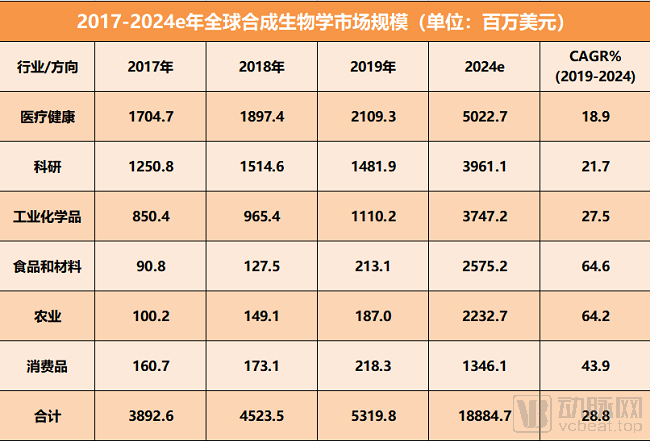
Data Source: Engineering Bio-Industry Data Analysis Platform; Chart by VCBeat
In the investment and financing sector, synthetic biology has demonstrated strong performance in recent years. According to data from Crunchbase, total funding in the field of synthetic biology reached $3.8 billion in 2018, an increase of nearly $2 billion compared with 2017, and this momentum continues to rise.In the first half of 2019, 65 synthetic biology companies raised a total of $1.9 billion in financing, with Ginkgo Bioworks setting a current funding record in the synthetic biology sector by securing $290 million.
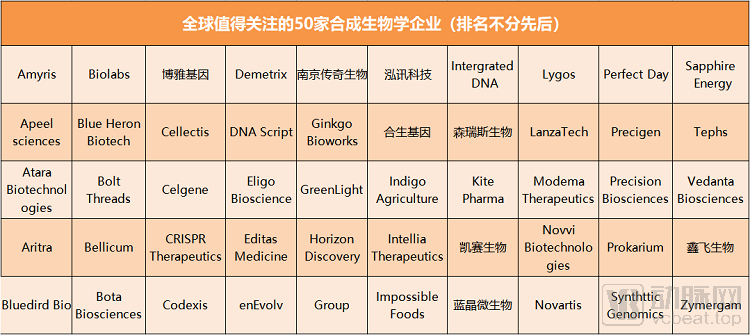
Data source: Engineering Biology Insights, an engineering bio-industry data analytics platform; chart by VCBeat
The influx of capital has injected momentum into corporate growth. Based on current development status and future value, the engineering biology data analytics platform Engineering Biology Insights (EB Insights) has highlighted 50 synthetic biology companies worldwide worthy of attention, including 42 international firms and 8 Chinese enterprises. Globally leading companies such as Amyris, Synlogic, Ginkgo Bioworks, Intellia Therapeutics, Cathay Biotech, and Bluepha are included in the list.
Synthetic biology technologies have broad applications, spanning fields from bioenergy to bio-based materials, microbial robots, food, agriculture, biopharmaceuticals, disease treatment, mass production of rare resources, environmental remediation, and the development of biotechnology engineering platforms.
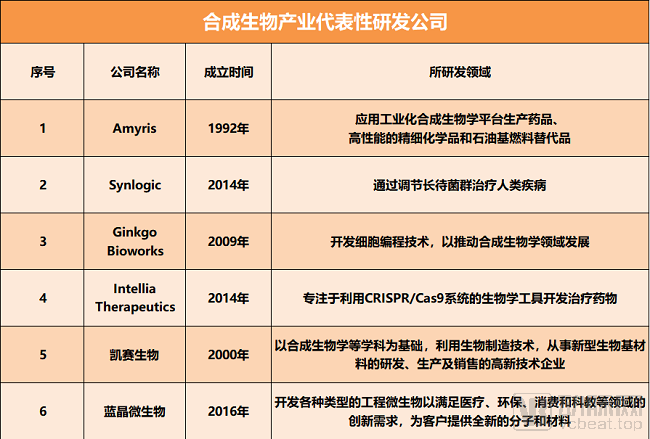
Amyris was among the first synthetic biology companies listed on the U.S. NASDAQ. Founded by Professor Jay Keasling, a pioneering figure in the field of synthetic biology, the company is dedicated to leveraging its industrial-scale synthetic biology platform to produce pharmaceuticals, high-performance specialty chemicals, and alternatives to petroleum-based fuels. Its market capitalization has reached $770 million.
Synlogic is a biotechnology company based in Cambridge, Massachusetts, USA, founded in 2014. The company focuses on the intersection of biology and engineering, pioneering applications in synthetic biology by leveraging advanced technology platforms to artificially design and synthesize therapeutic microbes, thereby developing novel live biotherapeutics capable of curing diseases. Currently, Synlogic primarily focuses on diseases in three areas: metabolism, inflammation, and cancer.
Ginkgo Bioworks, founded in 2009 and headquartered in Boston, Massachusetts, USA, is a biotechnology and pharmaceutical company. The company was established by Professor Tom Knight, an expert in synthetic biology at the Massachusetts Institute of Technology (MIT), along with several graduate students. Currently, Ginkgo Bioworks is dedicated to developing cell programming technologies to advance the field of synthetic biology. On September 19, 2019, the company completed a $290 million Series E financing round, setting a record for fundraising in the synthetic biology sector.
Intellia Therapeutics is a gene-editing company focused on developing therapeutics using CRISPR/Cas9-based biological tools, aiming to advance the application and development of CRISPR/Cas9 genome editing technology across a broad spectrum of promising new drug discovery programs.
In addition to foreign companies, domestic enterprises are equally worthy of attention.
Cathay Biotech is a star enterprise in the field of synthetic biology. Founded in 2000, it has accumulated profound experience in the field of biomanufacturing through nearly two decades of R&D investment and technological accumulation. It has developed into a globally renowned R&D and manufacturing platform for theoretical technologies and industrialization methods in biomanufacturing. The company has established R&D teams specializing in synthetic biology, cell engineering, biochemical engineering, polymer materials and engineering, and holds more than 100 patents. Cathay Biotech’s main products, including bio-based long-chain dicarboxylic acids, bio-based pentamethylenediamine, and bio-based polyamides, are all biomanufactured materials.
Bluepha is dedicated to designing standardized, high-performance biological genetic elements using synthetic biology technologies, enabling the development of various types of engineered microorganisms to meet innovative demands in healthcare, environmental protection, consumer goods, and science education sectors, thereby providing customers with novel molecules and materials. Bluepha’s vision is to establish a comprehensive molecular and material synthesis technology system based on synthetic biology that surpasses traditional petroleum-based chemistry and chemical engineering technologies, ultimately creating disruptive products capable of shaping future lifestyles.
On August 12, 2020, Cathay Biotech (Stock Code: 688065) was listed on the STAR Market, becoming China’s first publicly traded synthetic biology company.
In 1994, Liu Xiucai, founder of Cathay Biotech, resigned from the internationally renowned company Sandoz and made a firm decision to return to China to start his own business. In 1997,Liu Xiucai successfully transitioned from a “researcher” to an “entrepreneur,” co-founding Cathay Biotech with Zhang Qixian, specializing in the industrial-scale development of industrial biomanufacturing technologies.
After more than 20 years of development, Cathay Biotech has emerged as an industry leader.
Technologically, Cathay Biotech has mastered cutting-edge core concepts and established a robust intellectual property system.As of March 31, 2020, Cathay Biotech had obtained a total of 120 domestic authorized patents and 19 overseas authorized patents., wherein Liu Xiucai, Chairman and President, assumes overall responsibility for defining the company’s R&D direction and strategic roadmap, oversees the R&D process, and holds 51% of the company’s total patents.
In terms of products, Cathay Biotech has successfully industrialized four bio-manufacturing products.Biological Long-Chain Dicarboxylic AcidsThe technology has successfully replaced foreign chemical processes for the production of long-chain dicarboxylic acids;Bio-butanolThe successful industrialization has drawn significant attention from the international energy sector, leading foreign renowned media to name Liu Xiucai as one of the “100 Most Influential People in Future Energy.”Bio-based Pentamethylenediamine and Bio-based PolyamideThe industrialization has further broken the 80-year monopoly of foreign enterprises in nylon production, filling the gap in China’s manufacturing of bio-based polyamides. At a time when the country is vigorously promoting the “transition from old to new growth drivers,” Cathay Biotech, under the leadership of Dr. Xiucai Liu, has been contributing to national economic development and environmental protection through continuous innovation.
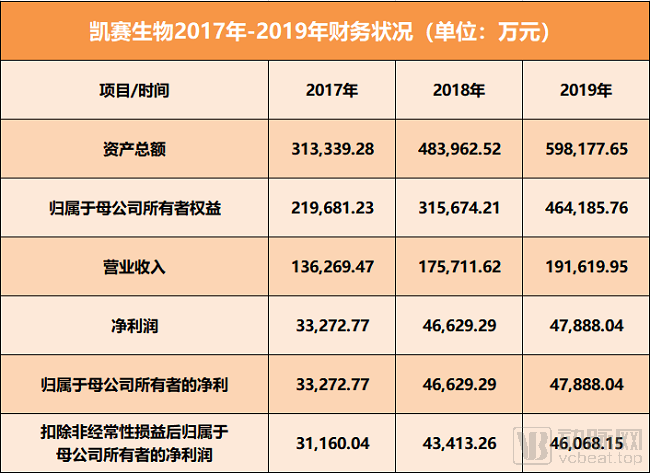
Data source: Cathay Biotech IPO prospectus; chart by VCBeat.
In the market, unlike many biotech companies that go public while operating at a loss, Cathay Biotech demonstrates substantial profitability. According to its prospectus, driven by its core revenue source—the bio-based long-chain dicarboxylic acid product series—the company’s total annual operating revenue reached the billion-yuan level from 2017 to 2019, showing a year-on-year upward trend. In the first quarter of 2020, despite the impact of the global pandemic, the company still achieved RMB 406 million in revenue and a net profit of RMB 118 million.
Looking ahead, Cathay Biotech’s next key product focus isBio-based Polyamide, comprising a series of polyamide products based on odd-carbon bio-based pentamethylenediamine, aimed at breaking the oligopolistic monopoly held by foreign companies over polyamide 66 and its raw materials. In his keynote address at the conference, Liu Xiucai also demonstrated great interest and strong confidence in this sector, statingBio-based polyamide materials feature renewable feedstocks, recyclable products, and cost competitiveness. Cathay Biotech’s series of bio-based polyamides have already demonstrated significant performance and application potential in fields such as textiles and apparel, industrial yarns, automotive lightweighting, and wind energy equipment materials.
For Liu Xiucai, this may well be just the beginning, as his goal is not merely corporate profitability but rather the advancement of China’s—and indeed the global—biomanufacturing industry.“We are not merely building a product, but an entire industry. The development of this industry may require the efforts of several generations, and we are willing to serve as the paving stones for its progress.”
With the continuous innovation of genome editing technologies such as CRISPR, alongside the rapid advancement of big data, artificial intelligence, and robotics, the prospects for synthetic biology are becoming increasingly clear, and its industrialization is poised to enter a period of explosive growth.
The rapid development of the market has created opportunities while also posing numerous obstacles; companies and investment institutions deeply embedded in this sector will continue to advance amidst these challenges.