

New Oxygen Asia-Pacific Medical Aesthetics Industry Summit Successfully Held, Signaling Market Recovery
Affected by the sudden outbreak of the novel coronavirus (COVID-19) pandemic, the market growth rate of the medical aesthetics industry has slowed down significantly this year. According to data on China’s medical aesthetics services market released by the renowned research firm Frost & Sullivan, the overall growth rate of China’s medical aesthetics services industry in 2020 is expected to narrow sharply to 5.7% due to the impact of the pandemic, which is far below the industry’s growth rate of 18% in 2019.
Risks and opportunities always go hand in hand. In the later stages of the pandemic, technologies and service scenarios related to medical aesthetics began to iterate, accelerating the digital transformation of medical aesthetic institutions. As policies and regulations have been progressively refined, the medical aesthetics industry has also moved toward standardization and healthy competition. According to data from Tianyancha, the number of medical aesthetic institutions that closed in 2020 was 1,410, significantly lower than the 2,404 recorded in 2019, which fully demonstrates the vitality of China’s medical aesthetics industry.
On December 19, at the 2020 6th New Oxygen Asia-Pacific Medical Aesthetics Industry Awards Ceremony (hereinafter referred to as the “New Oxygen Awards”), themed “Accumulating Momentum,” manufacturers, platforms, institutions, physicians, and other stakeholders from key segments of the medical aesthetics industry chain came together to discuss future trends in medical aesthetics. Representatives of China’s medical aesthetics industry jointly reviewed the sector’s development in 2020 and looked ahead to new trends and directions for 2021.
“Online integration is an unwavering long-term trend. The pandemic has accelerated the digitalization of the medical aesthetics market,” stated Jin Xing, Chairman and CEO of So-Young Technology, at the So-Young Asia-Pacific Medical Aesthetics Industry Awards Ceremony.
According to data from the New Oxygen Data Research Institute, the trend toward online integration in China’s medical aesthetics industry is evident. In August this year, the monthly active users (MAU) of the New Oxygen mobile app reached 9.74 million at its peak, making it the internet healthcare platform with the highest MAU in China. Throughout the year, brand exposure for New Oxygen once again surpassed the one-billion mark.
At the conference, Jin Xing expressed strong confidence in the recovery of China’s medical aesthetics industry. First, according to the Economic Blue Book released by the Chinese Academy of Social Sciences, China’s economic growth is projected to reach 7.8% next year. Second, with the gradual rollout of COVID-19 vaccines, the pandemic is expected to ease progressively.
Regarding industry trends, Jin Xing believes that first-tier cities will take the lead in becoming “mature medical aesthetics consumer markets” next year, exhibiting six key characteristics. First, both supply and demand will be robust. Second, consumers will become more rational, with greater diversity in age and occupational demographics. Third, surgical medical aesthetic procedures will rely more heavily on physicians’ technical expertise and aesthetic judgment. Fourth, non-surgical medical aesthetic treatments will place greater emphasis on new products and service quality. Fifth, consumer demands will upgrade, with both efficacy and cost-effectiveness being important. Sixth, high-quality physicians and professional institutions will command a market premium.
“Although the industry as a whole faced headwinds from the pandemic this year, New Oxygen turned the crisis into an opportunity, taking a strategic pause to build momentum. We made sustained efforts and achieved certain results in five key areas: ‘optimizing systems,’ ‘building brand equity,’ ‘driving innovation,’ ‘strengthening governance,’ and ‘investing in core infrastructure.’ In 2021, New Oxygen will continue to deepen its refined operational strategies, create greater value for customers, and contribute further to the development of China’s medical aesthetics industry,” Jin Xing told VCBeat.
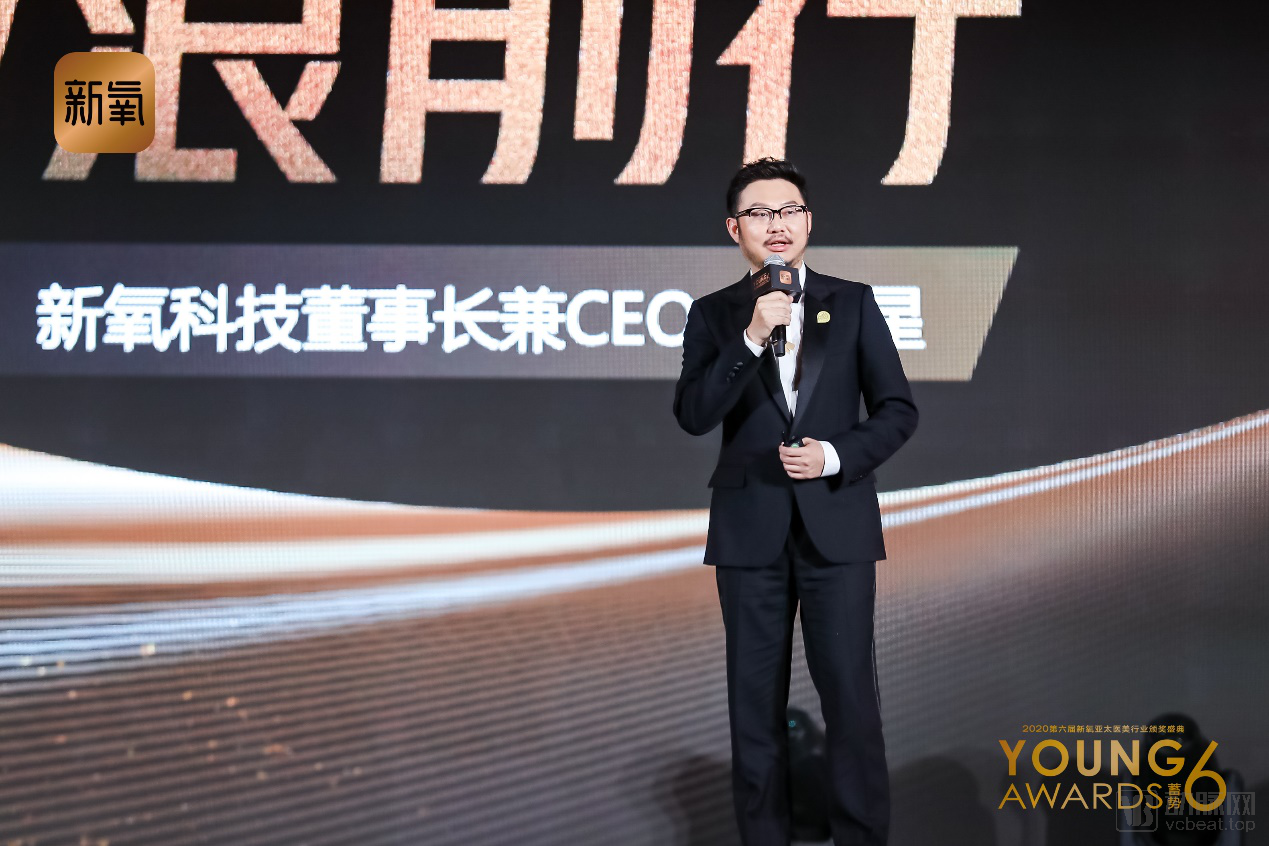
(Jin Xing, Chairman and CEO of New Oxygen Technology)
Restoring professionalism to physicians, returning clinical practice to technical expertise, and refocusing products on quality have long been the shared aspirations of medical aesthetics practitioners, and constitute the essential path for realigning the industry with its fundamental medical nature.
The gala announced the winner of the medical aesthetics industry’s “Nobel Prize,” namely the recipient of the 2nd “China Medical Aesthetics Flying Award · Annual Technological Breakthrough Award.”
Notably, Professor Li Shirong, Chairman of the Chinese Society of Medical Aesthetics and Cosmetology under the Chinese Medical Association and a leading authority in China’s medical aesthetics field; Professor Gao Jianhua, Vice President of the Chinese Association of Plastics and Aesthetics; Professor Luan Jie, Chairman of the Chinese Society of Plastic Surgery under the Chinese Medical Association; Professor Song Jianxing, Chief Physician of the Department of Plastic Surgery at Shanghai Changhai Hospital; and Professor Yang Daping, Vice President of the Plastic and Reconstructive Surgery Branch of the Chinese Association of Plastics and Aesthetics, attended the ceremony to serve as the on-site jury for the 2nd “China Medical Aesthetics Flying Award · Annual Technological Breakthrough Award.”
In the evaluation, experts conducted a detailed assessment of the six shortlisted talented aesthetic medicine physicians by scoring them across four horizontal dimensions—advancement, scientific rigor, practicality, and safety—and multiple vertical dimensions, including industry value and social impact.
Following the on-site defense, Dr. Liu Chunjun, Chief Physician at the Plastic Surgery Hospital of the Chinese Academy of Medical Sciences, was awarded the First Prize of the 2nd “China Medical Aesthetics Flying Award · Annual Technological Breakthrough Award.” The Second Prize was awarded to Dr. Wang Qiuyu, Associate Chief Physician at Chongqing Xingrong Plastic Surgery Hospital, and the Third Prize to Dr. Qian Yuxin, Associate Chief Physician at Shanghai Oriental Hospital.
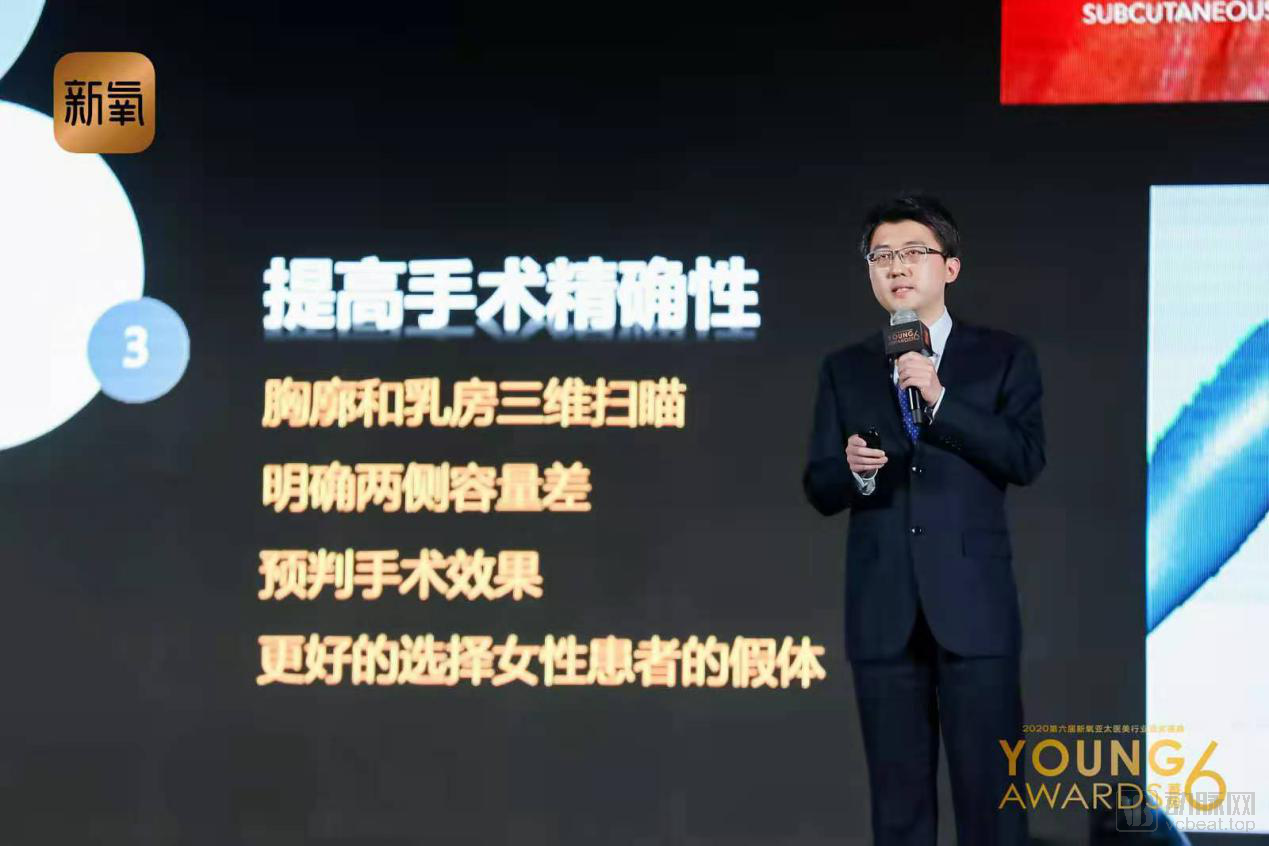 (On-site Defense by Dr. Liu Chunjun, Chief Physician at the Plastic Surgery Hospital of the Chinese Academy of Medical Sciences)
At the event, New Oxygen also announced the initiation of preparations for a special fund to support academic research in China’s medical aesthetics industry, with an initial investment of RMB 10 million. “In its future development, if New Oxygen focuses on enhancing academic capabilities and cultivating medical talent, it will naturally align with the essence of this industry. Peking Union Medical College has established a benchmark for talent cultivation over its 100-year history. By collaborating with New Oxygen and leveraging internet-based approaches to further train competent physicians in our field, we can certainly make greater contributions to the advancement of our profession,” said Wang Haitao, Executive Deputy Director of the Training Center at Peking Union Medical College, Chinese Academy of Medical Sciences, at the event.
Discussing the original intention behind establishing the academic fund, Jin Xing stated, “As the saying goes, ‘It takes ten years to grow trees, but a hundred years to cultivate people.’ The training of medical aesthetic physicians is invaluable. The best way to return medical aesthetics to its medical essence is to cultivate excellent doctors and create platforms for outstanding practitioners, especially those with advanced technical skills. In the future, New Oxygen will allocate 10 million yuan in academic training funds to encourage medical aesthetic physicians to engage in scientific research and innovation. We hope to collaborate with Peking Union Medical College to establish China’s first academic fund dedicated to scientific research by medical aesthetic physicians.”
As the market size of the medical aesthetics industry continues to expand, illegal medical aesthetic practices are increasingly encroaching upon the legitimate market: The White Paper on Insights into China’s Medical Aesthetics Industry (2020) reveals that approximately 100,000 people suffer injuries or disabilities annually due to illegal medical aesthetic procedures. With most consumers facing significant challenges in defending their rights, this has severely undermined consumer confidence in the industry.
To this end, in May of this year, New Oxygen announced an initial donation of RMB 10 million to launch China’s first public welfare project for the repair and relief of victims of illegal aesthetic medicine, in collaboration with the China Plastic Surgery Medical Relief and Repair Fund. With the support of this project, Luo Li, a 33-year-old woman from Sichuan Province, received reparative surgery for cleft lip and palate as well as for injuries caused by illegal aesthetic procedures; Xiao Lin, a 33-year-old woman from Chongqing Municipality, emerged from the shadow of botched illegal aesthetic treatments; and Shen Lin, a 46-year-old farmer from Guizhou Province, regained her nose...
At the ceremony, New Oxygen officially launched the New Oxygen Public Welfare Initiator Program, inviting nationwide participation in the second phase of its medical aesthetics charity assistance initiatives to harness the positive social impact of “Medical Aesthetics for Good.” It was announced that, to boost engagement in this cause, there will be no cap on charitable donations during the second phase. Donations will accumulate based on public “likes” gathered through the Public Welfare Initiator model, with the final donation amount determined by the number of likes received. To support this effort, New Oxygen has specially introduced a “Like-to-Donate” campaign, pledging to contribute RMB 1 for every like received between December 19 and December 26.
Meanwhile, New Oxygen announced the official launch of its public welfare assistance base.
“New Oxygen’s efforts in physician training, continuing education, and research investment embody the integration of industry, academia, and research across medical care, teaching, and scientific innovation, aligning with the current national requirements,” stated Professor Li Shirong on site. It can be said that, driven by internet-based forces represented by New Oxygen Technology, China’s medical aesthetics industry has achieved notable progress in areas such as industry self-regulation, the cultivation of high-quality physicians, and business model innovation. Moreover, digitalization has become a definitive pathway for the industry’s continued rapid growth.