

Shadow Intelligence: Bridging the Data Gap in Aesthetic Medicine with 3D Diagnostics and AI-Powered Consultation
An undeniable reality in the medical aesthetics industry is that, in an era of rapid advancement in digital concepts and technologies, the consultation phase throughout the entire medical aesthetics process remains relatively traditional. Although various medical aesthetics providers have begun to explore technological means for customer image capture and imaging in recent years,PSIn contrast, more often than not, counselors and clients communicate verbally, each holding their own understanding of the treatment plan and expected outcomes. This discrepancy can lead to a gap between the client’s postoperative expectations and the actual results, thereby giving rise to certain disputes.
Moreover, during the consultation process, medical aesthetic institutions fail to integrate and leverage collected facial features, customer behavioral data, and final transaction information. Consultants also lack access to customers’ historical treatment plans, making it difficult to draw insights from past successful or failed cases. This leads to critical operational challenges, including low conversion rates, low average transaction values, low repurchase rates, and high customer complaint rates—precisely the key performance indicators that require the utmost attention in the operation of medical aesthetic institutions.
In response, Shanghai Shadow Intelligence Technology Co., Ltd. (hereinafter referred to as “Shadow Intelligence”) has developed a digital consultation product called the “Meiji Consultation Assistant,” using medical aesthetics consultation as its entry point. By adopting an integrated hardware-software model, the product assists consultants in providing aesthetic design and surgical plans for customers, thereby achieving digitization of on-site medical aesthetics consultations.
Positioning as a general counselor, with multiple updates and iterations
Zhang Defeng, Founder & CEO of Shadow Intelligence, graduated with a degree in Computer Science from Fudan University. During his time at university, he participated in projects related to human behavior recognition. After graduation, Zhang worked with Decathlon and Hongqiao Airport, providing them with algorithms for human behavior recognition and aircraft tracking. Prior to founding Shadow Intelligence, Zhang focused on 3D virtual try-on technology, which involves constructing 3D human models using multiple DSLR cameras.
Drawing on years of experience in developing intelligent recognition systems, Zhang Defeng and his team identified the low level of intelligence in on-site consultations. They decided to introduce intelligent concepts into medical aesthetics consultations, subsequently establishing Shadow Technology and developing a 3D surgical simulation design software. Upon its launch, the product gained recognition from the market, as well as from managers and operators of medical aesthetics institutions. However, during actual implementation, frontline consultants’ acceptance of the product was lower than expected, whereas ordinary consultants demonstrated a greater demand for it.
Through research and analysis, the Shadow Intelligence Technology team found that senior frontline consultants possess ample consulting experience and strong sales conversion capabilities; the adoption of new products would instead disrupt their established work habits and impair consulting efficiency. In contrast, general consultants have shorter tenure and limited work experience, making it difficult for them to recommend surgical plans better suited to customers based on their individual facial features during consultations.
Consequently, the team targeted general consultants and standardized the consultation workflow. Consultants can now conduct on-site consultations in a standardized manner by following predefined steps within the software. Furthermore, all treatment plans available in the system were developed in coordination with the institutions and physicians to ensure high compatibility, displaying only services that the institution can actually provide. Through this system, institutions can not only customize the packaging of their service offerings but also avoid overpromising during the consultation process.
To address the lack of facial feature analysis skills among general consultants, the team has integrated a temperament-based aesthetic system for facial perception into its products and established related courses on temperament aesthetics to enhance the aesthetic awareness of institution managers and consultants.
Shadow Intelligence Technology granularizes aesthetic standards and employs unique algorithms to construct temperament-centric aesthetic designs. This approach empowers consultants to tailor medical aesthetic treatment plans that accentuate individual characteristics based on each customer’s facial features, staying within the ideal range of average facial proportions. It moves away from blindly following trends or pursuing generic ideals such as sharply pointed chins and oversized eyes.
In terms of usability, the Shadow Intelligence Technology team has made every effort to minimize the complexity of system operations. On-site consultations are highly interactive processes that require frequent communication between customers and consultants. Consultants must also continuously observe customers’ facial expressions and tone of voice to gauge their acceptance of the proposed design solutions. Introducing a complex and difficult-to-operate system into the consultation process would disrupt the entire flow of the interaction.
To address customer needs and potential concerns, such as those related to the chin area, the system automatically annotates the corresponding regions on the images. Consultants can click on these annotations to access relevant real-world surgical case studies for chin-related issues. This intuitive and low-complexity workflow enables general consultants to adopt the system with ease.
After multiple updates and iterations, the original 3D surgical simulation design software has evolved into the current Meiji Consultation Assistant APP, which, together with other product series, constitutes the entire Meiji Consultation Assistant System.
Develop Customer Tags to Achieve Digitalization of Consultations
Overall, the Meiji Consulting Assistant System can be divided into three components: hardware devices for facial scanning, a software app for consultation and design, and a backend system for institutional management.
In the field of aesthetic medicine, Shadow Intelligence has independently developed a 3D scanner capable of automatically detecting the distance between the subject and the device to initiate scanning. This technology enables the rapid acquisition of 3D facial data in just over 10 seconds, significantly enhancing data collection efficiency. Leveraging AI technology, customer scan data is automatically recorded into the system, allowing it to formulate personalized combination treatment plans based on individual customer needs during subsequent consultation and design phases.
In the realm of skin management, Shadow Intelligence has jointly developed a skin detection device and skin analysis system with Meitu Yifu. This solution enables the detection and analysis of 10 major dimensions and 17 types of skin concerns. To ensure diagnostic accuracy, Shadow Intelligence collaborates with specialized dermatology hospitals to train and calibrate its algorithms, achieving a high level of consistency between the instrument’s diagnostic results and those of physicians.
Based on the skin diagnosis results, the analysis system also provides customers with both non-invasive aesthetic treatment plans and medical aesthetic procedures to meet their genuine needs and achieve a high conversion rate of in-store visitors.
How to Achieve Efficient Utilization of Collected Data? Shadow Intelligence’s Answer Lies in TaggingBy integrating data such as consumer behavioral characteristics, facial features, and consultation records, Shadow Intelligence assigns appropriate tags to customers, enabling deep digitalization of customer profiles. Currently, the Meiji Consultation Assistant APP features 387 diagnostic defect tags, 216 medical treatment plan tags, and 64 customer behavior indicators, facilitating precise identification of customer needs and refined operational management for healthcare institutions.
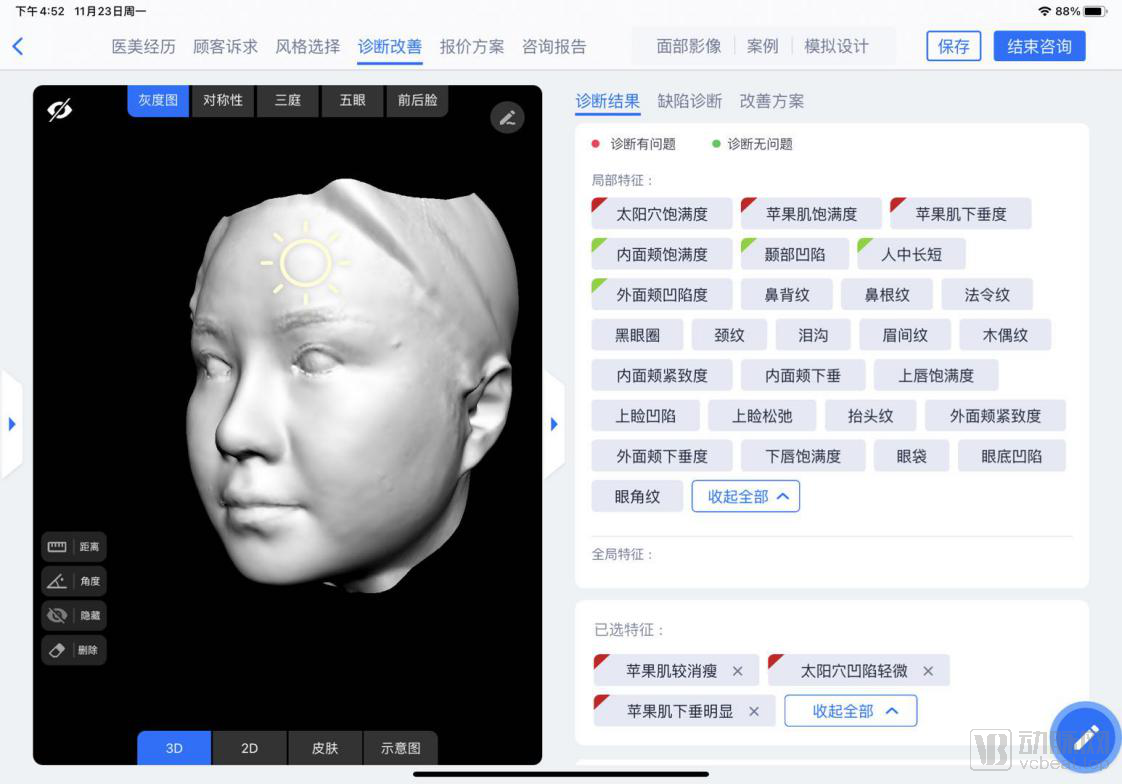
Comprehensive Anti-Aging Defect Analysis Helps Drive Upselling
During the medical plan design phase, consultants can use the simulation design module in the APP to collaboratively discuss with doctors and customers based on the services that the institution and doctors can provide and the customer's own needs, obtain a simulated postoperative effect, and form the final medical plan.
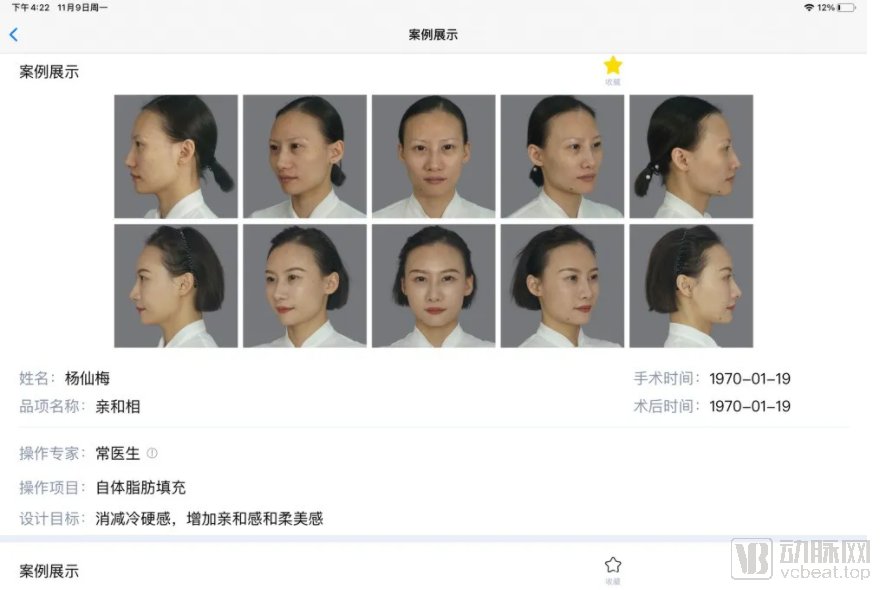
Upon completion of the consultation and design phase, the system generates a data analytics report containing personalized recommendations, which documents the customer’s needs, tags, treatment plan design, and treatment progress.
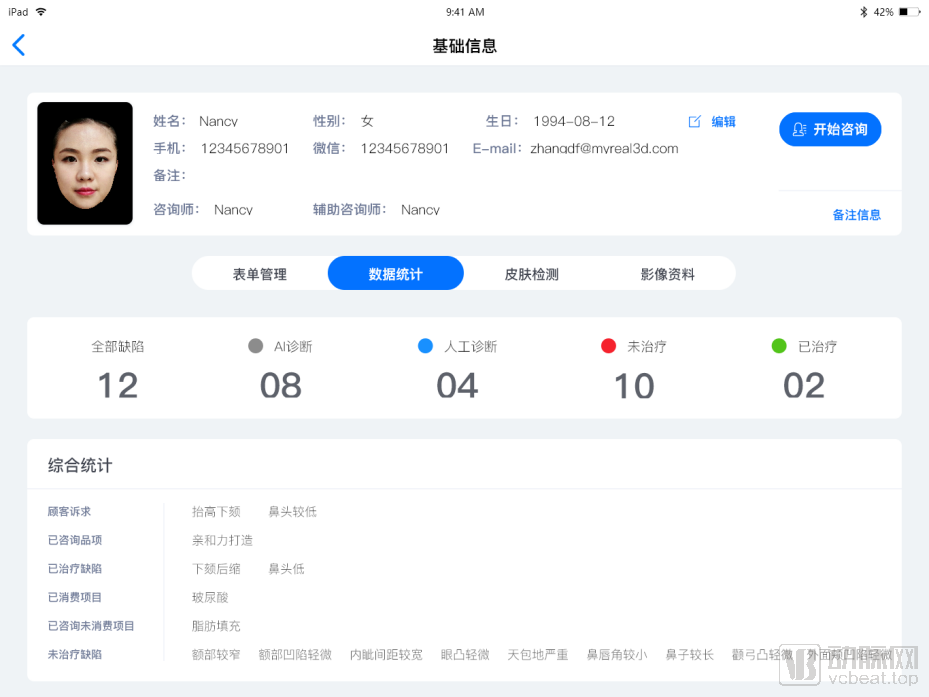
Customer Basic Information in the Report
The generated reports can be used not only internally by the institution but also provided to clients in electronic document format. Through these reports, institutions can summarize their consultation experience and identify areas for improvement. Meanwhile, customers can use the reports to independently compare different treatment options. Typically, the cycle from initial aesthetic medicine consultation to final decision-making is quite lengthy; however, with the aid of these reports, customers can refer to the personalized recommendations at any time and place, thereby accelerating their decision-making process.
High marketing costs and low customer conversion rates have long plagued the medical aesthetics industry. To address this, the management backend of the Meiji Consulting Assistant enables customer segmentation through tagging, facilitating refined operations to achieve higher traffic value at lower marketing costs.
The Meiji Consulting Assistant can rapidly digitize the existing service offerings of medical aesthetics institutions. Meanwhile, all consultation data can be intelligently analyzed to enable precise customer management based on assigned tags, while also uncovering customers’ latent needs.
Furthermore, the management backend can integrate an institution’s service standards, workflows, and various resources to establish a digital operational system. Institution managers can leverage data retrospection to analyze past operational experiences and current development status, thereby optimizing institutional management strategies.
It is reported that Shadow Intelligence’s first-generation 3D surgical simulation design software has been deployed in over 300 medical aesthetic institutions, while its Meiji Consulting Assistant, launched in April this year, has already been integrated into the SaaS platforms of more than ten institutions. It is revealed that by combining aesthetic principles with 3D design products, one institution managed to reduce its customer complaint rate from 20% to less than 5%, while simultaneously achieving continuous growth in both new customer conversion rates and existing customer repurchase rates.
Continuously standardize consultation processes and enhance product intelligence.
Moving forward, Shadow Intelligence will continue to integrate comprehensive industry knowledge, establish standardized consulting processes, refine consultants’ workflows, and develop standard operating procedures (SOPs) for on-site consultations.
In terms of product intelligence, Shadow Intelligence will continue to increase its R&D efforts to achieve intelligent design of medical aesthetic solutions. Currently, the Meiji Consultation Assistant is positioned as an auxiliary consultation tool for consultants, with medical aesthetic institutions as the purchasers. However, as the product’s level of intelligence deepens, consumers will be able to directly input their own requirement keywords into the system to automatically generate design proposals. Through this capability, Shadow Intelligence can provide technical support to consumer-facing traffic platforms.
Recently, Shadow Intelligence and Yahua Medical Aesthetics held a signing ceremony to establish a community of shared interests for co-building China’s diversified medical aesthetics ecosystem, and joined the National Medical Aesthetics Education Resource Sharing Alliance. This collaboration will not only enable Shadow Intelligence to access more resources within China’s diversified medical aesthetics ecosystem but also allow it to introduce digital consultation services and temperament-based aesthetic concepts into the education sector, thereby supporting the training of high-quality consultants.
It is reported that Shadow Intelligence is currently conducting its Series A financing round, with a planned fundraising amount of RMB 20 million, primarily intended for market expansion of existing products and the expansion of its technical team.
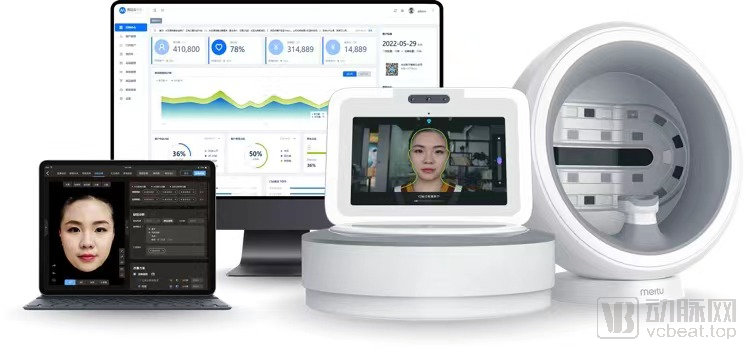
Meiji Consulting Assistant Full Product Series