

Pulse Medical Secures Nearly RMB 100 Million Series B Financing to Advance Platform Solutions for Structural Heart Disease

Sunland Fund
Professional Healthcare Investment Fund
VCBeat has learned that Guangdong Pulse Medical Technology Co., Ltd. (“Pulse Medical”), a company dedicated to the R&D and manufacturing of high-end medical devices for structural heart disease, recently announced the completion of its Series B financing round, raising nearly RMB 100 million. The round was led by Sunland Capital, a renowned investment firm in the healthcare sector, with participation from Weilai Capital and China Merchants Zhiyuan (a wholly-owned subsidiary of China Merchants Securities). Existing shareholder Zhuhai Gangwan Kerui also continued its investment. Bairong Capital served as the exclusive financial advisor for this financing round.
This round of financing will be primarily used to build the sales system for the LEFTEAR left atrial appendage occluder, fund the research and development of new products such as biodegradable patent foramen ovale (PFO) occluders, mitral valve repair devices, and left ventricular volume reduction umbrellas, and improve production facilities.
Pulse Medical, established in 2014, specializes in the research and development of cardiovascular implantable medical devices. Adopting an in-depth “medical-engineering integration” R&D model, the company leverages its robust engineering technology R&D team to incorporate clinical experts’ evaluations and recommendations on existing similar products, as well as their profound understanding of patients’ specific needs. This approach significantly reduces both financial and time costs while enhancing research efficiency.
Pulse Medical focuses on four key product lines in the field of structural heart disease medical devices—occluders, valves, heart failure, and interventional devices—providing a platform-based solution for structural heart disease medical devices.
Ruan Chengmin, Founder and CEO of Pulse Medical, stated that the project-based “medical-engineering integration” R&D model is a distinctive feature of Pulse Medical’s research and development approach. By engaging in in-depth communications with clinicians who possess extensive practical experience, the company gains insights for optimizing and improving existing medical device products, thereby designing solutions that better meet the needs of Chinese patients and clinical practitioners. The “import substitution” of high-end medical devices in China is not merely “simple imitation,” but rather “optimized surpassing.” For Chinese improved products, the clinical case data of comparable foreign products serve essentially as preliminary clinical trials. Given the significant physiological differences between East Asians and Europeans/Americans, directly using products that have obtained regulatory approval based on clinical trials conducted on European and American populations poses substantial risks to East Asian patients in the field of implantable medical devices for structural heart disease. Ruan Chengmin emphasized that Pulse Medical is determined to develop high-end medical devices for structural heart disease that are best suited to the physiological characteristics of East Asians.
Regarding left atrial appendage (LAA) occluders, Pulse Medical employs a globally exclusive dual-body plug design. The company’s product discards the shortcomings of existing domestic and international counterparts while retaining their advantages, thereby meeting the needs of patients with diverse LAA anatomies. It avoids the impact of an external cover on the endothelialization process and subsequent ablation procedures, resulting in significant improvements in clinical applicability, safety, and efficacy. Furthermore, as the cross-sectional area of the delivery sheath for the LEFTEAR LAA occluder is only 51% of that of imported products, the diameter of the accompanying delivery sheath required is merely 10F (compared to 14F for similar foreign products). This design substantially reduces vascular injury during surgery.
Pulse Medical’s LEFTEAR left atrial appendage occluder completed clinical trial enrollment of 200 cases by the end of 2019 at the cardiac centers of China’s top-tier Grade A tertiary hospitals, including Zhongshan Hospital Fudan University, Shanghai Tenth People’s Hospital Affiliated to Tongji University, Shanghai East Hospital Affiliated to Tongji University, Peking University First Hospital, The Second Affiliated Hospital Zhejiang University School of Medicine, Xiamen Cardiovascular Hospital Affiliated to Xiamen University, West China Hospital Sichuan University, The First Affiliated Hospital of Xi’an Jiaotong University, and Tianjin Medical University General Hospital. The company has currently submitted product registration materials to the National Medical Products Administration (NMPA). Such a “prestigious lineup” is rare for a product not yet commercially launched. Endorsement from these leading hospitals will help accelerate sales volume growth following the product’s market launch.
The company’s LEFTEAR Left Atrial Appendage Occluder was selected as one of the “Six Outstanding Original Chinese Studies” in cardiovascular medical devices at the 2020 China Interventional Therapeutics (CIT-2020) conference and was recommended for presentation at the 2020 EuroPCR conference. At EuroPCR 2020 in June 2020, the R&D team from Pulse Medical Technology presented the clinical trial results of the LEFTEAR Left Atrial Appendage Occluder, receiving high acclaim from conference experts. Highlighting “Made in China,” this achievement received in-depth coverage on the “Xuexi Qiangguo” learning platform under the Publicity Department of the Communist Party of China Central Committee.
Academician Ge Junbo stated, “The LEFTEAR occluder has been improved upon existing devices, with its hooks and wedge-shaped design being more patient-friendly for the Chinese population.” Professor Huo Yong from Peking University First Hospital commented, “LEFTEAR is a highly distinctive device with excellent adaptability to different patients. The successful implantation rate of LEFTEAR exceeded 98% in the study, indicating that this is a highly mature technology and device.”
According to the "Report on Cardiovascular Diseases in China," there are currently approximately 13 million patients with atrial fibrillation (AF) in China. Atrial fibrillation leads to three major consequences: first, disruption of heart rhythm; second, formation of thrombi; and third, development of heart failure. Among these, AF-related thrombosis poses four major hazards to patients: first, triggering stroke (cerebral infarction); second, causing acute myocardial infarction; third, leading to lower extremity gangrene; and fourth, inducing renal failure.
Atrial fibrillation (AF) patients are categorized into those with valvular AF and those with non-valvular AF. Patients with valvular AF account for approximately 35% of the total AF population (about 4.5 million), with over 60% of their thrombi originating from the left atrial appendage. Patients with non-valvular AF constitute roughly 65% of the total AF population (about 8.5 million), with more than 95% of their thrombi arising from the left atrial appendage.
Left Atrial Appendage Closure (LAAC) is a groundbreaking new technology that serves as an alternative to anticoagulant therapy for managing thromboembolism in atrial fibrillation. It is currently primarily used to prevent stroke and other thromboembolic events in patients with non-valvular atrial fibrillation (NVAF). Thromboembolism associated with atrial fibrillation poses a significant threat to human health. Since 1954, warfarin has been the standard anticoagulant used to manage this condition. Warfarin was originally identified in 1948 by American chemists as a highly toxic rodenticide derived from coumarin derivatives; rodents consuming it die rapidly due to internal hemorrhage, and warfarin remains a key ingredient in rodenticides today. Long-term use of warfarin in patients with atrial fibrillation presents challenges in precise dose management, increasing the risk of bleeding complications. Therefore, there is a critical need for novel alternative therapies. In March 2014, the Watchman Left Atrial Appendage Closure device, developed by Boston Scientific, received registration approval from the China Food and Drug Administration (CFDA), ushering in a new era in the treatment of thromboembolism in Chinese patients with non-valvular atrial fibrillation using left atrial appendage closure devices.
With the publication of long-term follow-up results from the PROTECT-AF and PREVAIL randomized controlled trials, as well as multiple registry studies, the efficacy and safety of left atrial appendage closure (LAAC) for stroke prevention in atrial fibrillation have been confirmed. Consequently, LAAC is recommended by major international guidelines in China, the United States, and Europe for the prevention of stroke in patients with non-valvular atrial fibrillation.
China's left atrial appendage occluder market started late but has developed rapidly, with the growth rate of surgical volume exceeding in each of the past three years100%, with the potential to replicate percutaneous coronary intervention (PCI)PCI) in patients with coronary heart disease10%penetration rate, the potential market size for left atrial appendage closure devices in China is estimated to be in the tens of billions.2019exceeding in China this year80%market is dominated by imported products from Boston ScientificWatchmanDomestic products still have significant room for substitution. However, the promotion of other currently available domestic products is somewhat hindered by structural design flaws.
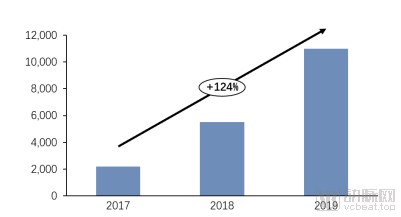
2017–2019 Volume of Left Atrial Appendage Closure Procedures in China
Other Company Product Introductions
The company’s independently developed bioresorbable Patent Foramen Ovale (PFO) occluder employs a unique braiding technique that significantly enhances device apposition, facilitates endothelialization, and fully degrades into water and carbon dioxide after implantation, thereby avoiding interference with subsequent cardiac interventional procedures.
According to the "Chinese Expert Consensus on Prophylactic Closure of Patent Foramen Ovale," the prevalence of PFO in adults is approximately 25%, with an estimated annual patient volume for PFO closure procedures approaching ten million, indicating a potential market size at the hundred-billion-yuan level. Numerous clinical studies have found that individuals with a patent foramen ovale face a significantly higher risk of stroke, migraine, arterial embolism, and decompression sickness compared to the general population. Currently, countries in Europe and the United States have incorporated PFO closure into their treatment guidelines as a preventive strategy for stroke patients. In China, an expert consensus on PFO closure has already been established, and it is expected to be included in treatment guideline recommendations in the near term. However, only one imported and one domestically produced non-biodegradable PFO occluder have currently received approval in China, with no biodegradable products yet available on the market. The company’s biodegradable product is about to enter the clinical trial phase, placing its development progress among the leading tier of similar domestic products.
The heart failure market represents a highly attractive, yet underdeveloped, opportunity within the field of structural heart disease, characterized by a large patient population and clear health economic significance. Nearly all cardiovascular diseases can progress to heart failure. According to the latest survey results published by Academician Gao Runlin and colleagues from Fuwai Hospital, there are over 13 million heart failure patients among residents aged 35 and above in China. Currently, heart failure patients in China are hospitalized an average of 2.4 times per year, with an average annual length of stay of 22 days. The average annual medical cost per patient is nearly RMB 29,000. Despite intensive treatment with existing heart failure medications and devices, the five-year mortality rate for patients with all types of heart failure remains as high as 30–70%.
The Pulse Medical team was deeply involved in the clinical trials of CardioKinetix Inc.’s Parachute device in China. CardioKinetix is a pioneering U.S. medical device company specializing in catheter-based treatments for heart failure. While fully incorporating the design philosophy and product advantages of the Parachute device, and integrating feedback from clinical experts as well as the actual needs of domestic patients, the company developed C-reducer, the world’s first volume-reduction umbrella featuring a “breaststroke-like + barbed” design. This innovation maximizes the prevention of “paravalvular leakage,” minimizes myocardial injury, and significantly reduces the incidence of strut fractures. Currently, no similar products have been approved in China. Based on the existing population of millions of patients with ventricular aneurysms in the country, the potential market size for volume-reduction umbrellas in China is estimated to reach tens of billions of RMB.
The valve market is also a key strategic focus for the company. Currently, China has approximately 250 million people aged 60 and above. According to the "Report on Cardiovascular Health in China," the prevalence of valvular heart disease in this age group is conservatively estimated at 2.05%, with some reports suggesting that the incidence rate exceeds 10%. Patients with valvular heart disease are often unable to undergo open-heart surgery due to factors such as impaired cardiac function, multiple comorbidities, and advanced age. Leveraging its design expertise in occluder devices, Pulse Medical has creatively developed mitral and tricuspid valve repair products that are better suited to the anatomical structure of Chinese patients and facilitate easier positioning and operation by clinicians. This achievement resulted from years of iteration and refinement based on structural and functional requirements proposed by clinical physicians.
As the lead investor in this funding round, Dr. Liu Daozhi, Founding and Managing Partner of Sunland Capital, stated, “China has a large population of patients with structural heart disease. Various treatment modalities, represented by left atrial appendage closure (LAAC), have already accumulated substantial evidence-based medical data both domestically and internationally, with clear clinical demand. Relying on top-tier expert resources in the field of structural heart disease, Pulse Medical closely aligns its product line layout and innovative R&D with frontline feedback on product usage, addressing critical pain points in clinical practice. This approach holds promise for providing newer and superior solutions to patients with structural heart disease. As another strategic layout by Sunland Capital in the cardiovascular sector, we are optimistic about the founding team’s years of accumulated experience in this niche market, as well as the founder’s vision and commitment. Sunland will continue to leverage its industrial resources to support the company’s growth, enabling more patients to benefit from technological and product innovations.”
Zhao Yang, Partner at Weilai Capital, believes that the development of innovative medical technology in China has transitioned from simple imitation to a new stage characterized by original research and development and import substitution. The R&D model driven by “digitalization” and “medical-engineering integration” constitutes a unique advantage for Chinese medical innovation enterprises. It will serve as a critical means for these companies to achieve import substitution and overtake competitors on the bend, a trend that is particularly evident in innovative sectors such as structural heart disease. Among the high-level innovative enterprises we have long tracked and monitored, Pulse Medical stands out as a highly representative example. Through the structured application of clinical data and an R&D model based on “medical-engineering integration,” Pulse Medical has achieved excellent clinical outcomes across multiple product pipelines, including its left atrial appendage occluder. We believe that digital R&D enterprises represented by Pulse Medical will become an indispensable force in the global field of medical innovation. Weilai Capital is honored to participate in the development of such outstanding enterprises and remains committed to growing alongside the team.
Sunland Capital
Sunland Capital is a specialized fund focused on early-stage and growth-stage investments in the healthcare industry. It targets high-growth segments such as biopharmaceuticals, medical devices (including in vitro diagnostics and gene technologies, minimally invasive interventions, implantable devices, minimally invasive surgical instruments, and medical robots), and healthcare services. The firm has invested in more than 20 leading healthcare companies. Sunland Capital’s core team comprises founders of publicly listed healthcare companies, as well as professionals with expertise in financial and strategic investment. The team provides value-added services to portfolio companies across various dimensions, assisting them in integrating advanced international technologies and establishing global operational philosophies and standards, thereby supporting their continuous innovation and development.
Weilai Capital
Weilai Capital is a professional industrial fund dedicated to value discovery and post-investment empowerment in the innovative healthcare sector, focusing on the early-to-mid growth stages of enterprises. Its cornerstone investor is By-Health, a publicly listed company. Weilai Capital remains optimistic about emerging sectors derived from the “people, products, and places” framework and payment linkages in consumer healthcare, including new healthcare payment models, new pharmaceutical retail, innovative medical scenarios, and consumer-grade medical products. Furthermore, given the high technical barriers, clear logic for import substitution, significant growth potential, and promising exit pathways via the STAR Market, medical devices and innovative biotechnology are also key investment focuses for the firm. Weilai Capital’s portfolio covers multiple high-growth areas, such as high-value cardiovascular consumables, multi-omics applications in oncology, commercial health insurance, assisted reproductive technology, new pharmaceutical retail, and healthcare media. Its investment research team and management system comprise top-tier interdisciplinary talents from the fields of medicine, law, finance, accounting, and management. Leveraging abundant technical talent and supply chain resources, Weilai Capital continuously provides post-investment services and empowerment to its portfolio companies, helping them become leading enterprises in their respective niche sectors.
China Merchants Zhiyuan Capital
China Merchants Zhiyuan Capital was established in 2009. As a wholly-owned private equity fund subsidiary of China Merchants Securities, which is controlled by the large central state-owned enterprise China Merchants Group, it manages cumulative assets under management of nearly RMB 24 billion, ranking among the top securities firm-affiliated private equity players. China Merchants Zhiyuan Capital focuses on investing in leading enterprises within niche industries and has completed investments in over one hundred high-quality companies. Its core businesses include private equity fund management, industrial investment fund management, and mezzanine fund management. Currently, it has actively expanded into Pre-IPO funds, industrial M&A funds, growth funds, venture capital funds, mezzanine funds, and incubator fund-of-funds, boasting a comprehensive fund spectrum and broad industrial coverage. Leveraging years of industry experience, China Merchants Zhiyuan Capital has built multiple professional and efficient equity investment teams, possessing strong capabilities in industrial resource integration and capital market operations.
Bairong Capital
Bairong Capital is a research-driven financial advisory firm focused on the healthcare sector. It aims to help healthcare enterprises achieve rapid growth through extensive transaction experience and provide investment institutions with insights into valuable investment opportunities through rigorous, in-depth research. Bairong Capital’s areas of focus cover multiple healthcare sub-sectors, including healthcare services, medical devices and consumables, IVD and precision medicine, biopharmaceuticals, and healthcare informatics. The core team of Bairong Capital consists of professionals from top-tier consulting firms and renowned investment banks.