

The Booming Era of Medical Venture Capital in 2020
In light of the key events in healthcare venture capital in 2020 and the future development trends of healthcare VC, an industry panel discussion was held featuring Lai Zhigang, Partner at KaiXuan Venture Capital; Qian Tingzhi, Founding Partner at Jingxu Venture Capital; Yang Ruirong, Partner at YuanYi Capital; Zhu Yibo, Partner at Tonghe Yucheng Capital; Lei Youning, Chief Technology Officer of Tiankeya, representing healthcare enterprises; and Jiang Tianjiao, Dean of VCBeat Research Institute. The following is a partially edited transcript of the discussion.
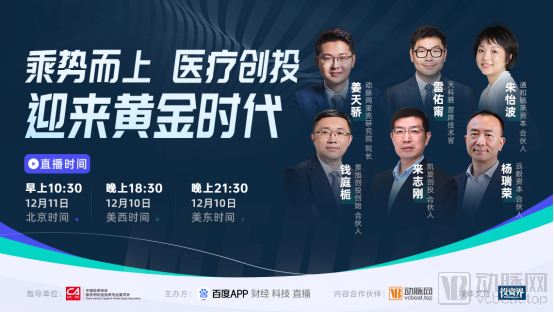
Jiang Tianjiao, Dean of VCBeat:The pandemic has been a major theme this year, particularly for the healthcare industry, bringing both significant opportunities and considerable challenges. What are your perspectives from both global and domestic viewpoints?
Zhu Yibo, Partner at Tonghe Yucheng:Throughout one’s life and career, it is rare to encounter an event with as profound an impact as the pandemic this year. In terms of challenges, the challenges faced in overseas markets are greater and have a more lasting impact. For instance, in the U.S. market, overall industry growth has slowed, with many hospitals closing or laying off staff; even for acute conditions such as stroke, there has been a significant decline in both treatment and surgical volumes.
Many healthcare companies are significantly influenced by hospitals in areas such as clinical trial implementation and product sales. Companies that have already entered the commercialization stage are clearly experiencing declines in revenue and profits, leading to a more pronounced need for capital. However, from the perspective of capital supply, the overall pace of financing is slowing down, and investors are becoming more cautious.
Meanwhile, there are other external factors beyond the pandemic, such as the U.S. presidential election. The world is currently experiencing a trend of “deglobalization,” a process that has been accelerated by the pandemic.Changes in the political environment and trade policies have, to some extent, hindered investment and business cooperation between Chinese and overseas enterprises.
The impact of the pandemic in China lasted for approximately one to two quarters. During this period, many enterprises experienced delays, but the market quickly rebounded in the second half of the year and remained robust.
This process will generate new investment opportunities, particularly in products related to the pandemic, such as testing and assay kits, antiviral therapies, and COVID-19 vaccines. It also includes medical devices and consumables, such as personal protective equipment (PPE), ventilators, ECMO systems, and other life-support devices, as well as imaging products capable of early diagnosis of COVID-19 complications.
Finally, the outbreak of the pandemic has spurred unprecedented public attention to the healthcare market. Coupled with a highly vibrant capital market during the same period, this trend presents more opportunities for enterprises while posing greater challenges for investors.Instead, under the impact of the global pandemic, many European and American enterprises have brought about some good investment opportunities due to their funding needs.The ebb and flow of changes across these markets is another dynamic we observed during the pandemic.
Lai Zhigang, Partner at Kaixuan Ventures:Products related to the pandemic are experiencing a boom year, with sales surging dramatically. In contrast, unrelated products have been adversely affected to some extent; in China, hospital outpatient visits and surgical procedures have plummeted, significantly impacting the sales volume of certain medical products.
Meanwhile, acting as a catalyst, the pandemic has driven more than a tenfold increase in both user registration and engagement in internet healthcare. This has also spurred significant changes in the national promotion and reimbursement of online medical services under the basic medical insurance scheme. Although full implementation remains a work in progress, there has been substantial policy advancement.
Furthermore, regarding mRNA vaccines, the vaccines from Moderna and BioNTech have garnered significant attention. However, from another perspective, these two companies have not had a single mRNA-based new drug approved in the past decade.The pandemic has provided a platform for technology to showcase its capabilities,The vaccination of tens of thousands of people has provided substantial validation in terms of both safety and efficacy,This is a prime example of the pandemic catalyzing technological innovation.
As for international engagement, the country was among the first to release the full genetic sequence of the virus in January, and shared its domestic epidemic control model with other nations. Without international cooperation—such as conducting clinical trials in the Middle East and South America—it would have been exceedingly difficult to independently develop our own vaccines.
Therefore, the pandemic this year has presented both challenges and opportunities for everyone.Everyone faces these challenges during the pandemic, but only those who are well-prepared can seize the opportunities.
Jiang Tianjiao, Dean of VCBeat Eggshell Research Institute:"The pandemic has brought significant opportunities for the digital transformation of healthcare. Which companies are more likely to stand out?"
Yang Ruirong, Partner at Yuan Yi Capital:From observations in recent years, this year can be defined as the inaugural year of digital healthcare. The SARS outbreak in 2003 spurred the development of many industries in China, including e-commerce and online payment. I believe that,The Biggest Opportunity Spawned by the COVID-19 Pandemic Lies in Digital Health.
In the short term, people’s lifestyles and healthcare-seeking behaviors have changed. In the long term, there is a significant gap between China’s leading basic technologies and its lagging healthcare system.
China’s internet and mobile internet technologies, as well as AI and 3D printing applications in the healthcare sector, are already at the forefront. However, overall medical infrastructure still requires significant improvement. The primary care system and tiered diagnosis and treatment model continue to exhibit a pronounced “inverted triangle” structure, and the payment system remains stuck in a single-payer stage.
But precisely because of this, it harbors tremendous opportunities for leapfrog development. The trajectory of China’s mobile payment industry serves as a prime example, and the healthcare sector presents similar opportunities.
Therefore, structural opportunities exist across various dimensions, including patient engagement, novel payment models, and efficiency-enhancing initiatives. These opportunities may not necessarily translate into significant short-term growth but are more likely to drive transformative changes over the next 5–10 years.
Jiang Tianjiao, Dean of VCBeat Eggshell Institute:"Amid the impact of this epidemic, which changes will have a lasting effect on the future, and which are merely fleeting opportunities?"
Qian Tingzhi, Founding Partner of Jingxu Venture Capital:In the short term, the market’s overall valuation system has experienced significant volatility, swinging from extreme cold in the first half of the year to extreme heat in the second half.Although the healthcare sector is considered counter-cyclical, it still exhibits its own cyclical patterns. Over a longer time horizon, certain segments of the primary market are currently at relatively high valuations, including new drug R&D areas with highly redundant targets, as well as certain high-value consumables and medical device sectors. These areas will require additional time to digest these valuations.
From a long-term perspective, the shift in consumer habits will have lasting effects. We are closely watching whether the pandemic will spur the emergence of giants in internet healthcare, health insurance, and payment services, and whether a viable commercial cycle can be established.
In addition, there are some sustained opportunities, and we will also monitor the potential for accelerated adoption of new technologies. Several areas in the pharmaceutical sector have garnered significant attention this year, such as mRNA, novel recombinant vaccines, and CRISPR-based diagnostic reagents. Without the impetus of public health emergencies, promoting these innovations within existing markets would not be cost-effective; however, due to the outbreak of the pandemic,Whether in pharmaceuticals or diagnostics, the focus is on efficacy rather than cost-effectiveness. This allows certain new technologies to rapidly mature through such practical validation, representing a significant shift in investment philosophy.
Jiang Tianjiao, Dean of VCBeat Research Institute:From a corporate perspective, perceptions of the pandemic may vary; for instance, how might business operations change amid processes of globalization or de-globalization?
Tiankeya Chief Technology Officer Lei Youning:The most significant trend is “internal circulation.” The previous model of globalization may become increasingly complex and ambiguous, encompassing the movement of business operations and talent—for instance, companies with headquarters in the United States but clinical trial or manufacturing centers in China.
From a corporate perspective, our one-stop, end-to-end model—covering R&D, manufacturing, and clinical applications locally—is more conducive to achieving breakthrough progress.
Furthermore, it depends on the markets the company intends to enter, as well as the locations where its subsidiaries are established and personnel are deployed. Therefore, from our perspective, the optimal strategy is to establish R&D centers and manufacturing bases in both China and the United States, with each location capable of conducting clinical trials independently. This approach most effectively mitigates various risks. This represents the most significant shift we have observed: moving away from the previous model of segmented development toward a greater emphasis on internal circulation.
Jiang Tianjiao, Dean of VCBeat Research Institute:Many important policies have been introduced in the healthcare sector this year. Which policy has left the deepest impression on you, and what impact will it have on specific sub-sectors?
Lai Zhigang, Partner at Triumph Venture Capital:The healthcare industry is subject to stringent legal and regulatory oversight, and policy changes exert a significant impact on the sector.
Internationally, policy changes—whether already implemented or potential—driven by shifts in Sino-U.S. relations warrant close attention, particularly in the field of biopharmaceutical technology, which is a highly sensitive area for both sides. Therefore, from both investment and entrepreneurial perspectives, especiallyCompanies seeking a bilateral presence in China and the United States need to plan ahead; it is essential to strategically structure their intellectual property and R&D operations within the framework of applicable laws and regulations.
In China,In the short term, impacted by the pandemic, the state will strengthen the construction of emergency response systems and deepen the deployment of preventive systems at the grassroots level.These efforts are clearly perceptible during the 14th Five-Year Plan period. For instance, there remains a substantial gap between China and the United States in the number of ICU beds per 100,000 population, and the Chinese government will undoubtedly continue to make robust investments and strengthen infrastructure development in this area.
From a medium- to long-term perspective, the two policies that have impressed me most this year are centralized volume-based procurement and DRG (Diagnosis-Related Groups).. The primary logic underlying these two initiatives is cost containment, which also represents a key long-term policy direction at the national level.
The price reductions achieved in the latest centralized procurement of high-value medical consumables have exceeded the expectations of many industry insiders. From a cost-containment perspective, the benefits are evident; however, several aspects warrant further consideration. For instance, the broader impact of aggressive price cuts on the overall healthcare ecosystem remains to be seen. Additionally, it is necessary to evaluate whether policy implementation will further affect the allocation of medical resources and human resources, including physicians and nursing staff. Similar concerns apply to Diagnosis-Related Groups (DRG): there is a risk that the focus may shift from overtreatment to compromising treatment quality in an effort to control costs. These issues require careful reflection.
Zhu Yibo, Partner at Tonghe Yucheng:While reviewing medical devices, I have also been observing the policy changes that have occurred in the pharmaceutical sector.Although there are fundamental industry differences between medical devices and pharmaceuticals, the rationale behind policy implementation, including the impact of such policies on enterprises, offers certain reference value.
Over the past 5–10 years, amid the broader context of healthcare cost containment, the Chinese government has progressively introduced a comprehensive suite of policies. These initiatives began with consistency evaluations for pharmaceuticals; once generic drugs met the required standards, the “4+7” volume-based procurement program was implemented. This approach aims to further control the winning bid prices for individual drug products, even in markets with multiple competing alternatives, thereby reducing overall healthcare expenditures.
Meanwhile, rather than simply suppressing prices through cost containment, the state has introduced numerous policies to encourage innovation. For instance, a green channel for drug review and approval has been established; overseas products that are scarce or feature cutting-edge technology, and for which there are no clearly defined treatment regimens domestically, can enter the Chinese market through this expedited review pathway.
Therefore, in the medical device sector, I believe that similar supporting policies will continue to be introduced from the policy side in the future,Prices of highly competitive products are declining, while innovation-driven products are accelerating their development.This will certainly also be a key consideration in my future evaluation of medical device projects.
Jiang Tianjiao, Dean of VCBeat Eggshell Research Institute:Which types of enterprises stand to benefit the most from the opportunities created by these policies?
Qian Tingzhi, Partner at Jingxu Venture Capital:Innovation in the medical field falls into two categories: disruptive innovation and incremental innovation. Policies are more supportive of products and companies driven by disruptive innovation. The efficacy of such products is overwhelmingly superior; if such a drug were available, patients would be willing to use it even at their own expense. These products and technologies attract greater market attention and have better opportunities for securing financing.
Products and companies pursuing incremental innovation face considerable pressure.For companies pursuing incremental innovation, investors place greater emphasis on the corporate system and product portfolio.A company with a relatively rich product portfolio is undoubtedly more attractive than one with only a single product line.
Of course, for such enterprises, we must also consider the speed of regulatory approval and their pricing strategy. Companies that struggle to raise capital in the capital markets or are unwilling to make more aggressive pricing challenges may have limited future opportunities.
Yang Ruirong, Partner at Yuanyi Capital: When we analyze policies, we examine the rationale behind their introduction and the resulting impact. The reason for implementing volume-based procurement (VBP) is straightforward: the social security fund is facing financial strain, with its surplus declining year after year, necessitating the elimination of inflated costs. Therefore, while some argue that the sharp price reductions brought about by centralized procurement are excessive, I believe this trend will instead intensify.
Examining the impact of these policies, the first wave drives market consolidation among enterprises, further accelerating the growth of high-performing companies and encouraging innovation. Generic drugs and conventional medical devices will gradually be phased out of the market.
The more profound impact is the redistribution of interests across the entire healthcare landscape.Price reductions will trigger profound transformations in existing distribution channels, prompting pharmaceutical and medical device manufacturers to identify more efficient methods for reaching patients. Furthermore, ensuring the interests of physicians and hospitals under the new pricing framework remains a significant challenge.
The opportunities lie in two key areas: first, how to enhance the value of medical services within the existing framework of low drug and device prices by leveraging new technologies to assist physicians in patient management and demonstrate the value of their services; second, how to utilize advanced technologies to help pharmaceutical and medical device companies better reach patients and physicians.
It is also necessary to establish a multi-tiered payment system. The original payment system was based on social security reimbursement, primarily covering urban employee basic medical insurance and urban and rural resident basic medical insurance."Can we create a new type of commercial insurance that allows people to access better products at relatively reasonable prices? This could give rise to new services and a new market for payment solutions."
Finally, it is worth noting that under the broader landscape of centralized volume-based procurement, in addition to developing new products and expanding product portfolios, medical companies must also address how to market their products once they are launched. In the United States, medical device and pharmaceutical manufacturers need to engage with insurance payers early in the R&D process. While the U.S. model may not be universally applicable, it can offer domestic startups a forward-looking perspective for strategic planning.
Jiang Tianjiao, Dean of VCBeat Eggshell Research Institute:Bubbles exist to varying degrees across many sectors. How should we view the bubble in the investment market of the healthcare industry? From the corporate perspective, how can companies achieve differentiation?
Tiankeya CTO Lei Youning:Bubbles can be observed across all industries, but they are particularly prevalent in the medical sector, especially within the field of new drug development. The most typical example is PD-1. After the first PD-1 inhibitor was approved abroad, approximately twenty companies in China initiated their own PD-1 research and development programs. In such a landscape, if we blindly pursue “me-too” drug development, which products will truly succeed in reaching the market? And once launched, how steep will the price discounts be? These are questions worthy of further discussion.
How to achieve differentiation is, in fact, the biggest challenge facing the industry when it comes to breakthrough innovations.National policies are also promoting innovation, but not “me-too” or “me-better” innovations; rather, the aim is to drive fundamentally groundbreaking innovation that targets markets that have yet to be truly conquered.
Jiang Tianjiao, Dean of VCBeat Institute:Many TMT investors are shifting their focus to the healthcare sector, even employing the “fast-paced” TMT strategy to drive up valuations and compete for deals. Will this bubble persist or even expand? Could structural divergence emerge in the future?
Zhu Yibo, Partner at Tonghe Yucheng:The phenomenon of intense competition was particularly evident in the market during the second half of this year. From the perspective of capital supply, the dividends from the secondary market have spilled over into the primary market, attracting significant capital inflows. These include government guidance funds and corporate venture capital (CVC), as well as funds seeking short-term profits.
On the capital demand side, several categories of projects have been particularly sought after over the past six months. One category comprises Pre-IPO projects, which offer a clear exit path within a short period after investment. The other includes projects branded as “innovative.” Within this group, some are genuinely engaged in innovation, while others are merely leveraging the current window of abundant capital supply by slapping on an “innovation” label to secure higher valuations.
In the long term,Bubbles Will Exacerbate Polarization, companies that merely pursue financing with an IPO as the end goal, or those that demand premium valuations simply by slapping on an "innovation" label, theseBubbles subside when the broader capital market undergoes a correction.We have observed certain changes in the secondary market, such as newly listed companies quickly falling below their IPO prices, and a trend of slowing approval processes for the STAR Market compared to a few months ago.
Conversely, these categories of projects will emerge: First,Truly pursue innovation projects with a down-to-earth approach.
Second, under the policy environment,In the long run, centralized procurement will facilitate industry consolidation toward leading enterprises.Certainly, this has also brought many challenges to the teams of leading enterprises. Founders can no longer rely solely on a scientist’s or engineer’s perspective; they must possess broader strategic thinking and a wider vision, while also knowing how to better leverage capital to accelerate growth.
The last category of enterprises may beLeveraging capital to consolidate single-product companies or relatively small enterprises in the market,If you cannot find a sufficiently capable team, build one yourself. Integrate existing resources by assembling the right players, and allocate and optimize them accordingly.
Yang Ruirong, Partner at Yuan Yi Capital:From a purely medical perspective, the industry is growing very rapidly, and bubbles undoubtedly exist. However, when viewed within the broader investment landscape—spanning online education, TMT, consumer sectors, and this year’s hottest semiconductor industry—the bubble in healthcare appears less severe by comparison.
Historically, overall investment in the healthcare sector was limited, valuations were low, and exit opportunities were relatively scarce. Amidst the pandemic and economic instability, healthcare has consistently been regarded as a safe haven. The healthcare sector is relatively resilient to economic cycles; while it does exhibit its own cyclical patterns, these tend to be milder, with comparatively lower volatility.
On this basis, with increased upfront investment, a surge in entrepreneurs, and more exit channels in the capital market, an exit pathway has been opened for both healthcare companies and healthcare investments. Inevitably, various types of enterprises will be mixed in, butFrom a broader perspective, the drive of capital has brought about an overall increase in social value; it is precisely these bubbles that allow us to savor the pure beer beneath.
Jiang Tianjiao, Dean of VCBeat Eggshell Research Institute:We often speak of long-termism. Given the inherent characteristics of the healthcare industry, time indeed plays a crucial role. From a long-term perspective, which companies are poised to create greater value?
Lai Zhigang, Partner at Kaixuan Venture Capital:In healthcare investment, becoming “friends with time” is an imperative choice. This is particularly true for early-stage investors, given the protracted timeline spanning product development, regulatory registration, and market launch for innovative therapies. Such a landscape demands deeper professional expertise and investment experience to identify targets worthy of long-term partnership.
The healthcare industry is a trillion-dollar market, and successful, scalable startups will emerge in every niche segment. As investors, we should adhere to fundamental principles amidst constant change, focusing primarily on the products a company develops, its innovations and technologies, whether the team maintains a balance between technical and commercial capabilities, and whether the addressable market for the product’s indications is sufficiently large. These are the key dimensions for evaluating investment opportunities.
If we add a little, it would beWe have a slight preference for teams with a global and international perspective., as domestic healthcare startups are increasingly demonstrating international competitiveness in their products and technologies. Previously, the core strategy of biopharmaceutical companies was license-in—acquiring promising overseas pipelines and leveraging them as their key value proposition for commercialization and promotion in China.Over the past two to three years, we have witnessed a growing number of innovative Chinese pharmaceutical companies successfully licensing out their assets, a highly encouraging trend.
Jiang Tianjiao, Dean of VCBeat Eggshell Research Institute:From the corporate perspective, how can companies persist in creating long-term value while also accounting for the pace of competition?
Tiankeya CTO Lei Youning:Adherence to long-term value is essential. In terms of short-term competition, domestic policies and regulations can help accelerate corporate development, particularly in the field of cell therapy, where most clinical trials are conducted within China. Policy frameworks such as the dual-track approval system can expedite the process from research and development to commercialization.
Therefore, from our own perspective, particularly within the cell therapy industry in which we operate, long-term value and short-term competition can be balanced. Our pace of progress appears astonishing to many large pharmaceutical companies abroad. Furthermore, as long as a company can identify suitable targets, indications, and appropriate markets, the amplification of future commercial value is to be expected.
Jiang, Dean of VCBeat Eggshell Research InstituteTianjiao:Over the years, the market capitalization structure of listed companies has undergone significant changes, and leadership in the healthcare market has been constantly shifting. From a ten-year forward-looking perspective, where lie the greater opportunities?
Qian Tingzhi, Partner at Jingxu Venture Capital:Early-stage investment places significant emphasis on the founder and team, especially given that the healthcare industry inherently involves long-term endeavors.Over the next decade, we must first analyze the age structure of these founders.
We can observe that the founders of medical companies that have already gone public or are in the process of doing so are predominantly from the generations born in the 1960s and 1970s, or even the 1950s, particularly those engaged in new drug development. The age demographic of founders in the medical device sector is slightly younger, generally ranging from those born in the 1960s to the 1980s. Companies founded by individuals born after the 1980s are rare, with the exception of artificial intelligence enterprises, which are primarily led by this younger cohort.
For the past two decades, our investment focus on international vision and domestic production capabilities has essentially capitalized on the dividends from multinational corporations and overseas returnees. As this wave of dividends subsides, where will the next wave emerge, and where will future entrepreneurs be found?
In the future, international exchanges will become increasingly frequent, and R&D professionals will be able to receive high-quality education at many domestic enterprises and universities.The talent supply system has undergone significant changes compared to the past.Therefore, we will pay more attention toOnly by identifying promising talent from among China’s leading enterprises, innovative R&D institutions, and universities can advanced technologies and products be successfully commercialized.