Experts Weigh In on Opportunities and Challenges for Healthcare SaaS in the New Landscape
Currently, the healthcare IT industry can be viewed as a superposition of two states. On one hand, supported by policies and practical demands, healthcare institutions are eager to pursue in-depth informatization reforms. On the other hand, the high costs and significant structural changes associated with reforming traditional models pose substantial obstacles to decision-making within these institutions.
In this context, new service models centered on the Software-as-a-Service (SaaS) model have begun to emerge in healthcare institutions. Under these circumstances, medical IT companies are no longer the sole players in the field of informatization. Internet giants such as Tencent and Alibaba, acting as providers of hospital cloud services, have also attempted to enter the market by offering cloud storage and technical middle-platform services to various healthcare institutions, ultimately establishing long-term relationships with them centered on SaaS offerings.
Today, SaaS services in niche sectors such as medical aesthetics, elderly care, and health management are gaining significant momentum. Under the SaaS model, healthcare institutions can benefit from more flexible management structures, more refined operational maintenance, and a richer suite of software capabilities, thereby substantially enhancing their operational efficiency.
To provide customers with an efficient, stable, and secure SaaS environment, a robust cloud service provider is essential behind the scenes, and Tencent stands out as a leader in this field.
Cloud computing is the infrastructure of the digital era. Tencent Cloud provides customers with globally leading technical products and services in cloud computing, big data, and artificial intelligence, building comprehensive industry solutions and a cloud service ecosystem to promote the development of the industrial internet and drive the digital transformation and upgrading of all industries.
Through Tencent Cloud, Tencent has fully integrated its foundational technological capabilities—including cloud computing, AI, security, audio and video technologies, and quantum computing—making these research achievements available to partners and providing leading digital technologies to traditional industries. Tencent Cloud currently offers more than 200 IaaS, PaaS, and SaaS products and over 90 industry-specific solutions. Its partner ecosystem has surpassed 6,000 members, spanning channels, services, consulting, R&D, and other domains. Its infrastructure covers 25 regions across five continents worldwide, operates 53 availability zones, achieves EB-scale data storage capacity, and deploys more than 1,300 acceleration nodes globally. Tencent has entered the “Double Hundred Era” in computing and networking, with its total number of servers exceeding one million and peak bandwidth surpassing 100 Tbps.
In terms of computing power, Tencent Cloud’s VStation computing operating system supports elastic scheduling for up to 100,000 instances within a single cluster and provides second-level flexible provisioning capabilities, built on a newly developed proprietary virtualization platform. In terms of storage capabilities, it introduces a 3-AZ (Availability Zone) high-availability architecture to achieve cross-data-center disaster recovery within the same city; it also features high QPS performance, increasing the request rate per storage bucket by 30 times, reaching up to 60,000 QPS. In terms of networking capabilities, cloud network products have been fully upgraded to support IPv6, enabling more than 30 of the top 100 internet applications to serve IPv6 users, with the deployment of next-generation high-performance networks. In terms of database capabilities, the self-developed cloud-native database CynosDB has officially entered commercial use, offering 100% compatibility with MySQL and PostgreSQL, with multiple research achievements from the team accepted by VLDB and SIGMOD.
In terms of IoT capabilities, the IoT Explorer development platform has been launched, enabling users to easily connect hundreds of millions of hardware devices. In the field of artificial intelligence (AI), a range of AI products are offered by leveraging technologies such as computer vision, intelligent speech, and natural language processing, along with two platform-level products: Cloud Intelligence Tianshu and Intelligent Conversation. Regarding cloud-native technologies, we have officially joined the global top tier, currently operating the largest container cluster among domestic cloud providers, while rapidly enhancing the performance of products such as microservices, serverless computing, and service mesh.
Today, Tencent is working with its partners to gradually build an open ecosystem for the industrial internet across three dimensions: digital technology supply, solution development, and enterprise growth. Through the Technology Open Alliance, we provide partners with technologies such as AI, 5G, blockchain, and cybersecurity to help them solidify their technological foundations. Via the Industry Open Alliance, we collaborate with over 8,000 partners to co-develop industry-specific solutions, resulting in more than 300 joint solutions that address practical challenges for industry clients. Additionally, we support partner growth and enhance their internal digital capabilities through corporate training and equity investments.
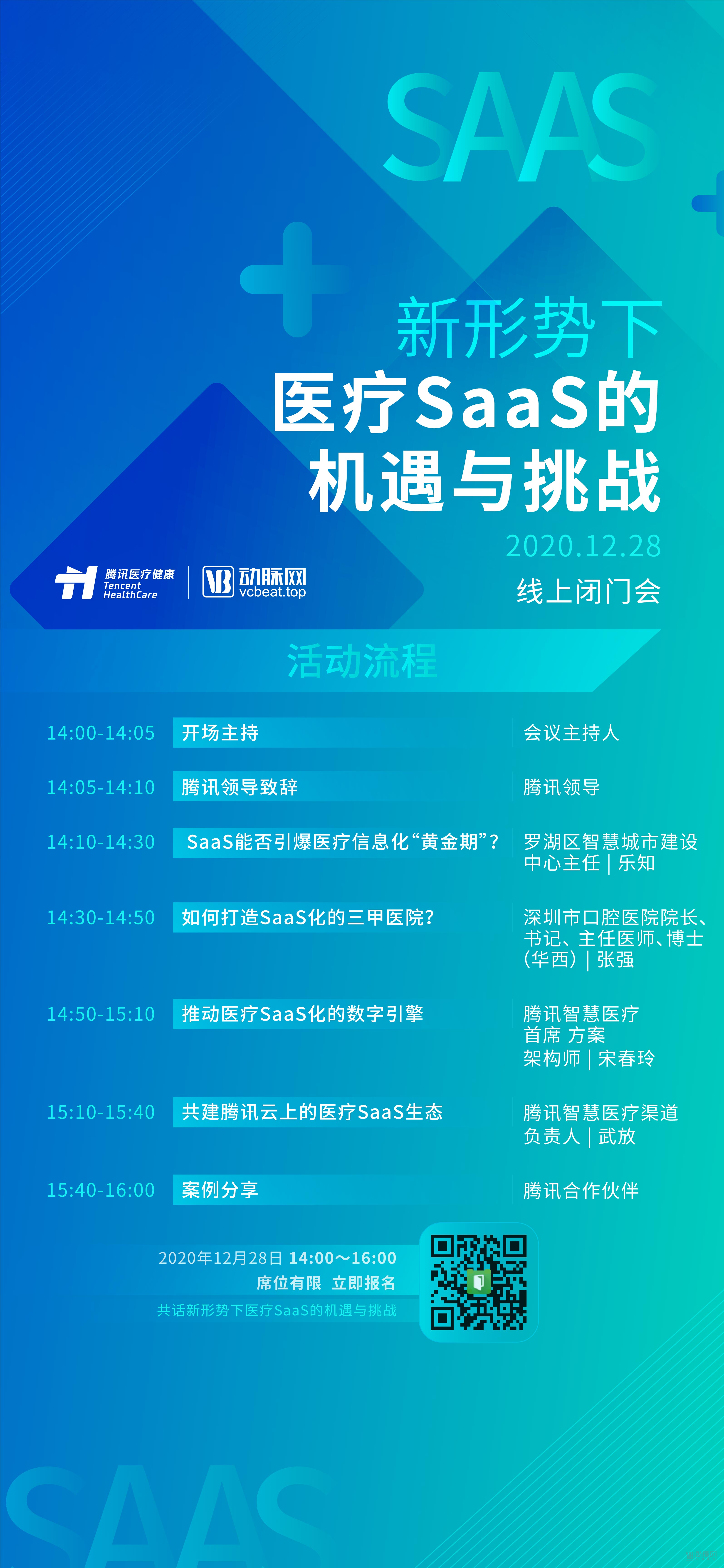
To help more doctors and practitioners understand and adopt SaaS, Tencent will host an online closed-door meeting on December 28, 2020, to explore the “Opportunities and Challenges for Medical SaaS in the New Landscape.” Multiple industry experts will attend the conference to share their insights. If you are interested in this event, please scan the QR code below to register.