

Verily: From Google Roots to a Healthcare Dream — IPO Filing Highlights Its Journey and Innovations

Temasek
Investment Company

Silver Lake Partners
Investment Company

Ontario Teachers' Pension Plan
Ontario Teachers' Pension Plan

Alphabet
Entity Control and Management Business
Amazon has entered the healthcare industry through its platform and products, with its smart speaker Echo serving as a home health tool; Apple has developed Apple ResearchKit to assist physicians in diagnosing various diseases; IBM has launched its artificial intelligence product Watson to improve the operational efficiency of healthcare institutions...
Tech Giants Enter the Healthcare Market: This Is No Longer a Novel Topic. As Dr. Topol of the Scripps Research Institute in the United States stated, “There is not a single tech company that isn’t involved; many view this as a field that balances saving lives with substantial business opportunities.”
Tech Companies Chase Their Healthcare Dreams: Life Sciences Firm Verily Is Part of This Dream-Chasing Cohort
On August 15, 2015, Google co-founder and CEO Larry Page posted a message on the official blog: Google would restructure and be renamed “Alphabet.”
On December 7 of the same year, Alphabet’s life sciences division (Google Life Sciences) officially adopted “Verily” as its new name.
The word “Verily” dates back to 12th-century English and is equivalent to the modern English words “truly” and “certainly,” conveying the meaning of truth. CEO Andy Conrad explained, “Only through truth can we defeat nature.” This name aligns with the mission stated on Verily’s official website: to reveal the truths of health and disease by integrating technology with life sciences.
Prior to this, the Life Sciences division was part of Google X, Alphabet’s research and development arm. Tracing its origins, the Life Sciences division initially emerged from the Google Diabetes Project. It was founded with the mission of leveraging technology to address diseases and health challenges affecting millions, including the prevention, detection, and management of conditions such as diabetes, cancer, and mental illness.
In 2013, Andy Conrad, a luminary in cell biology, joined Google X Lab, where he led a research team comprising over one hundred experts from fields such as physiology, biochemistry, optics, imaging, and molecular biology to conduct in-depth research in life sciences. Following the renaming of Life Sciences to Verily, Andy Conrad stated that Verily would primarily focus on areas within the life sciences sector, including medical software, high-tech devices, and clinical research.
Regardless of the name change, this department’s original commitment to leveraging technology to address diseases and health issues remains unchanged.
For Verily, a recent major milestone is securing $700 million in financing. This investment came not only from its parent company, Alphabet, but also from several existing investors, including Temasek Holdings, the Ontario Teachers’ Pension Plan (OTPP), and the private equity firm Silver Lake Partners. This marks Verily’s third round of funding since its inception. Reportedly, Verily will use these funds to further expand its commercial operations, including advancing the implementation of several life sciences projects in areas such as surgery, pathology, and immunology.
Backed by Alphabet’s strong pedigree and leveraging its own considerable growth potential, Verily has enjoyed a relatively smooth fundraising journey.
As early as 2017, Verily secured an exclusive $800 million investment from Temasek Holdings. Temasek stated that the funds would be used to enhance Verily’s prospects of entering the Asian healthcare market. According to data provided on Temasek’s official website, 23% of its investment portfolio was located in China at the time, making it the second-largest investment destination after Singapore.
Verily CEO Andrew Conrad stated that Temasek’s extensive network in Asia and its profound insights into the Asian economy would empower Verily to strengthen its expansion beyond the U.S. market.
That same year, Alphabet launched recruitment efforts in China, and the Google AI China Center was announced at the Shanghai Developer Conference. These moves were regarded as key milestones for Google’s basic research expansion into China. However, subsequent developments indicated that the related projects did not progress smoothly in the country.
In early 2019, Verily secured another $1 billion in financing led by Silver Lake. Representatives from Silver Lake stated that their decision to invest in Verily was driven by the company’s “unique capabilities”—namely, its world-class partnerships and bold vision. This capital injection from Silver Lake clearly demonstrates the firm’s confidence in Verily’s potential to address global healthcare challenges.
With three rounds of financing each exceeding $100 million and the steadfast support of its investors, Verily’s value and potential in the healthcare sector are self-evident.
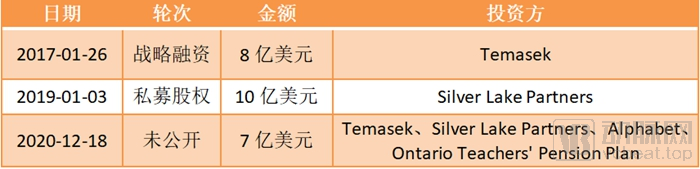
Verily’s Three Rounds of Financing History (Data Source: VCBeat)
With financial backing, Verily’s healthcare strategy has primarily centered on building its own care platforms and products, investing in healthcare companies, and forging deep collaborations with other enterprises.
1. Self-built medical product and service platform: The “healthcare + hardware” model struggles to achieve commercialization
Verily’s first R&D product was a smart contact lens designed to test blood glucose levels by measuring the glucose concentration in tears to assess whether the body’s state was balanced. Regrettably, in November 2018, Verily announced in a blog post that the project had been discontinued because the insufficient correlation between tear glucose and blood glucose levels could not support the development of glucose-monitoring contact lenses.
Subsequently, Verily launched a series of hardware products, such as smart spoons to help Parkinson’s disease patients control tremors, wearable sensors for multiple sclerosis research, and painless blood sampling devices similar to watches. Among these, the Study Watch received the most acclaim. Equipped with multifunctional physiological and environmental sensors, it can record electrocardiograms (ECG), heart rate, skin activity, and other metrics, enabling the detection of relevant health signals for a range of studies, including those on cardiovascular conditions and movement disorders. This research has also been applied to the personalized diagnosis and treatment of Parkinson’s disease. Notably, the Study Watch is not available for commercial sale and is used exclusively for capturing raw clinical data.
In its pursuit of the “healthcare + hardware” dream, Verily has been like a valiant explorer. Whether it was the smart spoon, the smartwatch, or the later-developed smart health shoe, none ultimately showed any signs of commercialization, despite generating significant buzz at the time in both the healthcare and technology sectors. The losses reported under Alphabet’s “Other Bets” segment, which includes Verily, have been substantial; this may well explain Verily’s subsequent foray into insurance and pharmacy services.
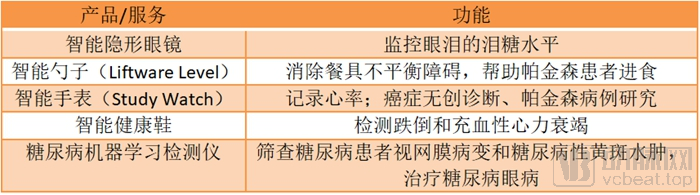
Verily's Series of Hardware and Platforms
2. External investments, focusing on startups in the fields of oncology, cancer, and Parkinson’s disease
Since its inception in 2015, Verily has participated in the financing rounds of nearly ten healthcare companies. Its largest single investment was $165 million in the health insurance unicorn Oscar Health, followed by a $160 million investment in Freenome Holdings’ Series B round. Verily has also been involved in funding rounds for Freenome Holdings, Cortexyme, Ciitizen, Culture Biosciences, and Mammoth Biosciences, including Culture Biosciences’ Series A financing in March 2020.
Over the past five years, Verily has invested a cumulative total of nearly $500 million.
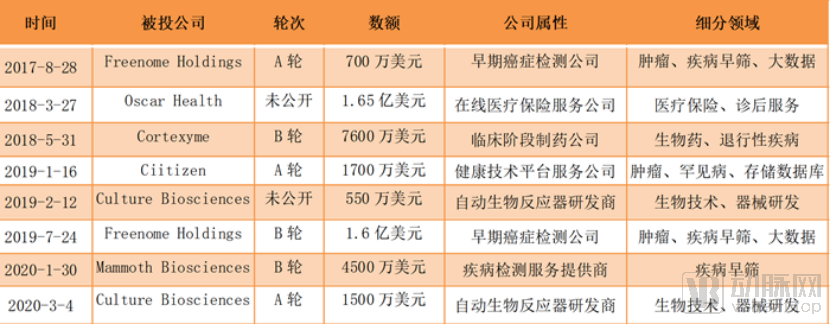
Verily’s External Investments (Data Source: VCBeat)
By reviewing Verily’s external investment portfolio, it is evident that Verily’s investments in the healthcare sector are primarily concentrated in early-stage biotechnology companies focused on oncology, cancer, and Parkinson’s disease.
Verily’s investment acumen is sharp. The first company Verily invested in was Freenome, a cancer detection company founded in 2014. By that time, the medical community already recognized that “liquid biopsies” using blood samples could detect cancer biomarkers, and numerous cancer detection companies were already on the market. Unlike its peers, Freenome’s technology not only identifies the type of cancer but also determines whether the tumor cells are benign or malignant and pinpoints their exact location. Recognizing both the pain points in the cancer detection industry and Freenome’s competitive advantages, Verily participated in Freenome’s Series A financing round.
In the following years, Verily injected capital into several other biotechnology companies. Beyond biotech, Verily’s investment portfolio expanded into the health insurance sector, helping online health insurer Oscar Health complete a $165 million strategic financing round. Notably, in August 2020, Verily announced the launch of a new insurance service, “Stop-loss,” designed to provide risk protection for enterprises. Evidently, each of Verily’s investments represents a carefully orchestrated move to expand its healthcare footprint.
3. Deep Collaboration to Tackle Chronic Degenerative Diseases
It is extremely challenging for a single entity to drive profound transformation in the healthcare sector. Tech companies’ pursuit of their healthcare ambitions relies heavily on support from professional medical companies and healthcare institutions. Verily’s consistent collaborative strategy involves partnering with benchmark medical enterprises or institutions to tackle specific disease areas.
In August 2015, Verily and Johnson & Johnson jointly established a new company, Verb Surgical, dedicated to the research and development of robotic-assisted surgical systems. Verb Surgical is engaged in developing an integrated surgical solutions platform that incorporates technologies such as robotic surgery and novel medical devices for use by operating room professionals.
To gain a foothold in the field of bioelectronic medicine, Verily partnered with GlaxoSmithKline, the UK’s largest pharmaceutical company, in August 2016 to establish Galvani Bioelectronics. The two parties agreed to invest £540 million over the next seven years to jointly develop miniature implantable devices designed to modulate irregular or disordered nerve impulses caused by certain diseases.
To combat diabetes, Verily partnered with Sanofi in September 2016 on a diabetes monitoring and treatment initiative. The two parties designed a comprehensive virtual diabetes clinic on their jointly created Onduo platform, aiming to integrate hardware and software tools for type 2 diabetes into a single platform accessible via smartphones.
To combat Parkinson’s disease, Verily partnered with Radboud University in the Netherlands in April 2017 to launch a personalized Parkinson’s disease project. This initiative combines clinical data research with observational data collection from patients, including metrics on cardiac function, electrodermal activity, and inertial motion. Through this study, researchers are able to identify indicators of disease onset—such as changes in heart rhythm or sleep patterns—during 24-hour monitoring. Additionally, by collecting monitoring data, Verily uses the project’s dataset to develop algorithms capable of classifying Parkinson’s patients, thereby enabling personalized treatment for different patient subgroups.
To combat coronary heart disease, Verily, AstraZeneca, and the American Heart Association jointly invested $75 million in the One Brave Idea project in April 2018. The project aims to better understand the factors contributing to different types of heart disease, as well as methods for preventing and potentially treating heart disease.
A series of collaborations have demonstrated that Verily has a clear understanding of its own strengths and weaknesses. Partnering with pharmaceutical giants and specialized institutions allows for complementary advantages to some extent. For instance, while Verily has accumulated expertise in microelectronic devices, data analytics, and software development, its partners bring extensive clinical medical knowledge and experience. By leveraging respective strengths and mitigating weaknesses through strategic alliances, Verily has been able to expand its healthcare footprint.
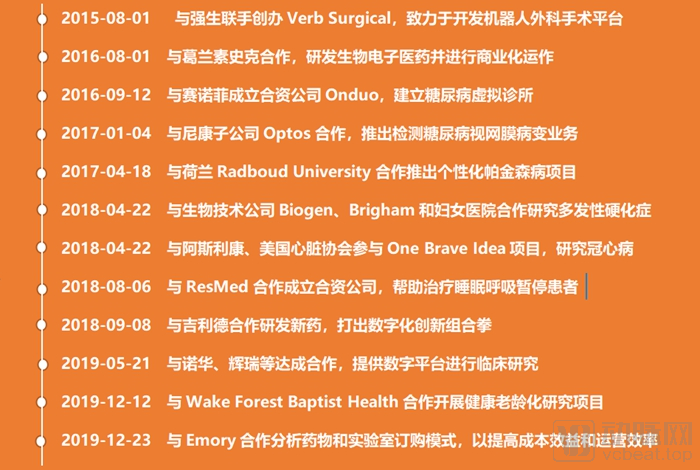
Verily Partnership History (Data Source: VBInsight)
Amid the global pandemic boom, Verily’s strength has been fully revealed.
In 2017, Verily launched Project Baseline in collaboration with Duke University School of Medicine, Stanford University School of Medicine, and Google to collect comprehensive health information from participating patients, with the aim of better understanding the transition from health to disease.
In March 2020, as the pandemic intensified in the United States, Verily launched a virus screening program exclusively for the San Francisco Bay Area (the Verily COVID-19 Testing System). Built upon Verily’s Baseline Study, this screening system allowed users to describe their symptoms on its website, after which Verily would direct them to testing sites if necessary. Although the system had limitations—applicants were required to be at least 18 years old, English-speaking, and U.S. residents—it marked Verily’s first major step in responding to the pandemic. This initiative drew the healthcare industry’s attention to virus screening.
Later, Verily improved its viral screening program and expanded it to communities across the country. Notably, users were required to register a Gmail account and provide basic personal information, such as their address and phone number, to undergo viral screening on the platform, raising concerns about data privacy and potential leaks. Meanwhile, the mandatory Gmail registration made it difficult for healthcare workers to screen homeless residents, who are precisely among the high-risk populations for COVID-19 infection. Given that the screening program failed to cover low-income groups, San Francisco and Alameda Counties in California proactively suspended their COVID-19 testing initiatives.
The termination of Verily’s COVID-19 testing program in San Francisco and Oakland underscores that the proposal and implementation of public health solutions must address the specific needs and challenges of their target populations. For residents in the San Francisco and Oakland areas, limited seamless access to the internet or smartphones, coupled with low trust in the healthcare system, made it particularly difficult to deploy Verily’s COVID-19 testing initiative locally.
COVID-19 testing continues in other cities. Verily recently announced that it has screened and tested nearly 2 million people at 351 testing sites during the pandemic.
Furthermore, Verily launched the “Verily COVID-19 Pathfinder” project. On this platform, patients can assess the severity of their symptoms and receive professional guidance from medical organizations such as the Centers for Disease Control and Prevention (CDC), the World Health Organization (WHO), Johns Hopkins Medicine, the American Lung Association, the American Heart Association, and the American Diabetes Association. This platform not only assists public health departments in improving testing efficiency during the pandemic but also helps users obtain timely professional medical guidance.
Targeted at businesses attempting to reopen and schools resuming operations during the pandemic, Verily has launched Healthy at Work, an app-based health screening service that provides users with COVID-19 diagnostic testing. This service no longer requires users to have a Google account. By collecting questionnaire data and conducting daily symptom screenings, Healthy at Work provides recommendations on whether patients should undergo viral testing or return to work.
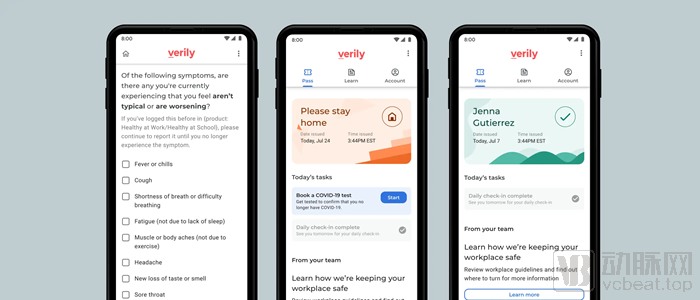
Healthy at Work interface (Image source: Verily official website)
According to the latest reports, COVID-19 infections in the United States have reached 18 million. The surge in cases has slowed down laboratory result turnaround times, which previously took two to three days but now require a week or even longer. To accelerate testing speed, Verily has established a COVID-19 testing laboratory.
Deb Hanks, Head of Pathology at Verily, stated, “When the viral pandemic struck, it was clear that we needed to rapidly establish a laboratory and obtain California licensure and CLIA certification, which we have accomplished. With this laboratory in place, we have been able to accelerate viral testing.”
After a year, the global pandemic continues to spread. In this special historical period, public attention is focused on the healthcare industry, with both expectations and concerns.
Advancements in the healthcare industry do not occur overnight; they are the result of years of relentless effort by society and the sector as a whole. In the face of disease, particularly during major disasters and crises, the public should maintain tolerance and confidence in the healthcare industry.
For healthcare enterprises, the current pandemic presents both challenges and opportunities. The demand for online medical and health services among the general public has surged further, elevating user habit formation and market acceptance to a new level. In the internet era, empowered by technology, healthcare companies still have immense room for expansion.
The pandemic has not ended, and diseases have not disappeared; for healthcare companies like Verily, the journey to realize their dreams remains long and arduous.