

Xinsec IoT: Pioneering a Wiring-Free Internet of Medical Things to Build Southern China's Largest Full-Scenario Smart Hospital
“Looking at the Internet of Things (IoT) in recent years, after experiencing substantial growth in sectors such as industrial manufacturing, logistics, and smart homes, the Medical IoT has suddenly emerged as a powerful force. This rise is closely tied to the attention and promotion by the National Health Commission, as well as to the fact that IoT technology is well-suited to address the ‘last ten meters’ bottleneck in medical informatization.” Based on factors such as China’s policy environment and market potential, Zhang Yong, Director of IoT Solutions at Xinshangan, offered this industry assessment on the development of the Medical IoT.

Zhang Yong, Director of IoT Solutions at Xinshangan
Medical IoT technology plays a pivotal role across various domains, including vital signs monitoring and patient location management in smart healthcare; medical asset management and staff performance evaluation in smart hospital administration; intelligent monitoring of medical waste and energy management in smart logistics; and even hospital-acquired infection control in the post-pandemic era. Currently, no single dominant player has emerged to consolidate the market. This sector is still in its nascent stage and is poised for an era of diverse innovation and flourishing growth. “We have been preparing for this day for many years.”
In 2018, it pioneered the launch of China’s first independently developed, full-scenario, platform-based IoT solution for hospitals. In 2019, it established the renowned full-scenario medical IoT model at the Second Affiliated Hospital of Guangzhou Medical University. In 2020, it partnered with a cohort of top-tier Grade A tertiary hospitals across China—including Zhaoqing First People’s Hospital in Guangdong, Xuanwu Hospital in Beijing, Longhua Hospital in Shanghai, and the Affiliated Hospital of Hebei University—to spearhead comprehensive smart hospital construction initiatives. Its efforts were recognized as one of the classic national cases of innovative “Digital Anti-Epidemic” applications at the 3rd “Digital China Construction Summit” in 2020. These achievements did not emerge out of nowhere; rather, they are the culmination of years of understated refinement of technology and product applications by Xinshangan IoT.
As early as 2014, Xinshangan Group began to lay out independent research and development of medical Internet of Things (IoT), established an IoT business unit, and silently laid out in the field of smart hospital IoT for many years. Now, with accumulated strength, it has independently spun off from the group.
As a key strategic initiative of Xinshangan Group in the medical Internet of Things (IoT) sector, Xinshangan IoT leverages the Group’s first-mover advantages in smart networking and network visualization analytics. Backed by over a decade of accumulated expertise in healthcare informatization and a nationwide service network, it has rapidly expanded its presence and achieved significant growth across China.
Zhang Yong stated that Xinshangan IoT will continue to leverage its superior R&D capabilities and mature project management expertise, continuously iterating on platform development and deeply optimizing designs for hospital scenarios to further expand its technological advantages in the medical IoT sector. To date, driven by its innovative technical approach and in-depth understanding of hospital operations, Xinshangan IoT has participated in the IoT system planning and design for over 100 new hospital campuses across China, as well as in the construction of IoT-enabled scenarios within existing hospital grounds.
Since 2014, Xinshangan IoT has clearly defined its development path: positioning itself as a “software DNA” enterprise, with a focus on integrating and developing optimal hardware designs while deeply understanding and creating solutions tailored to hospital business applications. “When engaging with hospitals, we aim to start from the perspective of comprehensive hospital-wide IoT platform planning and design, rather than merely discussing individual use cases. Medical IoT is not just about capturing sensor data and calling it a day; more importantly, it involves positioning based on client business processes, analyzing sensor data, and realizing functional capabilities.”
“Formidable passes stretch out like iron.” In 2018, Xinshangan Group launched China’s first integrated open application platform for the Medical Internet of Things (MIoT).
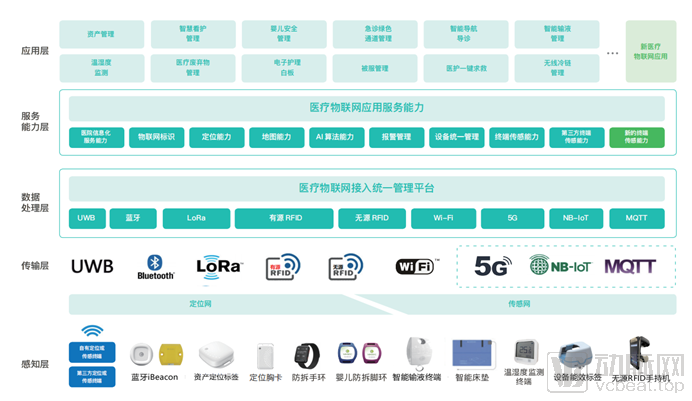
Xin Shang An Medical IoT Application Platform
Zhang Yong introduced that the Xinshangan Medical IoT Converged Open Application Platform features three key characteristics: wireless connectivity, convergence, and openness. By integrating broadband data networks, positioning networks, and sensor networks, this platform achieves hospital-wide signal coverage without the need for cabling. For the positioning network, Xinshangan IoT employs internationally advanced Bluetooth iBeacon standard networking technology to establish an independent network. This solution requires no cabling or power supply, does not rely on any other network equipment, and maintains positioning accuracy within 1–3 meters, allowing it to be reused across multiple positioning scenarios in smart hospitals. Xinshangan adopts the international LoRa standard to independently achieve sensor network coverage, operating in the 470–510 MHz frequency band. This approach avoids interference with Wi-Fi, is not limited by building walls, and establishes a hospital-wide sensor ecosystem.
Practice is the sole criterion for testing truth. In 2018, Xinshangan IoT took the lead in partnering with The Second Affiliated Hospital of Guangzhou Medical University (Guangyi Eryuan) to build the hospital’s IoT project on the Xinshangan IoT application platform, which was hailed by the industry as a paradigmatic model for IoT-enabled hospitals. It also became a representative case of leading technical routes in hospital IoT innovation, being selected as an Outstanding Case at CHIMA 2019, one of the Top Ten Outstanding National Healthcare IoT Cases in China in 2019, and receiving the Best Informatics Innovation Award at the 2019 China Hospital Information Network Congress (CHINC).
The IoT project at the Second Affiliated Hospital of Guangzhou Medical University, constructed by Xinshangan IoT, was initially launched in the cardiology ward and is gradually being expanded to other wards. The overall smart ward IoT planning follows a strategic shift from supply-side improvements to demand-side experience enhancement. It integrates the National Health Commission’s tripartite design concept for smart hospital construction, dividing smart ward development into three key components: smart diagnosis, treatment, and nursing services; smart ward safety monitoring; and smart ward management.
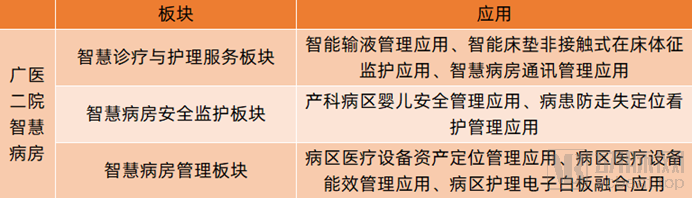
Xinshang'an IoT Medical Internet of Things Construction Plan
Currently, the construction of smart ward IoT infrastructure at the Second Affiliated Hospital of Guangzhou Medical University has taken shape, establishing a full-process model in which personnel, assets, and events are locatable, traceable, and subject to quality control. The hospital will continue to deepen its development in accordance with this model.
In addition, the Second Affiliated Hospital of Guangzhou Medical University has established a location-based sensor network covering major areas of the hospital, in-hospital navigation and triage services, an IoT-enabled green channel for emergency care, and smart operating room applications. All these systems are uniformly built on Xinshangan’s domestically pioneered converged open hospital IoT application platform, truly achieving the integration of IoT location and sensor data from ward areas with data from other related scenario-based applications.
In September 2019, the group standard “Technical Specifications for the Application of Patient Positioning and Tracking Technologies in Medical Institutions,” primarily drafted by Xinshang’an IoT based on the IoT application model of the Second Affiliated Hospital of Guangzhou Medical University and with participation from multiple Grade A tertiary hospitals in Guangdong Province, was officially released. It has become China’s first technical standard specification focused on patient care management in smart wards.
The hospital’s “IoT-Based Construction of Emergency Green Channels” project was commended by the National Health Commission and recognized as one of the top 50 nationwide typical cases of “Internet + Healthcare” that played a demonstrative and leading role in epidemic prevention and control in 2020.
Currently, Xinshangan IoT has established a hospital-wide Internet of Things (IoT) network covering three campuses, with applications in more than eight core scenarios and connectivity for over 5,000 beds, making the Second Affiliated Hospital of Guangzhou Medical University the largest IoT-enabled hospital in South China.
Zhang Yong stated that the application scenarios for the Internet of Things (IoT) in hospitals are highly diverse, with Xinshangan IoT having identified over 60 categories to date.
In 2020, the Smart Ward Project at Zhaoqing No. 1 People’s Hospital, constructed by Xinshangan, received high recognition and praise from industry experts. It was awarded the Third Prize for Outstanding Cases of Hospital IoT Applications at the 2020 CHIMA Conference, becoming a representative case of hospital IoT implementation.
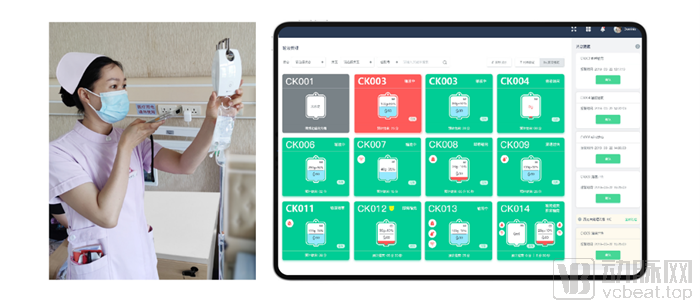
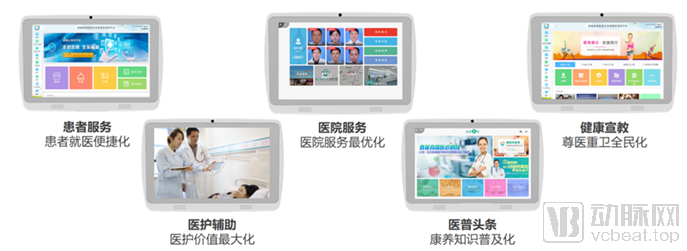
Xin Shang’an, with IoT technology as its core and ward operations as its guiding direction, aims to achieve intelligent ward management. Building upon the existing informatization applications in the wards of Zhaoqing No. 1 People’s Hospital, it establishes a closed-loop smart ward service model covering medical and nursing staff, patients and their families, nursing business management, and bedside management. The main components include: intelligent infusion, smart mattresses, and bedside interaction.
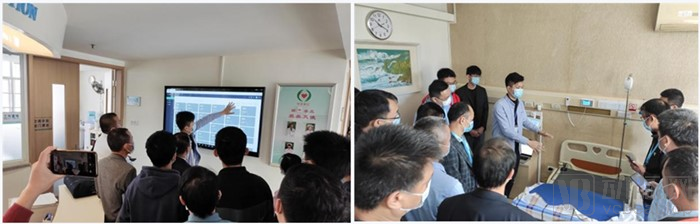
Xinshang'an IoT Smart Ward Project
Zhaoqing No. 1 People’s Hospital has implemented smart ward construction by adopting a contactless, non-intrusive service model with automatic data upload and end-to-end visualization, thereby delivering a safe, convenient, and accurate comprehensive upgrade of intelligent services for the ward.
The hospital has also taken the lead in adopting 5G network technology, with 5G coverage extended to all departments. Devices such as PDAs used by nurses and tablets and mobile carts used by physicians are all equipped with 5G SIM cards. As 5G network technology continues to advance, it is believed that Internet of Things (IoT) applications will soon be integrated into every aspect of hospital technology and management.
“The confidence to play so many strong cards in succession stems simply from the fact that, over the years, we have been more willing to invest greater time in understanding our clients’ business processes and needs. Medical IoT is an interdisciplinary field; one must not only grasp the development strategies of hospital information departments but also comprehend the workflow requirements of the specific clinical departments using the technology. For instance, if you do not even understand the treatment protocols and Door-to-Needle Time (DNT) timelines of an emergency stroke center, no one will believe you can successfully implement IoT solutions for the emergency green channel,” said Zhang Yong, Director of IoT Solutions at Xinshangan.
Looking ahead, Xinshangan IoT will intensify its R&D efforts, steadily expand the variety of its IoT application products, and broaden its market service coverage. “We are still on the journey; an early start does not mean resting comfortably in our comfort zone. We continue to iterate our entire platform and deepen the optimized design for various scenarios, further expanding our technological leadership in this field.” It is reported that Xinshangan IoT, which has never raised external funding since its inception, now intends to launch a round of financing in the capital markets amid its current strong growth momentum.