

"I'd Rather Die Than Grow Old": New Study by So-Young and Yicai Reveals the Roots of Post-90s' Anti-Aging Anxiety
For most individuals born in the 1990s and mid-to-late 1990s, “aging” remains a rather distant concept. However, recent shifts in the medical aesthetics consumer market reveal that an increasing number of people from the post-90s generation have become the primary consumers in this sector. Their anxiety about aging and their investment in anti-aging treatments even surpass those of the post-80s generation. “I’d rather die than grow old” has become a credo for many among the post-90s cohort.
Behind this reality lies both a shift in the collective mindset of the post-90s generation and the influence of their upbringing as digital natives. So, how do the post-90s’ attitudes toward “aging” differ from those of the post-80s? Which professions are most concerned about facial signs of aging? What factors shape their perceptions of aging? On December 25, 2020, SoYoung, in partnership with Yicai (First Financial), released the New Youth Anti-Aging Survey Report, shedding light on contemporary young people’s attitudes and choices regarding anti-aging treatments and medical aesthetic consumption.
“Aging” is an inevitable process in human life. Over the past few centuries, “aging” was often regarded as a symbol of longevity and thus affirmed. However, with advancements in modern medicine and public health, contemporary life expectancy has increased, leading to a shift in attitudes toward “aging.” Notably, and perhaps surprisingly, younger generations exhibit a stronger resistance to “aging” than previous ones. Among those born in the 1980s and 1990s, the latter group places significantly greater emphasis on “anti-aging” than the former.
The emphasis that the post-90s generation places on “anti-aging” is closely linked to the expansion of their social circles. Feifei, a 23-year-old finance professional at a state-owned enterprise, told VCBeat in an interview, “People our age are quite concerned about their appearance; we all hope to look better in selfies and be more visually appealing.” Feifei also noted that many of her classmates began trying medical aesthetic procedures right after graduating from high school. This demonstrates that, among the post-90s generation, physical attractiveness has become a significant form of social currency.
From the perspective of An An, a 42-year-old corporate manager, the appearance anxiety prevalent among those born in the 1990s may stem from their recent entry into the workforce, where they have had limited opportunities and accumulated little professional experience. For them, physical appearance serves as a relatively prominent advantage, leading to a greater emphasis on personal image. Consequently, many individuals born in the 1990s are choosing anti-aging interventions to enhance their competitive edge in the workplace.
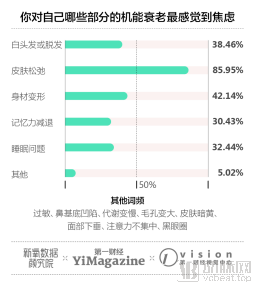
Survey data indicate that 59.2% of individuals begin to experience pressure related to aging between the ages of 20 and 30. As skin changes are one of the most significant indicators of aging, nearly 90% of respondents reported that their stress stems from skin laxity, with 85.95% prioritizing skin care management. Additionally, 40% of respondents cited body shape changes as a source of stress. From an occupational perspective, anti-aging needs vary across different professional groups. Employees in the service industry, staff of state-owned enterprises/civil servants, and professionals in the financial sector rank as the top three groups with the highest levels of aging anxiety, with those in the service industry experiencing the most severe anxiety.
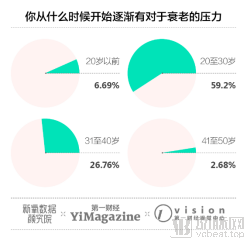
Surprisingly, the survey revealed that individuals aged 20 to 25 reported the highest levels of “severe anxiety” about aging, with nearly one-fifth of this group expressing significant concern. Some respondents born in the 1990s even proclaimed, “I’d rather die than grow old.” In contrast, those aged 35 and above provided much more rational assessments regarding their anxiety about aging. Analysts suggest that this may be because individuals born after 1995 are still far from old age, and the stark contrast with their current youth intensifies their fear of aging.
What Exactly Is Driving the Growing Anti-Aging Anxiety Among Post-90s Generations? Data indicates that “personal growth” and “peer pressure” are two of the most significant factors. Specifically, 57.19% of respondents reported noticing signs of physiological aging as they aged during their personal development journey, while 42.14% attributed their anxiety about aging to peer pressure. This suggests that the demand for “anti-aging” solutions is not merely an individual choice but also a reflection of shifting social consensus.
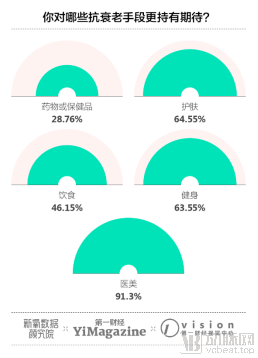
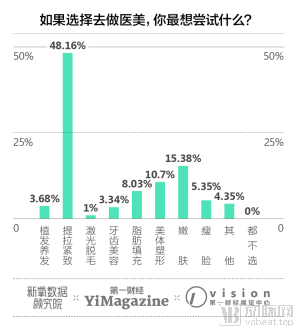
The convergence of social and developmental needs has fueled a booming medical aesthetics market. 91.3% of respondents consider medical aesthetic procedures as one of their anti-aging strategies, demonstrating a level of trust far exceeding that of the next closest options, “skincare” and “fitness,” which garnered expectation rates of 64.55% and 63.55%, respectively. Among skin care-related medical aesthetic treatments, “lifting and tightening” ranks first in terms of willingness to try, with a preference rate of 48.16%.
Corresponding to the growth in consumer demand is the high level of spending on medical aesthetics by the post-90s generation. Data shows that nearly 90% of consumers are willing to increase their investment in anti-aging treatments, with 23.41% of respondents willing to increase their spending by one-quarter or more.
Data from the New Oxygen Data Yanjiuyuan also clearly shows that “firming and anti-aging” has become a high-frequency term in medical aesthetics consumption in recent years. Even under the impact of the pandemic, consumption of firming and anti-aging procedures still saw a year-on-year increase of 263.6% in June 2020. According to a 2020 medical aesthetics industry report released by iResearch, “maintaining a youthful appearance” has been the most prevalent aesthetic trend among beauty seekers since the turn of the millennium. The report noted that among all popular medical aesthetics procedures for the post-2000 generation, “facial rejuvenation is a basic need; facelifts and eye bag removal are particularly favored.”
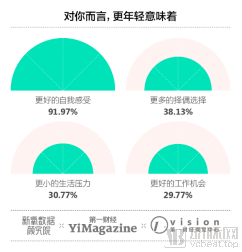
Overall, although the post-90s generation’s attitude toward aging and their emphasis on medical aesthetics consumption indicate a significant divergence from the post-80s generation, this shift aligns closely with the distinctive personality traits of the post-90s cohort. Survey results reveal that their desire for a more youthful appearance is driven primarily by subjective perceptions rather than a need for broader objective options. Specifically, 91.97% of respondents believe that looking younger translates to feeling better about themselves in the present moment. All other considerations are secondary to personal satisfaction. This also suggests, from one perspective, that while the post-90s generation experiences anxiety about aging, their approach to medical aesthetics consumption remains rational and healthy.