

SynBioLab Announces IPO Filing: A Synthetic Biology Platform Targeting a Trillion-Yuan Market

SynBioLab
Developer of High-Value Compound Production Technology
Replacing hundreds of thousands of mu of land used for cultivating raw medicinal plant materials with a 100-square-meter production workshop would undoubtedly result in substantial cost savings for the upstream production of active pharmaceutical ingredients (APIs) in drug development. This design is not merely a pipe dream. Since its establishment, SynBioLab has been dedicated to the application of synthetic biology in the fields of biopharmaceuticals and functional foods, building upon this expertise to develop its proprietary green manufacturing platform based on synthetic biology.
Synthetic biology primarily refers to the artificial “design” of biological structures and functions through computational design, synthetic reconstruction, and editing-based regulation, thereby overcoming the limitations of natural biological evolution and driving disruptive technological innovation. These engineered living entities (cells) are often required to perform specific tasks as envisioned by their designers.
“We are undergoing a revolution in synthetic biology. By leveraging synthetic biology—from the design of biological parts to the engineering of living organisms—we enhance the capacity of microbial cell factories to produce chemicals. The novel strains and processes created can effectively replace traditional methods, significantly reducing pollution and energy consumption while elevating the technological standards of conventional industries.” This prophecy is recorded on the official website of SynBioLab, a company that employs genetic engineering to artificially design microbial strains (cell factories) capable of producing target compounds, thereby replacing raw material compounds that would otherwise require cultivation across tens of thousands of mu of land.
VCBeat (WeChat ID: vcbeat) conducted an exclusive interview with Ms. Wang Xiao, co-founder of SynBioLab, lifting the veil on China’s first synthetic biology company dedicated to green manufacturing.
Wang Xiao, CEO of SynBioLab, holds a Ph.D. in Genetics from the Chinese Academy of Sciences and specializes in big data analytics for bioinformatics. Prior to founding SynBioLab, she studied in Yunnan Province, where she gained extensive exposure to traditional Chinese herbal resources and collaborated with numerous pharmaceutical companies. It was this experience that enabled her to keenly identify the pain points in active pharmaceutical ingredient (API) production within the upstream segment of the pharmaceutical industry.
From 2013 to 2017, a total of ten synthetic biology startups abroad secured financing rounds of $100 million or more, including Zymergen, Editas Medicine, Juno Therapeutics, and Novome Biotechnologies. With the rapid iteration of synthetic biology technologies, related sectors have been burgeoning at an unprecedented pace.
After completing his Ph.D. in 2018, Wang Xiao and several other co-founders, who also came from cross-disciplinary backgrounds, began entrepreneurial ventures in this field based on synthetic biology technologies. The founders possess diverse and complementary expertise, enabling them to facilitate the rapid implementation of SynBioLab’s projects from multiple perspectives.
As a leading enterprise in China to enter this field, SynBioLab leverages the advantages of synthetic biology and utilizes “all molecules from all microbes,” focusing on strain improvement and industrial-scale translation. It provides solutions for numerous industries that encompass nearly every aspect of daily life, including pharmaceuticals, agriculture, chemicals and materials, electronics, fragrances, health supplements and drugs, household and industrial cleaning, personal care, and waste management.
Wang Xiao told VCBeat,SynBioLab has its own set of criteria for selecting suitable target compounds:
First, the selected compounds must possess high added value and be widely recognized for their significant clinical therapeutic value;
Second, consider whether the traditional production methods for this compound have barriers that are consistently difficult to overcome;
Third, and most critically, we assess the compound’s market development potential, which must involve a substantial market size.
Under the guidance of this standard, SynBioLabPioneered the selection of biosynthetic cannabinoids in 2018Developed as a core project. Cannabinoids are a group of terpenophenolic compounds discovered in cannabis, which also occur naturally in the animal nervous and immune systems, exerting various pharmacological effects on the nervous system. Using cannabinoids as an example, we explored the application of synthetic biology in the production of natural products derived from traditional Chinese medicine.
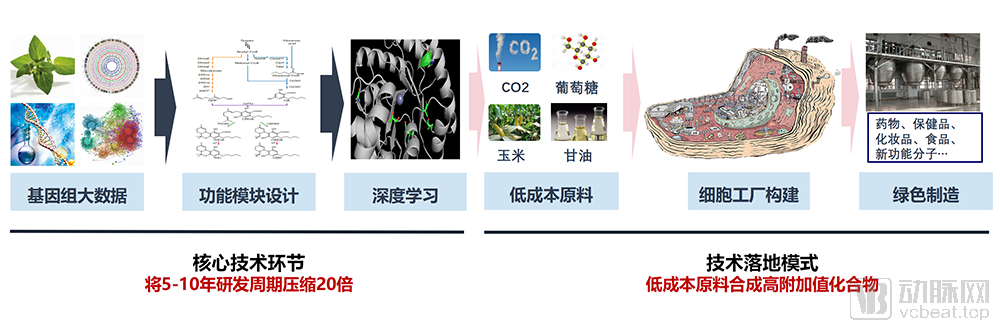
Wang Xiao, CEO of SynBioLab, introduced that biosynthetic cannabinoids represent a core approach to concentrating cannabinoids, offering an affordable pathway to obtain rare, potent, and sustainable ingredients. SynBioLab first employs computational analysis to identify the metabolic pathways for cannabinoid biosynthesis in cannabis plants. Subsequently, through functional module design and metabolic pathway optimization, the company engineers cell factories specifically designed to secrete cannabinoids. These cell factories can replace traditional cannabis cultivation for cannabinoid extraction, enabling pharmaceutical companies to acquire high-purity cannabinoids in large quantities within a short timeframe (no more than six months).
Compared to traditional plant extraction methods, the biosynthesis of cannabinoids effectively eliminates dependence on weather and geographical conditions, thereby conserving arable land. This approach requires fewer resources and enables rapid, large-scale production. It replaces planting cycles that span months or even years with fermentation cycles lasting only a few weeks. Furthermore, it can produce high-purity rare raw materials whose chemical structures are identical to their natural counterparts, ensuring equivalent efficacy.
It can be said that biosynthesis offers a dense and efficient approach, replacing tens of thousands of square meters of cultivation area with just 100 square meters of fermentation facility. This method utilizes low-cost raw materials to synthesize high-value core pharmaceuticals. Furthermore, the biosynthesis of high-purity cannabinoids avoids the contamination by THC (the psychoactive component) commonly associated with traditional cannabinoid extraction processes.
According to the latest data report from Bank of Montreal, if countries such as the United States and those in Europe fully legalize cannabis, the global cannabis market could grow to $194 billion within seven years. By 2024, Europe is projected to have the largest legal cannabis market, with the medical segment accounting for 57% of the total value; the overall European market is expected to reach $39.1 billion by that year.
Facing such a vast market, Wang Xiao stated that the decision to pursue cannabinoid projects was not merely about chasing trends. The core technology underlying this pipeline possesses significant reach and extensibility. By mastering the cannabinoid technology pathway, SynBioLab can effectively establish cell factory libraries for terpenoids and related pharmaceuticals, as well as series of enzyme component libraries, thereby achieving broader connectivity and influence across more pharmaceutical markets.
Wang Xiao told VCBeat that the use of artificially biosynthesized cannabinoids could save pharmaceutical companies nearly 20% in raw material production costs. SynBioLab’s strategic layout extends far beyond cannabinoids; by leveraging cell factories and pure enzymatic reactions, the company has synthesized a variety of compounds, including but not limited to paclitaxel and phloretin. The production costs for these compounds are projected to decrease directly by 30% to 50% in the coming years.
In terms of strategy, SynBioLab adheres to a “two-pronged” approach, advancing both long-term and short-term projects in parallel. While developing plant-derived active pharmaceutical ingredients (APIs) for biomedical applications (long-term projects), the company is also developing functional foods with proven health benefits—such as those containing tagatose and steviol glycosides (short-term projects)—to rapidly and accurately penetrate the market and generate cash flow.
It is reported that SynBioLab has recently launched its pre-A financing round, aiming to raise RMB 15 million. The funds will be used to enhance and iterate its green manufacturing platform for synthetic biology, accelerate the pilot-scale testing and industrial commercialization of existing projects. The company hopes to collaborate with other emerging teams in the field of synthetic biology to better establish and nurture this cutting-edge technology and its nascent industrial applications, thereby injecting greater vitality into the sector.