

Nference Announces IPO: Powering Biomedical Innovation with AI-Driven nferX Platform in Collaboration with Mayo Clinic and Janssen

Nference
Developer of Artificial Intelligence-Driven Life Science Software Platforms

Matrix Partners
Private Equity Investment Firms

Matrix Capital Management
Matrix Capital Management is an investment management company focused on public equity markets.

NTT Venture Capital
Venture Capital Firm

Mayo Clinic Ventures
Venture Capital Firm
Nference, an artificial intelligence startup founded in 2013 and headquartered in Kendall Square (Cambridge, Massachusetts), the “innovation heart” of the United States, specializes in developing deep learning software for the biomedical field.
Recently, VCBeat learned that Nference has completed a $60 million Series C financing round. The round was jointly invested by Matrix Capital Management, Matrix Partners, Mayo Clinic Ventures, and NTTVC, and the funds will be used to accelerate the development of new diagnostic and treatment models based on its artificial intelligence software platform, nferX.
It is reported that in early 2020, Nference completed a $60 million Series C financing round exclusively funded by Mayo Clinic Ventures. Having secured over $100 million in Series B and C funding within just one year, Nference’s appeal to the capital market is considerable.
How Has an AI Startup Earned Unwavering Support from Investors? Let’s Explore the Appeal of Nference.
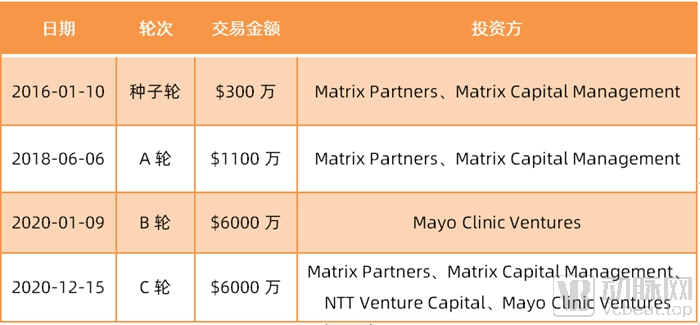
Nference’s Financing History (Data Source: Crunchbase)
Nference was co-founded by Dr. Murali Aravamudan and Dr. Venky Soundararajan, and boasts a leadership team comprising multiple entrepreneurs from the Massachusetts Institute of Technology (MIT) and Harvard Medical School.
Murali Aravamudan is a serial entrepreneur, inventor, and engineer. Prior to founding Nference in 2013, Dr. Aravamudan co-founded the software company Veveo in 2005 and served as its Chief Executive Officer. Veveo led its target market with over 100 million product device deployments, secured 89 U.S. patents and more than 70 pending patents, and raised $28 million in equity financing across two rounds from Matrix Partners, Norwest Ventures, and Northbridge Ventures. In 2014, Veveo was acquired by TiVo (formerly Rovi) for $75 million.
Prior to founding Veveo, Dr. Aravamudan served as Vice President and General Manager of the Winphoria division within Motorola’s Global Telecom Solutions sector. He founded Winphoria Networks in 2000 and served as its Chief Technology Officer until the company was acquired by Motorola for $200 million in 2003. During his tenure at Winphoria, he helped the company raise $54 million in equity financing.
Mr. Aravamudan is a veritable super-inventor, holding 110 U.S. patents and more than 100 pending patents in the fields of search, conversational interfaces, machine learning, artificial intelligence systems, data networks, and, most recently, computational biology.
Dr. Venky Soundararajan, another founder of Nference, is an entrepreneur, scientist, and inventor. He built and led a world-class team comprising more than 200 MDs from MIT and Harvard Medical School.
Furthermore, Dr. Soundararajan facilitated the establishment of a long-term strategic partnership between Nference and the clinical data analytics platform at Mayo Clinic. At Nference, Dr. Soundararajan conceived and directed the development of nferX, a data science platform.
His scientific research has also achieved multiple breakthroughs, including decoding the earliest signals of COVID-19 infection, identifying hosts infected with SARS-CoV-2 at single-cell resolution, and discovering various tumor-specific antigens to enhance the clinical diagnosis of complex diseases. Dr. Soundararajan has authored more than 50 scientific papers and holds dozens of patents.
The founders’ extensive academic and professional backgrounds have driven Nference’s positive growth.

Dr. Aravamudan and Dr. Soundararajan (Image source: Nference official website)
In the biomedical field, most biomedical information is unstructured, such as clinical records, scientific literature, pathological images, and electrocardiogram waveforms. These unstructured data contain rich biological knowledge that was initially interpreted by medical experts. However, from a research perspective, they are not directly computable.
Nference, Inc.’s AI software platform, nferX, makes unstructured medical knowledge computable. By leveraging neural network algorithms (both shallow and deep learning models) to triangulate unstructured and structured information from biomedical literature, large-scale molecular data, and real-world datasets, nferX can automatically generate relevant insights in real time to support drug discovery and development, drug lifecycle management, and precision medicine.
Biomedical Literature
The explosive growth of biomedical literature has outpaced human capacity to read and process this wealth of information. Leveraging neural network ensembles, nferX enables the automatic, real-time extraction of insights from hundreds of millions of biomedical documents.
Molecular Dataset
Over the past 10 to 15 years, the world has witnessed an explosive growth in molecular data, such as DNA sequencing, bulk RNA sequencing, and single-cell RNA sequencing. However, most of these data originate from independent studies conducted by different academic teams and are poorly annotated. Nference technology enables systematic and automated processing and analysis of thousands of samples along with their annotations.
Real-World Dataset
The nferX platform provides access to both public and proprietary real-world datasets. By triangulating real-world evidence through nferX’s molecular analysis and knowledge synthesis capabilities, causal relationships between genotypes and phenotypes can be inferred.
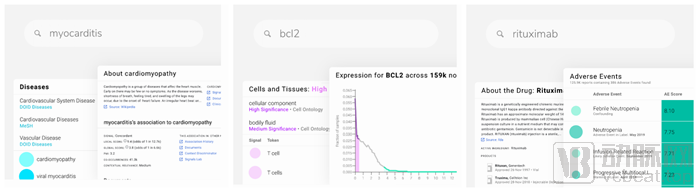
Three Work Interfaces of nferX (Image Source: Nference Official Website)
Undoubtedly, Nference’s strength lies in its AI-powered medical knowledge integration platform. Leveraging this advantage, Nference collaborates with leading biopharmaceutical companies both in China and abroad to address significant challenges across various domains, including drug discovery, clinical research, lifecycle management, clinical operations, and commercial strategy.
Partnering with Mayo Clinic to Establish a New Healthcare Company, Leveraging AI to Advance Novel Drug Development for Rare Diseases
In July 2017, Nference partnered with the 150-year-old U.S.-based Mayo Clinic to jointly establish an AI startup, Qrativ, dedicated to integrating clinical expertise with artificial intelligence to advance new drug development.
Qrativ, leveraging Nference’s AI-powered knowledge synthesis platform alongside Mayo Clinic’s expertise and clinical data, has developed Darwin.ai, a drug therapy platform that facilitates systematic drug discovery and development, with a particular focus on novel therapeutics for rare diseases.
Qrativ’s partners can leverage the Darwin.ai drug therapy platform to identify all potential applications for candidate drugs, including determining indications for rare diseases and pinpointing the patient subpopulations most likely to respond optimally to a given candidate. Through these partnerships, Qrativ maximizes the potential of each drug therapy to benefit more patients and treat a broader range of diseases.
In June 2019, Nference entered into a long-term collaboration agreement with the U.S. biopharmaceutical company Janssen (Janssen Pharmaceuticals) to integrate Nference’s artificial intelligence platform into Janssen, creating a unified, science-powered data platform to discover new diseases and link biological information with disease states and therapeutic mechanisms.
Janssen engages in research and development activities related to a broad spectrum of human medical conditions, including psychiatric disorders, neurological diseases, anesthesia and analgesia, gastrointestinal disorders, fungal infections, HIV/AIDS, allergies, and cancer. The collaboration between Nference and Janssen enables Nference to expand across a wider range of disease areas, delivering more competitive therapeutic solutions to customers and patients.
Amid the raging pandemic, in-depth research into COVID-19 requires the integration of all biomedical knowledge to decode its pathogenesis and develop response strategies. Nference’s data platform, nferX, conducts comprehensive analyses of COVID-19 across three dimensions—molecular research, clinical research, and epidemiological studies—by synthesizing insights from hundreds of millions of biomedical publications, yielding corresponding conclusions:
Molecular Research
Infection:At the onset of the pandemic, the specific cell types susceptible to SARS-CoV-2 infection were largely unknown. Nference was the first to map the viral receptor ACE2 at an unprecedented scale and resolution. This study revealed that, in addition to the respiratory system, the gastrointestinal and cardiorenal systems are significant sites of COVID-19 infection.
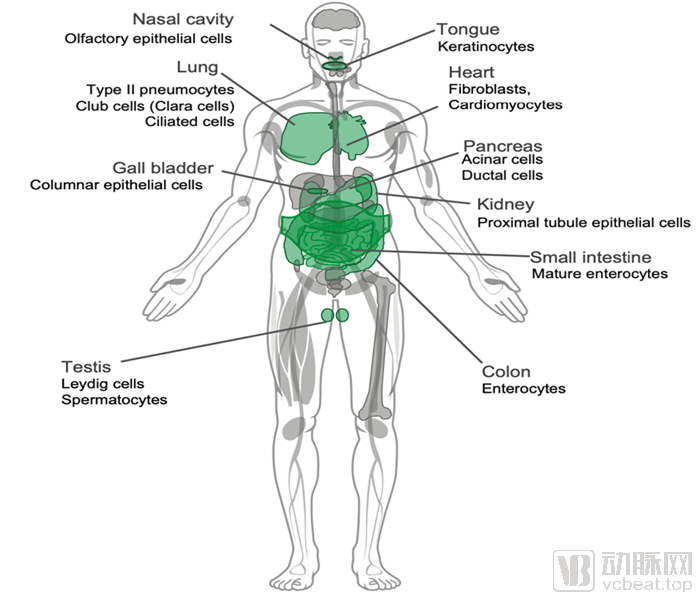
SARS-CoV-2 Receptor Analysis (Image source: Nference official website)
Evolution:Molecular mimicry is an evolutionary strategy adopted by the novel coronavirus to exploit host mechanisms. Studies have found that SARS-CoV-2 has evolved a unique furan (an oxygen-containing five-membered heterocyclic compound) cleavage site in its viral spike protein, which has not been observed in any previously sequenced coronaviruses. SARS-CoV-2 mimics the furan-cleavable peptide of human ENaC-α, which may be associated with the wet lung syndrome reported in some COVID-19 patients.
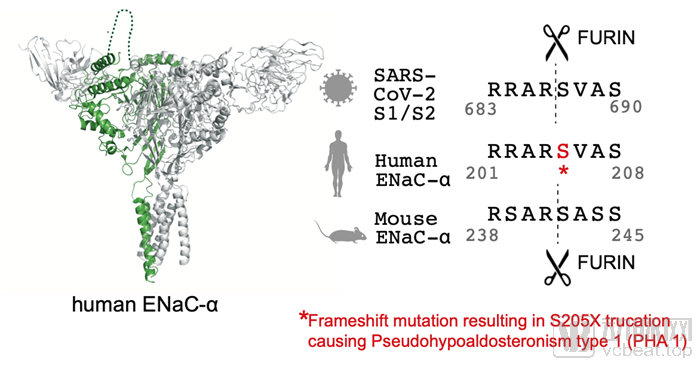
Mimetic Fission of SARS-CoV-2/ENaC-α (Image source: Nference official website)
Clinical Research
Early Detection:In research on the novel coronavirus, nferX pioneered the use of deep neural networks to analyze clinical records from tens of thousands of patients who underwent PCR testing for SARS-CoV-2. The study demonstrated that anosmia (alteration or loss of smell) and dysgeusia (alteration or loss of taste) are the earliest specific indicators predictive of a COVID-19 diagnosis, appearing 4–7 days before the typical date of PCR confirmation.
Prediction:To understand the potential course of COVID-19 disease progression, a comprehensive analysis of all test results from thousands of patients is required. Studies have shown that COVID-19-associated coagulopathy (CAC) is characterized by elevated plasma fibrinogen levels and reduced platelet counts at the time of clinical presentation; however, these laboratory findings change significantly in subsequent stages of the disease.
Treatment:The probability of ICU admission and death is associated with cytokine storm and acute respiratory distress syndrome (ARDS). Studies have shown that plasma IL-6 levels after corticosteroid treatment are a significant indicator of ICU length of stay in patients with severe COVID-19.
Epidemiological Research
Vaccination:Preliminary analysis by Nference of complete immunization records from over 100,000 patients indicates that multiple FDA-approved vaccines have played a role in reducing the risk of SARS-CoV-2 infection. These vaccines are recommended for most working-age populations, as well as for children and the elderly, thereby providing options to enhance SARS-CoV-2 immunity across all age groups.
Diagnosis:Nference’s SARS-CoV-2 PCR testing and IgG seropositivity results indicate that the majority of individuals with prolonged viral RNA shedding were neither hospitalized nor symptomatic. The study found that IgG-seropositive individuals can still shed viral RNA, necessitating monitoring of viral load and neutralizing antibody titers in cases of prolonged SARS-CoV-2 RNA shedding.
Community Transmission:Nference, in collaboration with Mayo Clinic, developed and deployed an epidemiological tracking platform that integrates county-level SARS-CoV-2 PCR testing data from across the United States. This platform enables the prediction of spatiotemporal “hotspots” of SARS-CoV-2 transmissibility and has been successfully utilized in the allocation of personal protective equipment (PPE) resources.