

Smart Devices as the Foundation of Digital Diabetes Management: Technological Barriers and Key Innovations
The 9th edition of the International Diabetes Federation’s IDF Diabetes Atlas indicates that approximately 463 million people worldwide currently have diabetes. Although diabetes is incurable, targeted interventions addressing medication adherence, lifestyle, nutrition, physical activity, and stress reduction can significantly improve disease outcomes. More importantly, patients should strengthen their self-management.
Diabetes is a condition requiring time-intensive management, with patients needing to make daily decisions regarding blood glucose monitoring, nutrition, insulin administration, and medication intake. Patient-centered digital management represents a highly suitable solution for diabetes, and technology professionals worldwide are continuously exploring and iterating on related technologies.
In 2019, Abbott and Novo Nordisk announced a non-exclusive collaboration to integrate insulin data from Novo Nordisk’s connected insulin pens into Abbott’s digital health management tools. Anders Dyhr Toft, Vice President of Commercial Innovation at Novo Nordisk, stated that the lack of reliable information has been a significant source of frustration for many patients with diabetes and their physicians. This partnership will enable healthcare professionals to gain better insights into patients’ diabetes management and help patients feel more confident in their treatment.
This project represents a typical framework for a digital healthcare solution for diabetes. Although implementation has not yet formally commenced, we have reason to believe that, with the aid of digital tools, individuals will be able to assess how data-driven interventions influence lifestyle modifications, as well as their impact on glycemic control, other clinical parameters, and medication adherence.
Digital healthcare should incorporate the “3D” elements: Device, Data (from the device), and Decision (medical decisions derived from the data). Among these three components, Device ranks first, underscoring its critical importance. This principle also applies to the digital management of diabetes; only sufficiently capable smart devices can address the issue of “lack of reliable information,” as noted by Anders Dyhr Toft.
An overview of the current mainstream digital management models for diabetes reveals two primary categories, differentiated by target patients and modes of use: first, artificial pancreas systems based on continuous glucose monitoring (CGM), automated insulin delivery (AID), and control algorithms; and second, self-management systems leveraging smart fingerstick blood glucose meters, insulin pen dose counters, and intelligent decision support. This article reviews the development and application of devices within these two models, aiming to provide reference insights for the industry.
Striving to return to a normal life is not only the strong desire of patients with diabetes but also the ultimate goal of researchers and developers. The “artificial pancreas,” which mimics the working mechanism of the human pancreas, is the tangible product resulting from this effort.
As intelligent devices for continuous physiological data acquisition and continuous drug delivery, CGM and AID can dynamically adjust blood glucose levels to closely mimic the physiological function of the pancreas; therefore, their level of development also represents the progress made in artificial pancreas technology.
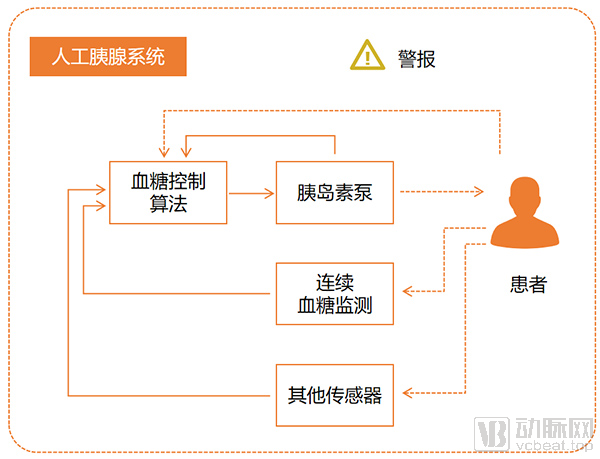
Workflow of the Artificial Pancreas, Graphic by VCBeat
The Value of CGM and AID in Artificial Pancreas
According to the consensus of the American Diabetes Association (ADA), the American Association of Clinical Endocrinologists (AACE), and the American College of Endocrinology (ACE), CGM and insulin pumps are primarily indicated for patients with type 1 diabetes and those with type 2 diabetes requiring intensive insulin therapy.
Continuous glucose monitoring (CGM) can help the aforementioned patients understand the changes and trends in their blood glucose levels resulting from behaviors such as diet, exercise, and medication therapy. This enables patients to accurately calculate and adjust insulin injection doses, while comprehensively managing their diet and physical activity. However, early “CGM + insulin pump” systems required manual adjustment of insulin dosage and were therefore referred to as open-loop artificial pancreas systems. With advancements in intelligent insulin delivery technology, closed-loop systems integrating “CGM + control algorithms + smart insulin pumps” have been developed.
In December 2019, the FDA approved Beta Bionics’ iLet Bionic Pancreas System. The iLet continuously collects patient blood glucose data via the Dexcom G6 or Senseonics’ Eversense continuous glucose monitors, and uses artificial intelligence algorithms to adjust insulin and glucagon infusion doses for patients with type 1 diabetes, reducing the incidence of hyperglycemia and hypoglycemia and maintaining blood glucose within the normal range.
Similar products include Insulet’s Omnipod Horizon automated insulin delivery system, which connects the Dexcom G6 continuous glucose monitor with its own Omnipod insulin pump and incorporates algorithms in the controller to adjust insulin pump dosages in real time.
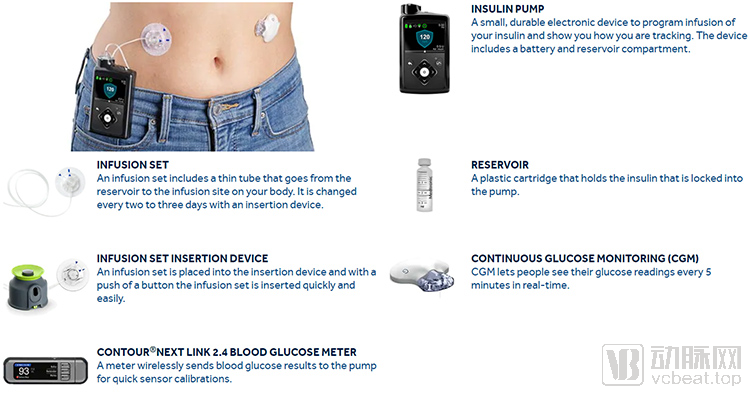
Composition of the Medtronic MiniMed 670G Artificial Pancreas, Source: Medtronic Official Website
Through decades of relentless research and market iteration, companies such as Medtronic, Tandem, Insulet, and Beta Bionics have achieved real-time automated control and adjustment of insulin infusion doses based on blood glucose data, which is regarded as the optimal solution for diabetes management and treatment at the current stage.
Technical and Market Challenges of the Artificial Pancreas
Despite the rapid development of artificial pancreas systems, challenges from both technological and market perspectives remain.
Taking the Tandem Control-IQ, which received FDA approval in December 2019, as an example, it represents the latest global technology in artificial pancreas systems; however, it remains far from truly mimicking physiological insulin secretion. Incorporating real-time monitoring of carbohydrate intake and exercise-induced energy expenditure, integrating these with continuous glucose monitoring (CGM) data, and leveraging algorithms to drive automated insulin delivery (AID) systems remain significant technical challenges yet to be overcome.
Furthermore, CGM systems also face technical challenges. A CGM system comprises three main components: a sensor, a transmitter, and a receiver. Among these, the sensor is the core component that directly determines the accuracy and stability of CGM measurements. Currently, CGM technology encounters difficulties in sensor membrane design, calibration algorithms, and enzyme immobilization techniques for sensors. For instance, the challenge with calibration algorithms lies in the non-constant discrepancy between the glucose concentration in subcutaneous interstitial fluid measured by CGM and the blood glucose concentration. Calibration algorithms must address measurement discrepancies caused by varying physiological states, sensor surface passivation and biofouling, and testing environments.
The ultimate ideal technology for CGM is non-invasive continuous monitoring. Non-invasive detection technologies have yet to identify the fundamental principles establishing a strong correlation between in vitro test indicators and blood glucose concentration. Although this area has remained a global R&D hotspot, its accuracy and reliability remain to be validated.
In terms of the market, due to factors such as affordability, wearing comfort, and product accessibility, out-of-hospital blood glucose monitoring among diabetic patients in China still primarily relies on fingerstick blood glucose meters. The overall penetration rate of continuous glucose monitoring (CGM) systems is less than 0.5%, significantly lower than the 25% penetration rate of fingerstick blood glucose meters. Meanwhile, although domestically produced CGM systems and insulin pumps have been under development for over a decade, they continue to face the challenge of lacking medical insurance coverage in the domestic market and encountering patent risks in international markets, which hinders further scaling.
If the artificial pancreas places greater emphasis on technical sophistication and therapeutic efficacy, then the management model for patients with type 2 diabetes requires a stronger focus on establishing and maintaining healthy lifestyle behaviors, as well as adherence to medical regimens.
Personalized reminders, intelligent recommendations, gamified entertainment incentives, and human-computer interaction based on individual data constitute the fundamental solution for this population: a digital diabetes management system featuring “smart devices + intelligent decision-making.”
Intelligent Monitoring Enhances Patient Retention and Engagement
Given the large population of patients with type 2 diabetes, management systems designed for these patients should achieve broad coverage and low cost, while also featuring high retention and high engagement.
In this digital management system that emphasizes patient self-management, blood glucose monitoring remains the most fundamental task. Currently, the vast majority of connected SMBG (Self-Monitoring of Blood Glucose) meters use Bluetooth connectivity, which facilitates registration, integration with other management systems, and connection to artificial pancreas systems. However, this approach has no direct correlation with patient retention and engagement.
To enhance patient retention and engagement, Dnurse’s first-generation mobile blood glucose meter, launched in 2014, achieved a cross-disciplinary integration of capillary blood glucose monitoring and audio communication technology. In addition to automatically recording blood glucose data in the diabetes management app, this device features a unique screen-less design. As a result, patients demonstrated significantly higher frequency and duration of engagement with the diabetes management app—four times greater than that observed with connected capillary blood glucose meters equipped with screens.
Similarly, the Dario blood glucose meter from the United States also adopts a similar audio or USB communication interface. The physical advantages of this technology are low cost, low power consumption, and convenient connectivity.
High retention and high engagement are key performance indicators for evaluating management effectiveness. Clearly, smartphone-connected blood glucose meters have effectively addressed the issue of patient adherence to self-management within digital diabetes management solutions. Such designs must also meet more stringent regulatory approval standards, specifically requiring joint registration and approval of the blood glucose meter and its accompanying mobile app. It is understood that Dnurse’s smartphone-connected blood glucose meter and app have obtained registration approvals from China’s National Medical Products Administration (NMPA, formerly CFDA) and CE certification, as well as FDA Class I registration for the app, and are exported to 15 countries and regions across Asia, Africa, and Latin America.
Furthermore, in July 2020, Dnurse launched the SPUG Blood Glucose and Uric Acid Tester, featuring dual testing capabilities for both blood glucose and uric acid in a single device. This facilitates comprehensive management for patients with comorbid diabetes and gout, while also meeting the needs of younger gout patients. The SPUG no longer uses a 3.5mm audio jack; instead, it features a modern Type-C communication interface, with a specially developed adapter cable provided for Apple devices.
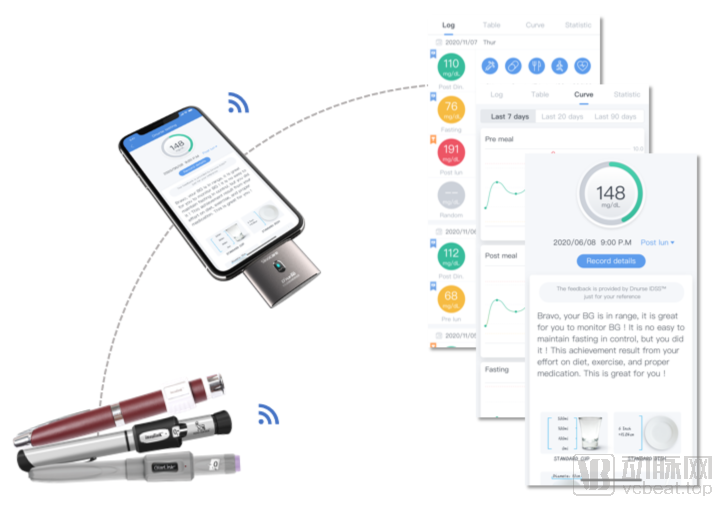
Dnurse’s fully automatic insulin injection dose counter, mobile blood glucose meter, and Dnurse App. Source: Public information
Intelligent Counting Enhances Patient Adherence
In the workflow of an artificial pancreas system, smart devices primarily address the patient’s question of “how much medication to administer.” In reality, “when and how much medication was administered” is equally important. Historical data not only enables patients to review their medication records—since patients in real-life settings may forget when and how much insulin they injected—but also allows family members, physicians, and other caregivers to monitor medication adherence. This facilitates timely reminders and encouragement for patients, as well as the adjustment of management plans by integrating other lifestyle and behavioral data.
Of course, data logging can also be achieved through smart solutions. Patient Pending developed Timesulin, a smart insulin pen cap that records the time of a patient’s last insulin injection. In 2017, Patient Pending was acquired by Bigfoot, and Timesulin was integrated into the Bigfoot Inject closed-loop insulin delivery system.
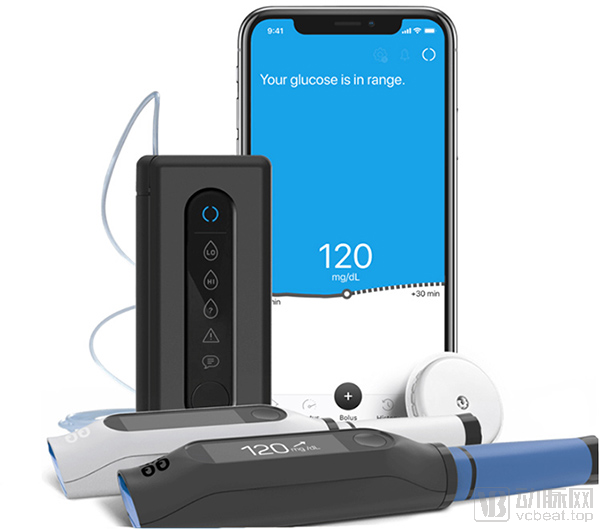
The Bigfoot Inject insulin closed-loop system, which utilizes a smart insulin pen cap product. Image source: Bigfoot official website
Unlike Bigfoot’s approach of integrating an ecosystem around technology and products, Dnurse has independently developed both its smart devices and intelligent decision-making systems. In October 2016, Dnurse launched insulinK, a fully automated insulin injection dose counter, in the United States. The device is designed to capture patients’ insulin injection behavior data and transmit it to the Dnurse app, where the intelligent decision-making system provides reminders, recommendations, encouragement, and interactive support to improve patients’ medication adherence.
Currently, insulinK has launched three models, compatible with Novo Nordisk’s durable Pen 4 and Pen 5, Eli Lilly’s HumaPen, and Sanofi’s Lantus pre-filled pen. Over the past two years, insulinK has served nearly 30,000 patients initiating insulin therapy, effectively reducing medication discontinuation rates among insulin users.
Whether through smartphone-based blood glucose meters or insulin injection dose counters, product model innovations have enhanced the collection of patient data, paving the way for more precise management plans. For patients, adherence to such tailored regimens is essential for stable glycemic control and reduced risk of complications. For pharmaceutical and medical device companies, these innovations boost sales of drugs and consumables among existing patients, delivering significant industry value.
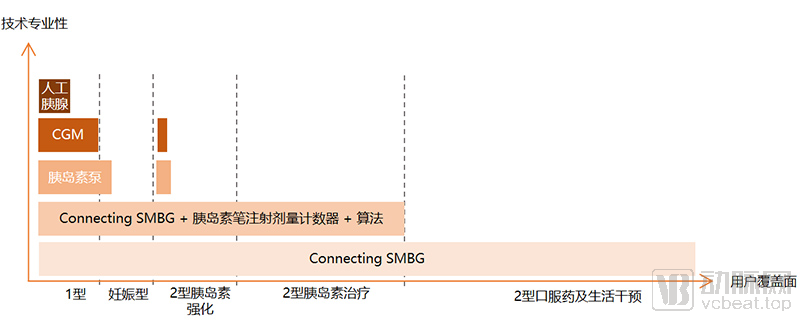
Differences in Technicality and User Coverage Among Various Devices for Digital Diabetes Management | Graphic by VCBeat
Based on the two major management models outlined in this article, artificial pancreas systems and their key components, such as continuous glucose monitors (CGM) and automated insulin delivery (AID) systems, represent a device-centric model that emphasizes technical expertise. In contrast, devices such as smartphone-connected glucometers and insulin dose counters exemplify a patient-centric model that prioritizes coverage. Regardless of the model, both rely on data collection via devices and leverage artificial intelligence to match users with personalized healthy lifestyle solutions. Characterized by efficiency and personalization, these approaches serve as the fundamental prerequisite for subsequent disease management.
For the 463 million diabetes patients worldwide and the 116 million in China, the supply of health interventions provided by healthcare professionals is far from sufficient, with manual interventions suffering from high costs and low efficiency. In digital management, both device-centric and patient-centric models can deliver significant value to their respective patient populations. Meanwhile, we have also identified key drivers such as technological barriers and critical innovation points within these two models, which are shaping the direction of continuous iteration in digital diabetes management.
Given that data and intelligent decision-making play equally critical roles in the “3D” framework alongside equipment, we will also review their related developments and applications in subsequent articles.