

Keya Medical Files for IPO After Securing China's First AI Class III Certification and Completing Four Funding Rounds in One Year
Keya Medical
International AI Medical Technology Service Provider
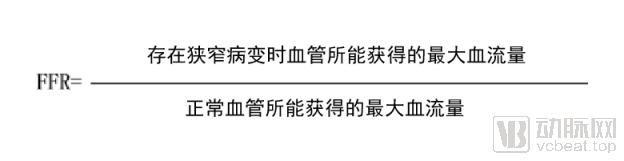
Fractional Flow Reserve (FFR) is a functional index for evaluating coronary hemodynamics. As the gold standard for assessing myocardial ischemia caused by coronary stenosis, FFR assists physicians in making precise diagnoses of coronary artery disease, reducing unnecessary coronary angiography, and facilitating better planning of treatment strategies for coronary artery disease.
Founded in 2007, Heartflow was the first to enter the CT-FFR segment of non-invasive FFR. Its FFRct analysis software received CE marking in 2011 and FDA clearance in 2014, rapidly expanding into markets such as the United States, Canada, and Japan in the following years.
However, despite the high accuracy of its computations, HeartFlow’s product still has certain limitations. Factors such as massive computational demands, lengthy processing times, and poor scalability of algorithmic models have, to some extent, hindered the widespread clinical adoption of its CT-FFR solution. As global demand for FFR continues to expand, these limitations have created opportunities for other companies to capture market share.
Keya Medical is a latecomer in this sector. Founded in 2016, this artificial intelligence company did not follow the mainstream trend toward fundus imaging or pulmonary nodule detection at the time. Instead, after recognizing market demand and the potential for product optimization, it decisively invested in the research and development of CT-FFR, aiming to address the limitations of existing CT-FFR solutions through deep learning.
In just two years, Keya Medical’s AI+ CT-FFR software, “DeepVessel FFR—Coronary Flow Reserve Fraction Calculation Software,” obtained CE certification from the European Union. In 2018, DeepVessel FFR entered the National Medical Products Administration (NMPA) Green Channel for Innovative Medical Device Approval, and ultimately received the NMPA Class III Medical Device Registration Certificate in January 2020 (Registration Certificate No.: Guo Xie Zhu Zhun 20203210035). Notably, this Class III certificate was the first AI-based imaging auxiliary decision-making device certificate issued by the Center for Medical Device Evaluation, marking a new phase in the commercialization of medical imaging AI.
It is now early 2021, one year since the issuance of the Class III medical device registration certificate. What has Keya Medical achieved over the past year, and what are its expectations? VCBeat had the privilege of interviewing Dr. Cao Kunlin, Vice President of R&D at Keya Medical, to discuss the company’s journey over the past year.
We often say that current medical AI should not indulge in unfettered speculation or fabricate demand out of thin air; instead, it should identify the right direction, integrate deeply into clinical workflows, clarify disease conditions, and deliver targeted solutions. Therefore, a viable track for AI in healthcare must incorporate both market demand and clinical need.
Keya Medical’s CT-FFR undoubtedly meets the clinical demand. Between 2013 and 2016, cardiology societies in the United States, Europe, China, and other countries successively affirmed the value of FFR in revascularization and in the diagnostic classification of certain types of coronary artery disease within their guidelines. During this period, guidelines in the United States and China stated: “The level of evidence supporting the use of FFR in stable coronary artery disease is Class I, Level A.”
Market Demand Trends: According to data from VCBeat Research Institute, the number of percutaneous coronary intervention (PCI) procedures in China reached 915,000 in 2018. The year-on-year growth rates of PCI volume over the years indicate an overall upward trend, suggesting a continuous increase in the number of patients with coronary heart disease in China. From 2011 to 2018, the compound annual growth rate (CAGR) of PCI procedures was 15.1%. Based on this trend, the number of PCI procedures in China is projected to reach 2.456 million by 2025.
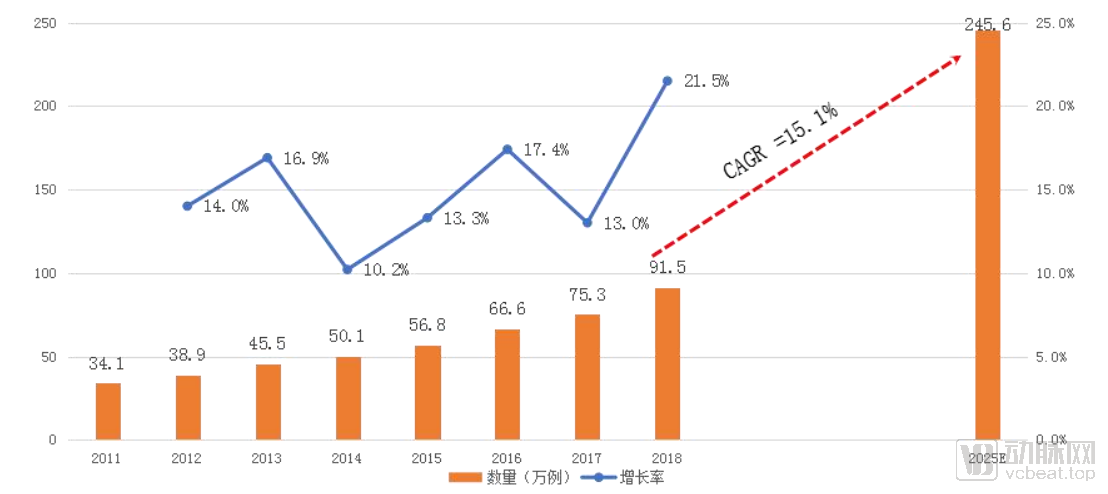
Volume of PCI Procedures in China, 2011–2025
Non-invasive FFR, led by CT-FFR, is gradually replacing wire-based invasive FFR in percutaneous coronary intervention (PCI) procedures and capturing a larger market share. Professor Hou Jiangtao from the Faculty of Medicine at The Chinese University of Hong Kong has stated that imaging-based FFR requires neither vasodilator drugs nor pressure wires and equipment. More importantly, it can be performed non-invasively or minimally invasively, significantly reducing patient pain during the procedure and effectively alleviating patient anxiety.
Meanwhile, image-based FFR can guide PCI treatment, reduce the number of unnecessary diagnostic coronary angiographies and stent implantations, and effectively avoid complications such as coronary artery spasm and perforation caused by invasive FFR. In addition, image-based FFR can also be applied in the treatment of multivessel disease, providing a basis for the selection of target lesions and the benefits of revascularization.
Beyond gaining insights into market demands, a “sense of mission” is equally vital for a life sciences company. At Keya Medical, this “sense of mission” stems from leading innovation in healthcare services.
Dr. Cao Kunlin told VCBeat, “When Keya Medical first entered the FFR sector, there were no mature non-invasive FFR solutions in China, whereas non-invasive FFR was already in the stage of development and widespread adoption in countries such as the United States, Europe, and Japan. This gave us strong motivation to bring better treatment options to patients in China.”
Secondly, we also aim to provide physicians with effective functional assessment tools. Therefore, while most companies were focusing on pulmonary nodules, Keya Medical began developing CT-FFR. We believe that products for pulmonary nodules assist physicians in image interpretation, primarily aiming to accelerate workflow; whereas CT-FFR offers clinicians a novel, non-invasive method for functional assessment, enabling evaluations that cannot be performed based on imaging alone, with the primary goal of enhancing clinical efficiency. Thus, the two differ in their clinical value.
Driven by demand and its mission, Keya Medical rapidly completed the development of DeepVessel FFR, thereby becoming the first company to obtain China’s first Class III medical device certification for an AI-based medical product. With this official endorsement, Keya Medical entered a fast track of development.
Keya Medical’s first round of financing in 2020 took place just one month after it obtained regulatory certification, with Kunlun Capital, Shanghai Guofang Fund of Funds, and Yahui Capital leading a Series B investment of over RMB 200 million. In August, GGV Capital, along with existing shareholders Kunlun Capital, Guofang Fund of Funds, and Yahui Capital, jointly participated in a follow-on investment, injecting an additional RMB 150 million into Keya Medical’s Series B+ round. However, the company remained in this funding stage for only three months before IDG Capital led its Series C financing in November, with Source Code Capital and Tasly Group, among others, participating as co-investors. On the last day of 2020, Keya Medical announced another milestone, securing over RMB 300 million in Series D financing from a consortium including CICC Capital, Shanghai Artificial Intelligence Industry Fund, Gaozu Asset, and Yonyou Medical Fund.
Within nine months, Keya Medical successfully completed four major rounds of financing, accumulating over RMB 900 million. In terms of both pace and scale, Keya Medical’s performance in the 2020 life sciences sector was undoubtedly top-tier. In retrospect, this success is closely tied to its rapid product commercialization and marketing strategy, which generated tangible revenue after it obtained China’s first Class III medical device certificate from the National Medical Products Administration (NMPA) for an artificial intelligence-based product.
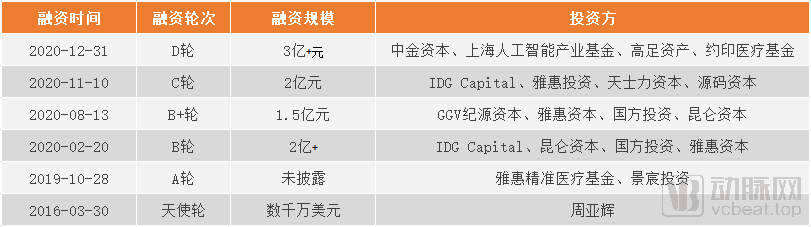
Keya Medical's Financing Path
In terms of product offerings, the DeepVessel FFR, developed based on deep neural networks and integrating patients’ individual imaging, anatomical, and physiological features, reduces Heartflow’s computation time from several hours to under 10 minutes. Meanwhile, the algorithmic model not only fully accounts for the structure of the vascular tree and performs global optimization, but also learns from complex lesions through training. It enables the calculation of FFR values at various points along the vascular tree, achieving precise FFR assessment and demonstrating strong concordance with FFR measurements obtained via pressure guidewires.
The “CuraRad-ICH” AI-powered imaging diagnostic system for hemorrhagic stroke, which received U.S. FDA 510(k) clearance in April 2020, demonstrates Keya Medical’s strength in multi-pronged development. Leveraging deep learning technology, this product can accurately and rapidly screen for acute intracerebral hemorrhage cases. It seamlessly integrates with hospital PACS systems, automatically elevating the priority of such cases to alert radiologists to prioritize diagnostic evaluation, thereby effectively reducing diagnosis and treatment time for stroke patients and saving lives.
“CuraRad-ICH” belongs to Keya Medical’s product portfolio for precision diagnosis and treatment of vascular diseases. In addition to this series, Keya Medical currently offers three major product portfolios comprising more than ten products, including those for precision diagnosis and treatment of oncological diseases and intelligent imaging-based diagnosis and treatment. Today, Keya Medical’s services cover both medical technology departments and various clinical specialties, integrating multi-omics information such as electronic medical records, imaging, pathology, biochemistry, immunology, and molecular diagnostics, thereby achieving end-to-end coverage of single-disease management from early screening and diagnosis to treatment.
Dr. Cao Kunlin stated, “Product line expansion may appear complex, but in reality, it is driven by the urgent needs of clinicians. For instance, AI-based medical imaging reconstruction of organs such as the liver and lungs enables both physicians and patients to clearly understand specific anatomical and physiological conditions. This allows doctors to formulate surgical plans with greater precision and efficiency, maximizing the resection of pathological tissues while minimizing damage to healthy tissues, thereby improving surgical outcomes—a benefit to both patients and healthcare providers.”
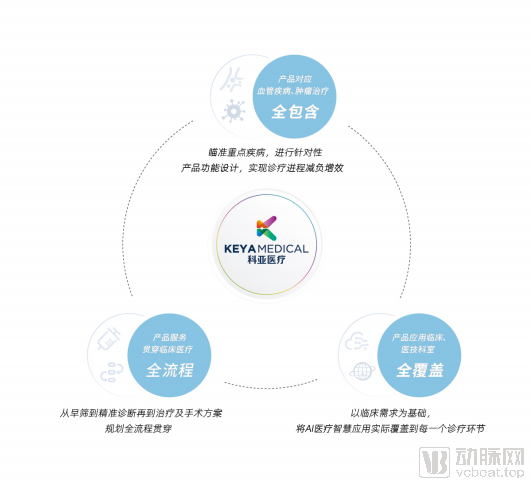
Meanwhile, there are certain commonalities among Keya Medical’s three major product series, enabling mutual support during the R&D process. For instance, while cardiology and neurology differ in their clinical applications, they share many underlying technologies. Consequently, the extensive development experience accumulated in cardiology can be rapidly applied to other circulatory system diseases, helping Keya Medical quickly expand its product portfolio.
"Keya Medical's team is rapidly expanding, bringing together industry elites with extensive experience in medical product development, as well as dozens of AI scientists with doctoral or postdoctoral degrees from prestigious universities both domestically and internationally. From R&D to registration and implementation, each product line is staffed accordingly, ensuring that all areas advance in tandem."
Commercialization is an inseparable aspect of the medical AI discourse. In 2020, amid the trials of the pandemic, while numerous AI healthcare startups were still exploring pathways for commercial implementation, Keya Medical successfully pioneered a new route for the commercial deployment of medical AI through its diversified product portfolio and AI solutions certified by authoritative institutions.
Over the past year, Keya Medical’s 150-member team has nearly doubled in size, with 65% of the new hires joining the sales team and 35% joining the R&D team. Its market footprint has also expanded significantly: from partnering with nearly 120 hospitals and establishing over 70 co-built centers at the beginning of the year, it now has product implementations across more than 30 provinces in China, collaborates with over 500 hospitals, has established more than 300 AI diagnostic centers, and serves a patient population of 22 million. In summary, following its Series B financing, Keya Medical rapidly captured the domestic market through effective promotion of its product applications.
When discussing this year’s development initiatives, Dr. Cao Kunlin continues to uphold “pragmatism” as the guiding principle for Keya Medical’s growth. “With multiple workstreams proceeding in parallel, we maintain careful deliberation in every decision we make. This ensures that we clearly analyze the development stage of each product and define its future trajectory. For products already approved, we will continue our efforts to include them in the price catalogs of healthcare institutions across more cities, while simultaneously expanding their clinical applications to maintain technological leadership. Furthermore, in the fields of cardiology, radiology, and surgical oncology, we plan to deliver more exciting advancements in the coming year.”
It is reported that multiple products across Keya Medical’s three major series have been refined to maturity, while the company’s product compliance initiatives are advancing rapidly and steadily. With established experience in securing CE, FDA, and NMPA certifications, Keya Medical is poised to obtain additional product approvals in the coming year. This will further accelerate its global market expansion, and, leveraging its strong development potential and high growth trajectory, the company is expected to generate greater commercial value and become an early entrant into the capital markets.