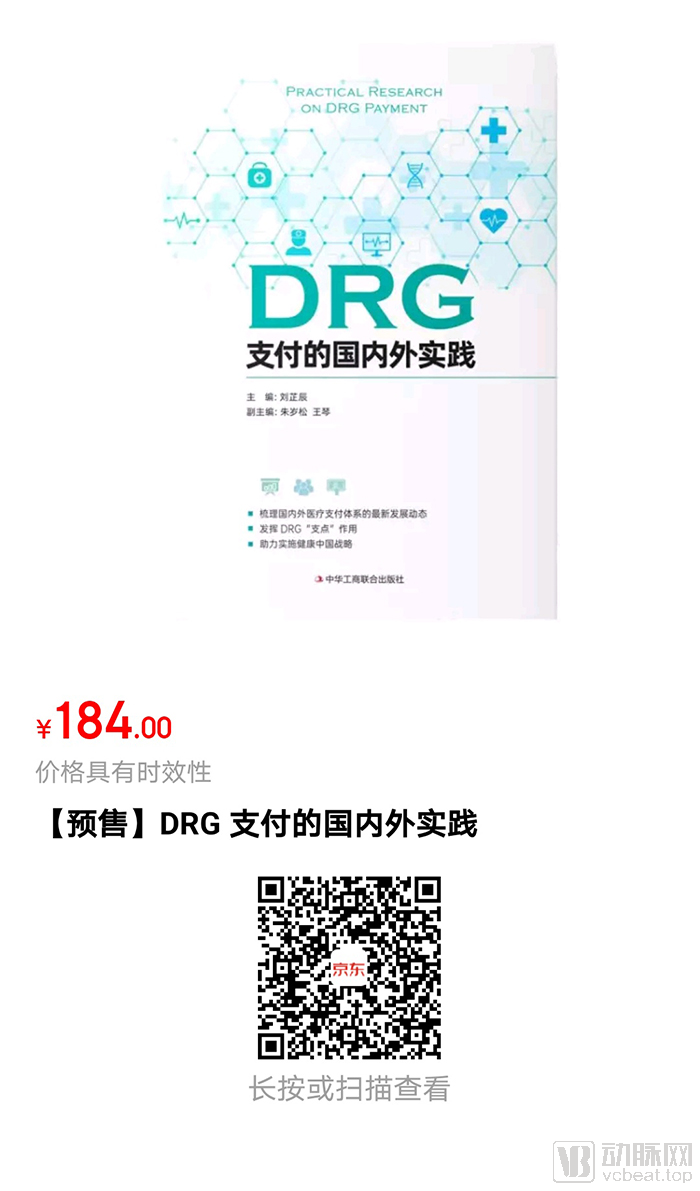
300,000-Word In-Depth Analysis: International and Domestic Practices of DRG Payment – Exploring the Ultimate Goal Behind DRG Payment
On January 8, 2021, the annual meeting of the Health Insurance Working Committee of the Chinese Society for Health Informatics and Medical Big Data (hereinafter referred to as the “Health Insurance Working Committee”) was successfully held online. The book *Domestic and International Practices of DRG Payment* (hereinafter referred to as the “White Paper”), edited by Dr. Liu Zhichen, Chief Expert in the Healthcare Industry at China Unicom Group, and jointly compiled by VCBeat (WeChat ID: Vcbeat), iShekang, and Peking Union Shenzhen Hospital of Huazhong University of Science and Technology, was officially released.
More than 100 participants attended the annual conference, including representatives from medical institutions, insurance organizations, the health industry, universities, and other branches of the society such as the Oncology Committee, the Smart Medical Care and Nursing Committee, the Elderly Health Care Committee, and the Human Resources Development Committee. Distinguished leaders who attended and delivered speeches included Jin Xiaotao, former Deputy Director of the National Health and Family Planning Commission and current President of the Chinese Society for Health Information and Big Data; Shang Jingguo, Secretary-General of the Insurance Association of China; Mao Qunan, Director of the Department of Planning, Development, and Informatization of the National Health Commission; and Zheng Jie, Director of the Beijing Medical Insurance Center.
This project aims to draw extensively on domestic and international experience and integrate the latest research findings from core experts in China’s DRG payment field, to jointly explore response strategies for all stakeholders in the industrial ecosystem under the transformation of DRG-based payment methods, thereby providing development recommendations for relevant ecosystem partners, including medical insurance authorities, health commissions, hospitals, commercial insurers, and pharmaceutical companies.
Throughout the advancement of the project, the leadership of the Chinese Health Information and Healthcare Big Data Society attached great importance to the research efforts and provided strategic guidance. President Jin Xiaotao personally wrote the preface for this report amidst his busy schedule, offering high praise for the research outcomes.

Jin Xiaotao, President of the Chinese Society for Health Information and Big Data in Healthcare
“This research project on ‘Domestic and International Practices of DRG Payment’ represents a collective effort by all participating parties. By integrating diverse resources from within and outside the industry, it provides an assessment of China’s healthcare reform policies, reviews the latest developments in domestic and international medical payment systems, offers a relatively objective trend analysis for industry development, and serves as a valuable reference for the healthy growth of the broader health industry. It proactively explores the construction of a medical and health service system centered on whole-life-cycle health management and accountability for individual health outcomes, leveraging innovative payment design to achieve ‘effective governance and high efficiency,’ thereby contributing to the early realization of the Healthy China strategic goals.” Thus remarked Jin Xiaotao in the preface to the white paper.
Dr. Liu Zhichen, Chief Expert in the Healthcare Industry at China Unicom Group, introduced the white paper as the representative of the research team and its editor-in-chief. Compiled over six months, the white paper synthesizes a vast array of case studies and practical experiences, incorporating insights from leading experts in core areas such as healthcare reform and medical insurance payment, as well as key ecosystem vendors. It stands as a testament to collective intelligence and collaborative effort.
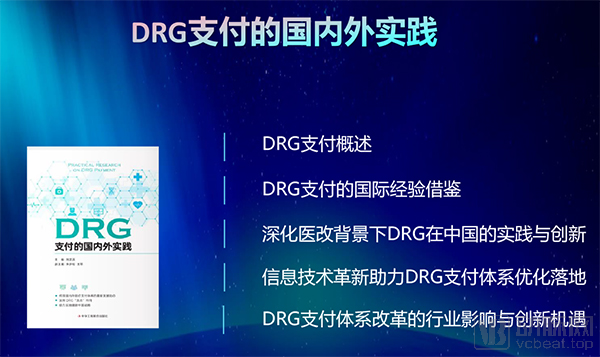
This white paper seeks to integrate the latest trends in national healthcare reform, the direction of public health system transformation prompted by the recent COVID-19 pandemic, and advanced international best practices. It also draws upon practical experiences from leading provinces and cities in China, as well as the diverse needs of ecosystem partners. From an objective and neutral perspective, it offers insights into the future direction and pathways for industry development, aiming to provide reference for decision-makers and guidance for all stakeholders, thereby promoting a more sustainable and virtuous cycle within the sector.
The white paper conducts an in-depth study of international practical experience, particularly focusing on the core technologies of Diagnosis-Related Groups (DRG) abroad. It systematically reviews key foreign technologies and places special emphasis on globally successful DRG payment implementation cases, such as those in Germany. The aim is to provide valuable references for China’s actual DRG payment practices, especially to address deficiencies identified during the DRG payment pilot programs.
The white paper posits that Diagnosis-Related Groups (DRGs) will serve as the pivotal lever driving transformative change across the entire healthcare industry. This shift will precipitate a profound restructuring of stakeholder interests, bringing about substantial changes in health insurance management models, regulatory frameworks overseen by the National Health Commission, operational and behavioral patterns of healthcare institutions, as well as the strategies of pharmaceutical and medical device manufacturers, insurance providers, and related industries.
Furthermore, the white paper’s research indicates that as more pilot cities fully implement substantive DRG-based payment in the future, numerous issues will still require joint exploration and effort across the entire industry. These include: the relationship between DRG payment and medical technological innovation, such as how to resolve conflicts between DRG payment and innovative drugs and therapies; the coordination and integrated oversight of DRG payment alongside other composite and diversified payment methods, such as those for outpatient services and long-term hospitalization; the standardization of healthcare institution behaviors under DRG payment and the regulation of potential moral hazards and compliance violations; and how DRG payment can facilitate the development of China’s future integrated healthcare service system and multi-tiered medical security system, ultimately realizing the visionary goal of value-based healthcare.
In addition, Ms. Qian Yun, Vice President of Pfizer Biopharmaceuticals Group China, and Ms. Zhang Wei, Vice President of Market Access and Government Affairs at Xi’an Janssen Pharmaceutical Ltd., also spoke highly of the white paper.
This white paper is based on the postdoctoral research findings of Dr. Liu Zhichen, Chief Expert in the Healthcare Industry at China Unicom Group and a postdoctoral fellow at Fudan University, as well as the technical achievements of Director Zhu Suisong from Union Shenzhen Hospital of Huazhong University of Science and Technology during Shenzhen’s DRG payment pilot programs and hospital implementation practices. Furthermore, this publication was developed under the leading guidance of the Health Insurance Working Committee of the Chinese Society for Health Informatics and Medical Big Data, and co-authored by core research teams from two leading healthcare think tanks—VCBeat and iShekang. It aims to consolidate perspectives from key experts in healthcare reform and medical insurance payment, as well as ecosystem vendors, representing a collective effort and shared wisdom across the industry.
The first-generation DRG system was developed in 1967 by Robert B. Fetter and his team at Yale University in the United States (hereinafter referred to as “Yale DRG”). Since then, it has been gradually applied in healthcare management research. It is a quality management tool designed to help clinicians and hospitals monitor service quality and utilization.
In the late 1970s, Yale DRGs were applied in a pilot reform of the payment system in New Jersey, USA, and subsequently underwent revision. During the revision process, significant adjustments were made to both the coding system and the grouping rules of the DRGs; in particular, the inclusion of clinicians in the development team greatly enhanced the “clinical acceptability” of the revised DRGs.
At this point, the DRG grouping process is essentially finalized, consisting of three steps:
Step 1: Classify the majority of cases into “Major Diagnostic Categories (MDCs)” based on anatomical systems, a process that typically relies solely on the primary diagnosis code;
Step 2: Subdivide MDCs into Adjacent Diagnosis-Related Groups (ADRGs). This process utilizes both the principal diagnosis code and the principal procedure code (for an introduction to principal diagnosis codes and principal surgical procedure codes, i.e., ICD codes, see Section 1.4.1);
Step 3: Further subdivision from ADRGs into DRGs, a process that utilizes additional diagnoses and procedures, as well as other variables reflecting individual patient characteristics.
In 1983, the U.S. Congress enacted legislation to incorporate the HCFA-DRG system—comprising 23 Major Diagnostic Categories (MDCs) and 470 DRG groups—into Medicare payment mechanisms, thereby initiating practical exploration of the DRG-based payment model. Subsequently, DRGs were gradually adopted by European countries, Australia, and select Asian nations and regions for healthcare service management. A 2003 research report indicated that more than 25 countries and regions worldwide had implemented DRGs. With further developments in recent years, it is estimated that over 30 countries and regions globally currently utilize DRGs.
As Diagnosis-Related Groups (DRGs) have been introduced and implemented across various regions worldwide, multiple localized DRG versions have emerged, such as Australia’s AR-DRG, the Nord DRG used in Nordic countries including Finland, the UK’s HRG, France’s GHM, and Germany’s G-DRGs. Meanwhile, continuous development of domestic DRGs in the United States has yielded several variants, including CMS-DRG, AP-DRG, and APR-DRG. According to incomplete statistics, there are currently more than 25 such versions, collectively forming what is known as the “DRG family.”
Within the DRG family, the Beijing version of DRG (BJ-DRG), developed and completed in China in 2008, was primarily modeled after the US AP-DRG and the Australian AR-DRG. In 2014, BJ-DRG was upgraded to CN-DRG. Subsequently, China has successively developed several DRG grouper systems. On one hand, different versions of DRGs exhibit significant variations due to differences in their operational objectives and focal points. Some versions are suitable for clinical performance evaluation, while others are used for health insurance payment.
From a broader perspective, China requires a unified version. This is particularly critical in the context of healthcare insurance payment reform, where the newly established National Healthcare Security Administration bears the crucial responsibility of ensuring the sustainable development of healthcare insurance funds, with payment reform being one of the most important measures. Therefore, a nationally unified DRG version is necessary. Against this backdrop, CHS-DRG (CHS stands for China Healthcare Security) was introduced and is planned to be piloted in 30 cities.
On October 16, 2019, the National Healthcare Security Administration officially released two technical standards: the Technical Specifications for DRG Grouping and Payment under the National Healthcare Security System and the National Healthcare Security DRG (CHS-DRG) Grouping Scheme. Integrating the core strengths of the BJ-DRG, CN-DRG, and CR-DRG versions, CHS-DRG comprises 376 Adjacent Diagnosis-Related Groups (ADRGs) (ADRG 1.0), covering more than 30,000 diagnosis codes and over 13,000 procedure codes, with a total coverage of 73,350 items. It essentially encompasses all critical and severe conditions treated within 60 days. Subsequently, on June 18, 2020, the National Healthcare Security Administration issued Version 1.0 of the CHS-DRG Subgrouping Scheme, which further subdivided the 376 ADRGs into 618 subgroups.
Considering the disparities in economic and technical development across different regions, pilot cities may either directly adopt the 618 subgroups or adjust the subgroups while maintaining the CHS-DRG ADRG grouping framework. Among the subgroup schemes announced for the 30 CHS-DRG pilot cities, 11 cities have directly adopted the 618-subgroup scheme of CHS-DRG, while the other pilot cities have optimized their subgroups based on local characteristics. As planned, CHS-DRG will gradually adjust local subgroups over the years following formal implementation, ultimately leading to a gradual convergence of subgroups across all pooling regions nationwide. This will, of course, be a long-term and incremental process.
In July 2020, the National Healthcare Security Administration (NHSA) introduced the Diagnosis-Intervention Packet (DIP) payment method and completed research on the Technical Specifications for Big Data-Based Diagnosis-Intervention Packet (DIP) Payment. In November 2020, the NHSA announced pilot initiatives in 71 cities to implement a diversified composite payment system that combines regional global budgeting for medical insurance with big data-based DIP payment. On November 20, the NHSA released the DIP Technical Specifications and the DIP Disease Catalog Database (Version 1.0).
The compilation of the National Healthcare Security Administration’s DIP Catalog (Version 1.0) was based on preliminary work conducted in regions such as Shanghai and Guangzhou, supplemented by data from ten representative provinces and municipalities across eastern, central, and western China. This effort aggregated nearly 60 million data samples, covering total medical service expenditures of approximately RMB 700 billion.
Data coverage periods vary across regions, with the longest spanning from 2013 to the present, initially forming a sample of medical service data representative of typical areas nationwide. Through data integration and cleaning, cases lacking disease diagnoses and a small number of cases with abnormal surgical procedure records were excluded. Clustering was then performed using the first four digits of the insurance-version disease diagnosis codes and surgical procedure codes. Based on common characteristics of diseases and treatment modalities, these were grouped to form a master catalog. Currently, Version 1.0 of the DIP Disease Catalog uses a threshold of 15 cases to divide the master catalog into approximately 11,553 core disease groups and 2,499 comprehensive disease groups.
Currently, China has established a composite payment model in health insurance reimbursement that simultaneously employs CHS-DRG and DIP, and these two systems will coexist for a considerable period in the future. Going forward, they are expected to complement each other’s strengths and weaknesses, gradually integrating to ultimately forge a composite health insurance payment system with distinct Chinese characteristics.
This publication is now officially on sale. Interested buyers may scan the QR code below to purchase.