

Baidu Health Files for IPO Amid Fierce Competition in China's Digital Healthcare Sector
"It was the best of times, it was the worst of times." This famous quote by Charles Dickens is equally applicable to today's booming internet health sector.
The reason it is described as the best is that, since the rise of the mobile internet, a group of industry pioneers seized the dividends offered by this emerging trend, further bolstered by policy support and the catalytic effect of the pandemic.The overall market space has been significantly expanded.IQVIA’s white paper, “Breaking the Cocoon: The Internet + Healthcare White Paper,” predicts that the market size of internet healthcare will exceed RMB 160 billion by 2023.
To say it is the worst lies in the fact that the internet health sector has experienced several waves of rise and fall over the past decade.LargeMany startups vanished in the torrent of the times before witnessing the industry’s dawn.. According to incomplete statistics based on publicly available data, more than a thousand internet health companies have gone bankrupt since 2015. This is primarily because the industry’s profit margins remain thin, and its business models have yet to be proven viable.
In a market environment of “ice and fire,”Internet giants such as Alibaba and JD.com, leveraging their traffic and capital, have entered the fray, engaging in fierce competition across online and offline channels, from B2B to B2C.. It is worth noting that since the beginning of last year,Baidu’s Moves in the Healthcare Sector Return to the Public Eye. Whether through the launch of anti-epidemic measures during the pandemic or by providing users with one-stop services ranging from health science popularization to medical consultations, Baidu Health has undoubtedly attracted significant attention.
However, in the face of numerous challenges in the internet healthcare sector and increasingly fierce competition, does Baidu Health still have opportunities? If so, how significant are they?Answering this question not only examines whether Baidu Health can secure its position in the market, but also explores whether there are greater possibilities beneath the surface of the internet healthcare sector.. If so, what would it be?
Therefore, it is time to take the pulse of Baidu Health.
Next, you will see:
1. Is there still opportunity in the internet health sector where Baidu Health operates?
2. What is Baidu Health’s moat?
3. What are the monetization channels of Baidu Health?
To assess whether a company has potential, one must first examine whether its chosen sector still offers sufficient market space and whether it has a business model capable of delivering solid returns.
Internet healthcare, which Jack Ma believed would disrupt the traditional health and wellness industry, was once highly anticipated by industry players. For instance, in 2014, dubbed the “Year One of Internet Healthcare,” the number of companies related to internet healthcare surged to over 5,000 within a single year, with total financing reaching approximately $7 billion. However, the subsequent outcome is well known: many pioneers failed and retreated, and investments worth hundreds of millions of yuan were lost. People cannot help but ask,What Exactly Went Wrong in the Internet Health Sector?
Looking back, the internet health industry has encountered challenges in its development due to various factors such as policies and market awareness.Two Bottlenecks“First, sustainable commercialization; second, the profitability outlook remains unclear,” Marco Ma, Vice President of Investment at Northern Light Venture Capital, told VCBeat.
This implies that,Internet healthcare is not simply a matter of transferring hospital functions to the online space., but rather requires breaking down information barriers and eliminating information asymmetry, and then promoting a supply-demand balance between the provision of medical resources and the demand for medical services by optimizing the supply-demand dynamics across the industry’s value chain. To achieve this goal in a sustained and effective manner,In addition to technological empowerment, internet health practitioners also need to establish a sound business model with a closed-loop structure.
To this end, pioneers in the internet health industry are continuously delving deeper into the sector, branching out into new directions, with some business models having undergone preliminary validation. Among them,Internet hospitals, pharmaceutical e-commerce, and internet-based health management are the primary forms of internet health business at the current stage.
Let the Data Speak.
Internet HospitalIt has achieved rapid development in the past two years. From the supply side, no more than 100 new internet hospitals were established annually between 2016 and 2018. Since 2019, internet hospitals in China have experienced rapid growth; as of October 2020, nearly 900 internet hospitals had been launched. From the demand side, online consultations at hospitals under the administration of the National Health Commission increased by 17-fold year-on-year last year, while online consultation services on some third-party platforms grew by more than 20-fold.
Pharmaceutical E-commerceBenefiting from factors such as the outflow of prescriptions and clearer policies, its market size continues to grow. According to a report by Southwest Securities, in 2019, online retail pharmacy sales accounted for only 3.63% of the pharmaceutical/non-pharmaceutical market, with a market size of approximately RMB 105 billion. As user education penetrates deeper into lower-tier markets, the online penetration rate is expected to rise to 11.1% by 2025, creating an additional market space of RMB 454 billion.
Internet Health ManagementIn recent years, increasing public attention, coupled with the elevation of full-lifecycle health to a national strategic priority, has heightened market activity. According to data from the VCBeat Orange Database, a total of 132 primary-market financing and investment transactions occurred in the health management sector from 2018 to the first quarter of 2020, with capital inflows amounting to approximately RMB 5.9 billion.
It is evident that, after years of turbulent development, the internet health sector has achieved certain results. In particular, internet hospitals and pharmaceutical e-commerce have realized robust commercialization, while internet-based health management also shows promising prospects from the current perspective. Furthermore, the growth potential of the internet health sector remains substantial. Therefore,The internet health sector remains a “good business,” with new entrants still having promising opportunities.Currently, Baidu Health is also primarily strategizing around these commercial pathways.
The track is fine; now it’s time to watch the racers.
In the internet healthcare sector, the currently listed companies Ali Health, JD Health, and Ping An Good Doctor all have aA common feature is that they are all extensions of internet giants into the broader healthcare sector.In contrast, the achievements of other internet startups are underpinned by a decade or even two decades of deep cultivation and accumulated experience.
Why can internet giants rapidly enter the market and achieve swift growth? This is because, in addition to their financial strength,Internet giants have built robust foundational capabilities within their core areas of strength, which can generate significant ecosystem synergies as they enter the internet healthcare sector., such as supply chains and insurance payments. Startups may not necessarily have these capabilities.
Let's take a look at Baidu Health. As the world's leading Chinese-language search engine,Baidu commands massive traffic entry points: hundreds of millions of health-related inquiries are fed into Baidu’s big data backend every day.The result is twofold: first, users have an inherent demand for medical content; second, these demands serve as a precise lever for Baidu to understand user pain points.
From this perspective, it is not difficult to understand why Baidu Health has invested heavily in its product, Baidu Health Medical Encyclopedia. HoweverThe commercialization of popular science knowledge in the current market is not as glamorous as imagined.This is because the production and dissemination of popular science knowledge is a labor-intensive endeavor, making it difficult to achieve scalable production or rapidly improve labor efficiency in commercialization. Furthermore, the secondary development of popular science content significantly tests the business acumen of operating institutions.
How does Baidu Health’s approach to creating its medical encyclopedia differ from traditional methods?The key lies in the underlying logic.. Specifically,The content provided by Baidu Health Medical Encyclopedia is guided by the search results of hundreds of millions of users.In other words, each health entry is driven by high-priority questions raised by users on Baidu, enabling the content of Baidu Health Medical Encyclopedia to better align with user needs and cover user concerns as comprehensively as possible.
Moreover, given the specialized and unique nature of medical knowledge, content development cannot rely on user-generated content (UGC), a model that struggles to ensure quality. Based on publicly available information,Baidu Health Medical Encyclopedia has established an expert-centric content production system.. In terms of team structure,Experts are classified into three tiers.. Tier 1 (S-tier) comprises academicians, including Academician Zhong Nanshan and Academician Li Lanjuan; Tier 2 (A+-tier) corresponds to the level of hospital presidents or chairpersons, typically referring to those serving as chairpersons of specific specialties within the Chinese Medical Association and the Chinese Medical Doctor Association; Tier 3 (A-tier) includes department directors and doctoral supervisors from the top three departments ranked among major hospitals in authoritative hospital rankings.
Guided by user needs and bolstered by extensive expert resources, these two dimensions establish the precision and authority of Baidu Health Medical Encyclopedia.By connecting users with physicians, Baidu Medical Encyclopedia has established a “two-way loop” channel: on one hand, users can access reliable and trustworthy medical knowledge on the platform; on the other hand, this knowledge is sourced from authoritative physicians who amplify their professional influence by sharing insights through the Baidu Health Medical Encyclopedia platform. It is evident that Baidu Health has built a bidirectional bridge linking users and physicians, thereby facilitating its subsequent expansion into healthcare services.
It can be seen from here that,The Value of Baidu Health Medical Encyclopedia Lies in Its "Two-Way Cycle", which means that unlike traditional content providers, Baidu Health Medical Encyclopedia can promptly respond to users' recent health information needs based on Baidu search data, while also providing high-quality physicians with opportunities for visibility. Under this logic,Baidu Health Medical Encyclopedia has addressed longstanding challenges in traditional science communication—such as content authority, user stickiness, and physician loyalty—thereby establishing a competitive moat.
For example, during the COVID-19 pandemic last year, when Baidu Health launched the first online medical encyclopedia entry on COVID-19, it was revised by experts on the front lines in Wuhan. In the early stages of the epidemic, this entry received hundreds of millions of searches each month, addressing the basic cognitive needs of a vast number of users regarding COVID-19.
Therefore, from the perspective of commercialization pathways, during the phase of rapid development in the internet health sector,Authoritative, professional, and targeted health science popularization content is undoubtedly a crucial gateway for user traffic; in the long run, it also serves as an entry point with sustainability and a moat effect.On this basis, by clarifying user needs and gradually building trust, users will naturally transition from using “Medical Reference” services to those such as “Ask a Doctor.”
A rough estimate based on public information shows that Baidu receives over 200 million health-related content searches per day. IfAt a 1% conversion rate, there would still be 2 million pieces of content per day that can be directly converted into services, which undoubtedly provides a boost for subsequent commercial monetization.
In summary, Baidu Health Medical Encyclopedia serves as a key content driver and traffic gateway for Baidu Health, while also establishing a competitive moat for its entire health ecosystem.
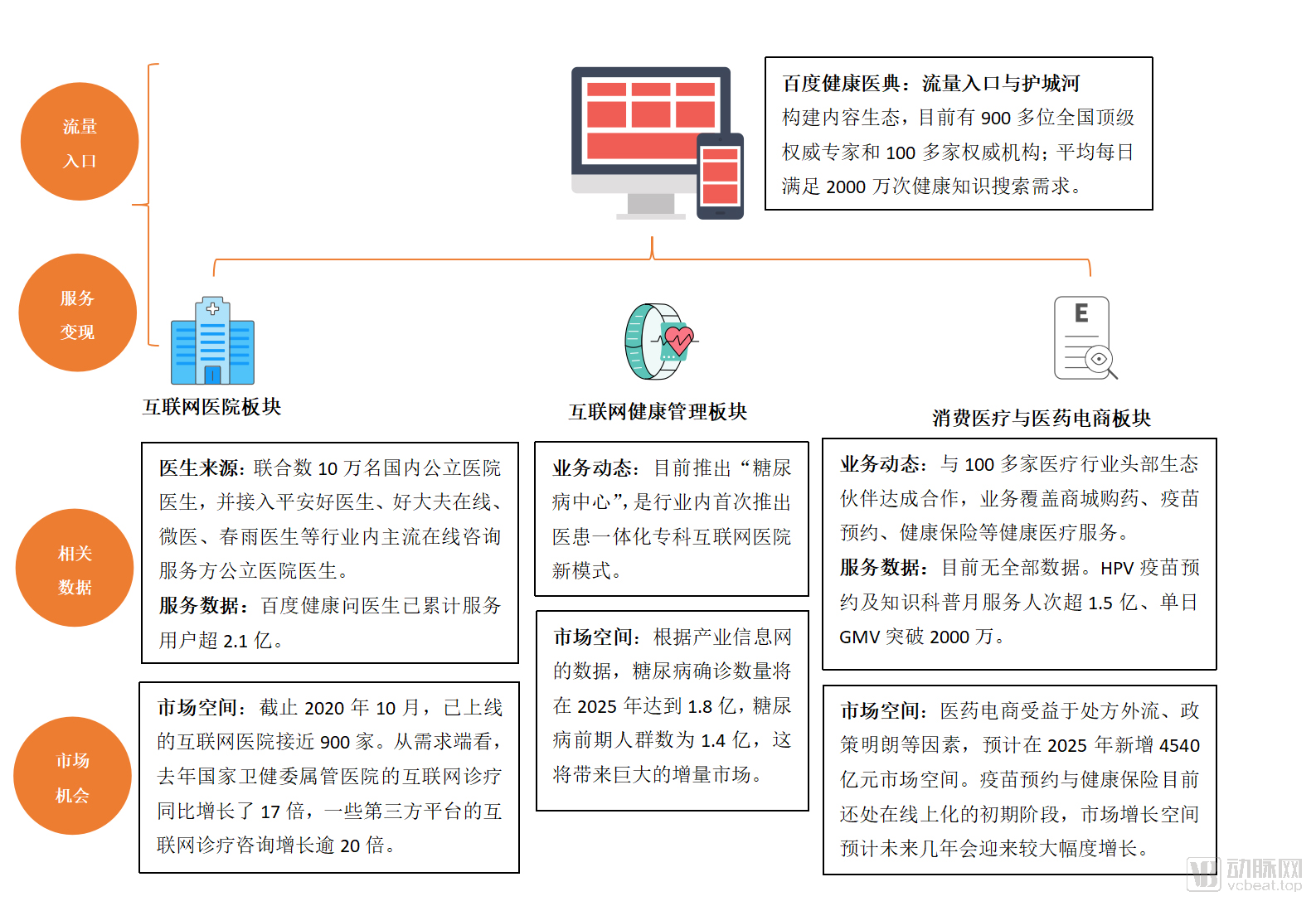 (Baidu Health’s Strategic Layout, Chart by VCBeat)
With access to traffic entry points, the next step is to address how to convert this traffic.Baidu Health’s approach is to expand into diversified service scenarios., including online consultations, appointment scheduling, online pharmacy services, and health insurance.
Explore online consultations. As a core component of internet hospitals,A key indicator of online medical consultations is whether there are sufficient physicians to meet patient demand.Baidu Health obtained its internet hospital license from Hainan Yilai in April last year. Public data shows that more than 100,000 doctors have joined the Baidu Health platform, which has cumulatively served over 210 million users. This undoubtedly expands the market potential for Baidu Health’s commercialization strategy. According to data from the National Health Commission, the total number of medical consultations reached 8.72 billion in 2019, while online consultations accounted for approximately 270 million, indicating substantial growth room. The market size of online consultation services in China is projected to reach RMB 68 billion by 2022 (data from AskCI Consulting).
Notably, accelerated by the pandemic, public medical institutions have also moved their services and access points online.Baidu Health has therefore partnered with select public tertiary Grade A hospitals and leading regional hospitals to co-establish internet hospitals, thereby empowering traditional medical institutions through technology.From this strategic opportunity, Baidu Health will leverage the timing of public hospitals launching internet hospitals to continuously expand its physician coverage.
In addition to Internet hospitals,Baidu Health is also expanding into diversified e-commerce services, including online medication purchases, vaccine appointment and administration, and nucleic acid testing reservations.. Taking vaccine services as an example, Baidu Health announced a strategic partnership with Rainbow Doctor last December. Rainbow Doctor provides online vaccine appointment scheduling and health prevention management services, which have been fully integrated into Baidu Health. Users can enjoy high-quality, one-stop online vaccine appointment services on the Baidu Health platform.
“Since 2016, the cumulative number of users who have vaccinated through Rainbow Parenting has exceeded 500,000,” Tian Guoliang, founder of Rainbow Parenting, told VCBeat. He noted that the online vaccine appointment market is still in its early stages, with substantial room for growth. “From the perspective of user demand, as mobile internet becomes more widespread, people are increasingly accepting the practice of booking vaccine appointments online. They can schedule an appointment on their smartphones whenever it comes to mind, regardless of the time. On the other hand, from the supply side,”"China approves and releases approximately 500 to 700 million vaccine doses annually, with adult vaccines accounting for about 40%. The demand for online vaccine appointment services among this population continues to rise."
With demand and supply in place, the next step is to address the challenge of limited offline vaccination sites.“Vaccinations should be administered at reputable offline institutions. Currently, the number of vaccination sites is limited, and public hospitals are operating near capacity. Therefore, how to efficiently and rapidly meet user demand, enabling offline institutions to handle a greater volume, is what we aim to address in collaboration with Baidu Health,” stated Tian Guoliang. He emphasized that by leveraging Baidu Health’s precise user traffic and Rainbow Doctor’s nationwide service reach, both parties can capitalize on their respective strengths and maximize the ecosystem synergies in online vaccine appointment services.
In addition to scaling up in niche markets together with ecosystem partners, Baidu Health is also actively laying out its internet health management services.In August last year, Baidu Health launched the “Diabetes Center,” leveraging the advantages of Baidu’s big data and AI technologies to create an innovative service model featuring precise “diagnosis and treatment + health management.” This marked the industry’s first introduction of a new model for specialized internet hospitals that integrates doctors and patients into a unified system.
It is worth noting that diabetes management has become a hot sector in the healthcare market in recent years, especially for solutions that can efficiently connect physicians, patients, pharmaceuticals, and smart hardware.Internet-Based Diabetes Management Is in a Phase of Rapid DevelopmentAccording to data from the Industrial Information Network, the number of diagnosed diabetes cases is projected to reach 180 million in 2025, with 140 million individuals in the prediabetic stage, thereby creating a substantial incremental market.
From the perspective of pathways,Baidu Health is implementing the currently mainstream business model in the internet healthcare sector, which involves gradually extending from addressing information needs to deeper levels of medical services.Among these areas—whether internet hospitals, pharmaceutical e-commerce, internet-based health management, or collaborations with ecosystem partners to expand into fields such as online vaccination—Baidu Health’s market potential continues to grow steadily. This reflects Baidu’s strategic shift from connecting “people and information” to connecting “people, information, and services.”
It is evident that Baidu Health leverages its medical encyclopedia content as both a competitive moat and a traffic gateway for its ecosystem, and has successfully established a closed-loop health service model by deploying internet hospitals and deepening its presence in pharmaceutical e-commerce on the service side. Of course,, The big health industry differs from other industries, as it has its own development patterns and characteristics.Therefore, for all market entrants, how to achieve steady and long-term growth in the unique health and wellness industry is a critical issue that demands thorough research and careful deliberation.