

Where Lies the Capability Boundary of Medical SaaS in Challenging Traditional Healthcare IT?
“It’s often joked that ‘laziness’ is the greatest driver of scientific progress,” a wry commentary on the conveniences technology brings to consumer-facing (C-end) markets, which offers an ingenious interpretation of demand-driven markets. Today, the trend toward simplification is equally prevalent in internet-based business-to-business (B2B) services.
Breaking away from the previously deliberate trend toward complexity, “user-friendly” SaaS solutions strive to strip away all redundancies unrelated to “service,” enabling customers to enjoy services at the lowest cost and with the greatest convenience. Amid the pandemic, the SaaS wave has swept through healthcare informatization.
Setting up server rooms for temporarily constructed fever clinics and makeshift hospitals is complex and time-consuming, making cloud-based Hospital Information Systems (HIS) the preferred choice for many temporary medical facilities. Policy initiatives are driving hospitals to launch internet hospital platforms; however, given uncertain returns, hospitals tend to adopt lower-cost Software-as-a-Service (SaaS) solutions to pilot internet hospital operations. Amidst the wave of building medical alliances and medical consortia, primary healthcare institutions—lacking funding and talent for IT infrastructure—are turning to SaaS models for their digital deployment.
The surge in diverse demands has propelled the development of medical SaaS to the forefront, positioning it as a disruptive force in healthcare informatization. However, attributing its internal drivers solely to “the pandemic effect” or “cost pressures” is an oversimplification. To uncover the underlying logic, we must clarify fundamental questions: What is medical SaaS? What problems can it solve? Who are the key stakeholders involved?
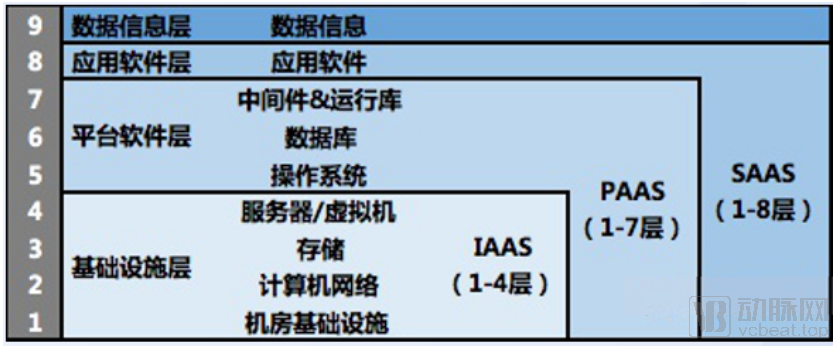
From a structural perspective, healthcare IT services are divided into nine layers. Layers 1–4 are referred to as the infrastructure layer, which, as the name suggests, encompasses servers/virtual machines, storage, computer networks, and data center facilities. Above this lies the platform software layer (Layers 5–7), including the operating system that serves as the foundation for software execution, databases, middleware, and runtime libraries. The eighth layer is the application software layer, covering internet hospital services, online consultation services, and prescription workflow services. The remaining ninth layer is the data information layer.
Generally, traditional software service providers offer services at Layers 5–7, requiring users to deploy the infrastructure layer themselves. What SaaS aims to do is to provide a bundled package of services spanning Layers 1–8, enabling users to focus solely on actual application performance and data information management at Layer 9.
However, the idea of providing software services to enterprises in a bundled package has likely been attempted before. The reason it has not been realized until now is the lack of a centralized storage mechanism to aggregate infrastructure distributed across various enterprises.
The emergence of cloud computing and the iterative advancement of mobile communication technologies have provided the necessary conditions for the rise of Software-as-a-Service (SaaS). Many B2B enterprises have since begun to build cloud-based services, leveraging this foundation to develop various bundled service offerings, thereby driving the ascent of the SaaS model.
The development of medical SaaS has lagged slightly behind that of other industries. This is because, under the SaaS model, data security is typically managed by the SaaS service providers, which is somewhat unacceptable in the healthcare sector, where data privacy and security are held in particularly high regard. Therefore, to ensure data security and alleviate the concerns of healthcare institutions, cloud service providers must continuously update their security strategies, entailing substantial and ongoing cost investments.
Core security concerns, along with the emergence of new technologies such as 5G and AI, are driving further specialization within the medical SaaS industry. SaaS providers, primarily startups, are increasingly focusing on software development, while internet giants are seizing opportunities to enter the market by offering industry-specific solutions and building cloud service ecosystems.
Taking Tencent as an example, its strengths lie in its well-established security architecture and industrial internet ecosystem, both of which have built a foundation of trust for the informatization of medical institution management.
Under the traditional model, users require software but are compelled to deploy customized infrastructure to support its operating environment, installing the software on designated devices. In contrast, the SaaS model leverages cloud storage for centralized infrastructure deployment, shifting the deployment burden from users to SaaS providers, thereby simplifying user preparation. Technological advancements have driven a transformation in service models, with the traditional “software-centric” approach evolving toward a “service-centric” paradigm.
Such a transformation brings many benefits. First, it eliminates the inefficiencies and costs associated with redundant infrastructure deployment. Second, for hospitals, deploying software typically involves steps such as hardware and software procurement, infrastructure setup, software installation and configuration, and go-live testing, which often takes weeks. In contrast, the SaaS model provides a tested, mature solution that can be deployed quickly and used immediately upon activation.
Song Chunling, Chief Solutions Architect and Head of Industry Operations at Tencent Smart Healthcare, further elaborated on the rapid deployment capabilities of SaaS: “In niche sectors such as internet hospital operations and elderly care, SaaS solutions can be deployed and launched within a week. For more complex projects, such as the construction of large-scale smart hospitals, the implementation timeline typically averages around one month, with all services fully operational within no more than three months.”
From a cost perspective, when hospitals acquire a Hospital Information System (HIS), the expenses include initial infrastructure investment, software costs, and annual service fees, which can be regarded as a one-time investment. Subsequently, hospitals must bear the depreciation risk caused by environmental changes and the opportunity cost associated with the upfront capital outlay. In contrast, the Software-as-a-Service (SaaS) model adopts a subscription-based payment structure according to the types and duration of services used. This eliminates the need for users to pay for hardware, network equipment, and software upgrades, thereby alleviating the financial burden on small and medium-sized medical institutions and shielding them from depreciation risks.
Certainly, this model has its pros and cons. Under the traditional model, service providers tailor software functionalities and forms to the specific circumstances of hospitals, addressing issues from a detailed perspective—for instance, selecting features based on departmental workload and priority. Systems built in this manner tend to align well with actual needs and existing systems. In contrast, the flexibility of the SaaS model stems from its inherent weak integration with legacy systems, which is both a drawback and an advantage. If a hospital realizes during actual use that it has misjudged its software requirements, it can quickly terminate the contract and purchase new software.
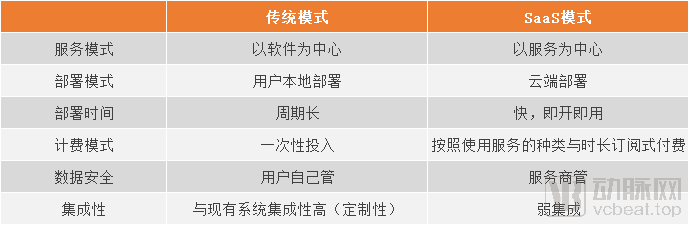
Comparison of Characteristics Between Traditional Model and SaaS Model
However, SaaS services are still in an exploratory phase, facing challenges such as data security concerns, difficulties in digital transformation, and high requirements for professional expertise. Consequently, performance varies across different niche segments. In the future, as SaaS offerings mature and professional capabilities improve, marginal costs will continue to decline. This will enable healthcare institutions to significantly streamline their operations, making this model likely to become the primary information management approach for healthcare organizations.
The characteristics of SaaS determine the scope of its adoption. Large hospitals emphasize information security and controllability, imposing stringent requirements on data security and system interoperability, which in turn drives a higher degree of customization. Consequently, there is significant potential for SaaS adoption in new healthcare models such as internet hospitals and remote hospitals, while scenarios like smart hospitals and mobile health may transition to the SaaS model in the future. In contrast, small and medium-sized medical institutions have lower requirements for interoperability; thus, lightweight integration, low cost, and cloud-based deployment better align with their needs.
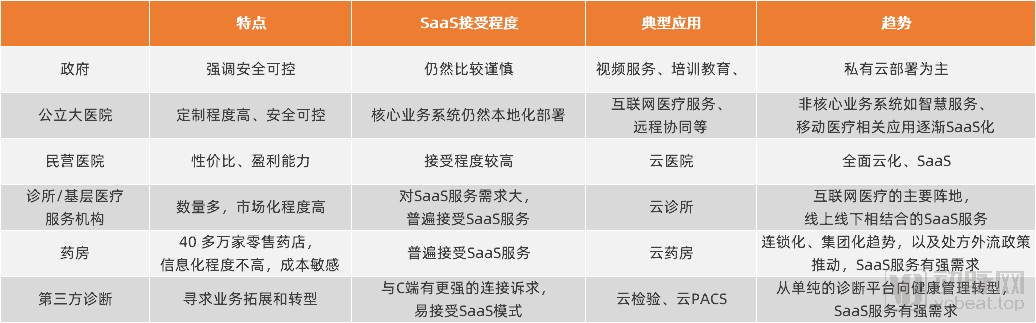
Medical SaaS Requirements Analysis
Specific requirements still depend on the specific scenarios. This article focuses on analyzing four types of SaaS models: Cloud HIS, Internet Hospitals, Family Doctors, and Dental Chains.
Cloud HIS
Cloud-based HIS differs significantly from traditional HIS, with system architecture being the most prominent distinction. Traditional HIS systems based on a Client/Server (C/S) architecture require users to install a client application on each computer, deploy servers within the hospital premises, and access the system via an internal local area network. In contrast, cloud-based HIS systems built on a Browser/Server (B/S) architecture do not require local client installation; they can be accessed directly through a web browser. Their servers can be hosted either in on-premises data centers or deployed in the cloud.
Prerequisites for Cloud HIS:
1. B/S Architecture
2. Capable of resolving communication issues with local hardware (such as medical insurance card readers, change-giving customer displays, etc.)
3. Addresses the issue of user-defined reports
4. Ensures uninterrupted business operations in the event of an external network (Internet) outage
5. Open-source software may be utilized to address the issue of prohibitively high costs associated with commercial software.
6. For EMR (Electronic Medical Record) systems, software supporting B/S architecture must be available.
7. There must be an open and comprehensive third-party API solution.
Revisiting the Requirements: Whether it is the construction of medical consortia/medical communities or the promotion of electronic health cards/electronic vouchers, integrating primary healthcare institutions into regional information networks is an inevitable path for reform. As mentioned above, the traditional buyout model for Hospital Information System (HIS) implementation poses various execution challenges for primary healthcare institutions, whereas flexible and standardized SaaS solutions offer a more cost-effective and agile alternative. It has become inevitable that traditional HIS will exit the market for small and medium-sized hospitals.
Although large hospitals have less extensive demands for cloud-based Hospital Information Systems (HIS) compared to small and medium-sized hospitals, the growing prevalence of multi-site operations—such as establishing outpatient departments across multiple facilities—has exposed the limitations of traditional HIS in managing data interoperability. In response, cloud-based HIS solutions have emerged. Due to data security concerns, hospitals typically adopt a hybrid cloud approach. This strategy allows hospitals to retain control over their data while ensuring that, in the event of network failures on the SaaS platform, they can swiftly switch back to internal servers, thereby maintaining uninterrupted hospital operations.
Currently, few enterprises are engaged in building cloud-based Hospital Information Systems (HIS). Non-listed healthcare IT companies such as Honghua Medical, Yilian Weizhi, Shangyi Zhixin, Xingxin Software, and Ruiyi Software primarily focus on developing cloud HIS solutions for small and medium-sized medical institutions. Meanwhile, established healthcare IT firms like Donghua Software, Winning Health, Jingyi Group, and Zuobiao Software are targeting the medical SaaS transformation of large hospitals, striving to capture market share amid the wave of smart healthcare development.
Internet Hospital
For SaaS, internet hospitals represent a distinctive sector.
From the perspective of its inherent attributes, an internet hospital’s system operates independently of a hospital’s existing infrastructure, making it initially well-suited for SaaS-based implementation. However, due to regulatory restrictions on hospitals establishing internet hospitals, medical SaaS solutions based entirely on public clouds do not meet compliance requirements. Consequently, current internet hospital SaaS providers typically deliver operation and maintenance services to hospitals through hybrid cloud architectures.
Within this niche sector, medical SaaS services primarily function to reduce costs, accelerate the development of internet hospitals, and enhance their operational maintenance. Therefore, in the view of Chen Can, CEO of Yi Yi Bang, securing a competitive advantage in the internet hospital SaaS market hinges on the product’s top-level design.
“Previously, the development of internet hospitals followed traditional medical IT project implementation models, engaging only with the information technology and finance departments to migrate offline hospital services online. However, an internet hospital is, in fact, a multi-tiered service ecosystem. Currently, it offers functionalities such as online consultations and appointment scheduling, but in the long term, features like prescription circulation, insurance reimbursement, and patient referrals will also be integrated. In this process, all stakeholders across the entire value chain—including the National Health Commission, hospitals, pharmaceutical e-commerce platforms, brick-and-mortar pharmacies, health kiosks, and elderly care institutions—should be incorporated into the system design.”
According to Chen Can’s vision, during the operation of its internet hospital, the hospital will share certain data with enterprises. These enterprises can leverage such data to help the hospital deepen its operational capabilities for the internet hospital—a dimension inaccessible under traditional models.
In this regard, Chen Can stated, “The SaaS model can help hospitals process substantial volumes of valuable data, such as patient age distribution and payment mix (social insurance versus commercial insurance), thereby enabling in-depth operational management. With the construction of internet hospitals now more than halfway complete this year, we believe the opportunities lie in operations and maintenance.”
Another important issue is information security.The "Measures for the Administration of Internet Hospitals," released in September 2018, explicitly requires that the construction of internet hospitals implement Level 3 classified protection for information security in hospital information systems.According to pricing data from Meichuang Technology, a leading company in medical information security, the cost of implementing a comprehensive data security system for a single hospital varies depending on its size, ranging from RMB 5 million to RMB 20 million. For internet hospitals, which have a relatively narrower scope of business, the estimated construction cost is approximately RMB 1 million. However, for small and medium-sized hospitals, data security still represents a significant financial investment.
Therefore, from the perspective of data security, medical institutions are motivated to adopt the SaaS model to build internet hospitals, in order to meet information infrastructure requirements such as MLPS 2.0 (formerly known as Classified Protection 3.0).
Regional Healthcare Information Management
Regional healthcare information management encompasses areas such as family physician management, regional medical informatization, and big data for epidemic prevention and control. At its core, it is fundamentally about data management in primary healthcare. To address the challenges of regional medical information management, it is essential to first recognize three key issues: the difficulties in managing health records, outdated data collection equipment, and the widespread existence of data silos.
To address the three aforementioned issues, healthcare IT companies have proposed a wide array of solutions, such as establishing electronic health record (EHR) systems for residents, introducing intelligent medical equipment systems, and enriching interfaces to enable data interoperability among online systems, thereby resolving the challenges prevalent in primary healthcare.
However, as the three fundamental issues are resolved, new challenges continue to emerge. Zhang Wei, Product Director at Lianyi Group, categorizes them into three advanced-level questions.
“The shortage of medical talent at the primary care level is the first issue. Many healthcare workers lack comprehensive training in modern medicine, struggle to manage common diseases appropriately, and are unable to adapt to new technologies; their competencies fall short of the requirements of the current public health service system.”
“Secondly, the upfront hardware construction costs are excessively high. For a district or county with a population of 500,000, establishing a regional medical information platform requires an initial infrastructure investment of RMB 2–3 million, excluding subsequent maintenance expenses, which is financially burdensome for such local governments.”
“Finally, there are the continuously rising post-deployment operation and maintenance (O&M) costs for enterprises. To cover information technology infrastructure in remote areas and keep a larger number of devices operational, companies must recruit additional talent. Moreover, many issues arising at prefecture- and city-level hospitals cannot be resolved remotely, requiring technical staff to travel on-site, which places significant operational pressure on enterprises. Lastly, there is the challenge of high turnover among O&M personnel. These three challenges have deterred many companies from engaging in the development of grassroots healthcare informatization.”
Why Can Healthcare SaaS Address These Issues? This Is Related to the Characteristics of the Technology.
Taking Lianyi Group as an example, empowering primary healthcare through the SaaS model means that all its servers and systems can be directly deployed on Tencent Cloud, significantly saving on the initial costs of building basic network infrastructure and subsequent maintenance costs. Secondly, by adopting unified cloud services, Lianyi Group eliminates environmental differences in underlying hardware, reducing production failure rates caused by inconsistent host environments and greatly improving system stability. Finally, leveraging the network protection and device detection capabilities inherent to cloud services like Tencent Cloud, Lianyi Group can effectively ensure the security of cloud resources, detect system failures and security risks in real time, and substantially reduce procurement costs.
Oral Cavity
Dental chain practices represent an early-stage SaaS sector with established success stories. Henry Schein’s Dentrix Ascend and Patterson Dental’s Fuse are pioneers in this space. These platforms not only facilitate information management for dental clinics but also integrate and analyze operational data, helping the dental industry improve management, marketing, and patient communication.
There are not many domestic companies focused on dental specialties, but among them are standout performers. For instance, Shanghai-based LinkCare Information has completed its C2 round of financing and is a representative enterprise in the dental SaaS sector. From LinkCare’s perspective, informatization infrastructure forms the foundation of specialized clinic operations, and to ensure sustainable survival, clinics need to analyze and leverage the data they collect.
Therefore, within Linker’s SaaS software suite, the intelligent social customer relationship management (SCRM) system is a critical component and key to improving doctor-patient communication and patient visit experiences.
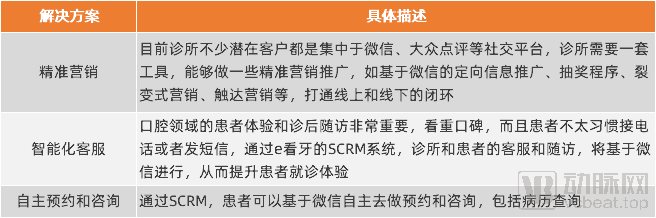
“Linker’s e-Kanya has been developing its Social Customer Relationship Management (SCRM) platform for two years. While SCRM theories and business models are not unique to China, e-Kanya is the first company to launch an SCRM tool specifically tailored for the healthcare industry. ‘When we began developing the software in 2015, we did not anticipate that SCRM would become a critical necessity,’ said Wu Zhijia, founder of Linker, in a previous interview. He firmly believes that ‘we should not focus solely on internal clinic operations and management, but also examine the entire upstream and downstream ecosystem of the dental industry, including the supply chain and consumer-facing services. By enhancing patient experience on the demand side and improving efficiency on the supply side, we can drive the overall upgrading of the dental industry.’”
Dental chain clinics represent a sector with an early start and established case studies, yet it is not fully mature. At present, there are few software service providers in this sector; more enterprises need to enter the market to enhance competitiveness and optimize clinic operations.
Nowadays, as the concept of medical SaaS gains increasing acceptance, the adoption of SaaS by small and medium-sized healthcare institutions and specialized chain clinics has become irreversible. However, for tertiary hospitals with more complex organizational structures, it will still take some time for medical SaaS to make significant inroads.
Amid broader trends, the development of medical SaaS is exhibiting industrial clustering, with early signs of factional division already emerging. Internet giants such as Tencent and Alibaba have established their own medical SaaS alliances, seeking to lead the reform of the healthcare informatization industry.
Within this ecosystem, numerous niche scenarios remain to be explored, such as medical aesthetics, clinics, veterinary care, and consumer-facing services in hospitals. SaaS providers need to deeply integrate with internet companies that provide underlying infrastructure capabilities, leverage their respective strengths, develop joint solutions, and explore optimal pricing strategies.
The establishment of standards is also a key battleground for competition among various ecosystems. Currently, the standards for medical SaaS services remain in a relatively chaotic state. How to unify interfaces, establish data standards, and even define what constitutes a SaaS service are still urgent challenges that the industry needs to address.