

Baidu Lingyi Zhihui Empowers Grassroots Eye Disease Screening with AI Technology
Recently, at the Third National Ophthalmology Artificial Intelligence Conference held in Shenzhen, Baidu Lingyi Zhihui hosted a “Sharing Session on Evidence-Based AI Fundus Screening Technology.” The event invited Yang Weihua, Director of the Artificial Intelligence and Big Data Laboratory at the Eye Hospital Affiliated to Nanjing Medical University, and Liao Dasi, Deputy Director of the Department of Ophthalmology at Jieyang People’s Hospital, to share the many benefits that AI technology has brought to primary eye care diagnosis and treatment.
Yang Weihua pointed out that common fundus diseases include diabetic retinopathy, age-related macular degeneration, various retinal vascular diseases, optic nerve disorders, and glaucoma. Among these, eye conditions such as age-related macular degeneration, diabetic retinopathy, and glaucoma have become the leading causes of blindness in patients.
Regarding the aforementioned blinding eye diseases, Yang Weihua believes that early and accurate screening for fundus diseases is a key step in reducing their blindness rates, particularly in improving the quality of life for elderly patients.
However, primary care fundus screening currently faces numerous challenges: a severe shortage of ophthalmologists, inadequate technical equipment, and the lack of a two-way referral mechanism between hospitals and communities. Addressing these pain points, Yang Weihua stated that AI technology is an effective means to bridge the gap in screening capabilities for common fundus diseases at the primary care level.
Taking the Eye Hospital Affiliated to Nanjing Medical University as an example, Yang Weihua shared successful experiences in leveraging AI technology to support the work of ophthalmic medical consortia. He pointed out that, building upon informatization, AI technology can facilitate tiered diagnosis and treatment in ophthalmology, effectively addressing the lack of screening capabilities for common fundus diseases at the primary care level.
Liao Dasi demonstrated the changes brought by AI technology to eye disease screening in Jieyang City. In the past, the fundus medical platform used by Jieyang People's Hospital had many problems: limited screening conditions, primitive remote image reading processes, excessively long feedback times, and data transmission relying on networks, which created data silos...
In 2020, the Lingyi Zhihui AI Eye Disease Screening System underwent a registered clinical trial at the hospital. Testing on 300 subjects demonstrated that the system effectively addresses key challenges in eye disease screening at primary healthcare institutions, reducing missed diagnoses of ocular conditions, alleviating physicians’ workload, enhancing patient satisfaction, optimizing patient triage, and improving referral efficiency.
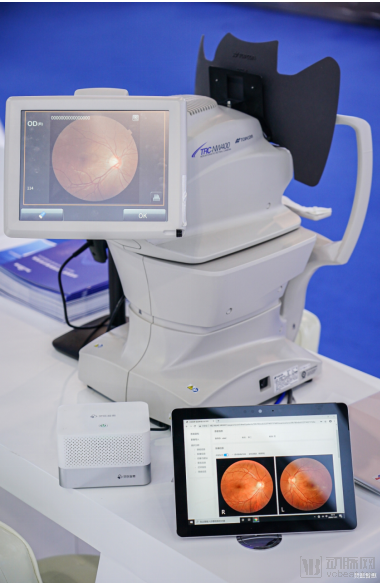
The AI-based eye disease screening system, independently developed by Lingyi Zhihui, can screen for a variety of ocular conditions. The equipment is easy to operate and learn, generating a screening report for each patient in just 10 seconds, with diagnostic accuracy comparable to that of professional ophthalmologists. Furthermore, the system does not rely on network connectivity for data report transmission and is compatible with mainstream fundus cameras available on the market. It holds significant application potential and social value, particularly in primary care settings and remote areas.
Notably, the Lingyi Zhihui AI Eye Disease Screening System prioritizes disease-related privacy and data security, providing robust safeguards for the security and regulatory compliance of data resources belonging to patients and healthcare institutions.
In light of the challenges in conducting population-wide screenings in remote areas, Liao Dasi outlined prospects for leveraging AI technology to empower eye disease screening.
He believes that, with the aid of AI technology, primary healthcare institutions can be equipped with efficient and user-friendly integrated examination devices, and are expected to collaborate with ophthalmology departments at large medical institutions to establish a unified AI ophthalmology service platform. Meanwhile, staff members with no prior background in ophthalmology can independently and proficiently collect examination data after brief training. The AI cloud platform provides immediate auxiliary diagnostic screening results to patients; cases with ambiguous findings are reviewed by ophthalmologists from tertiary hospitals via the unified technical platform, who also provide diagnosis and treatment recommendations. Referral services are available when necessary.
These prospects align perfectly with Lingyi Zhihui’s strategic focus on fundus screening. The Lingyi Zhihui AI Ocular Disease Screening System is an intelligent device custom-built to empower primary healthcare institutions. By integrating AI algorithms for multi-disease fundus screening with an edge computing hardware platform, the system aims to address the dual challenges of inadequate equipment and scarce medical resources at the grassroots level, enabling patients in remote primary care areas to access diagnostic and treatment standards comparable to those of Tier 3 Grade A hospitals.