

Nearly 30 Chinese Companies Shine at 2021 J.P. Morgan Healthcare Conference Amid Rising Trends in COVID-19 Vaccines, Telemedicine, and Healthcare Reform
As the annual international flagship event of the healthcare industry, the 2021 J.P. Morgan Healthcare Conference (hereinafter referred to as “JPM”) was held as scheduled from January 11 to 14. However, unlike previous years, this year’s JPM completely canceled in-person meetings due to the impact of the COVID-19 pandemic and adopted a virtual participation format. A total of 14 breakout session channels were allocated, including 10 public channels with a time limit of 40 minutes each, and the remaining private channels with a duration of 25 minutes each.
Since its inception in the 20th century, JPM has accompanied countless healthcare enterprises on their journey from startups to industry unicorns. This year marks the 39th annual conference, which invited over 500 representative companies from the global healthcare industry to deliver keynote speeches online. The virtual event gathered thousands of healthcare entrepreneurs and investors, who engaged in discussions spanning multiple sub-sectors, including biopharmaceuticals, medical devices, and healthcare services.
VCBeat (WeChat ID: vcbeat) has compiled a brief overview of the thematic content from the 39th JPM Healthcare Conference, reviewing the past and looking to the future, to provide readers with a concise summary of the core developments and trends in the global healthcare industry.
1. Strong Innovation Vitality in Biotechnology, Fierce Competition in the COVID-19 Vaccine Market
2. U.S. Healthcare Reform Combats Rising Prescription Drug Prices, FDA Approval Accelerated
3. Telemedicine and Chronic Disease Management Become Major Trends in Future Healthcare
4. 26 Chinese Companies Make Appearance at This Year’s J.P. Morgan Conference
5. Updates from International Pharmaceutical Companies at the J.P. Morgan Conference: Pfizer to Expand COVID-19 Vaccine Production
Post-Pandemic Era: Fierce Competition in the COVID-19 Vaccine Market
This year, COVID-19 was an unavoidable topic at the JPMorgan Healthcare Conference. Judging by the healthcare industry’s performance in 2020, the pandemic significantly accelerated the pace of innovation in biotechnology. Over the past few years, the biotech sector’s market performance generally lagged behind the S&P 500 Index, but it emerged as the biggest dark horse in 2020.
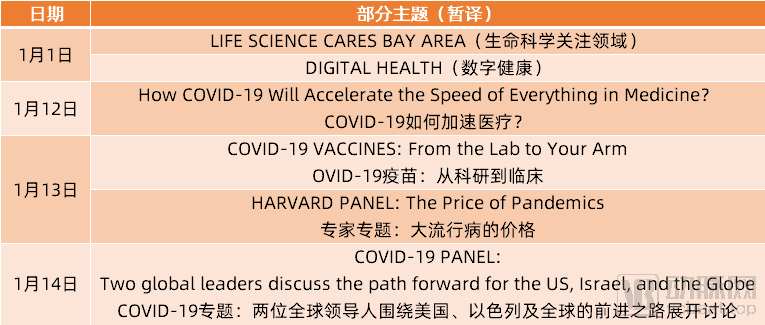
Selected Topics from the 39th JPM Conference (Source: JPM Report)
In the turbulent year of 2020, people relied on physical barriers such as isolation gowns and face masks to prevent the spread of the novel coronavirus. Meanwhile, the development of COVID-19 vaccines was in full swing, becoming a key focus in the following year, 2021.
Based on the currently approved COVID-19 vaccines, there are alreadyFive COVID-19 VaccinesVaccinations are being administered in approximately 50 countries and regions, utilizing the following vaccines: Pfizer/BioNTech’s BNT162 vaccine, Moderna’s mRNA-1273 vaccine, AstraZeneca/Oxford’s AZD1222 vaccine, the inactivated COVID-19 vaccine jointly developed by China National Pharmaceutical Group (Sinopharm) and the Beijing Institute of Biological Products, and the Sputnik V COVID-19 vaccine developed by the Gamaleya Research Institute of Epidemiology and Microbiology.
Among them, the BNT162 vaccine, jointly developed by Pfizer and BioNTech, has achieved the widest global adoption among COVID-19 vaccines. It was first approved in the United Kingdom in early December 2020, becoming the world’s first marketed COVID-19 vaccine. To date, the vaccine has been authorized for use in more than 20 countries, including Canada, the United States, Switzerland, Serbia, Mexico, Dubai, Israel, France, Norway, Iceland, Singapore, and Argentina.
In China, the National Medical Products Administration (NMPA) granted “conditional” approval for the market launch of the first COVID-19 vaccine on December 31, 2020. In the same month, the United Arab Emirates began administering Sinopharm’s vaccine in its capital, Abu Dhabi. Another Chinese COVID-19 vaccine with rapid development progress was developed by Beijing Sinovac Biotech Co., Ltd. This vaccine completed Phase III clinical trials in Brazil and has received orders from multiple countries, including Ukraine, while awaiting regulatory approval.
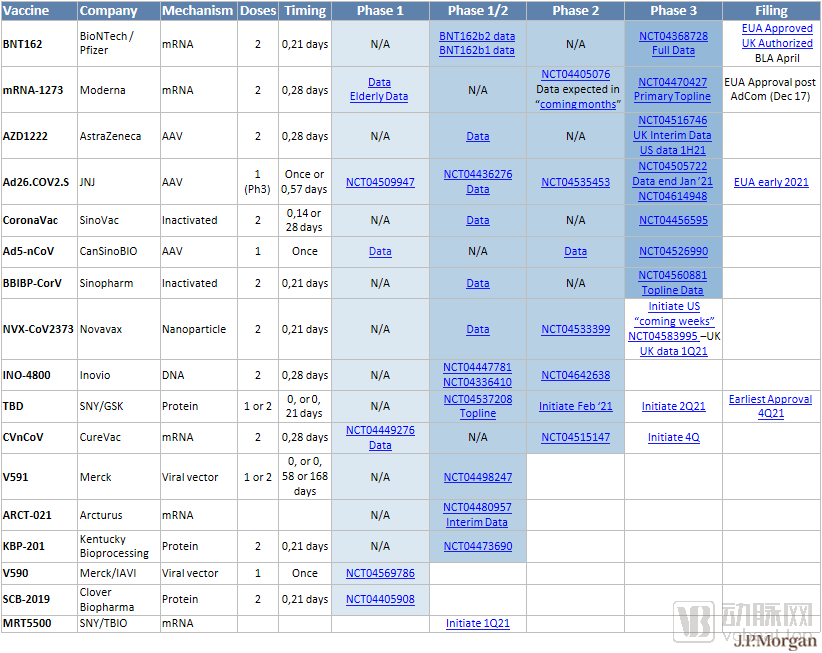
Selected Key Candidate COVID-19 Vaccines (Data Source: JPM Report)
In clinical development, several COVID-19 vaccines are undergoing pivotal clinical trials. Currently, approximately 52 COVID-19 vaccine candidates are in clinical trials, and 162 candidates are in preclinical development. In 2021, other highly anticipated vaccines include Johnson & Johnson’s Ad26.COV2.S vaccine, Novavax’s NVX-CoV2373 vaccine, and the TBD vaccine jointly developed by Sanofi and GlaxoSmithKline (SNY/GSK).
Telemedicine, Chronic Disease Management, and Unprecedentedly Vibrant Biotechnology
Since the outbreak of the COVID-19 pandemic,TelemedicineIts importance has increased significantly over the past year. At the 39th JPM Healthcare Conference, discussions centered on telehealth topics such as remote consultations and remote patient monitoring.
At the conference, Ascension, the largest private healthcare system in the United States, delivered a keynote report, revealing that telehealth service volume surged 40-fold between January and April 2020, and remained highly active in the subsequent months, sustaining levels nearly 20 times those seen before the pandemic.
Telehealth company Teladoc Health also experienced rapid growth during the pandemic, announcing during the conference its $600 million acquisition of virtual care provider InTouch Health to strengthen its telehealth strategic layout. Additionally, mobile health company TalkSpace announced a $1.4 billion SPAC merger with Hudson Executive Investment Corp. According to public estimates, TalkSpace’s net revenue in 2021 is projected to reach $125 million, representing a 69% increase over its 2020 net revenue.
However, many presentations failed to address the next steps for telemedicine in future strategic planning, prompting us to consider whether telemedicine will further evolve and become central to healthcare delivery and cost containment.
Nevertheless, we have observed certain distinctions, such as AccentCare’s remote monitoring for home health services and Henry Ford Health System’s “Hospital at Home” pilot program. MORE Health, a prominent cross-border healthcare company, also emphasizes that telemedicine platforms are not limited to critical care; it has partnered with U.S. hospitals to facilitate routine telemedicine practices.
“The pandemic has accelerated the development of telemedicine and heightened healthcare institutions’ willingness to advance remote services. In terms of service categories, our multidisciplinary consultations during the pandemic increased by more than 20% compared with 2019, while the number of contracted partner hospitals and physicians continued to grow, with an increase exceeding 30%.”Dr. Robert Warren, Co-founder of MORE Health“He stated, ‘On the MORE Health platform, previous demands were covered under medical malpractice liability insurance for critical care. Physicians would collaboratively discuss patients’ conditions, formulate detailed and cutting-edge treatment plans, and implement them through local hospitals. However, from both an industry development perspective and our platform’s standpoint, the demand for telemedicine is expanding into a broader range of disease areas, such as sports rehabilitation and chronic disease management.’”
And regardingChronic Disease Management, Rice Powell, CEO of Fresenius Medical Care, the global leader in the dialysis industry, also voiced their concerns at the conference: by 2030, the global population aged 65 and above is projected to reach 1 billion; diabetes prevalence is expected to be nearly five times higher than in 2000, affecting 578 million people; and the number of individuals requiring dialysis will exceed 6 million, representing an approximately sixfold increase compared with 2000.
Fresenius Medical Care is rapidly expanding in the field of chronic kidney disease care and ancillary services, yet the company has also expressed regret at witnessing the substantial growth in this market. Currently, one-quarter of the global population suffers from hypertension. We must consider how to respond to a future in which this chronic condition may become an increasingly prevalent trend.
As emphasized by David Cordani, CEO of Cigna, it is essential to begin effectively coordinating the integration of behavioral health with medical care, pharmacy services, and solutions to enhance efficiency and benefit humanity. Fresenius is also planning initiatives to address dialysis and chronic kidney disease in approximately 39 states.
As China’s population ages at an accelerating pace, the number of patients with chronic diseases is rising year by year. How to leverage the “Internet + Chronic Disease Management” model to improve the efficiency of in-hospital diagnosis and treatment as well as out-of-hospital management, and to reduce the societal costs of chronic disease treatment, has become a focal point of industry attention.
Furthermore, a key theme was also highlighted at the 39th JPM Conference:Biotechnology Innovation. In addition to the development of COVID-19 vaccines, the healthcare industry has seen sustained and significant innovations in “hot” fields such as oncology and rare diseases. Emerging technologies, including gene therapy and cell therapy, are expected to achieve substantial progress in 2021. Oncology, rare diseases, neurological disorders, and cardiometabolic diseases will be key therapeutic areas warranting close attention in the future.
Focus Topic: Healthcare Reform and Accelerated Approval
At the 39th JPM Conference, another key issue was highlighted: U.S. healthcare reform efforts aim to curb the rising out-of-pocket costs for prescription drugs under health insurance plans.
In 2020, around the time of the U.S. presidential transition, two key leaders, Trump and Biden, both enacted critical policies aimed at healthcare reform to address issues such as rising unit prices for prescription drugs and increasing out-of-pocket costs for insured individuals. A detailed analysis of these specific policies is beyond the scope of this discussion. However, the legislative stalemate on healthcare reform that emerged in the United States in 2021 has become an obstacle to large-scale industry-wide reforms, leading the public to increasingly believe that drug prices will continue to rise.
It is reported that in the United States, approximately 40% of pharmaceutical revenue is paid by the government, another 40% to 45% is covered by private insurance companies, and the remaining 10% to 15% is paid out-of-pocket.
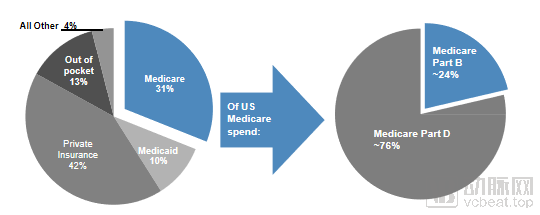
U.S. Healthcare Payment Reform (Screenshot from JPM Report)
In addition to healthcare reform, another key aspect of the JPM conference worth monitoring is FDA approval in the United States. Compared with previous years, the number of FDA approvals in 2020 was higher, with further clarification on regulatory requirements and expedited review pathways, highlighting a favorable regulatory environment. This trend is expected to continue in 2021.
Previously, the U.S. FDA approved 115 Fast Track designation requests in 2018 and 145 in 2019. The last available statistics for 2020 showed that the U.S. FDA had approved a total of 151 Fast Track designation requests, reflecting a year-over-year increase. This trend is expected to continue into 2021, with the regulatory environment continuing to support drug development.
The FDA also highlighted the continued success of its accelerated review pathway, making determinations on 99% of applications received in 2019 within 90 days under the Medical Device User Fee Amendments (MDUFA), thereby surpassing the 95% approval rate target for 510(k) submissions.
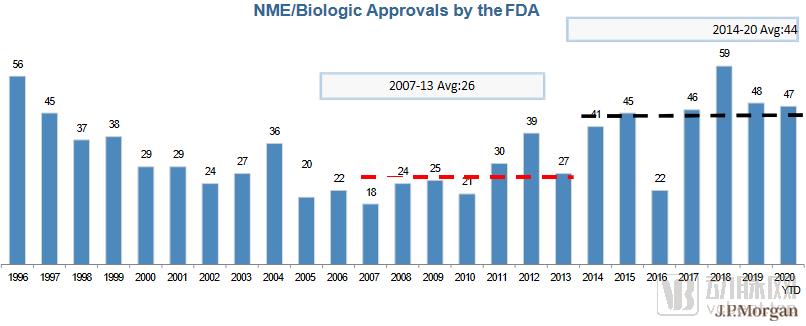
FDA-Approved Small-Molecule Drugs/Biologics (Screenshot from JPM Report)
Growing Chinese Presence: 26 Chinese Companies Make Appearance at J.P. Morgan Conference
This year’s JPM conference featured a greater Chinese presence than in previous years. According to incomplete statistics, 26 Chinese healthcare companies delivered keynote speeches or participated in closed-door sessions at the 39th JPM Healthcare Conference, including 3SBio, Zhifei Biological Products, Mindray Medical, Hutchison China MediTech, WuXi AppTec, Sino Biopharmaceutical, Genor Biopharma, RemeGen, CanSino Biologics, Vascure Pharmaceuticals, Ascentage Pharma, BeiGene, Innovent Biologics, Junshi Biosciences, Akeso, Zai Lab, Legend Biotech, Zhiyun Health, XtalPi, EMBiologics, Antengene Corporation, HUYABIO International, Klarys Pharma, Extreme Vision, LinkDoc Technology, and WeDoctor.
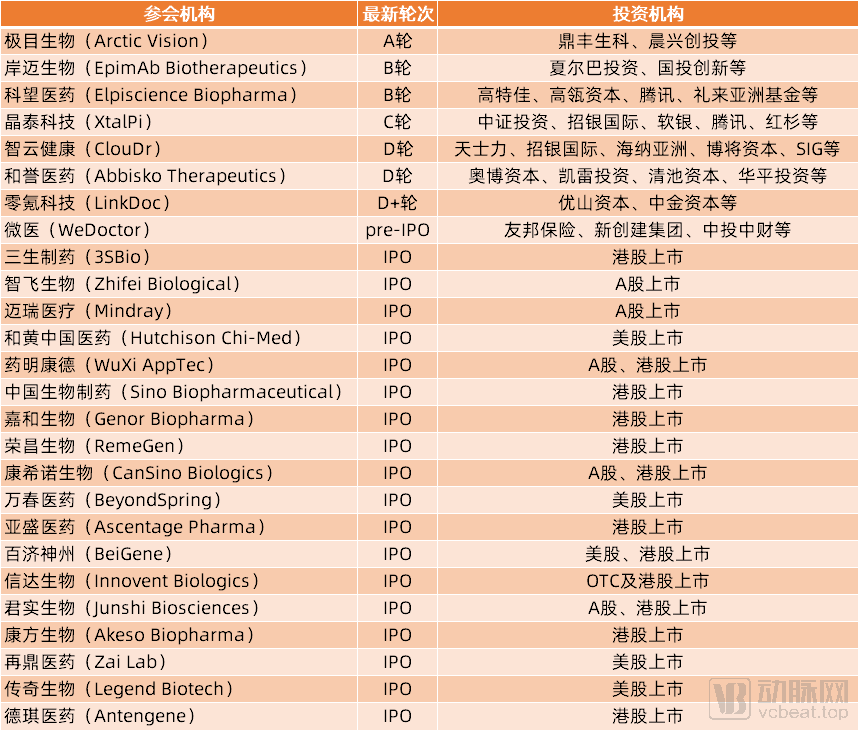
Chinese Companies Attending the 39th J.P. Morgan Healthcare Conference (Data Source: VCBeat Database)
Among these 26 companies, 18 have already gone public in the domestic market, on the Hong Kong Stock Exchange, or on NASDAQ. Of the remaining eight companies,WeDoctorFounded earliest (2010), at the latest stage (pre-IPO round);Extreme Vision BiopharmaFounded most recently (2019), earliest funding round (Series A).
Among them,WeDoctorIt is one of the largest and fastest-growing digital health unicorns globally. At the JPM Conference, Chen Hongzhe, the company’s Chief Strategy Officer, presented WeDoctor’s practices in digital healthcare to global industry investors and entrepreneurs. In the early stages of the COVID-19 pandemic response, WeDoctor rapidly mobilized over 77,000 doctors nationwide and launched an anti-epidemic platform via the WeDoctor Internet General Hospital, creating a “virtual battlefield” that made significant contributions to China’s national fight against the epidemic. Reportedly, 19 of WeDoctor’s 30 internet hospitals have obtained medical insurance accreditation.
Additionally,Zhiyun HealthRepresenting the “Internet Healthcare + Chronic Disease Management” sector on the global health industry stage, its founder, Kuang Ming, shared Zhiyun Health’s innovative experiences in chronic disease management in China at the conference. By leveraging its self-developed hospital SaaS system, pharmacy SaaS system, and advanced internet hospital platform, the company provides services to nearly 2,000 hospitals and over 100,000 pharmacies across China, digitally empowering every link of the industry chain.
Lingke TechnologyFocusing on providing AI and big data solutions for healthcare, CEO Zhang Tianze shared insights into China’s oncology drug market, discussed the commercialization challenges faced by innovative drugs upon launch, and presented LinkDoc’s digital healthcare solutions.
Elevation Oncology, Abbisko Therapeutics, and Ascentage Pharma are primarily focused on the novel oncology drug sector. Each has established its own core clinical pipeline, with all candidates having entered pivotal clinical trial stages.
Wuxi BiologicsThe company primarily develops bispecific antibodies for oncology. Its most advanced pipeline candidate is a novel dual-targeting drug against cMet and EGFR, currently undergoing Phase 1/2 clinical trials in both China and the United States.Abisko TherapeuticsFocusing on the development of small-molecule drugs for cancer immunotherapy, it has 12 anticancer drug pipelines under its portfolio, with four having completed Investigational New Drug (IND) applications; the most advanced candidates, ABSK011 and ABSK021, have just initiated Phase I clinical trials.Keswang MedicineAlso focusing on the development of tumor antibody drugs, the company mainly updated some new progress in their pipeline at JPM. Their ES101 is ready to initiate Phase II clinical trials, while another candidate, ES102, has already entered Phase I clinical trials.
The development trajectories of the new drug R&D companies participating in JPM demonstrate that anticancer drug development will remain the central theme of new drug research and development in the coming years, as well as a perennial hot topic in the healthcare industry.
In addition, a Chinese company specializing in computation-driven new drug R&D also participated in the 39th JPM.XtalPi, the company is a star player in the AI-driven new drug development sector. In 2020, it oversubscribed its Series C financing round, raising $318.8 million and setting a global record for the largest funding amount in the AI drug discovery field.
39th JPM: Pfizer/BioNTech to Significantly Scale Up COVID-19 Vaccine Production
The JPM Healthcare Conference each year brings together titans of the healthcare industry, offering insights into the global sector’s development trends through the moves of these industry leaders. In this particularly unique year marked by the COVID-19 pandemic, the latest progress on COVID-19 vaccines from major pharmaceutical companies has captured the attention of millions. Yet, the global healthcare landscape extends beyond pandemic control; further fresh insights can be gleaned from the presentations delivered by the ten leading international pharmaceutical companies in attendance.
At this year’s JPM conference, Pfizer disclosed that its PBGI fund, established in 2020, has extended investment offers to four biotechnology companies: a $60 million investment in Homology Medicines, a developer of therapies for rare genetic diseases; a $25 million investment in Vedanta, a company developing drugs for inflammatory bowel disease (IBD); a $25 million investment in Trillium Therapeutics, a CD47-focused enterprise; and a $10 million investment in ESSA Pharma, a prostate cancer treatment company.
In 2020, BioNTech partnered with Pfizer to develop the world’s first approved COVID-19 vaccine. When asked at a conference how they planned to scale up production to 2 billion doses in 2021, the two companies stated that they would expand COVID-19 vaccine manufacturing to meet the needs of 1 billion people by optimizing raw material supply, improving process design, and rapidly redeploying new equipment.
When asked ahead of the JPM conference about how Merck & Co. would respond to the impending patent expiration of its flagship product, Keytruda, CEO Robert Frazier stated that the company would rely on the development of new formulations of Keytruda, combination therapies, and other strategies to extend the patent life of this PD-1 inhibitor. He also noted that revenue growth through 2024 had been significantly underestimated.
Just as Merck faces the loss of future patent protection for Keytruda, AbbVie will also lose patent exclusivity for Humira in 2023. CEO Richard Gonzalez stated at the JPMorgan Healthcare Conference that Humira will face competition from multiple biosimilars in the U.S. market in 2023. However, the company’s two new immunology drugs, Skyrizi and Rinvoq, are projected to generate $15 billion in sales by 2025, partially offsetting the future decline in Humira’s revenue.
At the J.P. Morgan Healthcare Conference, Gilead Sciences stated that Veklury, its COVID-19 therapeutic, generated higher-than-expected profits, with total sales in 2020 projected at approximately $2.8 billion. Meanwhile, Gilead also announced a collaboration agreement with Vir Biotechnology at the conference to initiate a Phase II clinical trial evaluating various combination therapies involving Gilead’s selgantolimod, Vir Biotechnology’s small interfering RNA (siRNA) therapeutics, and marketed PD-1 checkpoint inhibitors.
Furthermore, Gilead Sciences CEO Daniel O’Day announced plans to expand the product portfolio of lenacapavir for HIV treatment, transitioning from a once-daily regimen to a long-acting formulation administered via subcutaneous injection twice a year.
In addition to its collaboration with Gilead, Vir Biotechnology announced at the JPM Conference a partnership with GlaxoSmithKline to co-develop an antibody for COVID-19, which is currently in Phase 3 clinical trials. Furthermore, the company has another COVID-19 antibody in preclinical studies and is collaborating with Alnylam on small interfering RNA (siRNA) therapy for COVID-19.
Sanofi delivered a standout performance at the JPM conference, boldly acquiring Kymab for $1.1 billion prior to the event to secure global rights to the monoclonal antibody KY1005 for the treatment of various immune-mediated and inflammatory diseases. Subsequently, the company announced at the conference a $125 million upfront payment to Biond Biologics to obtain global rights to its novel immune checkpoint inhibitor, the anti-ILT2 monoclonal antibody.
At the JPM Conference, Bristol Myers Squibb announced that four innovative therapies would be launched in 2021: the CD19-targeted CAR-T therapy liso-cel, the B-cell maturation antigen (BCMA)-targeted ide-cel, the oral TYK2 inhibitor deucravacitinib, and the cardiovascular drug mavacamten.
At JPM, Roche announced its corporate development strategy, aiming to drive future innovations in personalized medicine. The company plans to accelerate the drug development value chain through the application of digital technologies, employing parallel analysis of millions of cells per day using single-cell and genomic testing techniques, among other methods, to discover previously unknown cell types.
Takeda Announces Decade-Long Financial Goals at JPM, Aiming for $47 Billion in Annual RevenueAt the J.P. Morgan Healthcare Conference, Takeda unveiled its financial objectives for the next decade, targeting $47 billion in annual revenue. Christophe Weber, the company’s CEO, stated that Takeda’s 2020 revenue had already increased by 50% compared to 2019. He further noted that the company currently has approximately 40 new molecular entities (NMEs) in clinical development, which will help Takeda achieve its financial goals by 2030.
Postscript:
Since the outbreak of the COVID-19 pandemic at the end of 2019, we have crossed into the spring of 2021. Biomedical healthcare has become the sole means to “heal” the world, propelling the industry to unprecedented historical heights. Against this backdrop, greater attention has been directed toward the keynote addresses at the JPM Healthcare Conference, a premier global event for the medical industry. These presentations have illuminated the future direction of healthcare: the widespread administration of COVID-19 vaccines, the rapid development of telemedicine, and the expansion of the chronic disease market, which signals a surging demand for chronic disease management. Healthcare is indispensable for the future and remains a concern for all humanity.