

Lizhi Institute Files IPO Prospectus: Pioneering Mental Health Industry Incubation with Big Data to Empower Happy City Development
Since Jiangyin City introduced the concept of “Happy Jiangyin” in 2006, more than 100 cities across China have successively set forth the goal of building “Happy Cities.” The “indicators” used to measure happiness have gradually expanded from GDP figures to encompass multiple dimensions, including health, education, the economy, and family life. Greater emphasis has been placed on individuals’ subjective well-being, accompanied by growing societal attention to mental health.
Nanjing Lizhi Psychological Big Data Industry Research Institute Co., Ltd. (hereinafter referred to as “Lizhi Research Institute”) was established against this backdrop. Founded in 2019 and headquartered in Nanjing, Lizhi Research Institute is a member of the HRG ecosystem and has equity participation from Nanjing municipal state-owned assets. It is an industry incubation platform that leverages psychology and artificial intelligence technologies as its research foundation, focusing on the collection, analysis, storage, and development of application scenarios for psychological big data.
Since its establishment, Lizhi Research Institute has remained committed to supporting talent development, technological innovation, commercialization of products, and interdisciplinary technical exchanges within the mental health industry. Meanwhile, by empowering entrepreneurs in the field of psychological technology, it provides innovative solutions for sectors such as justice, education, and civil affairs, contributing informational solutions to the construction of happy, safe, and civilized cities.
Currently, Lizhi Research Institute has established branch institutes in Chongqing, Guangzhou, and Jiangsu Province. By collaborating with high-quality enterprises and research institutions, it continues to provide high-caliber services to government bodies, corporate clients, and individuals. As multiple projects under the institute advance, VCBeat interviewed Dr. Zhu Xiaoping, Chairman of Lizhi Research Institute, and Zhang Ling, Dean of the institute. They shared their insights on building the psychological health industry chain and discussed the institute’s initiatives in developing an industrial platform.
Over 40 Years of Industry Expertise: Building an Industrial Incubation Platform
In 1978, Zhu Xiaoping was admitted to the Engineering Psychology program within the Department of Education at Zhejiang University, becoming one of the first students in China to systematically study professional psychology knowledge after the restoration of the National College Entrance Examination. After graduation, Zhu served as a university lecturer in China for many years, conducting theoretical research in experimental cognitive psychology and psycholinguistics, before proceeding to the University of New South Wales in Australia for postdoctoral research. In 1999, Zhu transitioned into the fields of applied psychological research and corporate psychological services, participating in Employee Assistance Program (EAP) projects for multiple enterprises.
After nearly a decade of exploratory practice in the field, Zhu Xiaoping pursued further studies at CEIBS (China Europe International Business School) in 2009, earning an EMBA degree. Building on his accumulated knowledge and continuous industry learning, Zhu Xiaoping was awarded the only Lifetime Achievement Award in China’s EAP industry to date in 2017.
As Zhu Xiaoping accumulated professional experience, he gradually realized that the lack of tool-based product support in the practical application of psychological services had compromised both efficiency and effectiveness. The rise of internet and artificial intelligence technologies, however, offered him a new direction.
During the product development process, Zhu Xiaoping met Zhang Ling, the founder of the former Nanjing Sperm Whale Information Technology Co., Ltd. Sharing aligned visions on product development philosophy and industry growth, they immediately began developing related products, starting with speech recognition. As they delved deeper into market exploration, they connected in 2019 with Gao Rong, former Vice President of Zhongye Huigu Technology Group, along with other psychology experts. Leveraging Nanjing’s strong policy support for new-type R&D institutions, they assembled a team to establish the Lizhi Research Institute. By integrating academic and technical resources within the industry, the institute developed comprehensive mental health management solutions from multiple angles—including funding, product R&D, marketing, and services—and built a product incubation platform. This initiative not only serves the general public but also empowers entrepreneurs within the industry.
Academically, Lizhi Research Institute has established in-depth collaborations with organizations such as the Chinese Psychological Society, the Asian Psychological Association, and the International EAP Association, enabling real-time access to authoritative industry information. Industrially, through partnerships with members of the HRG ecosystem and a group of market-oriented angel investment funds, Lizhi Research Institute secures access to high-quality corporate resources.
In terms of technical product R&D, Lizhi Research Institute has established scientific research collaborations with institutions and universities such as the Institute of Psychology of the Chinese Academy of Sciences, Tsinghua University, Zhejiang University, and Southwest University, covering professional talent development and technical product development. Currently, Lizhi Research Institute has successfully developed core AI technologies based on semantic recognition, behavior recognition, and facial expression recognition, providing specialized tools for psychological applications.
Furthermore, leveraging the inherent incubator characteristics of the enterprise itself, Lizhi Research Institute maintains collaborative relationships with the majority of companies within the industry. Beyond this domain, Lizhi Research Institute has established strategic partnerships with enterprises such as Huawei and Tencent. By integrating multi-platform public data, they are constructing multimodal models for emotion and behavior recognition to support the development of mental health systems and facilitate related decision-making.
Multi-Scenario Data Application: Building a Comprehensive Mental Health Solution
In alignment with the development of Happy Cities, Lizhi Institute has initiated efforts across five key sectors—education, healthcare, civil affairs, politics and law, and enterprise. By integrating diverse service resources for various population groups, it aims to establish a comprehensive social psychological service system and a mental disease prevention and control system.
Education First: Enhancing Public Awareness of Mental Health
Implementing mental health education is a significant measure in advancing quality-oriented education. In the past, most universities relied merely on a few mental health courses or lectures, along with manual assessment and intervention by psychological counselors, resulting in limited effectiveness of psychological services.
In response, Lizhi Institute applies psychological big data and artificial intelligence technologies to the field of popular science education in psychology and behavioral sciences. By focusing on psychological science experiments, psychology-themed study tours, and public lectures, it integrates online and offline models to connect with disciplines-based education and the surrounding industries of quality-oriented education. For parents, Lizhi Institute also organizes group counseling activities and courses for home-school co-education, comprehensively supporting the physical and mental health development of students.
Through the home-school collaborative psychological big data platform, departments such as the National Health Commission and the Ministry of Education can also obtain information on students’ psychological status and early warnings of potential risks within the region, thereby achieving intelligent coordination.
Empowering Innovation in Medical Services with AI
To address common psychological concerns, Lizhi Research Institute collaborates with its incubated enterprises and partner companies to provide professional mental health support to the general public. This is achieved through various approaches, including developing intelligent hardware and software products for partners and integrating service resources into its own platform.
In the realm of disease diagnosis and treatment, the diagnostic approaches for psychological and psychiatric disorders differ fundamentally from those for physiological conditions, often relying heavily on clinicians’ experience and subjective judgment. Leveraging extensive data and case accumulations, Lzhi Research Institute provides solutions to institutions such as the National Health Commission, hospitals, and community service stations. Based on mental health screening, diagnostic, and rehabilitation equipment, the institute supports services including cognitive impairment screening for the elderly and autism screening for children, while also addressing referral needs at community service stations. It is reported that Lzhi Research Institute has established collaborations with several enterprises in the fields of microbiological testing and genetic testing, aiming to expand innovative technologies for the screening of psychological and psychiatric disorders.
Furthermore, by leveraging the analytical results from the psychological big data platform’s data services, service providers can evaluate and determine the appropriate intervention pathways, thereby facilitating timely referrals to professional counselors, institutions, and hospital specialists for early detection and intervention.
Starting with Civil Affairs to Build a Happy Community
Lizhi Research Institute, in collaboration with civil affairs departments, provides community grid administrators and social workers with various psychology-related software tools to assist them in organizing mental health education campaigns, lectures, and other activities for residents. Meanwhile, tailored services such as psychological assessments and employment support are offered to vulnerable groups—including the elderly, the frail, individuals with illnesses, and persons with disabilities—based on their specific needs, thereby maximizing multifaceted benefits for the public.
In its efforts to build “Happy Communities,” Lizhi Research Institute will integrate technological products such as biofeedback training devices, psychological adjustment equipment, and disease screening tools into the community healthcare system. By fully leveraging existing community spaces, the Institute will provide comprehensive support in terms of equipment, operations, and training for the development of Happy Communities.
Integrated Political and Legal Affairs for Efficient Urban Governance Support
The safe, stable, and sustainable development of cities relies on the operations and coordination of various political-legal departments and governance personnel. However, most social governance professionals face significant psychological pressure in their daily work and lives. Leveraging petition handling, public security, judicial administration, and emergency management as application scenarios for psychological big data, Lizhi Research Institute enhances communication efficiency between governance personnel, the general public, and key populations through its Social Psychological Service Platform. Meanwhile, it establishes a psychological service system for government agencies and public institutions, providing professional and confidential psychological support to strengthen the workforce of social governance professionals.
In terms of social governance, VBInsight utilizes various application software based on its deep learning platform for psychological big data to provide necessary supplements to the informatization, intelligentization, and data-driven indicators of urban governance capabilities.
Combining EAP to provide customized enterprise services
In recent years, workplace stress has garnered increasing attention in China. Amid rapid social development, employees in enterprises and public institutions are facing a surge in occupational challenges, leading to a series of psychological issues. In response, Dr. Zhu Xiaoping, drawing on extensive experience in implementing Employee Assistance Programs (EAPs), integrates employee needs with organizational characteristics to deliver customized, professional solutions.
For employees, Lizhi Research Institute provides authoritative psychological assessment services, conducting comprehensive employee profiling and analysis across multiple dimensions—including stress resilience, communication skills, and execution capability—to address and alleviate psychological concerns. In addition to basic psychological support services, the Employee Assistance Program (EAP) offered by Lizhi Research Institute encompasses management consulting, financial advisory, and legal consultation. Its services extend beyond individual employees to include corporate organizations themselves.
From the corporate perspective, Lizhi Research Institute deeply integrates enterprise human resource management with psychological knowledge. By leveraging technologies such as psychometrics, voice analysis, and deep semantic understanding, it provides a multidimensional analysis of job profiles and employee personas, thereby assisting HR managers in formulating and implementing precise talent incentive and potential development programs.
Leverage the Citizen Card to Achieve Regional Coordination
By examining the various project services behind Lizhi Research Institute, it becomes evident how critical data, as a resource, is to platform construction and development. The Citizen Card integrates functions such as information storage, information query, and transaction payment, making it one of the products most closely aligned with citizens’ daily lives and travel. It generates substantial volumes of citizen behavioral data, serving as one of the “raw materials” for psychological big data.
Therefore, through its collaboration with the Institute of Psychology of the Chinese Academy of Sciences, Lizhi Research Institute plans to integrate with the Citizen Card to create an integrated urban comprehensive service platform based on open data sharing. This platform will assume multiple social governance roles, including monitoring citizen satisfaction and happiness indices, as well as preventing and controlling mental disorders, thereby providing informatized and intelligent solutions for regional social mentality assessment, crisis intervention, and the allocation of social psychological service resources.
Leveraging the Industrial Ecosystem to Drive Industry Development
Overall, VBInsight is not positioned merely as a provider of mental health service solutions; rather, it leverages capital, resources, technology, and talent to cultivate an ecosystem for the psychological industry, foster innovation in psychological technologies, and drive digital transformation across the sector.
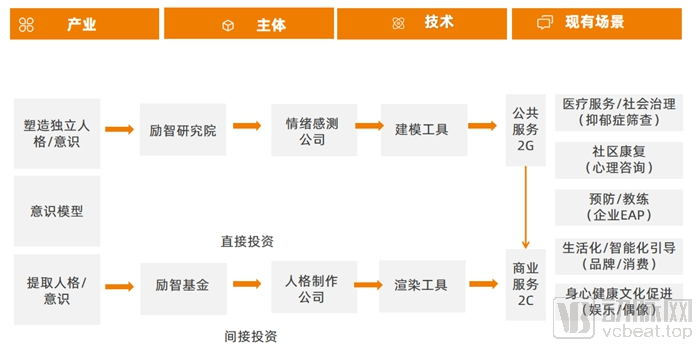
It is reported that VBInsight is currently actively preparing an industrial fund, primarily dedicated to the research and exploration of social psychological services and key technologies in social governance, thereby providing developmental support for innovative technologies and enterprises within the industry.
Moving forward, leveraging the development of its psychological big data platform, Lizhi Research Institute will continue to establish a comprehensive underlying data architecture and intensify R&D efforts in hardware infrastructure. By relying on the construction of a psychological service system to build an industrial demonstration park, and in conjunction with the “chain chief” mechanism for industrial chains, the Institute will gradually replicate and promote its service model across various cities, thereby supporting the development of “Happy Cities.”