

Panorama Cloud Health: Revolutionizing Medical Imaging with Cloud-Based Solutions and Smart Healthcare Services
As the concept of digitalization rapidly enters public consciousness, players across various sectors of the healthcare industry are increasingly integrating it into their services and products. Within this landscape, the multi-billion-dollar medical imaging market stands out as a veritable blue ocean. Key areas driving the development of medical imaging today include precision medicine, referral models, enhanced patient experience, and digital healthcare.
In recent years, provinces such as Zhejiang, Shanxi, Liaoning, and Guizhou have successively introduced multiple policies on the digitization of medical imaging, encouraging the adoption of “cloud films” for medical images and establishing pricing standards for digital medical imaging services, thereby accelerating the development of digital imaging.
On December 31, 2020, the National Health Commission issued the “Guiding Opinions on Further Regulating Medical Practices and Promoting Appropriate Medical Examinations,” which, at the level of mechanism innovation, requires medical institutions to promote the sharing of examination data by establishing databases or implementing “cloud films.”
Cloud-based films refer to electronic films stored in the cloud. When healthcare institutions perform X-ray, CT, or MRI scans, the originally generated lossless compressed DICOM images are stored on servers. Patients can verify their identity by scanning a QR code and then view and download the electronic films an unlimited number of times. Each patient has a dedicated personal space for storing all imaging data, which facilitates referrals and follow-up visits.
Compared with traditional film, cloud-based medical imaging is not only more portable but also capable of being stored for over 15 years. As the data is hosted in the cloud, it avoids data loss caused by factors such as mobile phone loss or damage, thereby offering higher security and stability.
Based on this, Beijing Yunyikang Medical Technology Group Co., Ltd. (hereinafter referred to as “Panorama Yunyikang”) leverages core medical imaging technologies to provide patients and hospitals with services such as cloud-based image storage, cloud data management, electronic imaging, mobile image viewing, AI-powered imaging cloud solutions, and telemedicine within medical consortia. It is reported that Panorama Yunyikang has currently provided 15 years of imaging cloud operational services to over 500 hospitals across 80% of China’s provinces, cities, and counties, serving more than 2 million patients online, facilitating 30,000 offline consultations and surgeries, and receiving positive market feedback.
With over 20 years of deep expertise in the healthcare industry, we entered the medical imaging sector through cloud-based film solutions.
Judging by its registration and establishment date, Panoramic Cloud Medical Health, founded in 2018, is undoubtedly a young company. However, based on the prior experience of its founders and team, it clearly possesses a solid industry foundation and technical expertise.
Wang Zhaohe, founder of Panorama Cloud Medical Health, graduated early in his career from Shandong University with a major in computer databases. He later entered the healthcare industry as a senior executive, possessing extensive experience in both the medical and IT sectors. As for the team, all founding members of Panorama Cloud Medical Health have over 20 years of experience in the healthcare industry, with most having prior entrepreneurial experience and rich expertise in healthcare, technology, and marketing.
Initially, Wang Zhaohe focused his efforts on health management within the broader big health sector. However, upon engaging with the medical imaging industry, he recognized that imaging data, given its applicability to a wide spectrum of diseases, could be regarded in a sense as the highest-quality foundational business asset in the healthcare industry. Consequently, Wang Zhaohe and his team decided to shift their focus to the field of medical imaging.
However, after entering the field of medical imaging, the team faced a new challenge: how to select the direction for product research and development. “Through in-depth industry research, we identified digital imaging as a high-potential sector and established Panorama Cloud Medical Health,” said Wang Zhaohe.
Building on its cloud film project, Panoview Cloud Medical Health is continuously expanding its service offerings and types. Currently, for hospitals and patients, Panoview Cloud Medical Health provides a one-stop medical imaging SaaS solution covering six key scenarios: remote diagnostic interpretation of medical images, video consultations, regional imaging platforms, digital medical films, and IT infrastructure development for third-party independent imaging centers, thereby optimizing the healthcare delivery process.
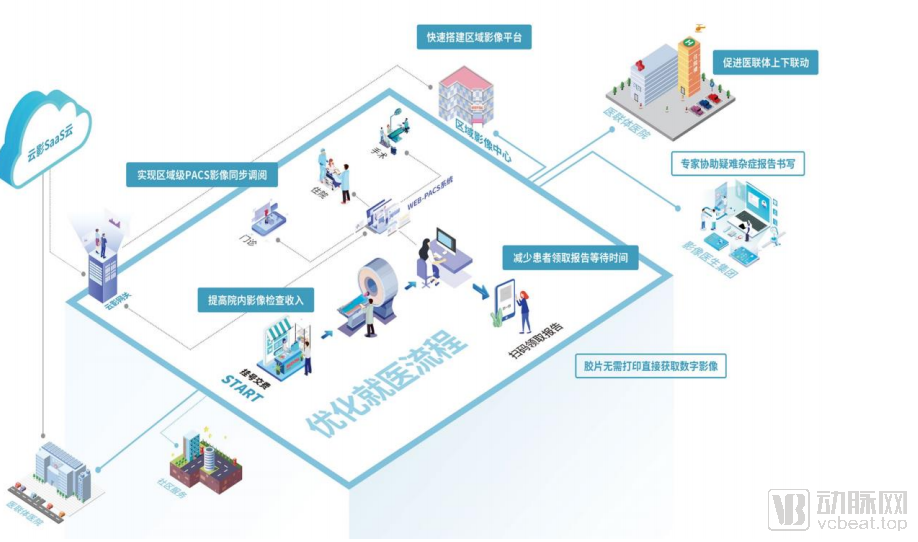
Furthermore, by integrating its existing core imaging technologies, Panorama Cloud Medical and Health has independently formulated a “One Horizontal, Five Vertical” strategic development layout. This strategy features an internet hospital-plus-business model as the core horizontal platform, while vertically extending into five specialized business segments: medical imaging, digital electrocardiography (ECG), optometry cloud SaaS platform, Sinopharm’s new operations, and cloud physician services, thereby covering multiple fields across the healthcare industry chain.
Leveraging professional technical expertise, we have accumulated tens of millions of imaging data records.
The rapid market expansion also underscores the strength and advantages of Panoramix Cloud Medical Health. According to reports, the biggest challenge in the practical application of cloud films is ensuring the speed and quality of data transmission. Leveraging years of technical expertise, the Panoramix Cloud Medical Health team has developed numerous data processing technologies, which constitute a key competitive advantage for the company.
From a technical perspective, the hardware cloud imaging front-end processor independently developed by Panorama Cloud Medical Health is based on the principle of multi-module cross-parallel connection. It features rapid response, high-speed data transmission, and fast image rendering, thereby resolving the bottleneck of sluggish overall hospital internet system performance caused by the transmission of large volumes of medical data. This innovation significantly optimizes the user experience of hospitals utilizing cloud imaging services.
To ensure the security and stability of medical data transmission, Panorama Cloud Medical Health has adopted a dual-backup storage model to address various scenarios.
Furthermore, the company’s independently developed image annotation technology can rapidly and automatically identify and mark various types of nodular lesions, provide quantitative information on multiple nodule types, and automatically generate structured reports to assist physicians in image interpretation and diagnosis.
Currently, Panorama Cloud Medical Health’s independently developed software and hardware products have secured 89 software copyrights. Leveraging the company’s in-house R&D capabilities not only enables the development of products that more closely align with market demands but also significantly reduces its operational costs.
Furthermore, in the course of serving hospitals and patients, Panoview Cloud Medical has accumulated a substantial number of image interpretation and consultation cases, thereby possessing high-quality foundational medical data. Currently, Panoview Cloud Medical is collaborating with enterprises and projects in the fields of medical AI, 3D imaging, and 3D printing, empowering their initiatives by providing data analytics and applications.
Diverse Product Forms, Serving Multiple Stakeholders
To serve diverse user groups, Panora Cloud Medical & Health delivers its services through four self-developed products: the Physician App, the Patient WeChat Official Account, the Hospital Cloud PACS Imaging Workstation, and the Service Provider Mini Program.
Via the official account’s platform service portal, patients can access their imaging reports anytime and anywhere, while maintaining long-term communication with physicians of their choice.
Supported by cloud-based PACS, hospitals can significantly reduce data transmission time. Multi-fold lossless compression technology ensures the precision of medical images while reducing storage costs. Furthermore, high-quality imaging services contribute to the overall improvement of diagnostic and treatment capabilities in hospitals.
By using the Panorama Cloud Medical Health APP, doctors can reduce image interpretation time and significantly improve work efficiency. Meanwhile, they can manage patient information more conveniently, acquire patients across multiple platforms, and provide services such as remote image interpretation and telemedicine consultations.
To better serve physicians, Panoview Cloud Medical has established an Imaging Physicians Group. Internally, this group supports the company’s business expansion, assists medical institutions and partners in implementing remote consultations, and conducts education and training programs. Externally, Panoview Cloud Medical is actively building collaborative relationships with other physician groups in the industry, regularly hosting online academic live-streaming columns, providing software products to physicians within the group, and facilitating internal data integration.
Within the overall business ecosystem of Panorama Cloud Medical Health, service providers play a pivotal role. By contracting with local service providers across various regions, Panorama Cloud Medical Health can rapidly expand its hospital-related business. Currently, the company has established collaborative partnerships with as many as 1,500 service providers nationwide. Through a mini-program, these service providers can monitor the real-time progress of relevant cloud imaging services, thereby helping to ensure the stability of these cooperative relationships.
Continuously Expand the Market and Promote the Decentralization of High-Quality Medical Resources
Next, Panorama Cloud Medical Health will expand its market coverage while continuously optimizing its products and services, enabling more medical institutions, physicians, and patients to access convenient, high-quality cloud imaging services, with the goal of achieving a penetration rate of over 10% among healthcare institutions in China within three years.
While promoting the decentralization of high-quality medical resources, QuanJing Cloud Medical & Health will also continuously develop its medical AI and medical derivative platforms. By leveraging new business formats and models, it aims to accelerate the government-led construction of medical consortia and the concrete implementation of the tiered diagnosis and treatment system, focusing on the real economy and driving industry development through technological innovation.
It is reported that Panoramic Cloud Medical Health is currently conducting its Series A financing round, aiming to rapidly promote services and products that meet market demand across China, thereby achieving a win-win outcome for hospitals, doctors, patients, and society.