

BioCreatech Submits IPO Prospectus: Pioneering Protein-Driven Synthetic Biology Platform for High-Value Biomanufacturing
In May 2020, the McKinsey Global Institute (MGI) released a report titled “The Bio Revolution: Innovations Transforming Economies, Societies, and Our Lives,” pointing out that 60% of industrial products could be manufactured through biotechnology in the future, and predicting that the synthetic biology technology revolution would generate $2–4 trillion in direct annual economic benefits globally between 2030 and 2040.
Synthetic biology holds immense promise. By modifying existing biological systems or reconstructing organisms through de novo genome synthesis, it aims to realize the third biotechnology revolution: the engineering of biological systems. This revolutionary technological breakthrough transcends the limitations of natural biological evolution, enabling the creation of urgently needed new drugs and vaccines, including novel compounds not found in nature.
Dr. Li Huazhen, one of the co-founders of Bai Kuirui Bio, holds a Ph.D. in Bioengineering from Monash University in Australia and served as a visiting scholar at the Cambridge Institute of Biotechnology. She has long been dedicated to research in industrial protein (enzyme) engineering, microbial cell engineering, and the rational design and application of protein (peptide) molecules. Dr. Li’s research experience at prestigious overseas institutions laid a solid foundation for her and her Australian team to return to China and establish Bai Kuirui Bio.
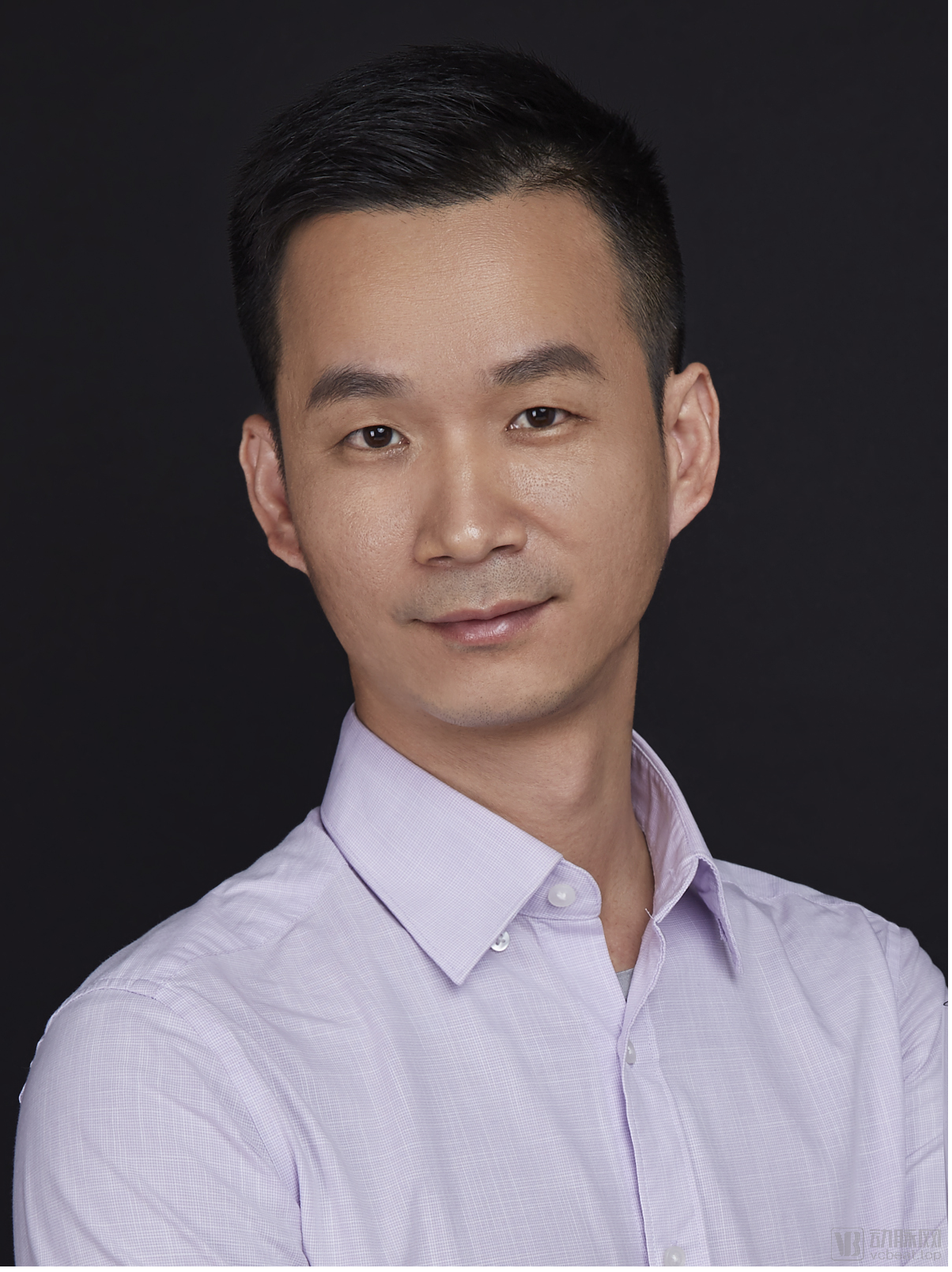
Dr. Li Huazhen
Recently, Google DeepMind’s AlphaFold artificial intelligence system, which has attracted significant public attention, has achieved a major breakthrough in the prediction and simulation of protein 3D structures. This advancement makes it possible to design protein amino acid sequences, predict and simulate their corresponding 3D structures, and thereby innovate and modify protein functions. This breakthrough has profound implications for understanding the critical role of proteins in the mechanisms of life formation.
BaiKuiRui’s team leverages precision protein design and protein molecular machine technologies, integrated with bio-big data machine learning and rational design, to develop powerful protein elements. Building on this foundation, they perform directed evolution of protein molecules to further enhance protein performance. By employing intelligent automated high-throughput screening systems combined with efficient gene-editing technologies, BaiKuiRui constructs protein machines with strong synergistic effects, thereby rapidly establishing metabolic synthesis pathways within cells. This approach enables the design and development of highly efficient cell factories, significantly boosting synthesis efficiency.
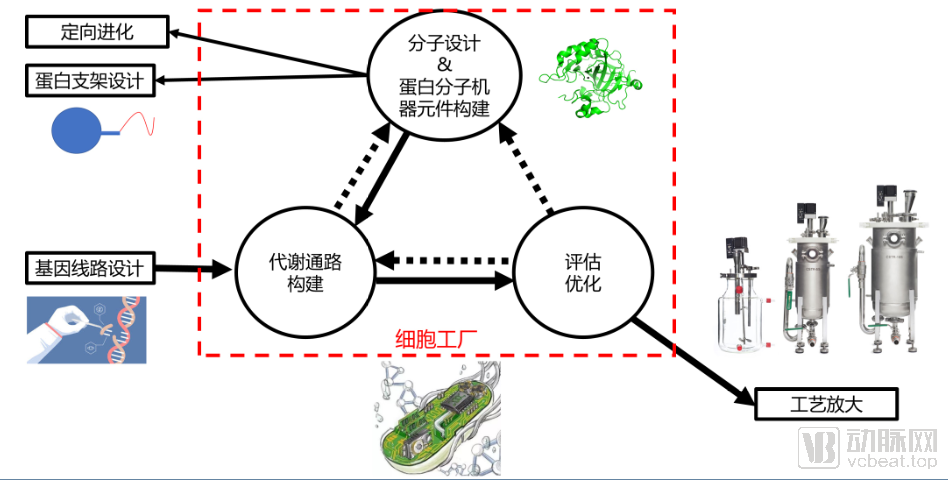
BaiKuiRui’s Product Development Logic in Synthetic Biology
Guided by this synthetic biology development paradigm, Bai Kuirui Biology has modularized the biosynthetic production process, creating “plug-and-play” biological parts that enable the efficient construction of metabolic pathways for target products in chassis cell factories. This approach paves the way for the rapid design of drug synthesis routes and the engineering of super biocatalytic enzymes. Bai Kuirui’s technology facilitates the rapid production of high-value-added products tailored to diverse application scenarios, such as antibiotic alternatives and engineered functional proteins in the biomedical field.
Dr. Li Huazhen also told VCBeat that the technical challenges in biosynthesis technologies based on precise protein design and protein molecular machines lie in the early-stage design of protein molecular machine components, high-throughput screening of large volumes of experimental data, and the design and regulation of complex genetic circuits. However, the company has overcome these technical hurdles by building a library of protein components and integrating machine learning with rational protein design. Currently, through the precise development of high-performance enzymatic protein molecules, the company’s biosynthetic efficiency has been significantly improved compared to traditional production methods.
Baikuirui Bio has consistently pursued the alignment of technology with market demands, leveraging synthetic biology to empower the transformation and upgrading of traditional industries. After establishing its synthetic biology technology platform, Baikuirui Bio initially focused on the development of pharmaceutical intermediates.
In response to this arrangement, Dr. Li Huazhen stated, “The market for pharmaceutical intermediates is substantial, and many manufacturers have been shut down due to environmental concerns. Therefore, Baikuairui Biotechnology leverages synthetic biology technologies to empower Chinese pharmaceutical companies through green biosynthesis methods.”
Leveraging Baikuairui Biotech’s proprietary technologies in precision protein molecular design and protein molecular machines, the company has established corresponding libraries of genetic elements and chassis cells. Addressing critical market needs, particularly the challenge of antibiotic resistance, the company has made significant progress in its bacteriophage-mimetic product pipeline. Currently, the company’s two major product pipelines under development focus on pharmaceutical intermediates and antibiotic alternatives, including:
I. Biosynthesis of the Cephalosporin Antibiotic Intermediate 7-ADCA
II. Biosynthesis of Phage-Like Particle Antibiotic Alternatives
Among them,Biosynthesis Project of the Cephalosporin Antibiotic Intermediate 7-ADCASelected as a key technology incubation project under the 2019 Tianjin Synthetic Biology Advancement Initiative. The company’s bacteriophage-like particle products are poised for application in areas such as skin infections and skincare. Meanwhile, the company has achieved industrial-scale production for its high-throughput screening and engineered strain synthesis project in collaboration with a biotech chemical enterprise in Shandong Province.Production capacity increased from 40,000 tons/year to 80,000 tons/year.。
The company adheres to a market-oriented approach, gaining an in-depth understanding of product requirements and pain points in manufacturing processes. By reverse-engineering cell factories tailored to products and processes, and leveraging technologies such as gene editing, protein bio-part assembly, and intelligent high-throughput screening, the company centers on combining rational design of protein molecular machines with directed evolution. This strategy simplifies genetic circuits and metabolic pathways, enabling green, efficient, and scalable production of high-value-added products.
Meanwhile, BaiKuiRui Biotech also emphasizes collaboration with peers within the field and across disciplines. The company is poised to establish its presence at the Shenzhen Institute of Synthetic Biology, Chinese Academy of Sciences. Leveraging this opportunity, BaiKuiRui Biotech will utilize the Bio-foundry—an automated high-throughput experimental platform that serves as a major scientific and technological infrastructure facility under the Shenzhen Institute of Synthetic Biology—to accelerate protein development through “high-speed” (high-throughput screening) and “digital” (cloud-based data analysis) approaches.
Empowered by this R&D platform, Baikuiri Bio will be able to reverse-engineer and construct cell factories tailored to diverse application scenarios, developing novel biosynthetic products such as artificial functional proteins for the food and nutraceutical sectors, and antibiotic alternatives for the treatment of Helicobacter pylori infection.
It is reported that Bai Kuirui Biotech is currently planning a Pre-A financing round, aiming to raise RMB 20 million. The funds raised will be primarily used for industrialization, product research and development, market expansion, and talent acquisition.