

Ali Health's YiLu App Launches Nationwide Nucleic Acid Testing Map to Support Spring Festival Epidemic Prevention

AliHealth
Medical and Health Services Network Service Provider
As epidemic prevention and control policies are adjusted in many regions, nucleic acid testing has become a “must-have” for residents traveling during the Spring Festival in numerous areas. Where can one find professional nucleic acid testing institutions nearby? Where can nucleic acid test reports be viewed? What preparations should be made before returning home? These and other questions have drawn significant attention from users.
On January 22, AliHealth launched the “National Nucleic Acid Testing Map” on its Yilu app, providing users across China with a comprehensive suite of services, including search and appointment booking for nearby nucleic acid testing facilities, scheduling of home-based nucleic acid testing, access to test results, and inquiries into travel policies for returning to one’s hometown.
Users can open the AliHealth app, click the “Nucleic Acid Testing” icon on the homepage or search for the keyword “Nucleic Acid Testing” to access the dedicated page and select different types of services.
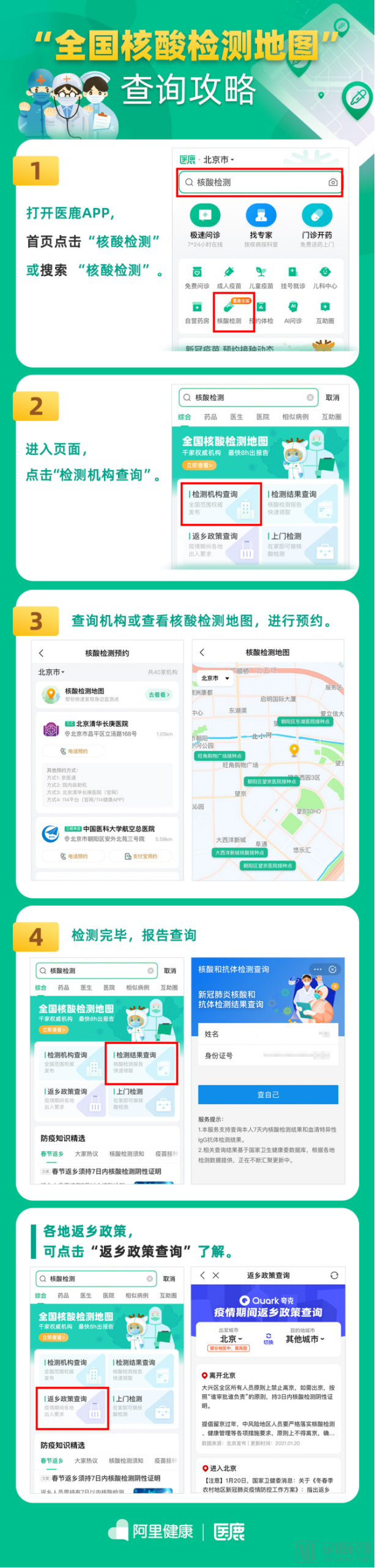
“National Nucleic Acid Testing Map” includes thousands of officially certified nucleic acid testing institutions across China. Users can intuitively locate the nearest testing facility and view related information on the map, with some institutions offering telephone or online appointment services. Additionally, if users are unable to travel, they can schedule home-based nucleic acid testing with a single click. After testing, users can check their results on the dedicated nucleic acid testing page. Furthermore, users can instantly query return-to-hometown policies for their respective cities.
It is reported that earlier this month, in response to cold waves affecting multiple regions, AliHealth’s Yilu platform launched home-based nucleic acid testing services. Furthermore, as soon as outbreaks emerged in Shijiazhuang and other areas, the platform introduced online free clinic services across several affected cities, helping to address practical challenges faced by individuals encountering difficulties in accessing offline medical care due to the epidemic.