

Angelalign Files for Hong Kong IPO to Challenge Invisalign in the $11.9 Billion Invisible Orthodontics Market

ANGELAIGN
Dental Medical Consumables Supplier and Service Provider
On January 29, Angelalign, a leading domestic enterprise in clear orthodontics, filed an IPO application with the Hong Kong Stock Exchange. The funds raised are primarily intended for the construction of its Wuxi base, enhancement of R&D capabilities, expansion of the sales team, and brand promotion and digital transformation. Notably, once the new production facilities at the Chuangmei Base in Wuxi are fully operational, the annual designed capacity is expected to reach approximately 100 million clear aligners.
According to statistics, China’s dental orthodontics market is expected to reach $29.6 billion in retail sales revenue by 2030, with the clear aligner orthodontics segment projected to hit $11.9 billion. However, the current penetration rate of clear aligners remains relatively low. As the first company in China to launch clear aligner products, ANGELAIGN’s move into the secondary market may signal a new phase for China’s clear aligner orthodontics industry.
Clear aligner orthodontics was first introduced in the United States in 1998 and offers numerous advantages over traditional orthodontics. For instance, transparent clear aligners are more aesthetically pleasing and difficult to detect at social distances. The customized design and advanced materials of clear aligners provide greater oral comfort. As removable appliances, they facilitate improved oral hygiene during treatment. Furthermore, manufacturers offer comprehensive support in treatment planning, resulting in a reduced frequency of follow-up visits.
According to a report by Frost & Sullivan, the global clear aligner market grew from USD 4.0 billion in 2015 to USD 13.1 billion in 2019 in terms of retail sales revenue, representing a compound annual growth rate (CAGR) of 35.0%. The development of the clear aligner market in developing countries, primarily China, has been the main driver of global market growth.
In 2019, China’s clear aligner orthodontics market became the second largest in the world. In terms of retail sales revenue, the market size grew from USD 200 million in 2015 to USD 1.4 billion in 2019, representing a compound annual growth rate (CAGR) of 56.0%. The number of clear aligner orthodontic cases in China increased from 47,800 in 2015 to 303,900 in 2019, with a CAGR of 58.8%.
In 2011, Align Technology established a wholly-owned subsidiary in Shanghai, marking the entry of its clear aligner brand, Invisalign, into the Chinese market. Since then, Invisalign has achieved rapid growth in China. In recent years, domestic brands have also increased their investment in R&D and promotion within the clear aligner sector, achieving swift expansion by offering competitive pricing and more convenient, efficient localized services. These companies primarily include Angelalign, Smartee Dental Technology, Henghui Technology, and Zhengli Technology.
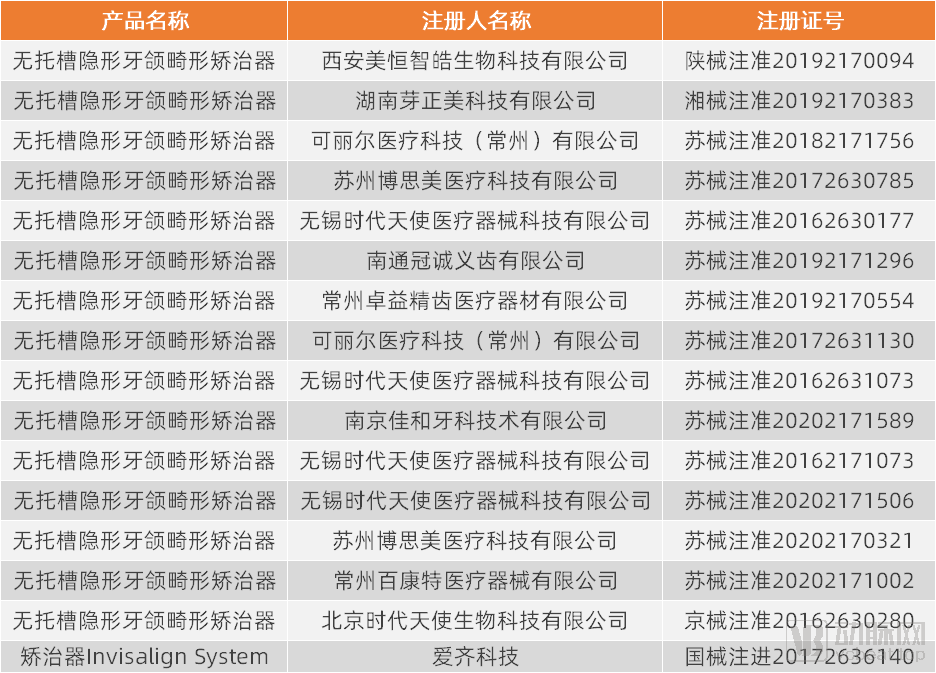
Invisible Aligner Products and Related Companies, Source: National Medical Products Administration, Graphic by VCBeat
According to the National Medical Products Administration’s medical device database, there are currently nearly 20 clear aligner products in China, involving 10 companies. However, the domestic clear aligner market is highly concentrated, with the vast majority of market share held by Invisalign and ANGELAIGN.
According to a report by Frost & Sullivan, in the first three quarters of 2020, the two major market players, including ANGELAIGN, accounted for approximately 82.3% of the total market share in terms of completed cases, with ANGELAIGN holding 41.3%, indicating that the two were closely matched. Although the report does not explicitly name the other player here, it is undoubtedly Invisalign.
However, from an overall perspective, the domestic clear aligner orthodontics market is still in its nascent stage. In 2019, among the 2.9 million malocclusion cases treated in China, only 10.5% utilized clear aligners; whereas in the United States, 33.1% of the 4.5 million treated malocclusion cases employed clear aligners. Specifically, among pediatric/adolescent and adult orthodontic treatment cases in China, only 4.3% and 37.8%, respectively, used clear aligners; while in the United States, approximately 15.9% of pediatric/adolescent cases and 69.3% of adult cases had adopted clear aligners.
Since its establishment in 2003, ANGELAIGN has been dedicated to the research and development, manufacturing, and sales of clear aligner products, and has developed China's first clear aligner treatment solution.
In 2010, ANGELAIGN established a manufacturing center in Wuxi to expand its production capacity. In 2011, it set up a 3D printing base in Wuxi, integrating 3D printing technology into standardized production processes, and established an operations center in Shanghai to enhance its sales and operational capabilities. In June 2015, Shuangbai Investment Group became the controlling shareholder of ANGELAIGN.
Currently, ANGELAIGN has four subsidiaries involved in its core business, each undertaking different functions such as R&D, manufacturing, and sales. The company primarily operates with Shanghai as its operational center and Wuxi as its manufacturing and R&D center.
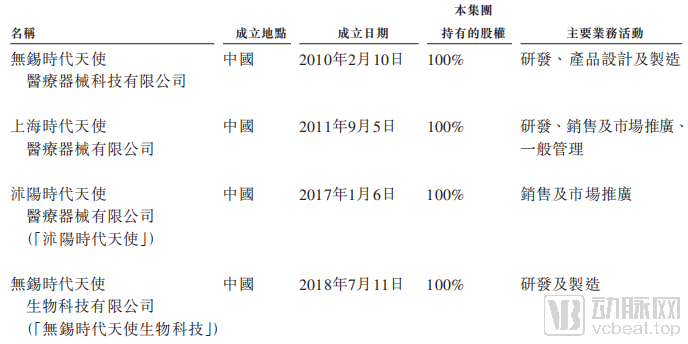
Core Subsidiaries of ANGELAIGN, Source: Prospectus
After 18 years of accumulation, ANGELAIGN currently has four clear aligner products on the market: ANGELAIGN Standard Edition, ANGELAIGN Champion Edition, ANGELAIGN Kids Edition, and COMFOS. The number of completed cases increased from approximately 77,700 in 2018 to approximately 120,100 in 2019, reaching approximately 101,700 as of September 30, 2020.
ANGELAIGN’s primary source of revenue is the provision of clear aligner orthodontic solutions. According to its prospectus, both its revenue and net profit have experienced rapid growth since 2018. In 2019, ANGELAIGN reported revenue of RMB 646 million and an adjusted net profit of RMB 130 million. For the first three quarters of 2020, its revenue reached RMB 601 million, with an adjusted net profit of RMB 204 million.
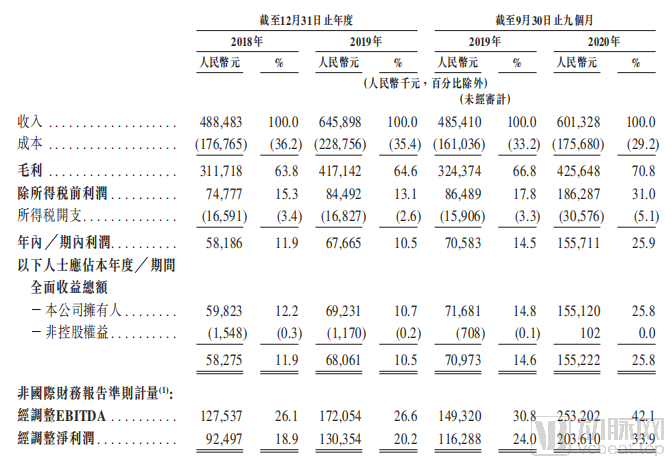
ANGELAIGN Financial Data, Source: Prospectus
Clear aligner orthodontics is an interdisciplinary field that integrates five major technological domains: orthodontics, computer science, materials science, modern intelligent manufacturing technology, and biomechanics. It requires the seamless integration of technology and clinical practice, which demands continuous technological investment and strong platform-building capabilities. The rapid growth of ANGELAIGN is primarily attributable to its multifaceted advantages.
First, market share is enhanced through synergies across a comprehensive product portfolio.Currently, ANGELAIGN’s four product offerings enable dentists to effectively manage malocclusion cases of varying complexity, while also meeting the needs of users across different age groups and spending capacities, thereby expanding its customer base and rapidly increasing market share.
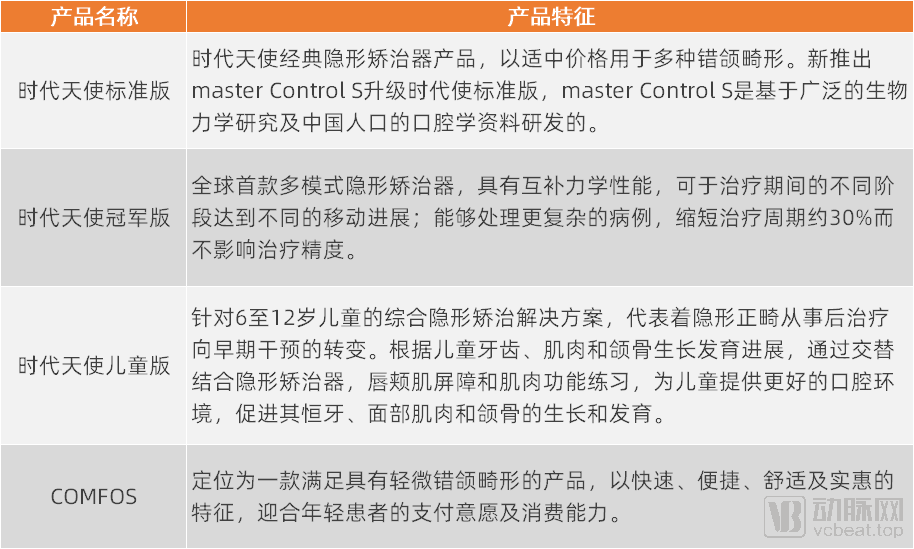
Four Products Under ANGELAIGN and Their Features, Source: Prospectus
Meanwhile, ANGELAIGN helps dentists rapidly, effectively, and efficiently address the complex cases that are prevalent in China through a series of innovative orthodontic devices and attachments. For example, ANGELAIGN has developed the traction product angelButton, which can be combined with clear aligners at any specified position to achieve optimal orthodontic biomechanical outcomes.
Recently, ANGELAIGN has also launched angelArm, an active-force mandibular advancement device. This product enhances the precision and control of force application, thereby expanding the range of treatable occlusal structures.
angelArm and angelButton, used in conjunction with various ANGELAIGN clear aligners, provide solutions for skeletal malocclusions common among Asians, such as maxillary protrusion and mandibular retrusion, demonstrating excellent treatment outcomes.
Secondly, to provide physicians with high-quality medical and technical services.ANGELAIGN provides dentists with comprehensive digital support for case assessment, medical treatment planning services, and technical assistance. Even general practitioners who do not specialize in orthodontics can proficiently use ANGELAIGN’s system. Additionally, ANGELAIGN has established a team of 400 medical designers who can propose treatment plans within three to four business days after case submission, helping dentists serve patients more efficiently.
Finally, it possesses robust research and development capabilities.ANGELAIGN has established interdisciplinary R&D capabilities spanning five major fields: clinical dentistry, biomechanics, materials science, computer science, and intelligent manufacturing technology. It has also developed proprietary technologies and data platforms, including masterForce, masterControl, and masterEngine.
Among these, masterForce is equipped with cutting-edge computer-aided engineering technology to gain constructive insights into the precise biomechanical mechanisms involved in orthodontic treatment; masterControl enables the development of more advanced clear aligner materials capable of delivering ideal, gentle, and sustained forces for tooth movement during orthodontic treatment, while offering greater resistance to plastic deformation and superior elastic recovery performance; masterEngine achieves accurate extraction and integration of data across multiple scenarios, assisting dentists in diagnosis and treatment planning workflows, and providing clinical stomatology with more comprehensive, reliable, and accurate information.
In the United States, the clear aligner market is highly competitive, with more than 30 companies having entered the field, including industry giants such as Align Technology, Henry Schein, 3M, Straumann, and Dentsply Sirona, as well as startups like Ortho Clear, SmileDirectClub, and Candid.
In China, although the number of companies is not yet large, Invisalign is clearly a formidable competitor for ANGELAIGN. With an earlier establishment date and deeper technological accumulation, how can ANGELAIGN continue to build and consolidate its differentiated advantages?
Li Huamin, founder of ANGELAIGN, stated in an exclusive interview with VCBeat that the company would highlight its differentiation and advantages from several aspects:
First, for the clear aligner orthodontics industry, the primary challenge to address is how traditional medical principles can be applied to new medical-grade polymer materials. ANGELAIGN has introduced China’s first PhD in orthodontics and has established a series of clinical protocols for addressing various dental issues, thereby forming the ANGELAIGN Medical System.
Secondly, ANGELAIGN collaborated with Professor Yan Yongnian, known as the pioneer of 3D printing in China, to develop 3D printing equipment specifically for dental orthodontics. Pioneering commercialization from the ground up, they worked with partners to create a complete high-precision 3D printing system tailored for dental model production.
Meanwhile, by combining big data accumulation, medical rules, and AI intelligence, ANGELAIGN has significantly shortened the time required to design treatment plans for patients. In addition, ANGELAIGN advocates the concept of “prevention,” which is another key differentiator.
The prospectus indicates that ANGELAIGN will enhance its competitiveness from several aspects in the future.
Strengthen R&D capabilities and continuously iterate orthodontic solutions.Recently, ANGELAIGN established the Digital Oral Intelligence Research Institute to strengthen multidisciplinary R&D efforts and lead innovation and application of digital technologies in the fields of oral health and dentistry.
Further strengthen the intelligence and digitalization of the system to improve operational efficiency.ANGELAIGN plans to develop a flexible and scalable information technology system to streamline and fully digitize all aspects of its operations, covering order placement, data transmission, treatment plan design, user interaction, procurement and production processes, quality control and product delivery, as well as after-sales service.
Optimize Medical Services, Enhance User Experience.ANGELAIGN will conduct in-depth biomechanical research and clinical validation to optimize its treatment planning capabilities, thereby strengthening dentists’ confidence in the ANGELAIGN clear aligner system and increasing its utilization rate, particularly among general practitioners.
Furthermore, ANGELAIGN will enhance production efficiency and expand capacity, while consolidating its market position by broadening its sales network and boosting brand awareness and academic influence.
According to a report by Frost & Sullivan, in 2019, there were approximately 1.037 billion cases of malocclusion in China, significantly higher than the approximately 244 million cases in the United States. However, among the 2.9 million treated malocclusion cases in China in 2019, only 10.5% were treated with clear aligners, whereas in the United States, 33.1% of the 4.5 million treated malocclusion cases utilized clear aligners. This significant disparity indicates an extremely low penetration rate of the clear aligner orthodontics market in China. The report also projects that, in terms of retail sales revenue, China’s dental orthodontics market is expected to reach $29.6 billion by 2030, with the clear aligner orthodontics segment projected to reach $11.9 billion by 2030.
In the future, from the user’s perspective, more adults will be willing to accept clear aligners due to their superior aesthetics. As disposable incomes rise and health-related consumer spending increases, the treatment rate for adult malocclusion will grow, whereas it has historically been relatively low.
Furthermore, as clear aligner therapy offers better control over tooth movement, it can address approximately half of the indications for malocclusion. Technological advancements are also driving the application of clear orthodontics to more complex indications that are prevalent in China, thereby continuously expanding the target patient population. In addition, intraoral scanners enable the visualization of treatment outcomes, allowing patients to preview the results before commencing orthodontic treatment, which in turn facilitates their consumption decisions. In 2019, the penetration rate of intraoral scanners was approximately 10% in China, compared to around 40% in the United States; the future increase in the penetration rate of intraoral scanners will further promote the development of the clear aligner market.
From the perspective of dentists, the number of practitioners capable of performing clear aligner orthodontics is expected to increase. As clear aligner therapy requires only moderate training and is backed by comprehensive medical and technical support from clear aligner solution providers, both orthodontists and general dentists can more easily implement clear aligner treatments.
Meanwhile, compared with traditional orthodontics, clear aligner therapy does not require dentists to bond brackets or adjust archwires, which reduces the treatment time per visit and improves dentists’ work efficiency, thereby encouraging more dentists to adopt clear aligner orthodontics.
Therefore, the increased willingness of doctors and patients to adopt these solutions will become a key driver of market growth. It remains to be seen how ANGELAIGN will leverage these two factors to truly propel the industry into a new phase.
Reference: Exclusive Interview with Li Huamin, Founder of ANGELAIGN: Playing an Infinite Game—How Should the Clear Aligner Industry Evolve?