

With $57B in Funds and 276M Online Users, Why Is Internet Healthcare Rushing Offline?
Over the past year, internet healthcare has unleashed unprecedented energy.
In the clinical care segment, an increasing number of public hospitals have joined internet healthcare platforms, leading to expanded collaborations. In the capital market, JD Health went public, and multiple companies secured substantial financing. At the user level, data from the 46th “Statistical Report on Internet Development in China” released by the China Internet Network Information Center (CNNIC) shows that as of June 2020, the number of online medical service users in China reached 276 million, accounting for 29.4% of the total internet population.
Despite the immense value delivered by internet healthcare’s ability to transcend geographical barriers, VCBeat has observed that companies, leveraging their substantial capital reserves and large user bases, are actively accelerating their offline expansion.
Following the inaugural year of internet healthcare, the sector once again attracted significant capital interest in 2020. According to the VCBeat Orange Database, there were 16 primary market financing rounds in 2020 (counting platforms that have established their own internet hospitals), with a total financing amount of RMB 16.8 billion. JD Health went public; based on its initial public offering price of HK$70.58 per share, the net proceeds from the global offering amounted to approximately HK$26.457 billion (approximately RMB 22 billion). Based on these figures, the total financing for the industry in 2020 reached RMB 38.7 billion.
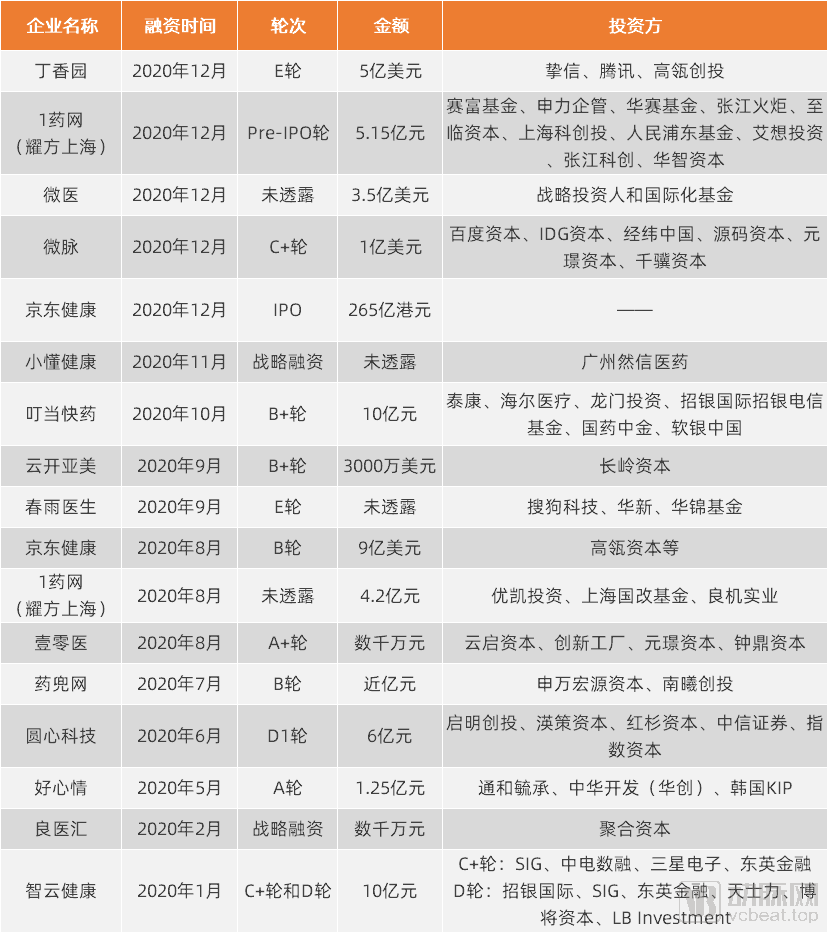
2020 Internet Healthcare Financing Overview; Data Source: Artery Orange Database; Chart by VCBeat
From the perspective of financing details, large-scale funding in 2020 was concentrated among a few companies. Among them, DXY and JD Health have already achieved profitability at scale. DXY’s $500 million financing round will be used to strengthen its professional barriers, explore more healthcare scenarios, and create a series of professional, trustworthy, continuous, and integrated health products. The funds raised from JD Health’s IPO will be used to further expand its user base, enhance supply chain capabilities for pharmaceuticals and health products, expand online medical and healthcare services, strengthen technology-enabled solutions, and drive continuous innovation.
However, internet healthcare companies still struggle to achieve large-scale profitability through online consultations, making the sales of pharmaceuticals and health supplements the dominant revenue model.
In fact, compared with offline medical services, internet healthcare mainly focuses on follow-up consultations for common and chronic diseases, and cannot carry out items such as examinations, tests, and surgeries. For platforms that provide both medical services and pharmaceuticals, drugs will naturally account for a large proportion. However, VCBeat’s analysis of the changes in 18 internet healthcare companies in 2020 found that the industry is strengthening its offline layout and exploring more diverse directions.
"From an overall industry perspective, the space-independent nature of internet healthcare has demonstrated significant value during epidemic prevention and control, with its benefits continuing to unfold. However, it is undeniable that a series of changes in 2020 also made the industry realize that online value needs to be maintained and consolidated through offline capabilities."
Public Hospitals “Go Online” Reshaping the Landscape
VCBeat previously in “Public Internet Hospitals Accelerate Market Entry: Online Healthcare Shows Three Major Changes and Three Key Trends》article analyzed that in 2020, a large number of public hospitals entered the market, subsequently generating corresponding construction and operational services.
According to statistics from VCBeat, by the end of December 2020, 71 of the top 100 hospitals in China (as ranked by Fudan University) had launched internet hospitals or online diagnosis and treatment services. Data released by the National Health Commission in 2020 showed that more than 5,500 secondary-level and tertiary hospitals across the country were capable of providing online services. Behind each hospital’s online platform, one or more service providers offer technical support.
Taking XinYi International, a provider of medical cloud application solutions, as an example, the company has built China’s most advanced intelligent medical cloud platform. It offers technical services such as telemedicine, mobile healthcare, and internet hospitals to medical institutions, covering multiple dimensions including diagnosis and treatment, teaching, scientific research, and management. By the end of 2020, XinYi International served more than 20,000 medical institutions, compared with 12,000 at the end of 2019 and 8,000 at the end of 2018, highlighting the substantial surge in technological demand in 2020.
Meanwhile, the medical insurance advantages of public internet hospitals have led to shifts in patient preferences. Currently, among internet hospitals designated as medical insurance providers, public hospitals predominate; when these institutions can meet patients’ needs for follow-up consultations, prescription issuance, and medication delivery, patients are highly likely to choose them due to medical insurance coverage.
Although public internet hospitals are currently in their early stages, a significant increase in their service volume in the future could divert a portion of patients who previously used online medical platforms for follow-up consultations and medication purchases. From this perspective, online medical platforms need to strengthen their collaborations with public hospitals.
Establishing an Offline Presence Is a Prerequisite for Integrating with Medical Insurance
Internet healthcare platforms can connect doctor, patient, and industry resources across China, featuring a cross-regional nature. However, from the perspective of inclusion in medical insurance coverage, certain barriers remain.
Currently, China’s basic medical insurance system is primarily managed at the municipal level. For offline services, patients mainly seek medical treatment and obtain reimbursement within their local areas, with supplementary provisions for cross-regional care settled locally; in all cases, expenditures are drawn from the medical insurance fund of the insured’s place of enrollment. However, there are no clear regulations governing the settlement of cross-regional medical expenses incurred through internet-based healthcare services. Therefore, if an internet healthcare platform wishes to be included in medical insurance payment schemes, it must establish operations within the relevant pooling region, integrate with the local medical insurance system, and consolidate medical resources to serve local enrollees. To connect with medical insurance systems in multiple regions, the platform must establish a presence in each of those areas.
Currently, WeDoctor Internet General Hospital has launched 30 internet hospitals across China, 17 of which have been designated as medical insurance providers. In February 2020, Chengdu High-Tech Haier Sen Internet Hospital, under Medlinker, also enabled online payments via personal medical insurance accounts, allowing insured patients in Chengdu to use their personal medical insurance funds to cover costs for online follow-up consultations and medications.
Ping An Good Doctor’s internet hospital enabled online payment via Hubei Provincial Medical Insurance in March 2020. Since then, its internet hospital has also implemented medical insurance payments in cities such as Yinchuan and Dongguan.
Furthermore, in July 2020, the Fangzhou Internet Hospital of Tumxuk City People's Hospital, invested and constructed by Jianke Group, signed an agreement with the Human Resources and Social Security Bureau of the Third Division of the Xinjiang Production and Construction Corps (XPCC) in Tumxuk City to become a designated medical insurance provider for internet hospitals. This enables local insured patients to access follow-up consultations, e-prescriptions, medication delivery, and online medical insurance reimbursement services.
It is evident that platforms must establish internet hospitals in various regions to qualify as entities eligible for inclusion in local medical insurance schemes. As internet hospitals must be built upon physical medical institutions, whether through self-built facilities or partnerships with existing ones, offline presence remains an indispensable component.
Entry of Tech Giants Intensifies Product Competition
Judging from the moves of major internet companies in 2020, healthcare is destined to become a fiercely contested battleground. In terms of specific products and services, specialized centers and chronic disease management centers have become standard offerings.
As of the end of 2020, JD Health had partnered with leading experts to co-establish 18 specialized centers, including the Heart Center in collaboration with Professor Hu Dayi, the Otolaryngology Center jointly established with Academician Han Demin, and the Traditional Chinese Medicine Hospital with Professor Gao Sihua serving as Chief Scientist.
Baidu Health has launched the “Diabetes Center,” offering users a comprehensive suite of services ranging from health education and disease prevention to online consultations, e-commerce offerings, personalized service packages, and end-to-end health management. The center also provides healthcare professionals with professional tools—including text-and-image messaging, video consultations, and monitoring capabilities—to facilitate online patient tracking, enable real-time interaction, and enhance the efficiency of diabetes diagnosis and treatment.
In 2020, the Ali Health app was rebranded as “Yilu.” Compared with its previous version, the Yilu app features a cleaner and more focused interface, consolidating medical services on the homepage—a move that signals Ali Health’s intensified push into healthcare services. Recently, the Yilu app has also launched a Pediatric Center, where pediatricians from Grade 3A hospitals have joined the platform to provide rapid responses within 30 minutes and offer night-shift coverage to address parents’ urgent concerns.
Regarding the layout of internet companies in online chronic disease management, VCBeat previously reported in “Baidu and JD.com Enter the Fray, User Base Doubles: Chronic Disease Management Hits the “Accelerator”》also provides a review.
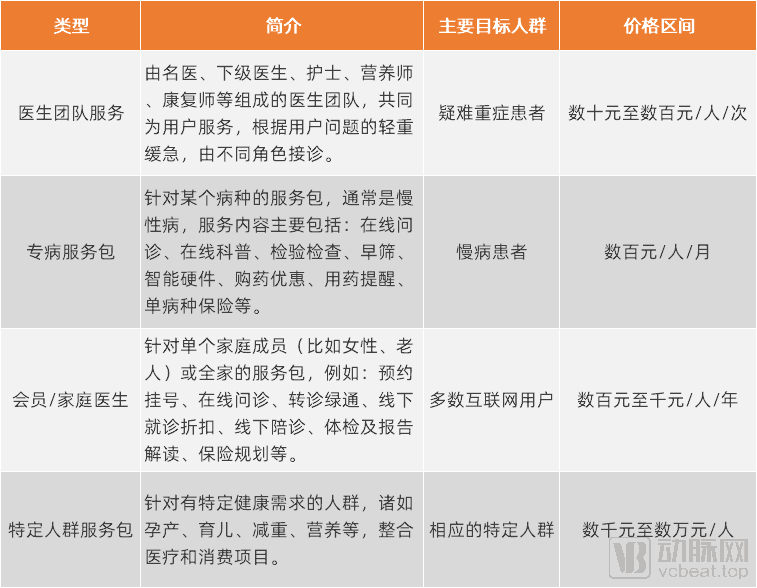
Common Service Package Types, Chart Compiled by VCBeat
However, among existing internet healthcare platforms, Medlinker and Zhiyun Health primarily focus on chronic disease management, while other platforms have introduced offerings such as physician teams, family doctors, and service packages tailored to specific populations, with bundled services becoming increasingly prevalent. As major internet companies enter the market, competition is intensifying. Moreover, online chronic disease management inherently requires addressing patient adherence issues. Therefore, it is imperative to consider how to deliver more robust services and achieve differentiation.
Due to the Seriousness of Disease Diagnosis and Treatment
Medicine is a serious and ever-evolving field. In offline settings, healthcare professionals must continuously engage in research within their clinical practice, constantly updating their understanding of diseases and diagnostic and therapeutic approaches. In online settings, although medical services are limited to follow-up consultations and prescription renewals, does the inclusion of this component lead to positive changes in the overall process of disease management, particularly for severe conditions? This question also requires long-term studies and rigorous data-driven evidence.
It is understood that Medlinker has currently carried out discipline construction in more than 15 specialties and over 30 diseases, covering multiple areas such as cardiovascular disease, diabetes, respiratory asthma, oncology, chronic kidney disease, liver disease, HIV, pediatrics, gynecology, general practice, traditional Chinese medicine (TCM), and mental health. In 2020, Medlinker, together with experts, societies, and associations from various fields, launched expert consensus projects on online chronic disease management for multiple specialties, providing an evidence-based framework for online chronic disease management. Meanwhile, it also established a strategic partnership with the Chronic Disease Management Professional Committee of the Beijing Association of Traditional Chinese Medicine to promote research on the clinical efficacy of TCM for multiple diseases.
Furthermore, while online platforms allow for follow-up consultations and prescription refills for mental health conditions, as well as psychological counseling via text, video, or voice calls, face-to-face in-person counseling enables therapists to make more authentic and comprehensive observations of patients’ emotions and behaviors—an aspect that cannot be fully replicated by online methods.
Given the unique nature of healthcare, the strengthening of offline presence in internet healthcare is mainly reflected in five aspects.
Strengthening Offline Resource Connections
Connecting individual physicians across China has long been the predominant approach for internet healthcare platforms to aggregate medical resources. Building on this foundation, in 2020, internet healthcare platforms intensified their collaborations with hospitals, clinical departments, and professional societies and associations, aiming to enhance their aggregation capabilities on both the physician and patient sides.
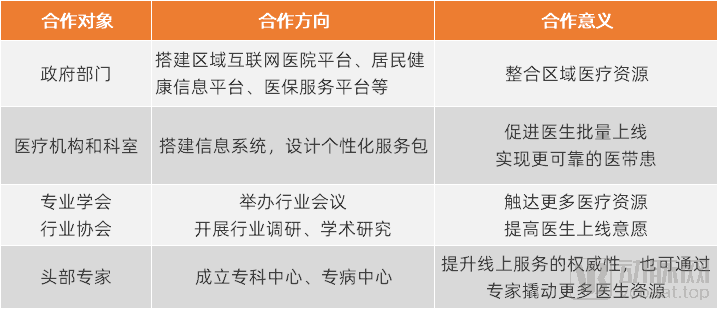
Key Approaches and Significance of Strengthening Offline Resource Integration in Internet Healthcare, Chart by VCBeat
In April 2020, under the leadership of the Tianjin Municipal Health Commission, WeDoctor Internet Hospital spearheaded the establishment of a grassroots digital health consortium, which is set to cover 267 primary healthcare institutions. Currently, efforts are being accelerated to implement the consortium in the 46 primary healthcare institutions that have already signed agreements. The digital health consortium built by WeDoctor is also being gradually implemented in multiple locations, including Tai’an and Dezhou in Shandong Province, Huanggang in Hubei Province, Yinchuan in Ningxia Hui Autonomous Region, and Pingdingshan in Henan Province.
The essence of the Digital Health Community lies in leveraging the capabilities of the WeDoctor platform to digitally upgrade the service capacities of medical institutions at all levels, elderly care facilities, pharmacies, and pharmaceutical companies within a given region, thereby innovating service delivery models and enhancing local healthcare standards.
JD Health’s government collaborations primarily focus on the “Healthy Cities” initiative. In 2020, JD Health signed agreements with cities such as Taicang in Jiangsu Province, and its “Smart Health Beihai” project in Beihai, Guangxi, has been gradually implemented, with seven informatization projects launched or piloted.
In mid-2020, Ping An Good Doctor implemented a strategic upgrade across three key dimensions: channels, services, and capabilities. Specifically, in terms of channels, it expanded from individual users and insurance services to enterprise services and internet hospital platforms. Regarding capabilities, it strengthened its hybrid network of self-employed and external physicians, evolving from an online-only focus to an integrated online-and-offline model.
Collaboration with government departments and physical hospitals is one of Ping An Good Doctor’s initiatives to expand into the internet hospital sector. Previously, the Fuzhou Regional Internet Hospital Platform, built by Ping An Good Doctor for the Fuzhou Municipal Health Commission, has gone live, and its jointly developed internet hospital platforms in various regions have also been gradually put into operation.
Haodf Online, which aggregates numerous renowned physicians, has strengthened its collaboration with hospitals through joint free clinics. In 2020, Haodf Online conducted multiple free clinic events in partnership with Sun Yat-sen Memorial Hospital of Sun Yat-sen University, the Department of Obstetrics and Gynecology at Peking University First Hospital, the Obstetrics and Gynecology Hospital of Fudan University, and Shanghai First Maternity and Infant Hospital.
For Weimai, which has long made hospital partnerships its core strategy, 2020 was a phase of accelerating the development of benchmark projects and replicating its business model.
As of the end of 2020, Weimai’s specialty-specific innovative services, designed in integration with hospitals’ clinical operations, had been deeply implemented and operational in more than 100 hospitals. These services covered over 30 specialties and disease areas, including gynecology, obstetrics, pediatrics, orthopedics, oncology, and chronic disease management, achieving strong operational outcomes in multiple cities across Zhejiang, Sichuan, Hunan, and other provinces. Moving forward, Weimai will accelerate its city-level coverage and expand its network of partner hospitals, continuously replicating its existing business model.
Yuanxin Technology Group, which has already established a closed-loop service ecosystem encompassing “medical care, patients, pharmaceuticals, and insurance,” is also accelerating its collaborations with hospitals. Currently, Yuanxin Medical Technology, a subsidiary of Yuanxin Technology Group, has built internet-based medical service platforms for more than 200 hospitals, including Tianjin Medical University Cancer Institute and Hospital and Beijing Chaoyang Hospital. It has also established an “Internet +” medical insurance payment system and improved the commercial health insurance framework.
Under the aforementioned collaboration model, physicians are permitted and encouraged by their departments, hospitals, and even local administrative authorities, resulting in greater motivation and willingness to join online platforms. For internet healthcare platforms, the most direct benefit is the ability to onboard physicians in batches, while these physicians also bring in patients in large numbers. This approach is more efficient than individually recruiting physicians and acquiring patients one by one.
Self-Built Offline Service Network
Some internet healthcare platforms are also deploying offline service networks through self-built channels.
As of the end of 2020, Shangyi Renjia had established nearly 20 self-operated TCM clinics and partnered with 100 affiliated and cooperative TCM clinics. Since the “inspection, auscultation/olfaction, inquiry, and palpation” (the four diagnostic methods) are indispensable in TCM consultations, these offline clinics primarily serve to meet the face-to-face consultation needs of online patients, while continuously expanding their network to broaden the coverage of such services.
Haoxinqing, an internet healthcare platform focused on mental health and medical services, has accelerated the development of its offline chain of shared clinics. Since opening its first clinic in Beijing in 2019, Haoxinqing established two additional clinics in 2020, primarily serving follow-up patients from its online platform by providing psychotherapy and psychological counseling. Each Haoxinqing clinic will be equipped with smart consultation rooms that integrate clinical psychological care, offering services such as precision pharmacogenetic testing, mass spectrometry-based blood concentration monitoring, VR therapy, and music-guided meditation for relaxation, thereby delivering more comprehensive diagnostic and treatment solutions to patients.
As is well known, physical medical institutions are mostly asset-heavy operations, and chain expansion entails exponentially increasing costs. Therefore, the expansion of offline service networks must be premised on controllable costs. In this regard, Shangyi Renjia has adopted a hybrid model combining self-operated clinics with franchising. It recruits outstanding TCM practitioners from its self-operated clinics as shareholders and empowers offline clinics through its proprietary internet healthcare platform, thereby shortening the break-even period and achieving overall cost control.
For mental health care, the lower reliance on large medical equipment for diagnosis, treatment, and counseling translates to lower capital investment compared to general clinics. This allows Haixinqing to effectively balance expansion speed with cost efficiency during its clinic development. According to Chen Guanwei, Founder and CEO of Haixinqing, the number of offline shared clinics is projected to increase to 30 in 2021, providing a significant complement to the comprehensiveness of mental health services in China.
Accelerate Offline Pharmacy Partnerships
While internet-based healthcare can transcend geographical barriers and efficiently connect physicians with patients, it is crucial not to overlook that pharmaceuticals constitute a critical component in delivering substantive diagnostic and therapeutic care. Therefore, the offline infrastructure for medications—encompassing both patient needs and pharmacy requirements—must not be neglected.
Regarding patient needs, the importance of offline pharmaceutical services was particularly evident during the pandemic. Under circumstances where traffic controls and disruptions to the normal operations of logistics companies occurred, patients might still face difficulties in receiving their medications in a timely manner, even after completing online follow-up consultations. Therefore, it is equally important for internet healthcare platforms to establish efficient drug distribution networks.
Taking JD Health as an example, its pharmaceutical supply chain has long been a core strength, and its distribution network addressed the urgent needs of numerous patients during the pandemic. However, since 2020, JD Health has continued to strengthen its pharmaceutical delivery capabilities. For instance, JD’s “Yao Ji Song” (Medicine Express Delivery) introduced a “same-city delivery” model, which is now available in over 100 cities. This initiative not only serves as a robust supplement to JD’s self-operated pharmaceutical offerings but also enhances delivery efficiency.
On the other hand, offline pharmacies also require empowerment through digital transformation. Zhiyun Health, which focuses on chronic disease management, has strengthened its pharmacy-side business through its Zhiyun Consultation SaaS platform. Zhiyun Consultation integrates pharmacy systems with Zhiyun Health’s diagnosis and treatment system, providing pharmacies with compliant follow-up visit prescriptions as a foundational service.
Yang Hongjie, Senior Director of the Pharmacy Business Division at Zhiyun Health, stated that Zhiyun Consultation also builds new retail systems based on membership management for pharmacies. This helps pharmacies establish customer health management profiles and leverage Zhiyun Health’s online physician resources and mature chronic disease management solutions to support customer chronic disease care. By integrating community e-commerce marketing, the initiative enables full online integration for pharmacies, transforming them into community health centers and enhancing their comprehensive service capabilities.
Launch of Physical Products
Most internet healthcare products are virtual, but some companies have now launched physical products.
Taking DXY as an example, its flagship brand, Dingxiang Doctor, has gained significant influence in medical science popularization. It is no longer limited to online educational content and virtual consultations but has also expanded into physical products, launching co-branded items with health consumer goods companies or introducing its own branded health products. In 2020, oatmeal, soft facial tissues, and other products deeply developed by Dingxiang Doctor became best-sellers on its self-operated e-commerce platform.
Li Tiantian, founder and chairman of DXY, believes that the “upstream” of disease management lies in health maintenance, which presents greater product demand and room for expansion, and is a key focus area for DXY. It is evident that DXY’s layout in physical health products is one manifestation of its focus on this “upstream” segment.
Furthermore, multiple platforms have launched smart hardware devices, represented by smart speakers, that connect to online consultation services, bringing convenience to the elderly population.
Increase Offline Promotion
It is worth noting that the promotional strategies of internet healthcare are also expanding into offline channels. Indeed, internet healthcare platforms previously relied on physician-led patient referrals for promotion, with activities taking place in offline settings. However, the most significant change in 2020 was that internet healthcare entered mainstream public life through offline advertising.
This change was primarily driven by epidemic prevention and control measures. During the pandemic, closed and semi-closed management systems reduced population mobility, while public demand for medical care remained. During this period, platforms such as Haodf Online, Ping An Good Doctor, and Shiliu Yunyi began advertising in residential communities and office buildings.
The pandemic significantly boosted the adoption of internet-based healthcare among users. In its wake, platforms such as Ping An Good Doctor, Haodf Online, and JD Health capitalized on this momentum by continuously running advertisements in public spaces, including buses, subways, airports, and shopping malls.
Unlike “physician-referral” models, offline advertising targets the general public, encompassing both patients and healthy individuals. Consequently, this promotional approach may not yield significant conversion rates. For enterprises, its primary value lies in building brand awareness; for the industry as a whole, it enhances public recognition of online healthcare services.
A review of the history of e-commerce reveals that early efforts focused primarily on establishing online connections. However, the lack of face-to-face transactions gave rise to certain drawbacks, most notably the frequent occurrence of products not matching their descriptions. As the industry has evolved, offline brands have expanded into the online space, thereby raising the overall quality of online merchandise. Concurrently, online-born brands have moved into the offline realm, either by establishing physical stores or entering brick-and-mortar shopping malls, in order to enhance brand influence and consumer trust.
Although healthcare is subject to stricter regulatory measures than e-commerce, the capabilities currently enabled by internet technology far surpass those of early-stage e-commerce. Nevertheless, the two sectors share a commonality: while the internet can enhance efficiency, improve accessibility, and reduce costs, the trust and sense of security established through face-to-face interactions remain indispensable.
Therefore, the deep integration of online and offline services will be the primary direction for the internet healthcare industry, encompassing the continuity of service workflows across online and offline channels, the interoperability of data between these channels, and collaborations between online platforms and offline hospitals.
Recently, when releasing the national economic performance data for the full year 2020, the National Bureau of Statistics stated that new models such as remote work, online education, and internet-based healthcare have grown and strengthened, injecting new vitality into economic development, and are expected to continue playing a significant role in 2020. Previously, the General Office of the State Council also issued a document, defining internet-based medical services as a new business format.
Amid the overarching trend of integrating online and offline channels and the growth of new business formats and models, it is believed that internet healthcare will explore more models beyond “pharmaceuticals.”