

NuoHui Health Passes HKEX Listing Hearing with Changweiqing Leading the Way, Accelerating Regulatory Compliance in Cancer Early Screening
On November 10, 2020, New Horizon Health submitted its prospectus to the Hong Kong Stock Exchange. Just one day earlier, on November 9, 2020, the company had obtained the Class III medical device registration certificate for cancer early screening issued by the National Medical Products Administration (NMPA). This was clearly no coincidence; the successful acquisition of the Class III certificate for its flagship product served as a critical pillar for New Horizon Health’s initial public offering. The Class III certificate represented years of dedicated effort by New Horizon Health and marked a significant milestone in its corporate development.
On January 31, 2021, the post-hearing information pack of New Horizon Health was officially published on the HKEX website (HKEXnews), indicating that this cancer early screening company had successfully passed the listing hearing and was poised for an imminent IPO. Among domestically listed companies, many have cancer early screening businesses, but New Horizon Health is the first to focus exclusively on cancer early screening.
In a sector still in its developmental stage, what sales figures has New Horizon Health already achieved? After securing China’s first approval for cancer early screening with Changweiqing, what will be New Horizon’s next strategic move?
The story of New Horizon Health bears a resemblance to the film *American Dreams in China* (Chinese title: *Zhongguo Hehuoren*). The three co-founders—Zhu Yeqing, Chen Yiyou, and Lü Ning—were classmates in the Department of Biochemistry at the School of Life Sciences, Peking University, who reunited around a shared vision. From the company’s inception to its initial public offering, the trio endured the hardships of entrepreneurship while maintaining clearly defined roles and mutual support. As CEO, Zhu Yeqing oversees strategy, management, and operations; Dr. Chen Yiyou, serving as Chief Scientific Officer (CSO), directs research initiatives; and Dr. Lü Ning, as Chief Technology Officer (CTO), leads technological research and development.
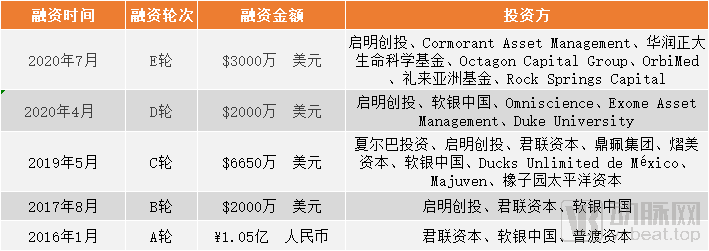
New Horizon Health's Pre-IPO Financing
Since its inception in 2016, New Horizon Health secured $20 million in Series A financing from two prominent investment firms, Legend Capital and SoftBank China. In subsequent funding rounds, these two early investors repeatedly increased their stakes. Qiming Venture Partners, which joined in the Series B round, participated in four consecutive rounds, while the final round introduced top-tier international institutional investors such as OrbiMed and Lilly Asia Ventures.
Beyond the non-executive directors affiliated with investment institutions, the three independent non-executive directors disclosed in the prospectus further underscore New Horizon Health’s strong appeal.
First, Professor Wu Hong, Dean and Chair Professor of the School of Life Sciences at Peking University, as well as a member of the European Molecular Biology Organization (EMBO) and a Fellow of the American Association for the Advancement of Science (AAAS)., has been dedicated for many years to researching the molecular mechanisms of tumorigenesis and novel approaches to cancer therapy, with particular achievements in studies related to the PTEN signaling pathway.
Second, Dr. Li Guodong, Honorary Fellow of the Hong Kong Academy of Medicine, Commissioner of the St. John Ambulance Hong Kong, Honorary Fellow of The Chinese University of Hong Kong, etc.Dr. Li Guodong is a private practice specialist in family medicine in Hong Kong and became a registered practicing physician in mainland China in 2012. Over the past two decades, he has been actively involved in promoting training and development in family medicine.
Third, Mr. Yu Danke, who first joined GE around 2000 and held various finance positions, later served as Chief Financial Officer at Goldwind Science & Technology Co., Ltd., Lightway Australia Pty Ltd, Trina Solar, and Wison Group.
Three independent non-executive directors, drawing on their respective expertise in scientific research, clinical practice, and finance, safeguard the future development of New Horizon Health.
Early screening is a massive market, with hundreds of millions of high-risk individuals making it a fiercely contested battleground for genetic testing companies.
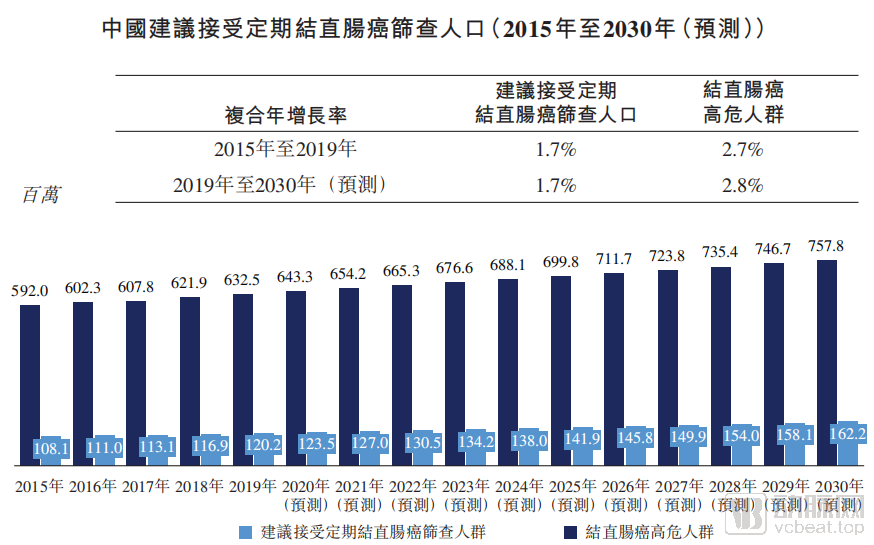
Data on the Population for Early Screening of Colorectal Cancer
New Horizon Health’s flagship products, Colotect and PupuTube, are both focused on early screening for colorectal cancer. Specifically regarding colorectal cancer, according to relevant reports from Frost & Sullivan, the five-year survival rate for colorectal cancer patients in China is 56.9%. However, if the patient population is narrowed down to those with early-stage disease (patients with carcinoma in situ that has not yet spread or metastasized), the five-year survival rate can exceed 90%; if precancerous lesions are detected and resected before the onset of cancer, the five-year survival rate approaches nearly 100%. This significantly enhances the value of screening for populations at risk of colorectal cancer.
As a leading enterprise in the field of early cancer screening, New Horizon Health has built a comprehensive pipeline based on its positioning and technological strengths. Its products focus on two major testing scenarios—stool and urine—to enable early screening and diagnosis of cancers with high prevalence in China.
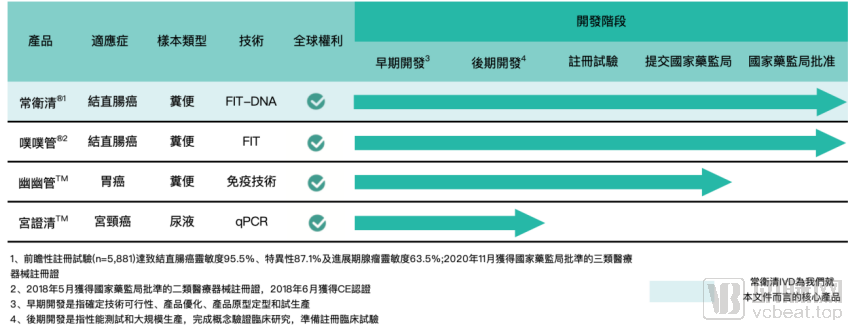
Latest Pipeline Progress of New Horizon Health
Its core product, Changweiqing, was approved for market launch in November 2020, becoming the first colorectal cancer early screening product positioned not as an adjunctive diagnostic tool.The corresponding risk assessment algorithm has also obtained a Class II medical device registration certificate from the Zhejiang Provincial Medical Products Administration. Pupu Tube, a widely used fecal occult blood testing product, has already secured its Class II medical device registration certificate. These two products are undoubtedly New Horizon Health’s flagship offerings at present.
“YouYou Tube” is a stool-based self-test product for gastric cancer developed by New Horizon Health. The most critical information update in the post-hearing document package concerns this product.Shortly after New Horizon Health submitted its prospectus, YouYouGuan completed its registration clinical trials and filed a registration application with the National Medical Products Administration in November 2020.
Centered on the core scenario of fecal testing, New Horizon Health has completed Class I medical device filings for its related equipment and consumables, such as fecal test pre-treatment devices (including sample preservation technology), nucleic acid extraction and purification reagents, and automated nucleic acid extractors. Its medical laboratory has also obtained a Medical Institution Practice License.
In addition to stool testing, Gongzhengqing, a urine-based cervical cancer detection product, is also preparing to launch its registration clinical trials in 2021.
At the core of the product pipeline is, without a doubt, Changweiqing, which has just obtained the Class III medical device registration certificate.
With Cologuard setting a high benchmark, stool-based early screening for colorectal cancer has long been regarded as the sub-sector with the greatest breakthrough potential in cancer early detection. New Horizon Health’s product is directly positioned against Cologuard; moreover, based on the currently released results from the prospective Clear-C clinical trial, it even outperforms Cologuard’s previously disclosed pivotal clinical trial results across multiple metrics.
The sensitivity of colorectal cancer screening reached 95.5%., representing a further improvement over Cologuard’s 92% at the time of its launch;For advanced adenoma, a key factor in assessing the risk of carcinogenesis, Changweiqing achieved a rate of 63.5%., whereas Cologuard achieved only 42.4% at that time;Meanwhile, the negative predictive value of Changweiqing reached 99.6%., which almost completely resolved the false-positive issue that Cologuard faced in its early days;The positive predictive value also reached 46.2%.
It must be acknowledged that the colorectal cancer early screening market has become increasingly crowded in the past two years. Recently, a new competitor, Amoy Diagnostics, has entered this market. On January 13, 2021, the National Medical Products Administration (NMPA) website announced that Amoy Diagnostics’ “Human SDC2 Gene Methylation Detection Kit (Fluorescent PCR Method)” had received Class III medical device certification.
As a Class III medical device, New Horizon Health holds a competitive edge in the current market, primarily due to the detailed specifications outlined in its Class III certification.
AmoyDx’s product shares the same name as the Class III medical device previously approved for Kangliming Biotechnology. Furthermore, under “Scope of Application/Intended Use,” it is specified that “this kit is intended for auxiliary diagnosis in patients whom clinicians have recommended for colonoscopy but who are unable to undergo the procedure due to poor compliance or other medical reasons; it shall not be used as a basis for early diagnosis or definitive diagnosis of tumors.”
Similar wording appears on the Class III medical device approvals previously granted to other colorectal cancer early screening companies. On one hand, this phrasing explicitly states “for auxiliary diagnosis,” coupled with the disclaimer that it “cannot serve as the basis for early diagnosis or definitive diagnosis of tumors,” which implies that such products are not entirely suitable for consumer-facing (C-end) user scenarios.
In the “Intended Use” section of Changweiqing’s Class III medical device certification, it is explicitly stated that the product is “for screening individuals at high risk for colorectal cancer who have poor compliance with colonoscopy.” The document does not mention auxiliary diagnosis anywhere, nor does it include a disclaimer stating that it “cannot serve as a basis for early tumor diagnosis or confirmation.”This means that Changweiqing can directly access the usage scenarios of end-users without relying on clinical doctors' judgments, which is the advantage of New Horizon Health's Changweiqing in the current market.
This difference in wording signifies the National Medical Products Administration’s endorsement of the product.New Horizon Health has invested substantial resources in recent years in the Clear-C prospective study to demonstrate the screening value of its products for high-risk consumers, thereby expanding the application scope of Colotect from clinical settings to home-based testing, allowing users to enjoy convenience with confidence.
Endorsement by the National Medical Products Administration (NMPA) has enabled Changweiqing to be rapidly incorporated into various screening guidelines. On January 15, 2021, Changweiqing was included in China’s first guideline for colorectal cancer screening. This guideline was commissioned and guided by the Bureau of Disease Prevention and Control under the National Health Commission, led by the National Cancer Center, and developed over nine months by a designated expert group for the Chinese Guidelines for Colorectal Cancer Screening, Early Diagnosis, and Early Treatment. On the same day, an online seminar on standardized early cancer screening in Beijing was held, during which the “Guidelines for Early Screening of High-Incidence Cancers in China” were released. These guidelines were formulated under the leadership of the Professional Committee on Early Cancer Screening of the Beijing Anti-Cancer Association. In the area of early screening for colorectal cancer, multi-target fecal FIT-DNA combined testing was listed as a recommended screening modality, alongside colonoscopy and fecal immunochemical testing (FIT) for occult blood. Notably, Shen Lin, Deputy Director of Peking University Cancer Hospital and Director of the Department of Gastrointestinal Oncology, directly cited clinical trial data from Changweiqing on the informational page introducing “multi-target fecal FIT-DNA combined testing.”
Following the formal approval of the Class III medical device certification for Colotect, New Horizon Health has been able to pursue more aggressive consumer-facing (C-end) promotion. To market its products nationwide, the company is gradually expanding its sales team to a scale of 1,000 personnel, while actively engaging in external collaborations with various terminal partners for joint promotion. Key external partnerships include hospitals (316), health checkup institutions (235), insurance providers (36 insurance companies), online healthcare platforms (78), and retail pharmacies (457). These four categories of application scenarios directly target end consumers, thereby maximizing the reach advantage of Colotect.
Unlike innovative pharmaceutical companies that generate no revenue because their products have not yet been launched, New Horizon Health has formally embarked on diversified commercialization efforts, thereby achieving steadily growing operating income in recent years.
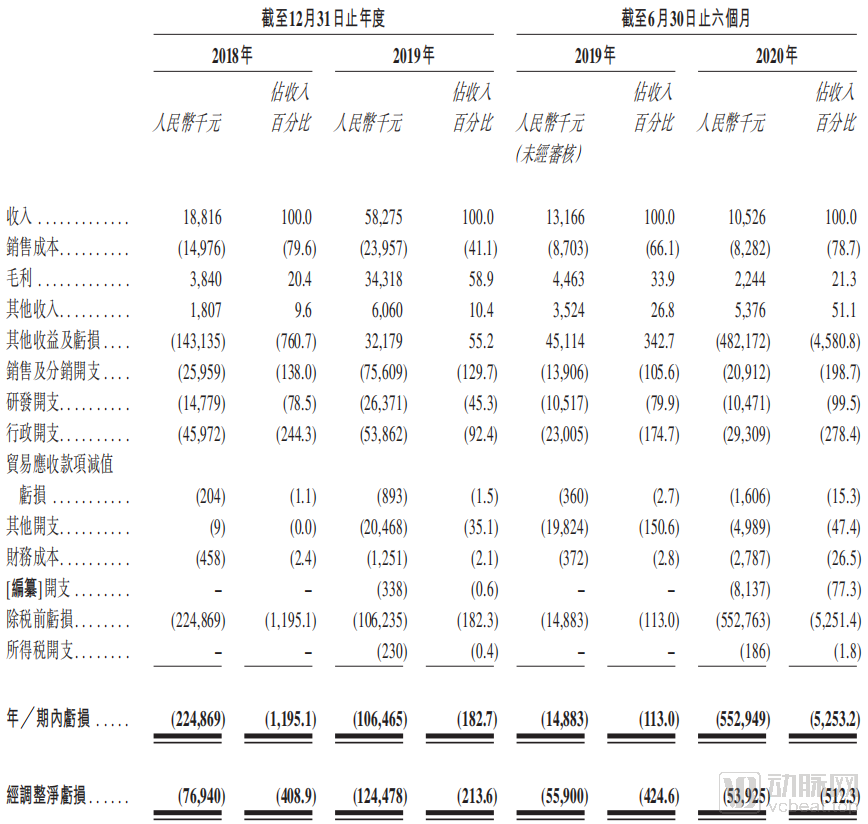
Selected Financial Data of New Horizon Health
At first glance, New Horizon Health’s financial data may not appear impressive, but in fact, much of the information is not reflected in the primary financial statements.
Regarding revenue, New Horizon Health experienced substantial growth in 2019, with the majority of its revenue derived from market sales of Colotect in the second half of the year. In the first half of 2020, the company was significantly impacted by the COVID-19 pandemic, as its primary sales channels relied on offline settings such as hospitals and health examination centers. However, a marked recovery was observed in the second half of 2020. As stated in its prospectus, New Horizon Health noted that“Changweiqing’s shipment volume rebounded rapidly in the second half of 2020, reaching approximately 61,400 units in the third quarter of 2020 and 23,100 units in October 2020, representing year-on-year increases of 17.6% and 46.4%, respectively, compared to the same periods in 2019.”. Given that New Horizon Health’s 2019 revenue was primarily driven by strong performance in the second half of the year, a further increase in sales revenue in the second half of 2020 could propel the company’s full-year 2020 revenue to rapidly surpass its 2019 level.
When taking into account the hospital access and consumer-end promotion channels opened up by the approval of its Class III medical device certification, New Horizon Health’s revenue expectations for 2021 remain highly promising.
Let’s further examine the loss that appears to be the most significant. In the first half of 2020, New Horizon Health reported a net loss of RMB 553 million, primarily driven by RMB 482 million in “other gains and losses.” However, this portion of the loss was mainly attributable to changes in fair value resulting from financing activities, rather than operational losses. Excluding this item, the actual operating loss was relatively modest.
Sales and R&D expenses are currently the primary sources of operating losses for New Horizon Health. The early cancer screening market is highly competitive, and as New Horizon Health is in a critical promotional phase following recent regulatory approvals, significant investment in sales and distribution is unavoidable. On the R&D front, the company’s main expenditures are directed toward conducting several registrational clinical trials, such as the Clear-C trial for ColonoClear and the registrational clinical trial for Urease Test. With the initiation and filing of the registrational clinical trial for CervicoClear in 2021, New Horizon Health’s R&D spending is likely to remain at an elevated level.
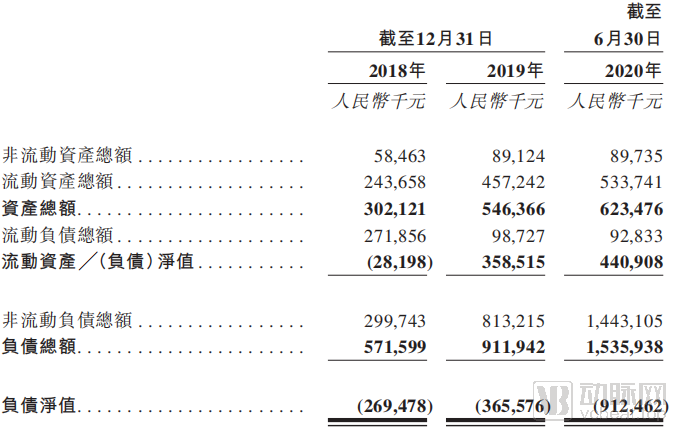
Selected Financial Data of New Horizon Health
Losses are difficult to avoid, but New Horizon Health has accumulated sufficient funds to cope with future risks. As of June 2020, New Horizon Health still maintained a total current assets of RMB 534 million, while its current liabilities were only about RMB 92.73 million. The non-current liabilities of RMB 1.443 billion may seem high, but among them, RMB 1.377 billion came from preferred shares, and only about RMB 67 million came from actual expenses such as bank loans and lease liabilities. Therefore, in reality, New Horizon Health's debt-to-asset ratio is very low. Even without considering the funds raised in this IPO, the substantial cash reserves ensure that New Horizon will not face any financial risks in the short term.