

Cue Health Files IPO Prospectus: Bringing 20-Minute Molecular Diagnostics for Flu and More into the Home

Cue Health
Developer and Manufacturer of Medical Diagnostic Products
With advancements in testing technologies, an increasing number of tests can now be performed at home, giving rise to the niche sector of at-home testing. At-home testing allows users to conduct sampling, testing, and result interpretation without visiting medical institutions, thereby meeting demands for privacy, convenience, and rapid results. This approach helps conserve hospital medical resources and, to some extent, alleviates the imbalance in healthcare resource distribution in China.
Currently, common home-based testing items such as blood pressure, blood glucose, and electrocardiogram (ECG) monitoring have become relatively mature. In vitro diagnostic tests for infectious diseases and early cancer screening are also gradually being implemented in home settings.
In the past two years, many in vitro diagnostic (IVD) companies in China have begun to enter the home testing market. For instance, Dian Diagnostics launched the online testing brand “Xiao Fei Jian,” enabling users to undergo tests without leaving their homes. New Horizon Health and ClearBlaze Biotechnology have focused on early cancer screening, providing at-home early cancer screening solutions. Anwo Health has introduced a range of home testing products designed to meet various health management needs in household settings. Jiajian Health, addressing users’ privacy concerns, has rolled out home testing products for sexual health and HPV detection, among others.
It is worth noting that at this stage, in vitro diagnostic (IVD) tests such as molecular diagnostics require sample processing and involve complex operational procedures. Currently, only home-based sample collection is feasible, while the testing process still necessitates sending samples to laboratories for analysis by trained professionals. This bottleneck significantly constrains the development of IVD products in the home-testing sector.
Therefore, how to achieve miniaturization, convenience, and home-based use of in vitro diagnostic (IVD) tests, bypassing sample transport and laboratory testing steps to complete the entire testing process at home, has been a key focus of exploration for companies both domestically and internationally. Overseas company Cue Health is developing a home molecular testing platform that enables convenient home-based detection of diseases such as influenza, similar to early pregnancy tests. The product portfolio and technological approach of this company may offer valuable insights for Chinese IVD companies positioning themselves in the home-testing sector.
Cue Health has developed a compact, user-friendly, and rapid diagnostic device that can replace medical testing laboratories. It allows users to perform tests at home or have them conducted by professional healthcare providers. By collecting samples such as saliva, blood, or nasal swabs, and utilizing advanced DNA/RNA amplification techniques alongside immunoassay methods, the device detects diseases like influenza and HIV. Accurate test results are delivered to the user’s smartphone in just 20 minutes.
Ayub Khattak, the founder of Cue Health, has a background in mathematics and biochemistry and conducted research on plant DNA barcoding at the University of California, Los Angeles. With influenza seasons occurring nearly every year in the United States, the global outbreak of the H1N1 influenza A virus in 2009 further accelerated the demand for rapid infectious disease testing. This inspired Ayub Khattak to develop a concept leveraging compact analyzers and disposable test cartridges to overcome the limitations of laboratory settings, enabling users to rapidly test for influenza and other diseases as well as health indicators from home.
Blood glucose meters have evolved over many years and occupy a significant position in the home testing market. Ayub Khattak and Clint Sever, another founder of Cue Health, decided to start with home blood glucose meters to explore ideas for developing at-home molecular diagnostic products. To this end, they conducted extensive research on the structure of home blood glucose meters to investigate whether similar underlying hardware could be applied to tests for influenza and other conditions.
Ultimately, Ayub Khattak and Clint Sever successfully developed a rapid molecular testing platform for at-home influenza detection. The platform consists of a compact analyzer, disposable test cartridges, swabs, and companion software. Users perform self-sampling and insert the sample into the test cartridge. As the sample reacts with specific chemical reagents, electrical signals are generated and captured by sensors within the cartridge. These electrical signals are then converted into digital data and transmitted via Bluetooth to a smartphone for review by both users and physicians. Each test result is recorded in the software to generate statistical charts, providing data-driven support for personalized health management plans formulated by users and doctors. In the event of abnormal results, the software proactively issues alerts and offers recommendations on exercise, diet, and medical consultation.
Cue Health’s molecular testing platform achieves full-process automation, eliminating 99% of human error to ensure precise and rapid test results. Reportedly, the platform’s diagnostic accuracy even surpasses that of traditional laboratories, with influenza testing speeds three times faster than conventional methods.
Leveraging its at-home rapid testing platform, Cue Health has garnered significant interest from numerous investors. To date, the company has completed nine rounds of financing. In 2020 alone, it closed three funding rounds: in October 2020, Cue Health secured $481 million from the U.S. government to scale up production of its rapid COVID-19 test kits; in June 2020, it announced the completion of a $100 million Series C round led by investors including Johnson & Johnson; and in April 2020, it received $13 million from the Biomedical Advanced Research and Development Authority (BARDA) to accelerate the development of portable, rapid COVID-19 testing products.
In addition to influenza, Cue Health’s at-home testing platform can currently be used to test for vitamin D levels, male testosterone, female reproductive health, HIV, and other markers. However, these products have not yet received FDA approval. Moving forward, Cue Health will continue to pursue regulatory clearance for its home-based influenza testing system, while also developing a broader range of test kits to enable rapid, convenient, and accurate at-home testing for a wider array of health indicators.
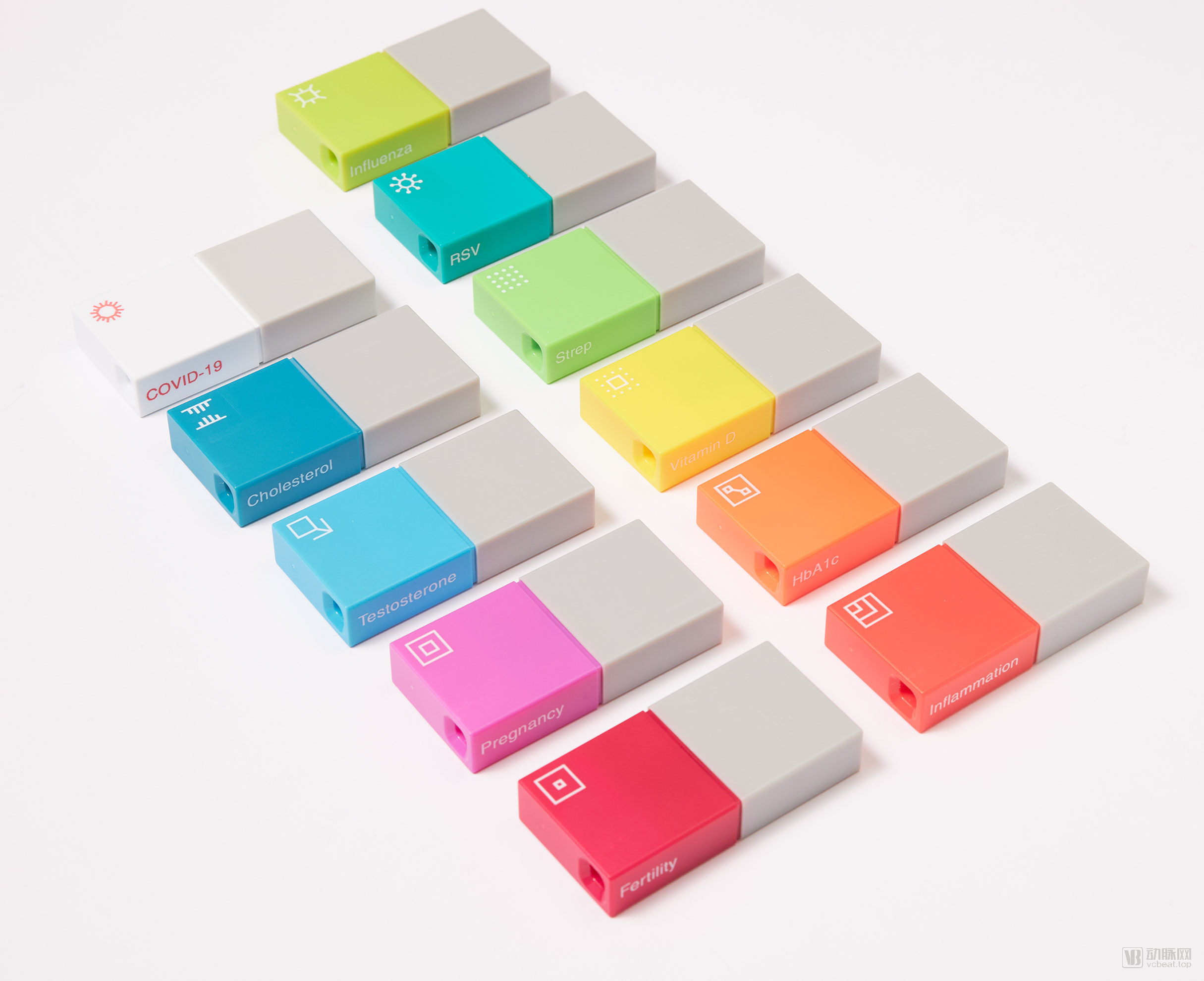
Cue Health’s at-home molecular testing platform can detect influenza, vitamin D, male testosterone, female reproductive health, HIV, and other conditions (Image source: Cue Health official website)
The COVID-19 pandemic that erupted in 2020 was the catalyst driving Cue Health’s rapid growth.
Previously, traditional nucleic acid testing for SARS-CoV-2, from sample collection and specimen transport to nucleic acid extraction, detection, and final report issuance, typically required 8–12 hours. During the nucleic acid extraction and detection process, front-end nucleic acid extraction alone took approximately 2 hours, and amplification required about 1.5 hours, resulting in very low efficiency.
In addition to being inefficient, traditional SARS-CoV-2 testing models require substantial human and material resources, impose stringent requirements on facilities, environments, and operators, and entail significant investments in equipment, space, and personnel. Consequently, they are unable to meet the testing demands in scenarios such as emergency care, management of fever clinics, entry and exit screening, and food safety testing.
Accurate, rapid, and convenient testing for SARS-CoV-2 has become a widespread need in epidemic prevention and control, and the rapid molecular testing platform developed by Cue Health is well-suited to meet this demand.
In 2020, Cue Health secured three rounds of funding to accelerate the research, development, and production of its COVID-19 testing products. The rapid nucleic acid test for COVID-19 developed by Cue Health offers three major advantages: rapid result turnaround, flexibility in testing locations, and low requirements for operator expertise.
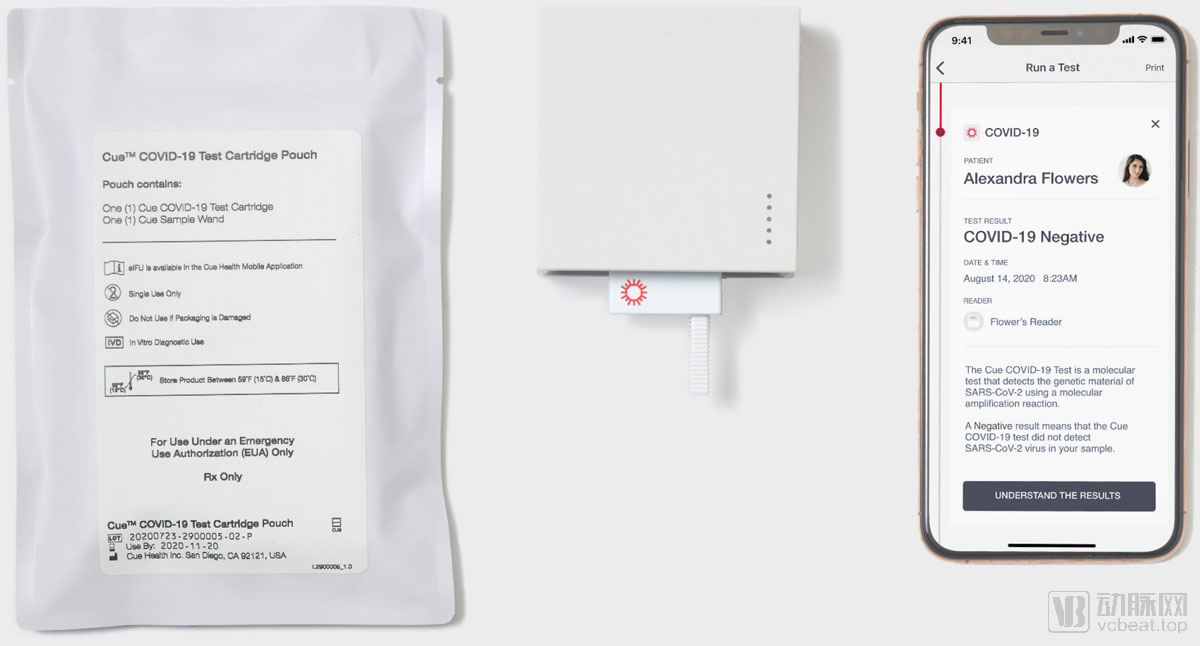
Cue Health’s COVID-19 Testing Product (Image from Cue Health’s Official Website)
During sample collection, other testing products require deep nasal and throat swabbing, whereas Cue Health’s SARS-CoV-2 nucleic acid test collects samples from the anterior nares, making the process more convenient and comfortable.
In the sample testing phase, Cue Health adopts an automated point-of-care testing (POCT) processing model, enabling on-site testing without the need to send samples to designated laboratories, thereby accelerating the turnaround time for test results. Cue Health’s products have obtained CLIA waivers (CLIA categorizes the complexity of diagnostic tests into three levels, from lowest to highest: waived (simplest), moderate complexity, and high complexity).
In the results presentation phase, Cue Health’s COVID-19 testing product can deliver results within 20 minutes and transmit them to the smart devices of both users and physicians. Studies have shown that the product achieves both sensitivity and specificity as high as 98%.
Currently, Cue Health’s COVID-19 testing product received Emergency Use Authorization (EUA) from the U.S. Food and Drug Administration (FDA) in June 2020 and is being deployed across clinics, mobile testing units, long-term care facilities, communities, schools, hospitals, and other settings in 10 U.S. states, including Colorado, Minnesota, and Pennsylvania. Cue Health plans to complete 6 million tests by spring 2021.
In fact, Cue Health’s SARS-CoV-2 nucleic acid testing product already meets the requirements for home-based testing; however, the FDA has not approved its use in a home setting.
However, the U.S. medical journal JAMA Network Open published the results of a comparative study on nasal swab sampling for SARS-CoV-2 infection conducted by patients themselves versus healthcare professionals, finding that the difference in test results between self-collected and clinician-collected samples was not significant. The FDA has also granted Emergency Use Authorization to several testing providers, including Verily, LetsGetChecked, and Phosphorus, for home-based SARS-CoV-2 infection tests.
Many experts believe that the novel coronavirus may persist for a long time, making testing for it a routine necessity. It remains to be seen whether Cue Health’s nucleic acid test for the novel coronavirus will subsequently gain approval for home use. In any case, with its rapid COVID-19 testing products, Cue Health is poised for rapid growth in the coming years.
In China, the COVID-19 pandemic has also ushered in a golden period of development for many domestic in vitro diagnostic companies.
Sansure Biotech’s innovative nucleic acid testing technology has reduced the time required for manual nucleic acid extraction (96 samples) from the original 3–4 hours to under 30 minutes, and when paired with automated extraction, the process can be completed in under 15 minutes, significantly improving the efficiency of large-scale nucleic acid testing. Its newly launched point-of-care testing (POCT) innovation, the iPonatic Nucleic Acid Testing Analyzer, enables rapid screening and confirmed diagnosis of tested populations. In as little as 8 minutes, the iPonatic can complete the entire workflow from nucleic acid extraction to result reporting, addressing the “accessibility” challenges of traditional nucleic acid testing while maintaining “accuracy.” Thanks to its outstanding performance during the pandemic, Sansure Biotech successfully listed on the STAR Market, becoming known as the “first stock of the anti-epidemic effort.” According to Sansure Biotech’s 2020 earnings forecast, the company projected a full-year net profit of RMB 2.5–2.8 billion, representing a year-on-year increase of 6,375%–7,008%.
During the COVID-19 pandemic, DaAn Gene developed a nucleic acid test kit for SARS-CoV-2 within just 48 hours, becoming one of the first two manufacturers in China to release targeted nucleic acid testing reagents. The company’s rapid nucleic acid testing system for COVID-19 supports a throughput of up to 16 samples, offering flexibility, convenience, and high reporting efficiency, with the entire testing process taking only 28 minutes. According to DaAn Gene’s earnings forecast, its net profit for 2020 was projected to increase by 2,069.63%–2,286.59% year-on-year.
Zhejiang Zhijiang Biotechnology Co., Ltd. was among the first enterprises to obtain registration certificates for novel coronavirus (SARS-CoV-2) nucleic acid testing kits. Currently, Zhijiang Bio’s SARS-CoV-2 nucleic acid testing reagents have successively obtained international certifications, including the EU CE marking, approval from Australia’s Therapeutic Goods Administration (TGA), and clearance from South Africa’s Health Products Regulatory Authority (SAHPRA), and have been included in the World Health Organization’s Emergency Use Listing (EUL). The company’s SARS-CoV-2 nucleic acid testing reagents and instruments are sold to more than 40 countries and regions worldwide. According to Zhijiang Bio’s earnings forecast, the company’s net profit for 2020 is estimated at approximately RMB 930 million, representing a year-on-year increase of about 1,705.1%.
Amid the pandemic, user habits are quietly shifting. Health management awareness is gradually rising, and coupled with the cumbersome and time-consuming nature of domestic medical consultation processes, users’ acceptance of home testing models continues to grow. Driven by these factors, the home health testing market is gradually heating up; it is only a matter of time before it experiences a major boom.
Previously, health monitoring devices used in households were limited to basic functions such as step counting, sleep tracking, blood glucose testing, and blood pressure measurement. Molecular testing can provide medical-grade, deeper, and multi-dimensional data. The trend toward home-based molecular testing devices is poised to bring about a revolutionary change in the home diagnostics sector.
It is worth noting that although many in vitro diagnostic (IVD) companies in China have entered the home testing sector, their currently available products only support home sample collection and online report access; the actual testing process still needs to be conducted in a laboratory.
Cue Health is one of the few molecular diagnostics companies worldwide to have implemented a fully end-to-end home testing process. However, home-based molecular testing companies like Cue Health are also facing skepticism. Some physicians argue that the pathogenesis of diseases is highly complex; even if home test results are accurate, they cannot serve as sufficient evidence for a definitive diagnosis. Accurate conclusions require the integration and comparison of multiple diagnostic data points. Taking male testosterone testing as an example, testosterone is only one of the factors affecting reproductive health, and clinical judgment must be made in conjunction with the patient’s specific circumstances.
In China, there is significant debate over whether home-based molecular test results can serve as a basis for physicians to make definitive diagnoses and prescribe medications. Currently, cancer screening products approved for home use in China are intended only as adjuncts to diagnosis; even if a positive result is obtained, patients must still undergo hospital-based examinations to confirm the diagnosis. Home-testing products in China require further standardized development.