

DiMa Biotech Files IPO Prospectus: Building a Comprehensive Rabbit-Derived Lead Antibody Library Against All Druggable Tumor Targets Within Five Years
Biopharmaceutical R&D is akin to a relay race, spanning from initial target identification and lead molecule screening to preclinical studies, Phase I/II/III clinical trials, and finally the submission of a New Drug Application (NDA). This entire process typically takes at least ten years. Most startup pharmaceutical companies lack the time and sufficient cash flow to complete this journey independently. Consequently, they often choose either to collaborate with CROs/CDMOs to accelerate drug development or to be acquired by large pharmaceutical firms, thereby integrating their assets into the clinical pipelines of global pharmaceutical companies.
The entire “story” of novel antibody drug development begins with the screening of lead antibody molecules against specific targets.Currently, there are approximately 400–500 tumor-associated targets known to humans that can be developed into antibody drugs. Research and development of innovative drugs targeting these antigens have never ceased; for certain hot targets, dozens or even nearly a hundred companies are crowded into the same competitive track. It is no exaggeration to say that developing a lead molecule against a specific target essentially secures an entry ticket—the “seed”—for new drug development. Whether this seed has the potential to grow, blossom, and bear fruit (i.e., druggability, safety, etc.) must be verified through prolonged cultivation by pharmaceutical companies (clinical trials).
Therefore, from the perspective of the entire R&D process for novel antibody drugs, lead antibody molecules serve as the starting point. However, it traditionally takes pharmaceutical companies one to two years to go from initial target identification to the final selection of preclinical candidate antibody molecules. If a comprehensive “seed library” of lead antibody molecules targeting tumor immune checkpoints could be established, allowing pharmaceutical companies to access the required antibody molecules on demand, would this not significantly accelerate the preclinical development of lead antibody molecules?

Ma Donghui, Founder of Dimabio
Recognizing this market demand and opportunity, Dr. Ma Donghui, founder of Dimma Bio, leveraged his expertise in the development of antibody-based biologics. He completed his postdoctoral research at the Johns Hopkins University School of Medicine and the University of Maryland School of Medicine. He previously served as Chief Scientist and General Manager at U.S. biotechnology companies OriGene, Biocheck, and Juventas Cell Therapy. In Wuxi, he and his team established a high-throughput murine monoclonal antibody R&D platform at OriGene, generating over 13,000 hybridoma cell lines. Furthermore, he led the development of the ALK (OTI1A4) pathological diagnostic antibody, which received Class III medical device registration approval from the National Medical Products Administration (NMPA) for market launch.
In 2018, Professor James P. Allison of the University of Texas MD Anderson Cancer Center in the United States and Professor Tasuku Honjo of Kyoto University in Japan were awarded the Nobel Prize in Physiology or Medicine for their discovery of the roles of the tumor immune checkpoints CTLA-4 and PD-1.
As an increasing number of innovative targets are discovered in the field of oncology, relying solely on pharmaceutical companies’ preclinical R&D capabilities or outsourcing preclinical development to CROs not only entails long outsourcing cycles but also makes timeline control difficult, rendering scalable implementation challenging. Directly introducing preclinical target products may offer pharmaceutical companies a new strategic approach. Introducing preclinical assets holds greater potential for value appreciation compared to acquiring pipelines that have already entered clinical stages. The direct acquisition of target products independently incubated by preclinical R&D companies can effectively reduce development risks and R&D costs. This constitutes the foundational logic behind the establishment of Dima Biosciences.
Founded in 2019 under the leadership of Dr. Donghui Ma, Dimabio’s founding team included R&D Director Hong Shujuan, who has extensive experience in monoclonal antibody development; R&D Scientist Huang Shaomei; Protein R&D Scientist Li Pei; and Ms. Liu Yuhua, Marketing and Operations Director with years of experience in scientific research marketing and operations.
The Company Has Established a Novel Platform, DimAb, for the Preparation of Rabbit Recombinant Monoclonal Antibody B-Cell Seed LibrariesTM, enabling the development of recombinant monoclonal antibody products targeting more challenging tumor immunotherapy targets. Dimabio first uses functional proteins as immunogens to immunize animals, then isolates peripheral blood mononuclear cells (PBMCs) from the whole blood of rabbits showing a positive immune response, and cryopreserves the B-cell seed library. The company then screens and functionally validates B cells from these rabbit-derived seed libraries, followed by humanized cloning and in vitro and in vivo functional validation, to identify lead antibody molecules with the potential to become monoclonal antibody drugs targeting corresponding disease indications.
The druggability of rabbit-derived antibodies has been validated by the market. As early as 2019, the FDA approved a humanized antibody drug derived from rabbit antibodies for the treatment of age-related macular degeneration (AMD). Similarly, in 2020, the FDA approved another novel humanized antibody of rabbit origin for the prevention of episodic migraine in adults.
Rabbit-derived antibodies possess more irreplaceable advantages compared to commonly used mouse-derived antibodies.First, rabbit antibody libraries exhibit greater diversity; the total number of B cells obtainable from each immunized rabbit is more than 50 times that of mice, with a single immunization yielding an average of over one thousand ELISA-positive clones. Second, rabbit monoclonal antibodies demonstrate higher affinity and broader epitope coverage for targets.
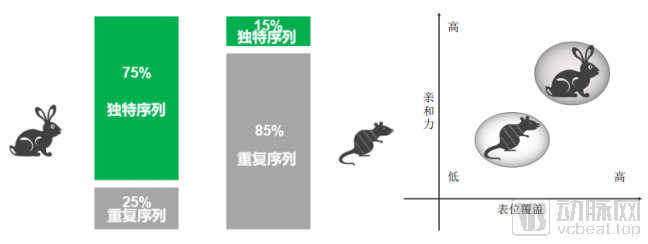
Comparison of Rabbit-Derived Antibodies and Mouse-Derived Antibodies
Furthermore, Dr. Ma Donghui also mentioned that the cryopreservation of B-cell seed libraries using the DimAb™ platform can help the company screen for lead antibody molecules in a shorter timeframe. According to the conventional process,DimAb™ lead antibody molecule preparation and screening by Dimabio can be completed in approximately four months, with an average project success rate of 80%–90%.。
However, if clients wish to screen for additional candidate antibody molecules targeting the same antigen after obtaining the lead molecule, Dr. Ma Donghui, the founder, explained: “Dimabio can simply rapidly revive the pre-validated, immunized B-cell seeds stored in its liquid nitrogen bank.”Re-screening and validation of clones can be completed within a very short timeframe (1–2 months)., delivered to the customer, greatly saving time.”
DimAb, independently developed by DimabioTMCompared with the hybridoma antibody preparation platform, the antibody seed bank also offers higher success rates and cloning efficiency, along with a shorter preparation time. DimAbTMThe antibody seed library technology platform is no longer constrained by myeloma cell lines, enabling the preparation of monoclonal antibodies from any animal species and direct acquisition of antibody gene sequences. Additionally, the cryopreserved B-cell seed library allows for long-term cryogenic storage.
By applying high-quality protein antigens, single B-cell target enrichment, expansion culture, antibody gene cloning, and next-generation sequencing technologies, DimAb Biotech rapidly screens a large number of recombinant monoclonal antibodies against targets. Meanwhile, DimAbTMB-cell seed banks can also serve multiple purposes; while developing therapeutic antibodies, it is also possible to screen the library for antibodies suitable for companion diagnostic applications.
Currently, Dimabio is prioritizing the establishment of a lead antibody molecule library targeting hematologic malignancies, whileThe company’s ultimate goal is to complete the development of recombinant monoclonal antibodies for 400–500 potential antibody drug targets in the oncology field, and to collaborate with pharmaceutical companies by delivering lead antibody molecule products.The Company also conducts secondary lead antibody screening for target antigens of existing antibody drugs with known defects or adverse effects, aiming to identify optimized candidate molecules that mitigate such undesirable effects. The market demand for such solutions currently exceeds supply.
It is reported that Dima Bio has launched a new round of financing to accelerate the construction of its comprehensive lead antibody library for all tumor targets. The company previously completed an angel round of financing amounting to tens of millions of RMB in 2019. The funds from this current round will be primarily used to enhance the B-cell seed bank for tumor monoclonal antibodies, recruit technical talent, and advance research related to bispecific antibodies.