

Major Boost for DRG: National Health Commission Releases 'Public Hospital Cost Accounting Standard'
Just now, the Department of Finance of the National Health Commission published on its official website“Notice on Issuing the Cost Accounting Standards for Public Hospitals”(National Health Commission Financial Department Document [2021] No. 4) (hereinafter referred to as the “Notice”). The Notice points out that, in order to improve the modern hospital management system, standardize cost accounting work in public hospitals, and promote high-quality development of public hospitals, the National Health Commission and the National Administration of Traditional Chinese Medicine have organized the formulation of the “Specifications for Cost Accounting in Public Hospitals” (hereinafter referred to as the “Specifications”).
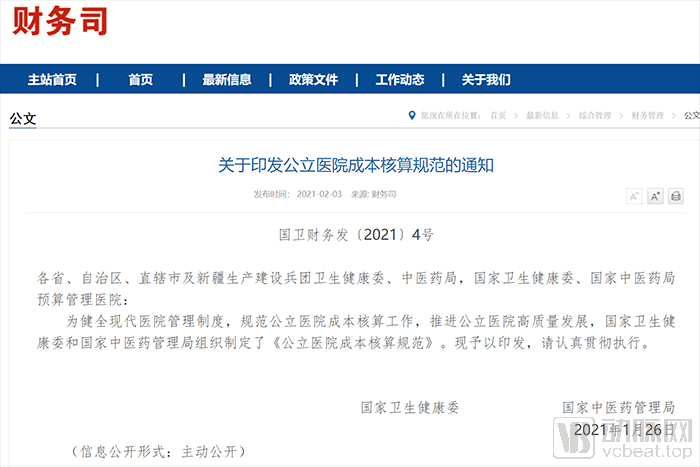
Screenshot from the official website of the National Health Commission
“The Guidelines” carry significant importance! This means that the collection of hospitals’ actual costs now has unified standards and specifications, which will have a major impact on cost data collection for bundled payment models led by Diagnosis-Related Groups (DRGs) in the future!
Under the traditional fee-for-service and global budget payment models, cost accounting was not a primary priority for hospitals. However, with the implementation of Diagnosis-Related Group (DRG) payment, all hospital services have shifted from generating incremental revenue to incurring incremental costs, making effective cost control increasingly critical. Without a robust cost accounting system, hospitals cannot determine whether specific DRG groups are profitable or operating at a loss.
A high-quality, accurate cost accounting system is the foundation for calculating relatively precise relative weights. The accuracy of DRG relative weights significantly affects the effectiveness and fairness of the DRG payment system. If the relative weight values are too high, it will be difficult to incentivize hospitals to improve efficiency by enhancing treatment methods. Conversely, if the relative weight values are too low, hospitals may compromise medical quality to reduce healthcare costs.
In light of the aforementioned reasons, following the implementation of Diagnosis-Related Groups (DRGs), countries and regions have successively begun to regularly collect hospital cost accounting data to calculate and continuously update DRG weights.
Due to the long-term implementation of a planned economy in China, funding for medical institutions has been allocated based on budgets and final accounts, resulting in a relatively short history of hospital cost accounting. Although there have been certain requirements for cost accounting, they have not been mandatory, nor have there been unified specifications or standards. Consequently, the cost accounting data currently required by China’s DRG system are primarily derived from relatively accessible health insurance settlement data, which serve as the basis for weight calculation and pricing.
However, for a long time, the fee-for-service payment model adopted by medical institutions in China has led to significant over-treatment, resulting in irregular medical practices and substantial discrepancies between cost and expense data in these institutions. Meanwhile, due to a limited understanding of cost management, even hospitals that have implemented cost accounting often view it merely as a means to provide data for bonus calculations, thereby directly applying cost accounting results to calculate bonuses under a revenue-minus-expenditure model.
As previously mentioned, because China’s current DRG payment system is based on charges rather than actual cost accounting, it has led to distortions in some data, significantly undermining the intended effectiveness of DRG payments.
To address this issue, as early as July 2020, the “Notice on Issuing the Key Tasks for Deepening the Reform of the Medical and Healthcare System in the Second Half of 2020,” released by the General Office of the State Council, required the National Health Commission, the National Healthcare Security Administration, and the National Administration of Traditional Chinese Medicine to “monitor the prices, costs, expenses, income distribution, and reform implementation status of medical services provided by public medical institutions, so as to serve as the basis for implementing dynamic adjustments to medical service prices. Strengthen cost accounting for medical services in public medical institutions.”
Subsequently, the National Health Commission announced that the Health Development Research Center of the National Health Commission would leverage data from the National Medical Service Price and Cost Monitoring and Research Network, which covers more than 1,400 medical institutions across 31 provinces (autonomous regions and municipalities) in China, to conduct monitoring of medical service prices and costs. This initiative aims to assess the progress of price reforms nationwide and produce the "Report on Medical Service Price and Cost Monitoring," thereby providing an evidence base for China’s institutional frameworks on medical service pricing and compensation policies.
Meanwhile, the National Health Commission will also develop the "Guidance Manual for Cost Accounting in Public Hospitals" to guide public hospitals in carrying out cost accounting. It requires member units of the "National Medical Service Price and Cost Monitoring and Research Network" to report institutional departmental costs and item-level cost data in accordance with unified cost accounting methods, thereby providing support for government price setting and compensation calculations, and facilitating the gradual rationalization of price ratios among medical services.
The final release of the "Specifications" signifies that public hospitals now have a unified, mandatory standard for cost accounting. Based on this data, the state will implement more refined optimizations to the existing DRG calculations, ensuring they accurately reflect actual resource consumption.
The Guidelines consist of 12 chapters and 46 articles. The main content includes: clarifying the objectives and scope of application for cost accounting in public hospitals, accounting foundations and principles, organizational structure and responsibilities, classification and accounting methods, cost items and cost classification, establishment of cost accounting units, and the cost accounting reporting system; it also requires strengthening cost accounting analysis.
In terms of accounting principles, the "Specifications" require that hospital cost accounting adhere to the principles of relevance, authenticity, adaptability, timeliness, comparability, and materiality. It further clarifies that the internationally common methods of "top-down approach," "bottom-up approach," and "cost-to-income ratio method" are adopted for disease-specific cost and DRG cost accounting.
Furthermore, the “Guidelines” require public hospitals to regularly prepare cost statements and cost accounting reports, provide detailed explanations of cost accounting results and cost control performance, and mandate that hospitals produce an annual cost accounting report at least once a year.
From the perspective of specific detailed rules, the “Specifications” refine the standards for accounting and reporting, demonstrating strong practical operability. Public hospitals will be mandatorily required to conduct cost accounting and submit corresponding data in strict accordance with the “Specifications.”
Recent policies indicate that relevant national authorities are addressing the shortcomings of the existing DRG payment system through various mandatory regulations and standards. In the long term, this will facilitate the success of DRG payment reform and lean hospital management, while also presenting significant benefits for related industries.