

Sogou Launches 'Expert Recommendation' to Address Two Major Challenges in Cancer Patient-Physician Matching
Today is World Cancer Day, and cancer prevention and control have become a global challenge. Recently, André Ilbawi, a cancer expert at the World Health Organization (WHO), stated that in 2020, there were 19.3 million new cancer cases and 10 million cancer-related deaths worldwide. Currently, one in five people globally will develop cancer during their lifetime. In China, there are approximately 3.8 million new cancer cases and about 2.29 million cancer-related deaths annually. In response, the Chinese government has formulated the "Healthy China Action—Implementation Plan for Cancer Prevention and Control (2019–2022)," aiming to improve the five-year survival rate for cancer patients, with early diagnosis, early treatment, and key scientific research breakthroughs being central to this effort.
Matching patients with the right physicians is a fundamental prerequisite for fully unleashing high-quality medical resources and enabling early diagnosis and treatment of cancer; therefore, achieving efficient and precise alignment between patients and medical resources is of paramount importance.
To this end, Sogou launched its “Expert Recommendations” feature on World Cancer Day. Leveraging Sogou’s years of accumulated AI capabilities, along with a large-scale disease knowledge graph and comprehensive physician profiles, the system recommends specialists tailored to users’ specific conditions.
The core of Sogou’s “Expert Recommendations” lies in information matching, with the aim of addressing two major challenges that patients frequently encounter when seeking medical care.
The Challenge of Seeking Offline Medical Care: Information Asymmetry as the Greatest Barrier
A persistent and pronounced information asymmetry has long existed between physicians and patients. Patients often struggle to identify the most appropriate physician, typically relying on recommendations from friends, family, or other patients, or by default seeking out the highest-ranking specialist in the relevant department at the top-tier local hospital.
However, evaluating physicians through either of these two approaches is one-sided. Even among patients with the same disease, specific symptoms can vary widely, and recommendations from other patients may not be applicable to one’s own situation. Typically, each physician focuses on specific treatment modalities for a limited number of diseases, conducting long-term and in-depth research. Beyond the single metric of seniority or title, numerous additional dimensions of information are required to identify a suitable physician; yet patients and their friends and family often lack the channels and capability to gather such information.
Online Channel Challenges: Complex and Multidimensional Information Difficult to Process and Assess
The Internet has, to some extent, alleviated the information asymmetry between doctors and patients. However, to obtain comprehensive and objective information about a specific physician online, users must browse multiple sources, including hospital websites, professional society portals, and medical journals. To gain deeper insights into a doctor’s areas of clinical expertise, users may even need to review their published papers, including those in English. Even when comprehensive information is accessible, comparing and filtering through the complex, multidimensional data across multiple physicians poses a significant challenge for the average person. Moreover, the quality of medical information on the Internet varies widely, and there is even the risk of false or misleading content driven by commercial interests.
The earlier cancer patients receive standardized diagnosis and treatment, the more likely they are to achieve better therapeutic outcomes. If patients are misled by false information or resort to indiscriminate medical consultations based on fragmented information, they may suffer financial losses at best, or miss the optimal window for treatment at worst, potentially resulting in both loss of life and depletion of financial resources.
From this perspective, finding the right doctor requires collecting, evaluating, and processing multi-dimensional information—including hospitals, departments, physicians’ areas of expertise, research advancements, and professional society affiliations—to make a choice based on comprehensive, objective, and professional insights. Sogou’s “Expert Recommendation” feature is precisely designed to meet these needs.
Currently, Sogou’s “Expert Recommendations” initially covers 17 types of cancer, including the ten most prevalent malignant tumors in China, with information matching based on multiple criteria. Patients can use this product to find doctors and specialists who are proficient in treating specific diseases and employing corresponding treatment modalities within China, their respective provinces, or cities. By searching for disease-related keywords on Sogou, users will see relevant expert information.
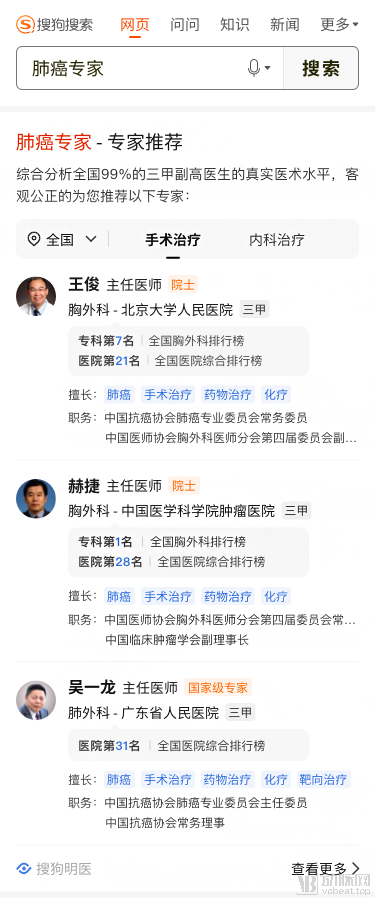
Sogou’s “Expert Recommendations” Page (Using Lung Cancer as an Example)
Powered by AI as its underlying technology, Sogou’s “Expert Recommendations” primarily feature two key characteristics:
First is the large-scale disease knowledge graph. Zhang Qi, Chief Researcher at Sogou Search, introduced that the team comprehensively employed techniques such as named entity recognition, fuzzy matching, relation extraction, attribute extraction, and coreference resolution. By leveraging structured and semi-structured textual data from medical encyclopedias, medical textbooks, and other publicly available authoritative sources, they mined and integrated information on disease-related synonyms, disease classifications and subtypes, treatment modalities and terminology, as well as relevant medical departments and professional societies. Ultimately, they constructed a knowledge graph centered on diseases, incorporating nodes for treatments, medical departments, hospitals, and professional societies.
Large-scale knowledge graphs form the foundation for recommendation models to identify physicians’ areas of expertise in diseases and treatment modalities from text.
Next is the comprehensive physician profile. To accurately describe the areas of clinical practice in which physicians excel and to objectively assess their level of expertise, Sogou has collected detailed physician information from authoritative public sources. By leveraging various structured and semi-structured texts and integrating machine learning algorithms with rule-based methods, dozens of dimensions were ultimately extracted. In addition to common dimensions such as practicing hospital, department, clinical title, and academic title, more specialized dimensions are also included, such as descriptions of clinical specialties, awards, positions in professional societies, journal editorial board memberships, Chinese and English academic publications, research grants, scope of practice, and years of clinical experience.
Subsequently, the Sogou technology team leveraged knowledge graphs to extract rich disease and treatment tags from the aforementioned physician information, thereby constructing physician profiles. Based on users' search keywords, the system then matches and displays the corresponding physician information to users.
Thus, Sogou has established an objective and professional expert recommendation mechanism that is unaffected by users’ subjective evaluations and free from commercial interests.
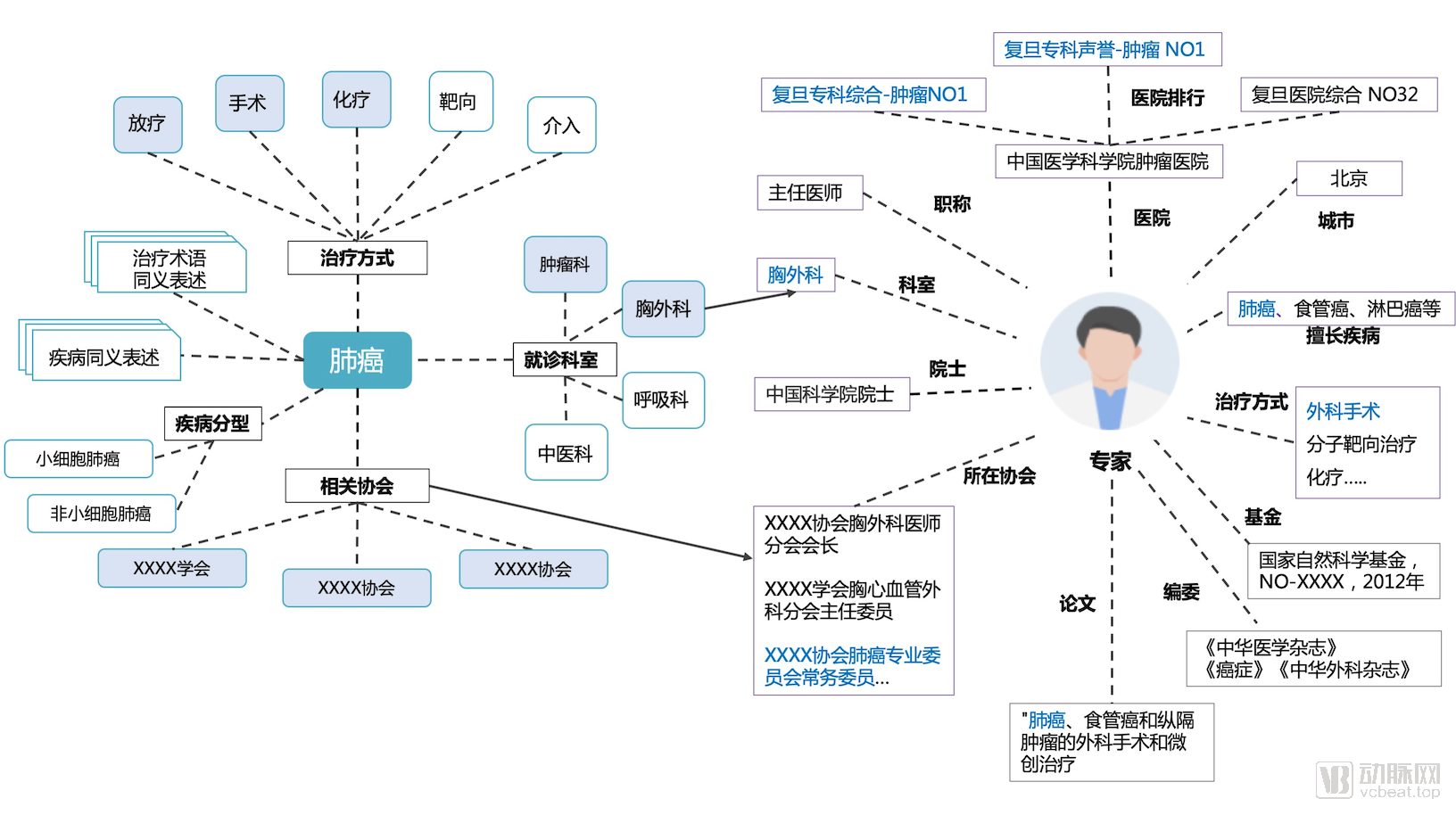 Sogou’s “Expert Recommendation” Knowledge Graph and Physician Profiling Model (Using Lung Cancer as an Example)
Currently, Sogou has completed the collection and processing of information for 600,000 physicians, a scale comparable to that of major internet healthcare platforms. Among these, comprehensive profiles have been established for 240,000 physicians with associate senior professional titles or above from Grade A tertiary hospitals, covering nearly all such physicians across China. The constructed knowledge graph encompasses hundreds of types of cancer and thousands of common diseases, drawing upon six million Chinese and English academic papers, all National Natural Science Foundation projects in the medical field since 2010, and positions held in domestic authoritative medical societies. The team has evaluated hundreds of ranking models and tens of thousands of parameter sets. To ensure the objectivity and professionalism of the recommendation model, nearly 200 expert physicians with associate senior professional titles or above from Grade A tertiary hospitals were invited to participate in the evaluation.
“These efforts took a full year to complete,” stated Zhang Qi. He emphasized that the rigorous nature of medicine necessitates that the team adopt various measures with even greater strictness to ensure data accuracy. “For instance, issues such as physicians sharing identical names, the use of abbreviated English names by doctors, physicians changing their affiliated institutions, and hierarchical relationships among medical terms are frequently encountered. These granular challenges significantly increase the complexity of developing intelligent analysis algorithms.”
Currently, the “Expert Recommendations” for 17 types of cancer have gone live only after multiple evaluations by Sogou. The next step is to expand the product to cover 90 high-incidence cancers and gradually include common diseases in pediatrics, gynecology, dermatology, respiratory medicine, and other specialties, with an expected launch covering 500 diseases by 2021.
Due to the inherent connectivity of internet companies, a product rarely exists in isolation. From the perspective of industry collaboration, “Expert Recommendations” carry inherent traffic advantages and can foster synergy with multiple stakeholders within the industry.
Li Shizheng, Deputy General Manager of Sogou Medical, stated that once users select a suitable specialist, the next step is to establish a connection with them. Online communication facilitates mutual selection, enabling the rapid determination of treatment plans and medical visit schedules, thereby avoiding unnecessary healthcare costs.
Among the 17 types of cancer diseases launched this time, approximately 40% of experts are available for online consultations. Li Shizheng stated that Sogou’s “Expert Recommendation” feature is still in its early stages. As the range of covered conditions expands and the number of expert profiles increases, Sogou also aims to connect with more stakeholders:
First, individual experts or teams. More precise patient targeting can be achieved through the “Expert Recommendation” product.
Second are physician groups and hospital management groups. Physician groups and large-scale hospital management groups have recruited a significant number of high-caliber physicians; if integrated with “expert referrals,” they can likewise gain access to more precisely targeted patients.
Third, internet healthcare platforms. These platforms have attracted renowned physicians from across the country to join their networks, and through collaboration with Sogou, they can provide patients with a broader range of high-quality medical services.
According to statistics, medical searches account for 10% of Sogou’s total search volume, rising to as high as 20–30% during the 2020 pandemic. In the face of this massive demand for information, what additional measures has Sogou taken beyond recommending experts and providing search results? What further actions can it take?
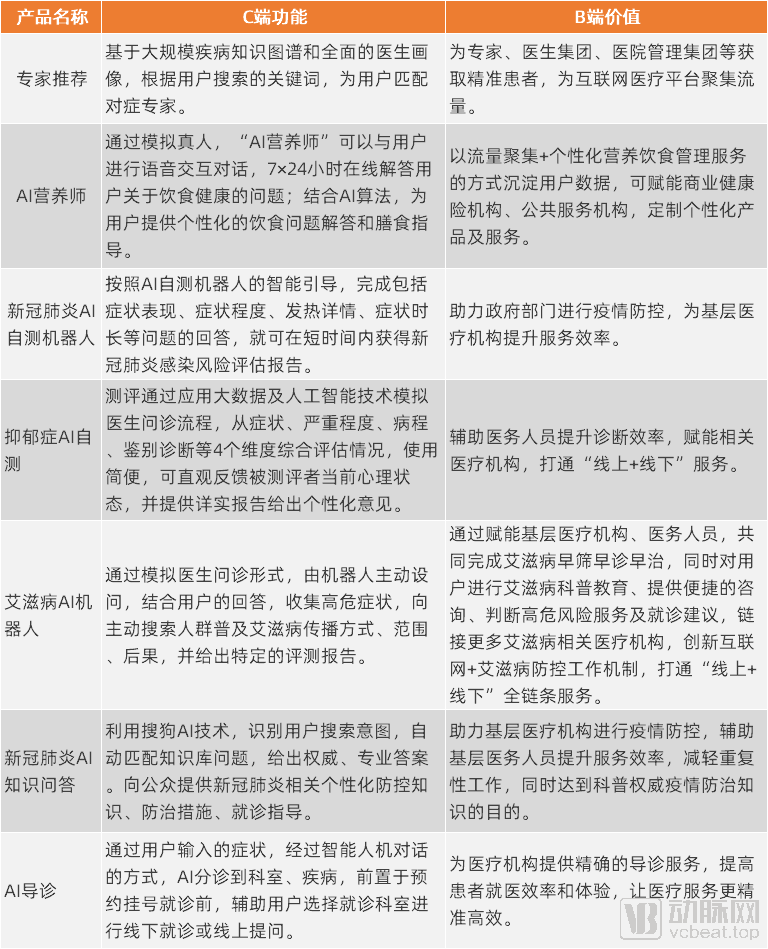
Main Features and Value of Sogou’s AI Medical Products, Chart Compiled by VCBeat
Public records show that, in addition to its already launched AI products, Sogou has registered multiple trademarks related to AI healthcare, including “Sogou AI Nurse,” “Sogou AI Psychological Counselor,” “Sogou AI Family Doctor,” “Sogou AI Pharmacist,” “Sogou AI General Practitioner,” and “Sogou AI Fitness Coach.”
With the launch of the “Expert Recommended” products, VCBeat has examined Sogou’s AI-driven medical offerings and found that Sogou’s AI healthcare strategy appears to be advancing along the following trajectory: leveraging its high-traffic entry points to transition from information provision to service delivery, crafting a multi-dimensional value proposition that not only builds practical, intelligent consumer-facing functionalities but also empowers relevant institutions, helping partners reduce costs and enhance operational efficiency.
Recalling the globally popular Sogou AI anchor, we can foresee that products currently existing merely as trademarks may soon debut with vivid, lifelike personas. Furthermore, Sogou AI Healthcare’s entry-point advantages and technical barriers will continue to inject new momentum into industry participants such as government agencies, medical institutions, and healthcare enterprises.