

Ping An Good Doctor Reports RMB 6.866 Billion Revenue in 2020, Enters Phase Two of Growth with Enhanced Core Capabilities
On February 2, Ping An Good Doctor released its 2020 annual performance report. Over the past year, Ping An Good Doctor achieved a total revenue of RMB 6.866 billion, representing a year-on-year increase of 35.5%. Among this, the core online healthcare business continued to experience rapid growth, contributing RMB 1.566 billion in revenue, a year-on-year increase of 82.4%.
Regarding profitability concerns within the industry, Ping An Good Doctor responded that in 2020, the company focused on “channels, services, and capabilities” and increased strategic investments, which would, to some extent, delay the achievement of overall break-even. However, as the gross margin of online healthcare continues to rise and its proportion of revenue keeps increasing, there is still room for improvement in the company’s overall gross margin, and its profitability plan is aligned with its business plan.
Reviewing the three areas where Ping An Good Doctor has invested heavily in upgrades, VCBeat believes that upgrading capabilities is the foundation. Only solid capability building can deliver high-quality online medical services, enable channel development to fully leverage its potential, and thereby have a positive impact on overall profitability.
According to the annual report, in the process of upgrading its capabilities, Ping An Good Doctor has established a four-tier physician network system: anchored by AI physician assistants, supported by in-house physicians as the foundational service layer to address common needs, bolstered by external physicians as the clinical backbone to resolve patients’ core healthcare demands, and featuring renowned specialist studios composed of leading experts to focus on specific diseases and specialties, thereby cultivating a reputation for rigorous medical care.
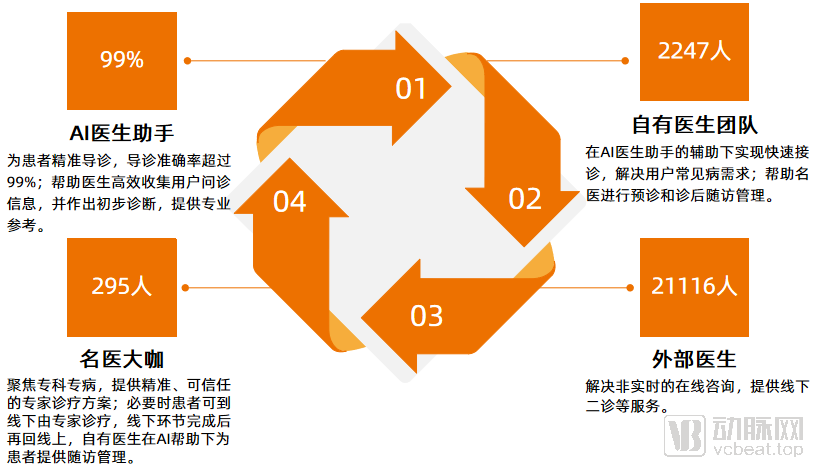
Four-Tier Physician Network System Established by Ping An Good Doctor, Source: Ping An Good Doctor 2020 Annual Report, Graphic by VCBeat
Specifically, the AI Doctor Assistant, an AI-assisted diagnosis and treatment system, primarily serves to provide precise patient triage and support diagnostic processes. The system has been deployed across all 23 departments of our in-house medical team, encompassing diagnostic knowledge for over 3,000 diseases. Prior to consultations, the AI Doctor Assistant matches patients with the most suitable physicians based on their stated needs; currently, the system’s triage accuracy exceeds 99%, significantly enhancing user experience and consultation efficiency. During consultations, the AI Doctor Assistant efficiently collects relevant patient information and generates preliminary diagnoses, offering professional references for physicians while providing personalized medication recommendations. Currently, the accuracy rates for both its assisted diagnostic outputs and medication suggestions exceed 90%.
The in-house medical team is primarily responsible for rapidly attending to patients with the assistance of AI doctor assistants, addressing users’ needs for common conditions, and supporting renowned specialists with preliminary diagnoses and post-consultation follow-ups. By the end of 2020, the in-house medical team had grown to 2,247 members, an increase of 838 from the end of 2019.
External physicians primarily provide non-real-time online consultations, offline second-opinion services from renowned specialists, and other related services. By the end of 2020, the number of external physicians had rapidly increased from 5,381 at the end of 2019 to 21,116, among whom 14,714 were from tertiary hospitals.
“Top-Tier Physicians” focuses on formulating precise and trustworthy expert diagnosis and treatment plans, delivering high-quality integrated online and offline medical services through “Top-Tier Physician Studios.” Since the launch of the first batch of these studios in August 2020, a total of 295 nationally renowned top specialists had signed with Ping An Good Doctor by the end of 2020, among whom 175 physicians established Top-Tier Physician Studios. These studios cover specialized fields including dermatology, pediatrics, obstetrics and gynecology, urology, orthopedics, and traditional Chinese medicine.
“In the past, Ping An Good Doctor focused more on two layers: the AI doctor assistant and its in-house physician team. The AI doctor assistant saved doctors a significant amount of time, while the in-house physicians effectively ensured consultation speed. Following our strategic upgrade, we have added two more layers to our physician system: rapidly expanding our network of external specialists and introducing renowned medical experts,” said Fang Weihao, Chairman and CEO of Ping An Health Medical Technology Co., Ltd., when interpreting the strategic upgrade. He stated that external specialists are distributed across various hospital departments and can help patients address more substantive medical issues; furthermore, introducing renowned medical experts not only better serves patients with complex and severe conditions but also helps establish Ping An Good Doctor’s specialized reputation.
From this perspective, the construction of a four-tier physician network system is the core component of capability-side upgrading.
The profitability of internet healthcare companies has long been a topic of intense focus within the industry. At this annual report press conference, Ye Lan, CFO of Ping An Healthcare and Technology Company Limited, stated that while increased strategic investment would, to some extent, delay the overall break-even point for Ping An Good Doctor, the company’s profitability plan is generally aligned with its business plan. “The strategic upgrade in 2020 has also further opened up room for our future upward growth.”
The annual report shows that Ping An Good Doctor’s adjusted net loss in 2020 was RMB 516 million. Excluding the impact of investments in strategic upgrades, the net loss from its traditional business amounted to RMB 239 million, representing a year-on-year decrease of 65.6%. Based on these figures, the funds allocated by Ping An Good Doctor for strategic upgrades were approximately RMB 277 million. Although Ping An Good Doctor has not disclosed the costs associated with building its four-tier physician network system, it is certain that the investment proportion would not be small, as channels, services, and capabilities are key areas of focus, with physician resources being the core component of its capability upgrade initiatives.
Why Is Ping An Good Doctor Investing Heavily in Capability Upgrades? Looking at the Overall Industry Landscape, We Believe There Are Mainly Three Reasons.
At the macro level, it represents an inevitable trend for both the healthcare system and the internet healthcare industry.
Given the uneven distribution of medical resources in China, the state has vigorously promoted tiered diagnosis and treatment, which has begun to show initial results after years of effort. In 2020, the National Health Commission announced in the first national performance assessment results for tertiary public hospitals that the number of outpatients, emergency patients, and inpatients referred downward from tertiary public hospitals had increased year by year, making the downward referral of appropriate patients within medical consortia a trend. This result indicates that the allocation of medical resources within certain regions is moving toward balance.
However, the distribution of medical resources across regions remains uneven. For instance, first-tier cities such as Beijing, Shanghai, and Guangzhou are concentrated with a large amount of high-quality medical resources, while some remote areas suffer from a scarcity of such resources. Currently, various regions are planning and constructing “National Regional Medical Centers” to address this issue.
In facilitating the allocation of medical resources across regions, efficient internet infrastructure can play a significant role. From the perspective of Ping An Good Doctor’s four-tier physician network, some doctors handle common ailments while others address complex and critical conditions; follow-up consultations are conducted online, whereas initial diagnoses, surgeries, and other procedures take place offline; in-house physicians manage real-time demands, while external doctors handle non-real-time requests. Together, this forms an enterprise-level “tiered diagnosis and treatment system” that integrates online and offline services and balances the management of minor and severe conditions.
Fang Weihao stated, “A significant role of internet healthcare is to help medical institutions facilitate tiered diagnosis and treatment in the pre-care stage.”
An analysis of the current state of internet healthcare reveals that the industry experienced rapid development in 2020. Nearly one thousand internet hospitals have been established, with follow-up consultations for common and chronic diseases becoming a standard offering. This represents the most substantively valuable online medical service permissible within the existing policy framework. However, amid the influx of numerous market participants, relying predominantly on online services makes it difficult to achieve differentiated competitive advantages within the industry.
VCBeat recently in "With 38.7 billion yuan in cash and 276 million online users, is internet healthcare now expanding into offline services?The article also posits that while the internet can enhance efficiency, improve accessibility, and reduce costs, the trust and sense of security established through face-to-face interactions remain indispensable. Consequently, the deep integration of online and offline services will be the primary direction for the internet healthcare industry.
Ping An Good Doctor has built professional and authoritative offline capabilities within its newly added two-tier physician network, thereby enhancing the competitiveness of its platform.
From a meso-level perspective, changes on the demand side drive changes on the supply side.
In 2020, the pandemic drove widespread adoption of internet healthcare among end users. According to data from the 46th Statistical Report on China’s Internet Development released by the China Internet Network Information Center (CNNIC), as of June 2020, the number of online medical service users in China reached 276 million, accounting for 29.4% of the total internet population. This marked the first time that official authorities had disclosed the scale of online medical service users.
Specifically, in 2020, Ping An Good Doctor intensified its efforts to build traffic entry points across several channels, including insurance, corporate services, and internet hospitals.
In terms of insurance, Ping An Good Doctor, as a key component of the Ping An Medical Ecosystem, has established an Insurance Business Division to advance deep online business collaboration with Ping An Health Insurance. By jointly developing customized product bundles that integrate medical health services with insurance offerings, the company aims to achieve mutual empowerment between healthcare and insurance services.
On the corporate front, Ping An Good Doctor leverages Ping An Group’s integrated financial services network to rapidly reach target users. By the end of 2020, Ping An Good Doctor had expanded its enterprise client base to over 1,100 companies, including numerous large state-owned enterprises, leading internet companies, and well-known financial institutions.
In the realm of internet hospitals, spurred by supportive national policies introduced in 2020, there has been a growing demand among public hospitals to build and operate such platforms. By the end of 2020, Ping An Good Doctor had entered into agreements with 100 offline hospitals to co-develop internet hospital platforms (including the Fuzhou regional platform), 41 of which had gone live. Additionally, Ping An Good Doctor had obtained qualifications to independently establish internet hospitals in nine cities. Among all the launched internet hospitals, five were integrated with local medical insurance payment systems.
The development of diversified traffic channels will inevitably attract more users, especially after the integration of medical insurance payment, which will increase users’ motivation to seek online consultations. By the end of 2020, Ping An Good Doctor had reached 373 million registered users.
Patients’ primary objective in seeking medical care is to resolve their health conditions, a goal that may not be fully met through online follow-up consultations and prescription services. This demand for more substantive, in-depth medical care necessitates optimization of the supply side within the internet healthcare sector.
Based on the above analysis, changes on the demand side of internet healthcare are primarily characterized by an increase in user volume and heightened expectations for service quality, which necessitates that the supply side match these demands with sufficient service capacity and capability. According to Ping An Good Doctor’s four-tier physician network system, the number of in-house physicians increased by 59% year-on-year in 2020, while external physicians surged by 292%, significantly expanding the volume of service supply. The introduction of renowned specialists has further enhanced service capabilities, particularly the ability to extend services to offline settings.
From a micro perspective, it is necessary for the professional and practice development of individual physicians.
In 2020, the pandemic not only enhanced users’ awareness of internet-based healthcare but also deepened physicians’ understanding of it. During the outbreak, major internet healthcare platforms and public hospitals launched free online consultation services, familiarizing doctors with virtual consultations and enabling physicians at all professional levels to find their place in the digital healthcare landscape.
For junior physicians, offering online services can increase their legitimate income, enable them to contact and manage a larger volume of cases through efficient internet platforms, and accelerate their professional growth. For senior physicians, providing online services helps attract more precisely matched patients, facilitates focused research breakthroughs in their specialized disease areas, and continuously enhances their academic capabilities.
The upgraded physician system of Ping An Good Doctor can meet the professional needs of doctors at different levels and provide them with academic exchange tools to fulfill their practice requirements.
In fact, as Ping An Good Doctor underwent its strategic upgrade, we observed similar optimizations in supply-side capabilities across the industry. Examples include forming physician teams centered on renowned specialists and establishing specialized disease centers in collaboration with leading experts. Compared with other approaches in the industry, what are the differentiating features and characteristics of Ping An Good Doctor’s four-tier physician network system? After a thorough review, VCBeat has identified the following key points:
First, a large-scale in-house physician team ensures rapid consultation response times. At this annual report press conference, Fang Weihao introduced that, in accordance with Ping An Good Doctor’s service-level agreements, free users receive a response within 45 seconds, while paid users are responded to within 30 seconds. Such performance is clearly unattainable with externally partnered specialist physicians; it can only be achieved by full-time doctors.
The second advantage is its unique channel resources. In September 2020, Ping An Group disclosed its healthcare ecosystem strategy for the first time. Ping An Good Doctor occupies the user-facing and online medical service segments within this ecosystem, serving as a key member whose business activities complement those of other members. Leveraging the ecosystem, Ping An Good Doctor has access to extensive insurance channels. Furthermore, by tapping into the vast pool of corporate clients within Ping An’s integrated financial ecosystem, it can reach enterprise customers more broadly and conveniently, thereby extending its reach to end consumers.
In addition, Ping An Good Doctor has partnered with Ping An Smart City and Ping An Medical Insurance Technology to efficiently integrate medical insurance payments into its internet hospital services.
Thirdly, there is technological capability represented by artificial intelligence (AI). Ping An Good Doctor has independently developed an AI Doctor Assistant, which incorporates a knowledge graph covering 3,000 diseases. Trained continuously on a massive dataset of one billion patient interactions, the system spans the entire consultation process, significantly enhancing physicians’ diagnostic efficiency and reducing the likelihood of misdiagnosis and missed diagnoses. This technology provides critical support for handling an average daily volume of 900,000 consultations. In April 2020, Ping An Good Doctor received certification from the World Organization of Family Doctors (WONCA), the largest global organization of family physicians, with its AI Doctor Assistant rated at the highest level.
To continuously enhance the safety of AI operations, Ping An Good Doctor has conducted regular tests on AI-assisted diagnosis of critical illness cases since the second half of 2020. This initiative aims to improve the accuracy of critical care rules while alleviating physicians’ review workload. Additionally, a three-tier review mechanism has been established to extract cases with significant AI diagnostic discrepancies. Senior chief physicians verify the accuracy of critical care rules in these cases, thereby accelerating the AI’s professional learning process and improving the accuracy of its algorithms.
In summary, although there is a convergence in the direction of supply capacity building within the industry, Ping An Good Doctor can still maintain a differentiated position by leveraging its internal and external advantages.
Although strategic upgrades and other factors may delay Ping An Good Doctor’s path to profitability, a review of its annual reports in recent years reveals that the proportion of revenue contributed by its core online healthcare business has continued to grow, along with an increase in the gross profit margin of this segment. At the press conference, Ye Lan noted that following the completion of the strategic upgrade, the company’s overall gross profit margin still has room for further improvement as the share of revenue from online healthcare services increases.
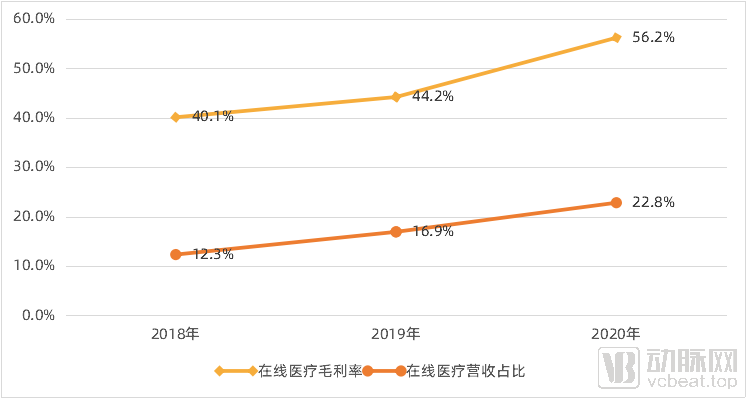
Ping An Good Doctor’s Online Healthcare Gross Profit Margin and Revenue Share Over the Past Three Years. Source: Ping An Good Doctor Annual Reports; Chart by VCBeat.
In addition, Ping An Good Doctor mentioned in its 2020 annual report that the company had completed the first phase of its internet healthcare startup journey over the past few years, accumulating a large-scale user base, establishing a comprehensive system of internet healthcare services and products, and exploring monetization pathways for medical services that leverage the company’s competitive advantages. It is now advancing into the second phase of its startup development, characterized by rapid business expansion, solid revenue growth, and continuously improving profitability.
We believe that the capability upgrade centered on the four-tier physician system will serve as a guarantee for Ping An Good Doctor to consistently deliver high-quality services, ensure an increased proportion of online medical service revenue, and act as a prerequisite for enhancing profitability.
“Online healthcare penetration was below 3% in 2019 and, following rapid development, approached 5% in 2020, reaching 500 million consultations,” Fang Weihao stated at the press conference. He projected that by 2025, online healthcare penetration would reach 16%, with 1.8 billion consultations.
In the vast future market, greater opportunities will undoubtedly be reserved for participants with outstanding capabilities; Ping An Good Doctor has upgraded its capabilities and is well-prepared for the second stage of its entrepreneurial journey.