

HaoXinQing's Strategic Move: Building a Leading Digital Mental Health Platform with 30,000 Specialists
With economic development and consumption upgrading, mental health is receiving increasing attention within the healthcare sector. On the capital front, China’s digital health sector completed dozens of financing rounds throughout 2020. On the policy front, 15 mental health-related policies have been successively issued since January 2020, covering guidance on mental hygiene services, specific implementation measures, and ongoing promotion efforts. On the market front, a growing number of players are entering the field, targeting the mental health market, which is projected to reach a scale of hundreds of billions of yuan in the future.
2020 was a breakout year for internet healthcare, and also a harvest year for Haoxinqing, an internet medical service platform provider in the psychiatry and psychology sector. At the beginning of the year, Haoxinqing, a leading enterprise in the psychiatry and psychology track, completed a RMB 125 million financing round—the largest single investment in China’s psychiatry and psychology healthcare sector to date—which remains widely praised. With this, Haoxinqing completed its Series C financing, securing hundreds of millions of yuan in capital from industrial partners and top-tier investment institutions across various fields, including Nhwa Pharmaceutical, Tonghe Yucheng, Korea Investment Partners (KIP), and China Development Capital. In the second half of the year, Haoxinqing successfully launched two mid-to-high-end specialized psychiatry and psychology clinics. From a full-year perspective, Haoxinqing’s internet hospital platform gradually expanded its businesses along the psychiatry and psychology service chain, further enlarged its team, and achieved several-fold growth in business volume compared to the previous year.
From the perspective of Chen Guanwei, founder and CEO of Fine Hin, this is positive feedback on his unwavering commitment five years ago to a specialty field within internet healthcare that was not widely favored at the time.
Founded in 2015, Fine Hin is an internet healthcare platform focused on mental health within the central nervous system (CNS) sector. It has since grown into China’s largest internet hospital specializing in CNS disorders, with registered physicians accounting for 80% of China’s clinical mental health professionals and a user base exceeding 3 million. “Striving for excellence” is Chen Guanwei’s pursuit. As a serial entrepreneur with over a decade of experience in the internet and mobile healthcare sectors, he emphasizes that healthcare requires a sense of mission and patience. Fine Hin’s mission is to leverage technology and innovative models to become an internet healthcare platform enterprise that connects both doctors and patients as well as upstream and downstream industry players, ultimately delivering professional, advanced, and comprehensive specialized digital medical services to users with mental health needs. How will Fine Hin realize this vision step by step? Chen Guanwei shared their strategy with VCBeat.

“The development of medical big data and artificial intelligence has entered its second half” has become an industry consensus. With continuous technological advancements, the application of big data and AI in healthcare will expand into deeper and broader dimensions, including management and scientific research. For instance, through the collection, cleaning, integration, and mining of comprehensive hospital data, these technologies can enhance clinicians’ diagnostic and treatment efficiency and quality; boost the research efficiency and output of medical experts; and improve the scientific rigor of clinical decision-making in hospital management.
Since 2016, Fine Hin has been strategically deploying the application of big data in internet-based medical consultations. Chen Guanwei analyzes that the psychiatric diagnosis and treatment process has not yet been digitized or standardized. For this category of diseases, laboratory tests and imaging studies cannot serve as the basis for clinical diagnosis; instead, diagnoses are primarily based on symptomatology, relying on physicians’ judgments derived from symptoms and clinical experience. To address this, Fine Hin aims to develop an intelligent clinical decision support system focused on central nervous system and psychiatric disorders, leveraging its existing database of one million patient records. This system is designed to help physicians improve efficiency, reduce clinical misdiagnosis rates, and enhance the accuracy of medication prescriptions.
After five years of investment and accumulation, Fine Hin has independently developed an intelligent diagnosis and treatment system based on big data. This system features targeted functionalities designed for various types of mental and psychological disorders, enabling Fine Hin’s AI bots to rapidly assess the risk levels and categories of mental health conditions. By integrating modular and standardized components—including clinical psychological scale assessments, follow-up systems, electronic medical records, a pharmaceutical knowledge base, and clinical diagnostic systems—the platform matches users with appropriate specialists once results are generated. Users can then autonomously select services to receive authoritative and comprehensive rehabilitation solutions.
At present, the Fine Hin intelligent auxiliary system permeates the entire business workflow, covering patient follow-up visits, medication purchases, consultations, psychological assessments, medical quality audits, and psychological relaxation and counseling, thereby forming coherent longitudinal disease progression data and user profiles. Leveraging the patient base accumulated through the rapid online growth of Fine Hin Internet Hospital, Fine Hin’s intelligent diagnosis and treatment system possesses unique data advantages in terms of volume and sustainability that are not available to typical AI companies. The platform’s rapid annual patient growth also provides continuous data and technical validation for the system’s ongoing learning.
Furthermore, in the realms of clinical digital marketing and scientific research, Fine Hin is progressively strengthening its academic and clinical collaborations with pharmaceutical companies specializing in the central nervous system (CNS) sector. It has established in-depth partnerships with 50 domestic and international enterprises and is actively recruiting talent in intelligent systems research to enhance the application of artificial intelligence and big data in assisted diagnosis, thereby leveraging technology to improve physicians’ academic and clinical capabilities. Over the past two years, Fine Hin has repeatedly collaborated with national committee chairpersons and experts to conduct clinical courses and academic conferences on psychiatric and psychological disorders, aiming to promote academic development within the mental health industry. On January 31, 2021, driven by Fine Hin’s co-initiative, the Psychological Assessment Professional Committee of the Beijing Federation of Social Psychological Work was successfully established. This milestone will facilitate broader adoption of Fine Hin’s intelligent assessment systems and service frameworks, expanding its services from clinical psychology to public mental health and education, as well as corporate mental health services.
Chen Guanwei revealed that, in the short term, Fine Hin will continue to deepen its presence in the field of central nervous system disorders, expand market scale, and provide professional services to a broader user base with mental health needs. Meanwhile, Fine Hin is committed to contributing to the development of the entire industry, aiming to become China’s largest platform-based enterprise in the mental health sector, promote the steady growth of the mental health service industry, and contribute to the “Healthy China 2030” initiative.
Mental and psychological disorders affect individuals across all age groups. Common mental disorders include depression, anxiety disorders, obsessive-compulsive disorder (OCD), and dozens of other conditions, spanning the entire population from children to adults and the elderly, and covering ailments such as attention-deficit/hyperactivity disorder (ADHD), autism spectrum disorder, anxiety, and depression. Among these, depression has the highest incidence rate, accounting for 30% of all mental disorder cases, making it the most prevalent condition in psychiatric outpatient clinics. OCD is the most difficult to cure, with an incidence rate of approximately 2.5%. Currently, the overall prevalence of various mental and psychological disorders in China is 17.5%, affecting 250 million people, while there are only 40,000 psychiatrists. This translates to fewer than two psychiatrists per 100,000 people, which is less than one-quarter of the international standard. Furthermore, according to an analysis of the "National Mental Health Work Plan (2015-2020)," psychiatric medical resources in China are primarily concentrated at the provincial and prefectural city levels. County-level and grassroots medical institutions rarely have psychiatric or psychological departments, resulting in insufficient supply and uneven distribution of mental health services.
As a mental health platform company, Fine Hin will inevitably not consider the business model of internet hospitals in isolation; rather, building a comprehensive service system and strengthening disciplinary development are its key strategic goals. Regarding the importance of offline diagnosis and treatment for mental and psychological disorders, Chen Guanwei provided insights from the perspective of their clinical characteristics.
Mental disorders are characterized by two key features: a prolonged disease course and high complexity in treatment. As typical chronic conditions, mental disorders require long-term, continuous care. The high complexity stems from the lack of advanced imaging and laboratory tests for diagnosis and treatment; instead, clinicians rely solely on their clinical knowledge and experience. Once patients engage in the diagnostic and treatment process and establish trust in their physicians, a strong one-on-one doctor-patient relationship is formed. Therefore, although online internet hospitals offer various consultation services and prescription refills, face-to-face psychological counseling and clinical assessments allow for more authentic and comprehensive observation of patients’ emotions and behaviors—an advantage that online platforms cannot replicate.
Beijing Fine Hin’s first specialized psychiatric and psychological clinic was successfully established in Beijing in 2019. As a pilot project, it facilitated the integration of online and offline services, enabling Fine Hin to complete a critical component of its psychiatric and psychological care system over the past year. In 2020, Fine Hin accelerated its expansion by opening two mid-to-high-end specialized psychiatric and psychological clinics in Beijing and Jiangsu Province. By leveraging traffic from its online platform, the company created a self-sustaining ecosystem, fully capitalizing on its specialized advantages. The initiative received highly positive feedback from both users and physicians, thereby validating and streamlining its business model.
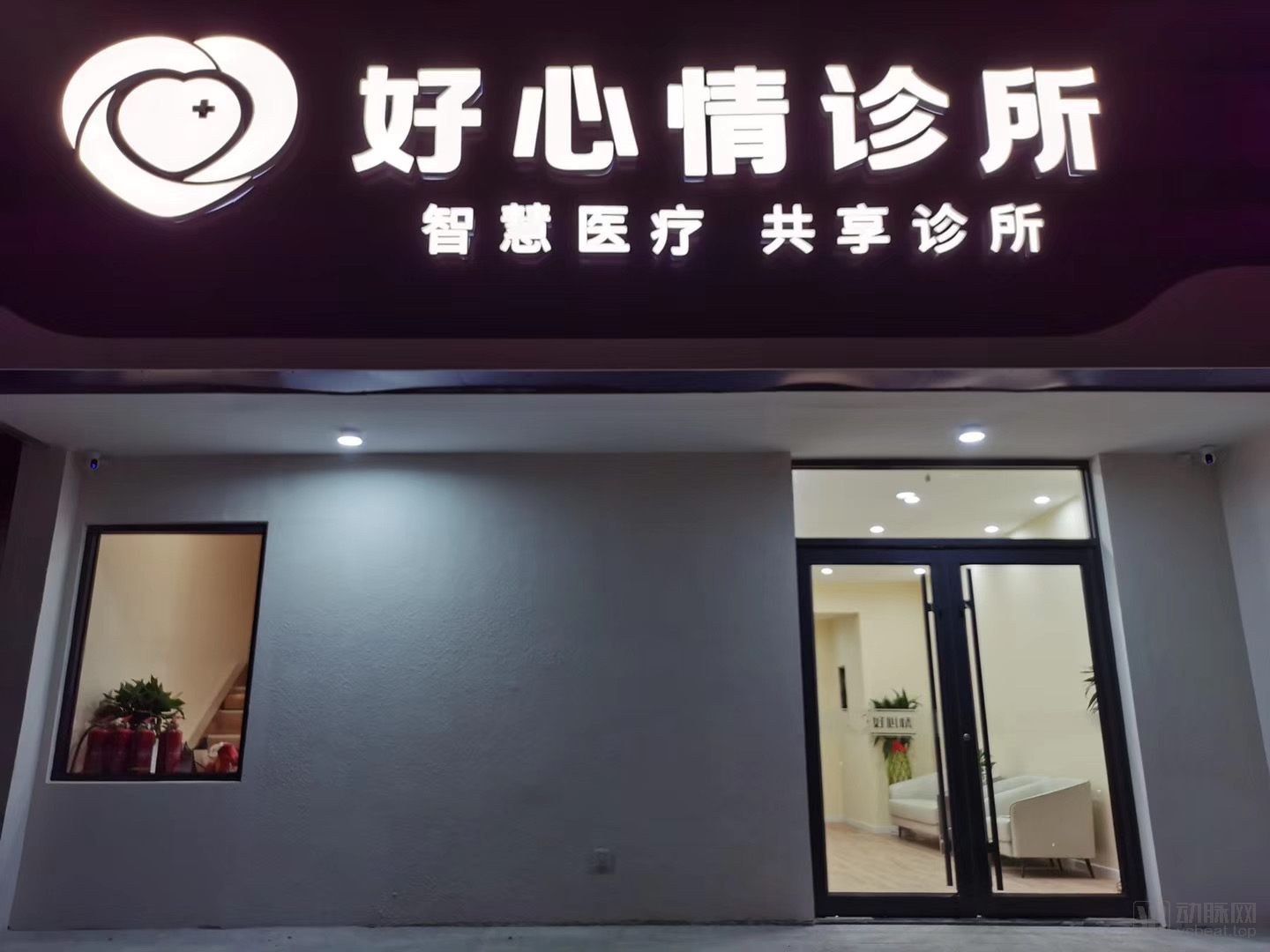
It is reported that each Haixinqing clinic is equipped with smart consultation rooms, integrating clinical psychological care to provide services such as precision pharmacogenetic testing, mass spectrometry-based blood concentration monitoring, VR therapy, and music-guided meditation for relaxation. These offerings enable the company to deliver a more comprehensive service chain encompassing both psychological diagnosis/treatment and counseling.
It is worth noting that, unlike traditional clinics, the Fine Hin Clinic is a shared clinic built upon its own “platform user” doctor-patient relationships. Chen Guanwei explained that the concept of the clinic as a platform-shared space primarily serves the platform’s own users. This relationship model was adopted in consideration of the company’s inherent advantages and to create a closed-loop service ecosystem:
First, in terms of service value, Fine Hin is positioned as a supplement to outpatient services in public hospitals.Public hospitals face severe “three long waits and one short consultation” issues, where physicians cannot thoroughly understand patients’ conditions and needs within the limited face-to-face consultation time, resulting in suboptimal treatment outcomes. Fine Hin prioritizes value-based collaborations with public hospitals to provide patients with more comprehensive clinical care services and experiences, thereby optimizing the entire diagnosis and treatment process.
Secondly, improve patient adherence and engagement.From the perspective of patient conversion rates, clinical patient needs are more clearly defined, resulting in higher conversion efficiency. When providing medical services on internet healthcare platforms, doctors spend considerable time understanding patients’ conditions and chief complaints and conducting rigorous diagnoses. In offline settings, physicians can deliver more refined and comprehensive diagnoses, thereby enhancing the patient experience.
The most critical consideration is that the Fine Hin platform possesses robust service capabilities and a foundational user base, featuring precise user data that other platforms lack.A relationship of trust has been established between doctors and patients through the platform. Offline interactions, grounded in a “familiar” doctor-patient dynamic, are more readily accepted by both parties. On one hand, physicians’ thorough understanding of their patients and their medical conditions enables them to provide care with greater confidence, while patients are more likely to comply with treatment plans. On the other hand, follow-up consultations conducted via the platform better align with national laws and regulatory requirements.
In selecting clinic locations, Fine Hin leverages big data on the geographic distribution of users and physicians from its online hospital platform to choose sites that are “closer to both doctors and patients.” This proximity enables doctors and patients to access services more conveniently, while the unique advantages help reduce investment risks for Fine Hin clinics. Fine Hin clinics operate under a self-managed model. Once online physicians meet the required standards, they can join the clinics, facilitating the development of their personal brands. Fine Hin provides comprehensive platform-based service support to facilitate the translation of academic achievements, knowledge, products, and experience into practical outcomes. Chen Guanwei stated that Fine Hin planned to expand to 30 shared clinics in 2021, providing an important supplement to the completeness of mental health and psychological services in China.
Through a vertical strategic layout, deep investment in R&D, and a firm commitment to building a comprehensive mental health service system, Fine Hin has established its own competitive advantages and service framework. As a rising star in the mobile healthcare sector, Fine Hin is dedicated to providing a more professional and comprehensive digital healthcare platform for the mental health industry.