

Can Nanox Imaging, the 'Tesla of X-ray', Live Up to Its $3 Billion Valuation?

Nanox Imaging
Medical Imaging Technology R&D Provider
On January 21, 2021, Nanox Imaging's stock price rose by 26.21%.
Nanox Imaging is an Israeli developer of medical imaging technology that created the world’s first commercial-grade digital X-ray source for real-world medical imaging applications, Nanox.ARC, with the aim of democratizing CT scanning.
The direct cause of the recent surge in share price is a major overhaul of Nanox Imaging’s core management team: Jim Dara, former president of myCharge, has been appointed Chief Operating Officer; Ofir Koren, former Israel General Manager of ReWalk Robotics, has assumed the role of Chief Technology Officer; and Tamar Aharon, formerly with Tempo Beverages, has taken on the position of Chief Marketing Officer.
Regarding this personnel change, Ran Poliakine, Founder and CEO of Nanox Imaging, stated that this is a significant strategic move for Nanox Imaging in 2021, and their addition will accelerate the company’s path to FDA approval.
According to foreign media reports on February 2, Nanox Imaging recently received a Request for Additional Information from the U.S. Food and Drug Administration (FDA), requiring the company to address issues such as the intended use of its core product, Nanox.ARC. In response, Nanox Imaging stated that it would continue to optimize and develop the functionalities of Nanox.ARC and plans to submit an additional 510(k) premarket notification to the FDA in 2021 for its multi-source Nanox.ARC and Nanox.CLOUD systems.
As of February 4, 2021, the market capitalization of Nanox Imaging, hailed as the “Tesla of the X-ray industry,” had surpassed $3 billion, marking a qualitative leap from its valuation of nearly $1 billion on its listing day, August 22, 2020. However, the technical professionalism of its offerings has drawn criticism from certain institutions. What challenges will Nanox Imaging face in bringing its products to market? How sustainable is its growth momentum? Perhaps we can gain some insights by examining its development trajectory.
Nanox Imaging’s origins are deeply rooted in Sony’s history. In 1998, Sony was seeking to develop high-definition televisions that could avoid the dead pixels, flickering, and aging issues associated with LCD and plasma screens. Sony’s solution was to revisit the fundamental concept of traditional cathode-ray tube (CRT) televisions—electron guns firing onto a phosphor display—and modernize it. Instead of employing a single electron gun scanning across the screen, Sony fabricated a MEMS chip that integrated millions of micro-scale electron guns onto a silicon wafer. This represented a novel approach to illuminating screen pixels, contrasting with conventional CRTs that rely on a single-source electron beam.
Compared with contemporary products, televisions based on this technology offered high definition and reduced the risk of pixel defects, presenting optimistic market prospects. However, as LCD/LED television prices continued to decline, Sony’s technological advantage was undermined. In 2009, after spending nearly $1 billion on research and development without achieving desired results, Sony halted the project’s development. That same year, the technology eventually came into the possession of the Japanese company FET Japan. In 2011, the predecessor of Nanox Imaging acquired the relevant X-ray source technology from FET Japan; Nanox Imaging was subsequently established and has since been dedicated to applying this technology to medical imaging.
Ran Poliakine is a successful serial entrepreneur who founded multiple technology companies across the healthcare, wireless, printing, broadcasting, and media industries before establishing Nanox Imaging. These ventures included Powermat Technologies, a global leader in wireless charging technology and products, and Magink Display Technologies, the world’s first manufacturer of billboards based on proprietary e-ink technology.
Since its establishment in 2011, Nanox Imaging has been dedicated to developing digital medical imaging devices and applying them to the field of preventive healthcare.
After eight years of exploration, Nanox Imaging launched its first commercial-grade digital X-ray technology based on proprietary silicon MEMS semiconductor technology in January 2019. Reportedly, this novel digital X-ray source can significantly reduce the cost and footprint of imaging systems, with the aim of making medical imaging more universally accessible worldwide.
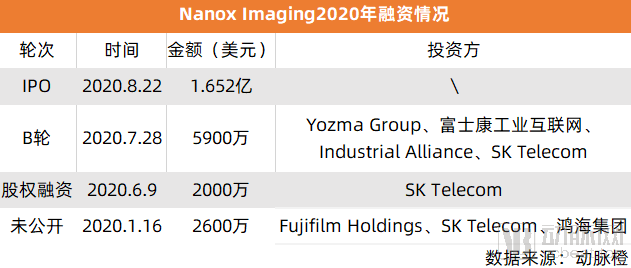
In 2020, as the COVID-19 pandemic raged, medical imaging played a critical role as a key screening tool for the disease. Nanox Imaging, a company dedicated to the research and development of medical imaging equipment, also attracted significant attention from investors. That year, the company completed three major rounds of financing, raising a total of $270 million, and successfully listed on the NASDAQ.
Currently, Nanox Imaging is advancing the development of a series of digital devices. Its cloud-based software, Nanox.Cloud, is also under intensive development to provide end-to-end medical imaging services. Nanox Imaging plans to collaborate with medical imaging system vendors, radiology associations, AI-driven medical diagnostics companies, government agencies, and healthcare providers to deploy advanced imaging systems on a large scale globally, thereby improving patient diagnosis, treatment, and care. Both the Nanox system and the Nanox.Cloud software operate on a pay-per-use basis.
CT, MRI, mammography, fluoroscopy, angiography, and dental imaging systems are the primary early detection tools for symptomatic patients and represent the main categories of medical imaging systems currently utilizing X-ray sources. These systems employ conventional X-ray sources that generate X-rays by accelerating electrons to high energies, causing them to strike a metal target and emit X-rays from that target.
Nanox Imaging believes that the X-ray source is a key factor contributing to the high cost of medical imaging equipment such as CT scanners, and is also the fundamental reason why medical imaging has not been widely adopted. According to Nanox Imaging’s prospectus, the company’s primary task in producing new, affordable medical imaging systems is to identify and develop novel X-ray sources.
Over the past decade of development, Nanox Imaging has remained committed to addressing the high costs and outdated deployment models of medical imaging systems. The company developed Nanox.ARC to drive the accessibility of medical imaging by enabling large-scale deployment through a pay-per-use business model.
Nanox Imaging’s X-ray source utilizes a novel semiconductor cathode based on MEMS technology, achieving electron emission via non-thermal low-voltage triggers to approximately 100 million nanoscale molybdenum cones. These cones function as multiple electron guns, delivering performance comparable to traditional analog X-ray cathodes while enabling lower production costs than existing medical imaging systems. Nanox Imaging states that this technology forms the core foundation of the Nanox.ARC system and has the potential to replace conventional X-ray sources in current imaging systems.

The Nanox system consists of the Nanox.ARC hardware and Nanox.CLOUD.
Nanox.ARC features a sci-fi-inspired design, resembling the bio-beds from the *Star Trek* films, and weighs 70 kg, allowing for rapid deployment. The device utilizes cold cathode technology and semiconductor components to replace the cathode ray tubes found in traditional machines, thereby eliminating the need to heat semiconductors for scanning or to provide cooling, which significantly reduces power consumption.
According to Nanox Imaging's prospectus, its X-ray source has three technical advantages:
Reduce radiation exposure duration.This X-ray source enables precise control of "stop-and-start" operations, significantly reducing radiation exposure duration.
MakeUtilizing the multispectral imaging capability of a single X-ray source.The X-ray source is designed to enable multispectral imaging using an X-ray source chip, as the X-ray penetration intensity is completely independent of the number of illumination photons.
Higher frequency of use can extend service life.Nanox Imaging’s X-ray source is based on multiple field-emission electron guns on a MEMS cathode. Compared to the single filament heated to high temperatures in conventional X-ray tubes, this electron gun distributes the electron generation load across many “emitters,” resulting in higher stability, a longer service life, and a longer mean time between failures.
Nanox.ARC must be used in conjunction with the dedicated software, Nanox.Cloud. Nanox.Cloud is a cloud-based companion platform that provides end-to-end medical imaging services, including an image repository, radiologist matching, online and offline diagnostic reviews and annotations, integration with AI-assisted diagnostic systems, billing, and reporting. These services enhance the accessibility and affordability of early detection solutions worldwide.
In February 2020, Nanox Imaging partnered with USARAD, which is invested in by Siemens Healthineers, to adopt a novel “Image-as-a-Service” revenue model—providing the Nanox.ARC system free of charge to medical centers and clinics, with fees incurred only when the equipment is used for scanning. In its prospectus, Nanox Imaging stated that it plans to commercialize its X-ray source technology through three models: subscription, sales, and licensing. Nanox Imaging secured $160 million in orders in 2020.
Furthermore, upon obtaining FDA approval, Nanox Imaging plans to launch the Nanox.ARC 3D tomosynthesis imaging system. Tomosynthesis is an imaging technique widely used for early detection, designed to generate high-resolution 3D X-ray image reconstructions of scanned body parts for review by diagnostic specialists.
In 2020, Nanox Imaging embarked on a path of rapid development. In June, Nanox Imaging entered the Asia-Pacific region by signing a strategic agreement with Golden Vine International to deploy 500 Nanox.ARC medical imaging systems across the region; it also signed a $48 million agreement with distributors in Russia and Belarus to deploy Nanox.ARC systems and provide related services; additionally, it reached an agreement with Promedica Bioeletronics in Italy to deploy 500 Nanox.ARC units. Nanox Imaging disclosed that its short-term goal is to deploy 15,000 systems worldwide.
To gain further market share in Asia, Nanox Imaging will inevitably have to engage in direct competition with Chinese medical imaging companies.
In 1951, the Shanghai Precision Medical Instrument Factory began developing a 200mA four-tube single-phase full-wave rectified X-ray machine, marking the beginning of China’s independent research and development of medical imaging equipment. The prototype was completed after one year of trial production, just before the third anniversary of the founding of the People’s Republic of China; accordingly, the machine was named “National Day,” ushering in a new chapter in the development of China’s medical-engineering integration field.
In the late 1970s, China’s biomedical engineering sector experienced a true boom. In 1979, inspired by information from international exhibitions, Chinese administrative authorities designated “CT” as a national key project. After the project was approved that same year, research institutes established special task forces, with more than 40 organizations and over 200 leading scholars participating in the development of this CT scanner. Finally, in 1983, China’s first domestically produced head CT system passed appraisal in Shanghai. According to records, the scanning time for the first volunteer subject was as long as 3 minutes and 20 seconds.
Supported by technologies such as the Internet and artificial intelligence, medical imaging equipment has established a comprehensive solution centered on devices, supported by PACS systems, and assisted by AI software. This marks a transition from mere “images” to intelligent devices focused on “doctor-patient services.”
On the path of development for domestically produced imaging equipment, a large number of talents have emerged. Pioneering enterprises such as Neusoft Medical, United Imaging Intelligence, Kaipu Imaging, and Minfound Medical are exporting their technologies and products to markets across various dimensions. The field of imaging equipment, once lagging behind Western countries, is gradually demonstrating China’s strength.
Reference Article:
Nanox Imaging Prospectus
US Stocks | The Tesla of X-Ray: The Strongest MedTech Stock, How It Disrupts Tradition, In-Depth Industry, Outlook, and Financial Statement Analysis
NNOX Stock Price Increased 26.21%: Why It Happened