

How Pulmonx Achieved $30M Annual Revenue with a Single Interventional Pulmonology Product: A Blueprint for Chinese MedTech Global Expansion

Pulmonx
Minimally Invasive Medical Device and Technology Development, Marketer
On October 1, 2020, U.S. medical device company Pulmonx listed on the Nasdaq under the ticker symbol LUNG, with an initial public offering price of $19 per share, raising over $200 million. As of February 3, 2021, Pulmonx’s share price exceeded $58, and its total market capitalization surpassed $2 billion.
Pulmonx, founded in 1998, is a commercial-stage medical technology company. Currently, Pulmonx generates revenue primarily through the Zephyr Endobronchial Valve. As an interventional device, the Zephyr Endobronchial Valve is used for the minimally invasive treatment of patients with severe emphysema.
According to information on Pulmonx’s official website, the company reported revenue of $20 million and a gross margin of 61.4% in 2018, and revenue of $32.6 million with a gross margin of 68.8% in 2019. In the first half of 2020, Pulmonx generated $12.29 million in revenue, representing a slight year-over-year decline due to the impact of the pandemic.
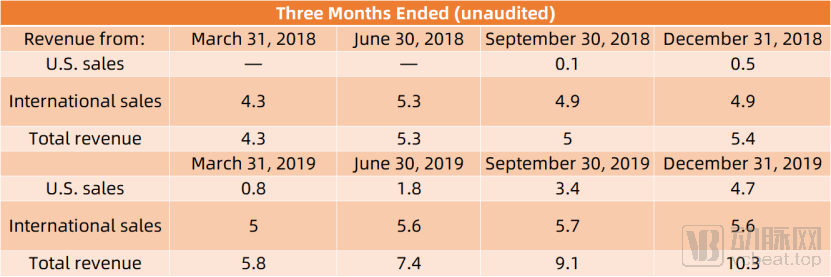 (Data Source:PulmonxOfficial Website)
From its founding to its listing on the NASDAQ, Pulmonx has traversed a 12-year journey. Over these 12 years, Pulmonx has remained steadfastly focused on the research, development, and commercialization of the Zephyr Endobronchial Valve, while also launching complementary lung assessment systems and pulmonary analysis platforms.
Pulmonx Milestones:
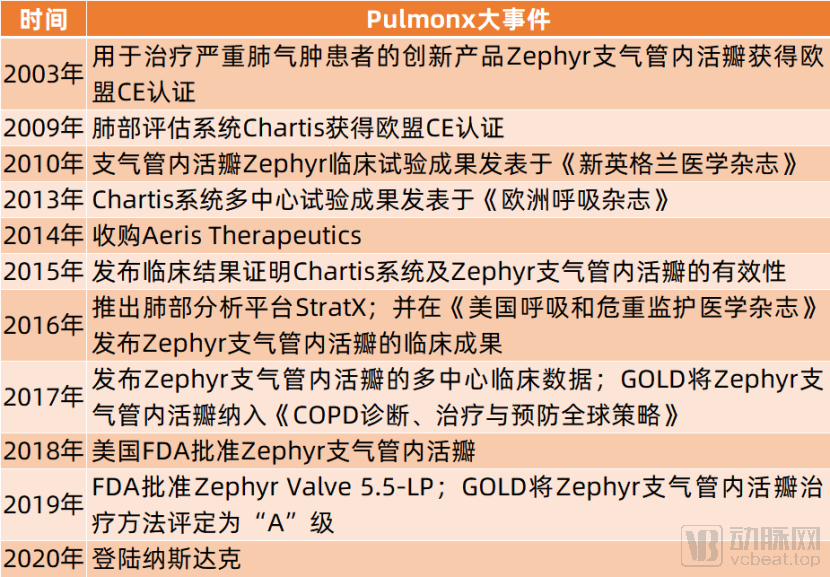 (Source: Compiled by VCBeat)
How Did Pulmonx Achieve Over $30 Million in Revenue and a Market Cap Exceeding $2 Billion with Just One Product? What Is the Industry Landscape for Pulmonx? What Is Pulmonx’s Sales Model? How Does Pulmonx Conduct Marketing? How Does Pulmonx Capture the Global Market?
To address the aforementioned issues, VCBeat has conducted an in-depth analysis of Pulmonx’s market landscape, product features, sales and promotional strategies, and corporate development history, culminating in this article with the aim of providing valuable insights for entrepreneurs in China.
Core Viewpoints
1. The market for minimally invasive treatment of emphysema is approximately $12 billion, presenting significant market opportunities;
2. Minimally invasive interventional therapy is becoming a trend, with over 100 clinical trials demonstrating its safety and efficacy;
3. Promote market adoption through scientific journals, academic conferences, and relevant guidelines;
4. Mature markets generate profits through direct sales, while non-mature markets are expanded through distributors;
5. Focus on the medical insurance system and insurance companies to reduce patient costs and increase penetration rates;
Emphysema refers to the reduced elasticity of the airways distal to the respiratory bronchioles, including the respiratory bronchioles, alveolar ducts, alveolar sacs, and alveoli, leading to persistent abnormal hyperinflation, overdistension, and increased lung volume. Emphysema and chronic bronchitis are two characteristic manifestations of chronic obstructive pulmonary disease (COPD), and both conditions coexist in the majority of COPD patients.
Studies have shown that emphysema has a high prevalence and mortality rate, posing significant health risks. According to Pulmonx’s prospectus, there were approximately 8.5 million patients with severe chronic obstructive pulmonary disease (COPD) in developed markets worldwide in 2019.In severeCOPDAmong patients, approximately 3.2 millionPatientSuffering from severe emphysema.
Pulmonx stated: “Among the 3.2 million patients with severe emphysema, approximately 1.2 million are suitable for treatment with Zephyr endobronchial valves.”This represents a global market opportunity of approximately $12 billion.
In terms of treatment, physicians may choose pharmacological or surgical interventions based on the severity of emphysema in patients. Conventional medical management of emphysema primarily focuses on smoking cessation and inhaled medications; patients with severe emphysema require inhaled bronchodilators and glucocorticoids to alleviate dyspnea. However,Some patients with severe emphysema still experience dyspnea despite medical management, and may even become unable to perform activities of daily living.,Significantly Impairs Quality of Life。
Surgical treatment refers to surgical lung volume reduction surgery, in which doctors remove lung lobes severely affected by emphysema to reduce the volume of emphysematous lung tissue, enhance the elasticity of the remaining lung parenchyma, and improve pulmonary function.ButDue toPatient Pulmonary FunctionRelativelyPoor; the 90-day postoperative surgery-related mortality rate was 3%-19%, and the incidence of severe complications was 59%,andSignificant surgical trauma,The patient is unable to tolerate it.。Another surgical treatment option is lung transplantation; however, due to its high risk, low success rate, potential for rejection, and scarcity of suitable donors, it is difficult to widely implement.
Therefore, there is an urgent clinical need for a safe and effective solution. After extensive research, Pulmonx has finally launched the Zephyr Endobronchial Valve. Clinical experts can implant the Zephyr Endobronchial Valve into hyperinflated lung tissue via the nasal or oral route using a bronchoscope. The valve facilitates the expulsion of air and secretions while preventing air inhalation, thereby inducing atelectasis in the overventilated lung tissue and allowing healthy lung tissue to re-expand and function effectively.
Pulmonx states that, on average, four Zephyr endobronchial valves are required per patient with severe emphysema to occlude the diseased regions of the lung. Compared with surgical interventions for emphysema, this minimally invasive technique is associated with fewer complications and faster postoperative recovery. Furthermore, the Zephyr endobronchial valves are removable, offering a higher safety profile.

(Image of Zephyr Endobronchial Valve, from the Pulmonx website)
Multiple clinical studies have demonstrated that treatment with Zephyr Endobronchial Valves offers advantages such as being non-surgical, minimally invasive, enabling rapid postoperative recovery, effectively reducing lung volume, and having fewer complications, making it a safe, effective, minimally invasive, and disruptive solution.To identify patients suitable for treatment with Zephyr Endobronchial Valves, Pulmonx developed a lung assessment system.Chartisand Lung Analysis PlatformStratX。
Pulmonx stated: “The vast majority of the Company’s revenue is derived from the Zephyr Endobronchial Valve. The Chartis System generates a smaller portion of revenue, while the StratX Platform, used to identify patients eligible for treatment with the Zephyr Endobronchial Valve, is provided free of charge by the Company.”
To date, Pulmonx has collaborated with clinical experts in emphysema from various countries to publish more than 100 articles on the clinical data of Zephyr endobronchial valve therapy in renowned journals such as The Lancet, the New England Journal of Medicine, and the American Journal of Respiratory and Critical Care Medicine, all demonstrating that:Compared with pharmacotherapy alone, patients treated with Zephyr Endobronchial Valves demonstrated statistically and clinically significant improvements in lung function, exercise capacity, and quality of life.
Based on relevant clinical outcomes, the Zephyr Endobronchial Valve has been incorporated into multiple guidelines for the treatment of emphysema. The Global Initiative for Chronic Obstructive Lung Disease (GOLD), a leading authority in the field of emphysema, included the Zephyr Endobronchial Valve in its emphysema treatment guidelines in 2017 and, in 2020, upgraded it to a Grade A (highest level) therapy based on clinical evidence.
In June 2018, the U.S. FDA approved the Zephyr Endobronchial Valve, based on Pulmonx’s innovation. Previously, the Zephyr Endobronchial Valve had received CE marking in the European Union in 2003.CutoffJune 30, 2020, ZephyrEndobronchial ValveThe valve has been marketed in over 25 countries, with more than 80,000 Zephyr units.Endobronchial ValveThe valve has been used to treat over 20,000 patients.。
To date, Pulmonx has marketed and sold the Zephyr Endobronchial Valve in over 25 countries, with annual revenue from this single product exceeding $30 million.Analysis of Pulmonx’s Sales Strategy Offers Lessons for Chinese Medical Device Manufacturers Going Global。
First,Pulmonx, taking into account global economic development and regulatory approval landscapes, first applied for registration of the Zephyr Endobronchial Valve in the European Union., and received approval in 2003. Since then, Pulmonx has extensively conducted multicenter, multinational clinical trials in the European Union region, and leveraged clinical expert resources to publish high-impact journal articles, as well as organize or participate in academic conferences to educate the market.
Second,Pulmonx has been included in national and global guidelines for the treatment of emphysema based on clinical evidence, and is applying for medical device registration certificates in various countries.Through global emphysema guidelines, Pulmonx’s Zephyr Endobronchial Valve has become widely recognized by clinicians worldwide. At this stage, Pulmonx will collaborate with local clinical experts to conduct clinical trials and publish the results in prestigious medical journals, thereby educating the market while achieving a win-win outcome with these experts.
Third,Pulmonx identifies regions with high demand and partners with leading local hospitals to create a win-win marketing model among hospitals, physicians, and patients.Pulmonx collaborates with emphysema specialists and hospitals to establish Emphysema Centers, guiding physicians in patient screening and treatment using the Zephyr Endobronchial Valve. This approach enables patients to receive higher-quality care, provides physicians with greater professional development opportunities, and generates new revenue streams for hospitals, achieving a win-win outcome for all three parties. Additionally, Pulmonx works with Emphysema Centers to establish referral pathways among primary care hospitals, emphysema rehabilitation centers, and Emphysema Centers, ensuring accessible treatment options for patients in need. It also enhances patient awareness of the Zephyr Endobronchial Valve therapy through direct-to-patient marketing efforts. It is important to note that treatment with the Zephyr Endobronchial Valve requires experienced physicians.Establishing an emphysema center helps train more physicians, expand the local market, and promote sales of Zephyr endobronchial valves.。
Fourth,Pulmonx continues to educate the market, raising awareness of the Zephyr Endobronchial Valve among patients, physicians, media outlets, medical associations, long-term care facilities, and pulmonary rehabilitation centers.In addition, Pulmonx educates the market by sequentially publishing clinical data in scientific journals and presenting clinical outcomes at industry conferences.
Fifth, Pulmonx has established its own sales team. Once the Zephyr Endobronchial Valve is included in local medical insurance coverage, the sales team will negotiate directly with hospitals and supply products to them. Additionally, Pulmonx collaborates with distributors to expand into global markets; as these markets mature, Pulmonx’s direct sales team will replace the distributors.The reason for this isThis is because Pulmonx recognizes that distributors facilitate its expansion into international markets, while its direct sales team helps maintain high gross profit margins. By prioritizing direct sales and supplementing them with distribution, Pulmonx achieves both high profitability and rapid market expansion.
Sixth,Pulmonx is fully committed to securing reimbursement coverage for the Zephyr Endobronchial Valve under both public health insurance and commercial insurance plans, thereby reducing out-of-pocket costs for patients and increasing the adoption rate of the Zephyr Endobronchial Valve.Currently, commercial insurers Aetna and Humana have included the Zephyr Endobronchial Valve in their coverage, while United Healthcare is gradually recognizing the Zephyr Endobronchial Valve therapy. Other insurers are progressively approving reimbursement for the costs associated with the Zephyr Endobronchial Valve treatment. In international markets, the Zephyr Endobronchial Valve has been incorporated into the national health insurance systems of several countries, including Australia, South Korea, and the United Kingdom, thereby reducing patient out-of-pocket costs and helping to increase product penetration. Pulmonx estimates that approximately 75% of patients treated with the Zephyr Endobronchial Valve benefit from either public health insurance or commercial insurance. Among these, 25% of patients rely on commercial insurance, while 50% utilize public health insurance.
Overall, Pulmonx’s strategy can be divided into three directions: first, obtaining regulatory approval through multicenter clinical trials and conducting initial market promotion; second, achieving high profit margins while expanding market reach by building an in-house sales team and collaborating with distributor networks; and third, reducing product usage costs and increasing product penetration through coverage by basic medical insurance and commercial insurance.
Following a series of strategic moves, Pulmonx will rapidly capture market share.
Through comprehensive analysis, it can be observed that Pulmonx’s success stems from the following four factors:
First, select industries with substantial market potential, target unmet clinical needs, innovate and develop disruptive products, and leverage clinical data to demonstrate therapeutic outcomes, thereby gaining recognition from physicians and patients. Additionally, expand product indications or broaden the product portfolio through continuous investment in research and development.
Second, leverage the power of “win-win” collaboration by partnering with clinical experts and renowned hospitals to provide them with high-quality research topics or additional income. Utilize experimental data to include products in relevant disease treatment guidelines, thereby promoting market adoption, while continuously educating the market and training physicians. Achieve substantial returns through a direct sales team and expand market reach through distributor networks.
Third, to benefit patients, include the product in both national medical insurance and commercial health insurance plans to reduce out-of-pocket costs and increase market penetration.
Fourth, intellectual property portfolio and patent layout to raise technical barriers.
For domestic enterprises, innovation and R&D are of paramount importance; only by developing disruptive products can they break the entrenched interest structures and capture the global market. High ex-factory prices are not a concern, as commercial insurance and national medical insurance will help enhance product penetration. Establishing an in-house sales team is essential, as it will significantly boost gross profit margins.
Finally, we hope this article will provide some inspiration for entrepreneurs in China.