

Ping An Healthcare Technology: Accelerating Leadership in China's Medical Insurance Informatization Race
2020 marked the final year of China’s 13th Five-Year Plan. Among the most significant reforms implemented during this period was the establishment of the National Healthcare Security Administration (NHSA) in 2018. The NHSA consolidated seven major responsibilities related to healthcare security and management, which were previously dispersed across the Ministry of Human Resources and Social Security, the former National Health and Family Planning Commission, the National Development and Reform Commission, and the Ministry of Civil Affairs. By leveraging healthcare insurance payments as an economic tool, the NHSA has assumed a central role as the “super payer” in China’s healthcare reform.
Tasked with ensuring the sustainable operation of the national medical insurance fund, the National Healthcare Security Administration (NHSA) has implemented bold and sweeping reforms since its establishment. It has formulated, studied, and rolled out a series of policies covering volume-based procurement, adjustments to the medical insurance drug list, DRG-based payment systems, and supervision of the medical insurance fund. Through these policies, the NHSA is gradually becoming a link connecting the supply and demand sides of healthcare services, a lever guiding the value propositions of healthcare providers, and a regulatory valve influencing healthcare delivery practices and medical expenditures.
The implementation of these policies has yielded positive impacts and tangible results. Taking medical insurance supervision as an example, in 2019, medical insurance authorities at all levels continuously carried out special campaigns to crack down on fraud and deception involving the misappropriation of medical security funds, recovering a total of RMB 11.556 billion. In addition, through intensive unannounced inspections conducted in 2019, the National Healthcare Security Administration identified suspected illegal and non-compliant amounts totaling RMB 2.232 billion.
Both DRG and the supervision of medical insurance funds impose high demands on the level of informatization. The "General Office of the State Council's Opinions on Promoting the Reform of the Regulatory System for Medical Security Funds" proposes to basically establish a regulatory system and law enforcement system for medical insurance funds supported by big data supervision by 2025. Therefore, in the upcoming 14th Five-Year Plan, the acceleration of upgrades to medical insurance informatization has been elevated to an unprecedented height.
The “Golden Social Security Project,” launched in 2002, is a crucial component of the government’s e-government infrastructure. Traditional vendors serving human resources and social security departments are referred to as “Golden Social Security” vendors, with a total of 13 enterprises.
Unlike other sectors, the informatization of social security and medical insurance involves critical matters and demands exceptionally high reliability and stability. Vendors involved in the “Golden Insurance” project, having participated early in the development of these systems, have accumulated substantial experience, which has become their competitive moat. Consequently, the market share for social security and medical insurance informatization is largely dominated by these “Golden Insurance” vendors.
However, due to the lack of unified top-level design and the fact that these insurance services were dispersed across four major departments adhering to different construction standards, the resulting systems struggled to achieve interoperability after completion, making refined management virtually unattainable. After clarifying its strategic approach, the National Healthcare Security Administration swiftly decided to address this issue fundamentally by building a unified national healthcare security information system.
In the first half of 2019, the National Healthcare Security Administration conducted three rounds of bidding for the national medical insurance information platform. The winning bidders effectively gained state endorsement, securing an inherent advantage in subsequent provincial and municipal medical insurance bureau platform tenders. This triggered intense competition among healthcare IT enterprises.
Surprisingly, among the nine companies that won bids from the National Healthcare Security Administration (NHSA), only four were from the traditional group of 13 “Jinbao” vendors. The other five winning bidders include Donghua Software, Winning Health Technology, B-Soft, Haixi Pharmaceutical, and Ping An Medical Insurance Technology. This bidding outcome has completely upended the market landscape in the field of healthcare insurance informatization.
Swimming against the current, one must advance or fall behind. Surveying the entire medical insurance informatization market, one company appears significantly younger compared to these established players. Founded in September 2016, the company only completed its first round of financing in early 2018. Nevertheless, it won the bid for Package 7 of the National Healthcare Security Administration’s projects, namely the Macro-Decision Big Data Application Subsystem and the Operational Monitoring Subsystem. This enterprise is Ping An HealthCare Technology.
Following the lead of the National Healthcare Security Administration, various provinces and municipalities have successively initiated tenders for their healthcare security platforms. Qinghai Province was the first to announce its tender results. Ping An Health Insurance Technology secured two core packages: the Macro-Decision Big Data Application System for Healthcare Security and the System Support Software, accounting for the highest share of the total award amount among the 13 winning vendors. To date, Ping An Health Insurance Technology has won bids for 14 provincial-level healthcare security platforms and has also secured contracts for smart healthcare security platform construction projects in multiple prefecture-level cities.
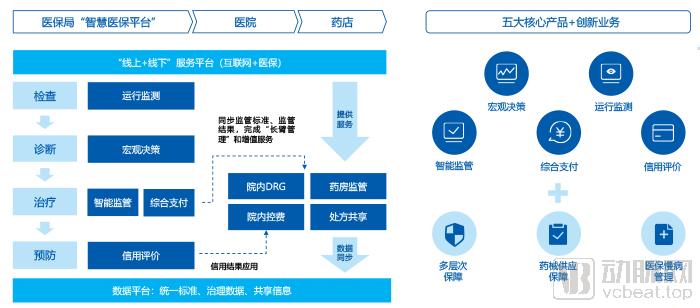
Ping An HealthTech’s Business Landscape, Image from Ping An HealthTech
Notably, in November 2020, the intelligent supervision system information platform for the Shandong Provincial Healthcare Security Administration, awarded to Ping An Health Insurance Technology, was successfully delivered, becoming China’s first provincial-level intelligent supervision system to go live.
Guided by the fund supervision tasks of the Provincial Healthcare Security Administration and aligned with the actual conditions of intelligent healthcare security supervision in Shandong Province, this platform adheres to the design principles of “dual-wheel drive, combining unblocking with blocking, and addressing both symptoms and root causes.” With a focus on supervisory effectiveness, it innovates the “informatization + supporting capabilities” supervision model. By establishing a standardized provincial and municipal intelligent healthcare security supervision platform, it achieves monitoring and early warning of fund utilization, thereby ensuring the safe operation of healthcare security funds.
In fact, as early as August 2020, prior to the launch of the Shandong Provincial Intelligent Supervision Platform, Ping An Health Insurance Technology had already explored a bidirectional linkage model for building a health insurance credit system that integrates “intelligent supervision with credit evaluation” through its jointly developed “Intelligent Health Insurance Supervision System” project with Weihai City, Shandong Province. This initiative received unanimous acclaim from the expert guidance group of the National Healthcare Security Administration, achieving outstanding results in the interim assessment.
The Weihai municipal platform has integrated over 2,000 designated medical and pharmaceutical institutions, 17,000 medical insurance-certified physicians, and more than 2 million insured individuals across the city, achieving a coverage rate of over 90%. While leveraging information technology for intelligent supervision, the system also incorporates a credit evaluation mechanism that offers discounted medication purchases to individuals with an AAA credit rating. Conversely, it raises the threshold for handling medical insurance administrative matters for entities and individuals with low credit ratings. By employing a dual approach of “incentives + penalties,” the city is gradually establishing a new regulatory paradigm integrating “medical insurance + credit.”
The Medical Insurance Supervision Information System Project for the Tianchang People’s Hospital Medical Community in Anhui Province serves as another example. By leveraging medical insurance supervision tools, this project facilitates the development of intelligent fund supervision and real-time point-of-care audit systems. It provides comprehensive, end-to-end supervisory services—encompassing “pre-event warning, in-process control, and post-event analysis”—to healthcare institutions within the medical community and insured individuals. This approach aims to achieve “intelligent auditing, specialized services, refined management, and data-driven decision support,” thereby curbing unreasonable growth in medical insurance expenditures.
Specifically, the large-screen monitoring dashboard for the operation of medical insurance funds within Medical Consortia can minimize the risk of fund overspending based on preset early-warning indicators; meanwhile, the real-time monitoring dashboard for intelligent medical insurance audits can update indicator information in real time and present it visually, facilitating the formulation of targeted management measures.
The project has played a significant role in strengthening the management of medical insurance funds and hospital medical practices within the medical consortium after its implementation. It enables early detection of medical insurance fund risks, standardizes medical behaviors, and has garnered widespread attention and acclaim.
What are the killer apps of the young Ping An Health Insurance Technology that can pave a high-speed lane in the highly competitive field of health insurance informatization?
Leveraging technological means to achieve refined management of medical insurance funds constitutes the competitive advantage of Ping An Health Insurance Technology. Within the Ping An healthcare ecosystem, Ping An Health Insurance Technology fulfills the core function of providing comprehensive medical and commercial insurance management services and technological support to payers, including cost containment services, actuarial services, medical insurance account services, healthcare resource management, and health record applications.
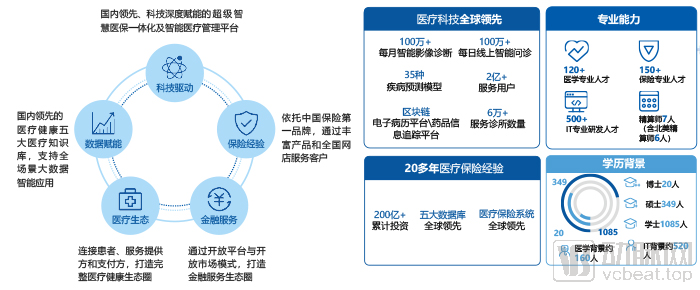
Ping An Health Insurance Technology Possesses World-Leading Medical Technology. Image Source: Ping An Health Insurance Technology
After years of accumulation, Ping An Healthcare Technology has developed globally leading medical technologies. As of the end of November 2020, Ping An Healthcare Technology had filed more than 720 patent applications across various fields, covering foundational technological innovations such as AI and blockchain, as well as data processing technologies including the Daas-based healthcare insurance data middle platform, the intelligent medical coding platform, and the intelligent AI algorithm platform, thereby deeply empowering the development of smart healthcare insurance systems.
In addition, as a core member of Ping An Group’s “Grand Healthcare Ecosystem,” Ping An Health Insurance Technology collaborates with multiple key entities within the ecosystem to leverage the advantages of large-scale, coordinated operations. It strategically covers consumer-facing services, healthcare delivery, commercial and basic medical insurance payment, health technology, and government regulation, thereby empowering all stakeholders.
For government clients, Ping An Health Insurance Technology offers China’s leading comprehensive solutions for medical insurance cost containment, along with five major healthcare knowledge bases that support big data-driven intelligent applications across all scenarios. For hospital clients, its DRG-based integrated hospital management platform has been deployed in cities such as Shenzhen, Changzhou, and Ningxia, receiving widespread acclaim.
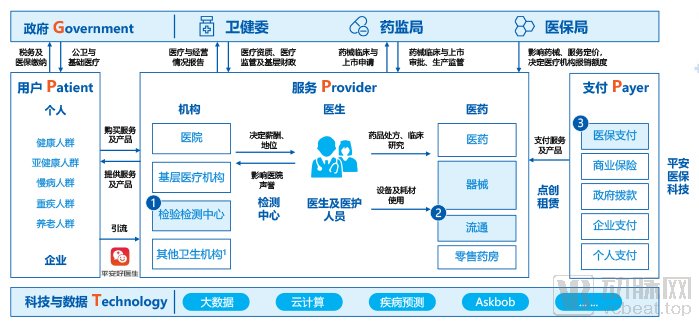
Ping An Health Insurance Technology is a key component of Ping An’s “Big Healthcare” strategy. Image courtesy of Ping An Health Insurance Technology
Based on this, Ping An Health Insurance Technology has achieved a leading market position in the construction of China’s national health insurance information platforms within less than five years of its establishment, with its achievements in smart health insurance development widely recognized by multiple stakeholders. Its strategy of “comprehensively empowering the healthcare ecosystem” has also garnered significant acclaim for aligning with the development trends of health insurance informatization.
Undoubtedly, the strategy of building a “healthcare ecosystem” will become the future direction of development. More and more capable enterprises will attempt to enter this arena, leveraging their areas of expertise to gain traction and ultimately achieve success. This approach is not unfamiliar to major internet companies. Driven by expectations of sustainability and high returns in the healthcare industry, an increasing number of tech giants are seeking to cross industry boundaries and stake their claims in the healthcare sector.
As provincial medical insurance platforms across China successively opened their bidding processes in 2021, competition in the medical insurance informatization sector has intensified dramatically, with outcomes poised to fundamentally reshape the existing competitive landscape. Amidst this profound transformation, one constant remains: the urgent demand from regulatory authorities for enhanced refined management capabilities within both medical insurance systems and hospitals.
This enhancement is not only a requirement of the medical insurance system reform but also an intrinsic imperative for the high-quality development of hospitals in the future. In the arena of medical insurance informatization, Ping An Medical Insurance Technology has begun to demonstrate its leadership potential. We also hope that more enterprises will join this field, committing themselves to diligent efforts and continuous innovation, thereby consistently supporting regulatory authorities in achieving scientific, efficient management and decision-making.