

Accunome Biotech Secures Nearly RMB 100 Million Series A2 Financing to Advance Automated PCR Platform
VCBeat (WeChat ID: vcbeat) has learned that Jiaxing Accunome BIOTECHNOLOGY Company Limited (“Accunome”) has completed a new round of A2 financing amounting to nearly RMB 100 million, invested by Sinovation Ventures. Previously, Accunome had received investments from Chende Capital, ZhenFund, and Chuang Capital. The proceeds from this financing will be primarily used for the clinical trials of its instruments and reagent products, applications for NMPA registration certificates, and the transfer of production.
Accunome was founded in July 2018 by Dr. Yang Xing and Dr. Xiao Guohua, both returned overseas scholars with Ph.D. degrees. Headquartered in Xiuzhou District, Jiaxing City, Zhejiang Province, Accunome has established R&D centers in San Diego, USA, and Shanghai. Equipped with comprehensive molecular biology instrumentation and laboratory facilities, the company specializes in the automation of molecular diagnostic laboratories. It develops and promotes fully automated nucleic acid testing platforms for clinical laboratories, along with a series of assay kits for the clinical diagnosis of severe infectious diseases.
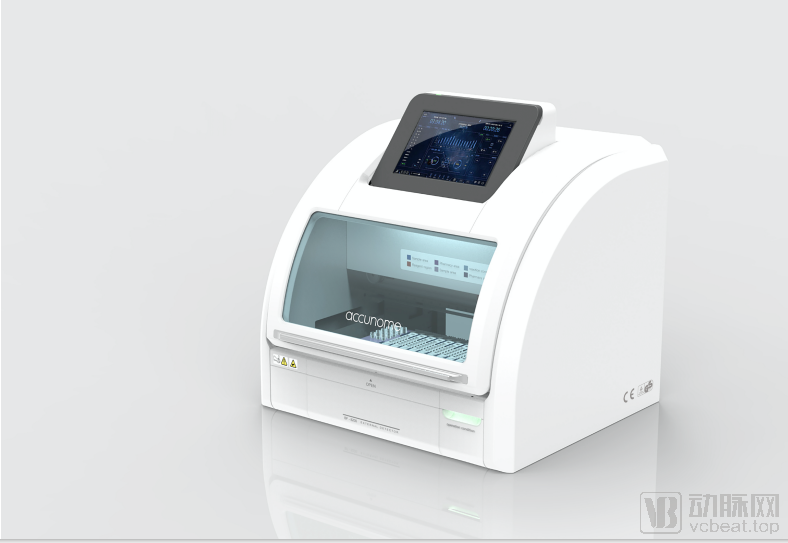
The COVID-19 pandemic in 2020 made nucleic acid testing and PCR familiar to the general public. Most nucleic acid tests for SARS-CoV-2 employ quantitative real-time PCR (qPCR), a key technology in molecular diagnostics. While SARS-CoV-2 has brought PCR testing into the public spotlight,It has also accelerated the research and development of fully automated, integrated PCR testing equipment, making fully automated PCR a hot segment within molecular diagnostics.
As early as 20 years ago, Dr. Yang Xing, founder of Accunome, began researching automated PCR technology. After earning his Ph.D. at the California Institute of Technology, Dr. Yang joined GeneOhm Sciences, founded by his alma mater’s chemistry professor Jacqueline K. Barton, as its first employee. At that time, they were the first in the world to use molecular diagnostic PCR for detecting the “superbug” MRSA, and the company became the first globally to develop a corresponding kit product and obtain approval from the U.S. FDA.
Dr. Yang Xing recalled that the molecular diagnostics industry in the United States at that time shared many similarities with the current stage of development in China, such as low levels of automation and initial clinical adoption. Twenty years ago, Dr. Yang began designing automated PCR products and started accumulating related technical expertise.
In addition to GeneOhm Sciences, Dr. Yang Xing served as a core R&D member and Vice President of Technology at three other startups. Notably, all four companies received investment from Domain Associates, a venture capital firm established in 1985 that has achieved remarkable success in the life sciences sector and is among the earliest VC firms globally to focus exclusively on this field.
Among these four companies, GeneOhm Sciences was acquired by BD for $255 million in 2006, and Helixis was acquired by Illumina for $105 million. Bionano Genomics is listed on the NASDAQ stock exchange in the United States.
After gaining experience in the United States developing multiple molecular diagnostic products, including PCR and liquid biopsy assays, Dr. Yang Xing returned to China in 2014 to serve as Vice President of R&D for bioMérieux’s Asia-Pacific region and Head of Molecular Diagnostics.
Returning to China marked a turning point in Dr. Yang Xing’s career. His tenure at bioMérieux enriched and diversified his professional experience, transitioning from a focus on technical research and development to comprehensive product management.
“As a leader in bioMérieux’s Asia-Pacific region, I oversaw multiple projects, with a primary focus on promoting our flagship molecular diagnostics product, FilmArray, which achieved global sales exceeding $1 billion in 2020. I was responsible for the market launch and promotion of FilmArray across every country and territory in the Asia-Pacific region. It was through this process that I came to recognize the unique characteristics of China’s molecular diagnostics market, where simply following, imitating, or directly replicating the approach used for flagship products fails to meet local demands.”
After gaining an in-depth understanding of China’s in vitro diagnostics (IVD) market, Dr. Yang Xing identified two major contradictions within the sector.
First, although laboratory physicians have a high level of acceptance for automated products, the actual level of PCR automation in China is currently very low. Most procedures still rely on manual operations, which has led to high costs for PCR testing. Despite its advantages, such as high sensitivity and strong specificity, PCR, like any technology, has inevitable limitations. The operational process is complex and requires skilled personnel. It is also susceptible to contamination, which can result in "false-positive" test results. Therefore, clinical laboratories in China adopt a zoned approach to prevent contamination, with molecular diagnostic laboratories divided into three to four separate areas, resulting in high operational costs.
Second, foreign molecular diagnostic POCT products have not met the needs of domestic clinical laboratories.Neither bioMérieux’s FilmArray nor Cepheid’s Xpert molecular diagnostic products have gained traction in the Chinese market.
China’s molecular diagnostics market has a unique characteristic compared to other segments of the in vitro diagnostics (IVD) industry. In other segments, such as chemiluminescence immunoassay, multinational corporations dominate; however, in the field of molecular diagnostics, they do not hold a competitive advantage. A straightforward example is that during the COVID-19 nucleic acid testing, Chinese companies far outpaced their foreign counterparts in both speed and coverage.
Dr. Yang Xing stated, “In fact, the primary reason is the excessively high cost. Taking FilmArray as an example, it is an excellent product, but its end-user price exceeds RMB 2,000. In China, it is difficult to persuade a patient with a respiratory infection to spend RMB 2,000–3,000 on a respiratory test. Meanwhile, in terms of throughput, the larger patient population in China imposes higher demands on testing capacity.”
Based on these two insights, Dr. Yang Xing believes that automated PCR holds significant promise in China’s diagnostic market, but the path of import substitution is not viable.
Dr. Yang Xing pointed out, “China’s molecular diagnostics market is present; however, the task at hand is to develop a product that meets the needs of the Chinese market, rather than blindly replicating a foreign product.”
Where Does China’s Molecular Diagnostics Market Stand, and Where Is It Headed? Dr. Yang Xing believes that while the markets for hepatitis, female HPV testing, tuberculosis, and drug-resistant TB strains represent substantial existing opportunities, Accunome, as a startup, prefers to focus on respiratory infections and critical care—two major future growth segments.
Dr. Yang Xing, who has several years of experience in the U.S. molecular diagnostics market, stated, “China’s molecular diagnostics market lags behind that of the United States, and the trajectory of development in the U.S. can serve as a predictor for China’s progress. The market share for molecular diagnostic tests for respiratory tract infections in the U.S. has already exceeded $1 billion, whereas this market is only just emerging in China.”
A clear trend in China is the growing clinical awareness of respiratory infection testing, with increasing recognition that influenza can pose a fatal threat. Dr. Zhang Wenhong once cited data in a speech indicating that the case fatality rate of SARS was 10%, while that of influenza-associated pneumonia was 9%. High-risk populations—including the elderly, young children, individuals with obesity, pregnant and postpartum women, and those with chronic underlying conditions—face a higher likelihood of developing severe influenza. Consequently, the diagnostic testing market is expected to expand gradually in the coming years.
Accunome has strategically prioritized respiratory tract infections as a key area for initial breakthroughs, driven by the fact that this domain demands automated equipment more urgently than traditional chronic infectious diseases.
Respiratory tract infection testing differs significantly from testing for chronic infectious diseases such as hepatitis and HPV. Chronic infections like hepatitis and HPV do not have stringent requirements for turnaround time, allowing hospitals to reduce costs by batching large volumes of samples for centralized testing. In contrast, respiratory tract infection testing demands much higher timeliness; clinicians require rapid results, making it difficult to conduct these tests efficiently without automated equipment.
Therefore, Accunome positions its products as new tools for laboratory physicians to enable rapid clinical testing. Dr. Yang Xing emphasized that the company aims to develop automated PCR instruments, not molecular diagnostic POCT devices.
POCT devices are typically positioned to serve clinical departments and secondary hospitals; however, laboratory testing relies heavily on quality control performed by laboratory physicians. After years of development in the U.S. molecular diagnostics industry, respiratory infection testing in clinics is nearly nonexistent, with 90% of such tests conducted in hospital laboratories. In China, critically ill patients are predominantly concentrated in tertiary hospitals, which means that demand for respiratory testing will also be centered in the laboratories of these tertiary institutions. Therefore, the market currently served by POCT remains immature, and Jiaxing Accunome BIOTECHNOLOGY Company Limited sees greater potential in the laboratories of tertiary hospitals.
For fully automated, integrated nucleic acid testing equipment, R&D technical challenges are often constrained by two factors: cost and throughput. Cost control cannot be achieved simply through domestic substitution; the true test lies in product design.
Currently, Accunome’s “sample-in, result-out” fully automated universal molecular diagnostics platform has developed a PCR instrument that fully integrates sample preparation, amplification, and detection. It can process 12 samples per batch, detect up to 16 targets per sample, and deliver results within one hour. The first-generation product has completed development and is poised to initiate clinical trials and regulatory registration.
The ability to achieve rapid product development is linked to Accunome’s cross-disciplinary integrated team, which possesses extensive professional expertise and experience in entrepreneurship and operations within the healthcare industries of both the United States and China.Co-founder Dr. Xiao Guohua holds a Ph.D. in Electrical Engineering from the University of Central Florida in the United States. He also possesses extensive entrepreneurial experience, having successfully launched multiple ventures in both the United States and China, including the unicorn company Anhan Medical.
Although automated PCR in China lags behind international standards, it is developing rapidly and has gradually emerged as one of the most promising segments within the IVD industry. Leveraging its strong team and unique market insights, Accunome aims to provide Chinese physicians with more convenient and accurate diagnostic tools, delivering more accessible solutions for patients.
Wu Kai, a partner at Sinovation Ventures and an investor in this round, stated, “The IVD sector is a key focus of Sinovation Ventures’ healthcare investments over the next two years. Within the IVD landscape, molecular diagnostics stands out as the area with the most active technological innovation and the fastest growth. The global COVID-19 pandemic, in particular, has elevated the demand for automated PCR testing to a position of critical importance. Sinovation Ventures has chosen to bet on Accunome for two primary reasons. First, the company boasts an exceptional team. Dr. Yang Xing, the founder, has over 20 years of experience in R&D, regulatory approval, and new product launches in molecular diagnostics across China and the United States. The core team consists entirely of industry veterans from top-tier IVD companies. Co-founder Dr. Xiao Guohua possesses extensive networks and channel resources in the medical device markets of both China and the United States. Second, Accunome has accumulated profound technical expertise and market insight in the respiratory molecular testing segment. In mature European and American markets, the proportion of molecular diagnostics for respiratory diseases is remarkably high. In contrast, the Chinese market has long lacked products with competitive technology and pricing. This represents a blue-ocean market with the potential to exceed RMB 10 billion in scale. We are highly optimistic about Accunome’s ability to deepen its presence in this field.”
Dr. Chen Gaopeng, Vice President of Investment at ZhenFund and an investor in the Series A round, stated, “The traditional IVD sectors, such as clinical chemistry and immunodiagnostics, have already given rise to more than 20 listed companies. Molecular diagnostics is rapidly emerging as a high-potential market with ample room for growth. Since partnering with Accunome, we have been pleased to witness Dr. Yang and his team efficiently and swiftly advancing the R&D of both instruments and reagents. The team’s strong synergy, profound industry expertise and resources, and their ‘benevolence-centered’ values have strengthened our confidence and raised our expectations for the company’s future product pipeline and market expansion.”
Dr. Zhao Ruilin, Investment Partner at Chende Capital and an Series A investor, stated, “Accunome is a company truly rooted in the Chinese market, dedicated to developing automated PCR instruments and reagents. The widespread clinical adoption of PCR urgently requires automation across the entire workflow. As a fund with IVD as one of its core investment focuses, Chende has been actively positioning itself within the industry for many years. We are delighted to see that, under Dr. Yang’s leadership, Accunome has rapidly emerged as an industry benchmark and is poised to evolve into a platform-based enterprise.”