

Qinglan Bio Successfully Industrializes Dissolvable Microneedle Technology with Annual Production Capacity of Nearly 150 Million Patches, Surpassing Japan, Korea, Europe, and the U.S.
Currently, there is a growing demand for skin care and maintenance. However, the sheer variety of skincare products available can be overwhelming. Phrases such as “hydrate and lock in moisture,” “keep skin fresh,” and “serums penetrate deep into the skin” are perhaps the most common slogans seen on cosmetic product packaging. But can the “essence” in these products truly penetrate the skin and be fully absorbed by the face?
As early as 1983, American scholar Elias PM proposed the renowned “brick-and-mortar model” of the skin’s natural barrier: the stratum corneum, along with its cells and the intercellular spaces, forms a brick-wall structure composed of lipids and natural moisturizing factors, thereby creating a natural protective barrier for the human body. This theory elucidates the barrier function of the stratum corneum, which is therefore aptly referred to as the body’s protective “Great Wall.”
Therefore,When the stratum corneum is intact, skincare products such as creams, serums, and lotions actually have difficulty penetrating into the basal layer.If you truly want to infuse the essence serum into the deeper layers of the skin, it may be necessary to visit a beauty clinic or dermatology department for professional infusion using specialized devices.
Whether employing deep or superficial penetration, the infusion process is conducted in multiple steps. On one hand, it relies heavily on skilled professionals at beauty clinics or dermatology departments, requiring prolonged sessions that are time-consuming, labor-intensive, and complex. On the other hand, the procedure involves numerous needle insertions across the entire face, resembling a net, which disrupts the normal structure of the stratum corneum. This not only significantly increases the risk of infection but also entails an extended period of social awkwardness during recovery. Furthermore, seeking treatment from unlicensed or non-compliant providers exposes individuals to additional risks, ultimately causing harm to themselves.
Dissolvable Microneedle Transdermal Drug Delivery TechnologyIt effectively resolves the aforementioned challenges, enabling the safe, efficient, painless, and non-invasive transdermal delivery of active pharmaceutical ingredients through the stratum corneum into the body, thereby bringing about a transformative revolution in aesthetic dermatology.
Qinglan BioFounder, Dr. Jiang LinIn 2019, he led his research team to overcome numerous challenges and pioneered the successful industrialization of dissolving microneedle technology. Following two years of integrated process engineering research and development of industrialization technologies, he formally established Shenzhen Qinglan Biotechnology Co., Ltd. in July 2020.
Qinglan Biotech boasts a team with extensive experience in the R&D and industrialization of biopharmaceuticals, both domestically and internationally.Three production lines have been established, with a single-line output ofAchieve4 million patches/month, with an annual production of nearly 150 million microneedle drug delivery patches, andCapable of rapidly expanding production lines and product portfolios in response to market demand.Currently, the company has pioneered the mass production of dissolving microneedle patches for weight loss and hair growth worldwide.
“Dissolvable Microneedle Transdermal Drug Delivery Technology FeaturesDrug AdministrationExtremely low dosage, short treatment cycle, high efficacy, minimal side effects, excellent user experience, precise drug administration, and for professionalsDependencycharacterized by low sexual activity,“Capable of achieving transdermal delivery and drug administration in a single step, it represents the truly anticipated painless and non-invasive drug delivery method,” Dr. Jiang Lin told VCBeat. Dissolving microneedle transdermal drug delivery technology can safely and effectively deliver active pharmaceutical ingredients through the stratum corneum into the body in a painless and non-invasive manner. It is not only simple and convenient to use but also unrestricted by location, significantly reducing reliance on professional healthcare personnel.
Clinical studies have shown that the dosage administered via dissolving microneedles ranges from one-half to one-two-hundredth of that delivered by injection or oral administration.Therefore, microneedle delivery patches represent an excellent option for certain drugs that require highly precise dosing.
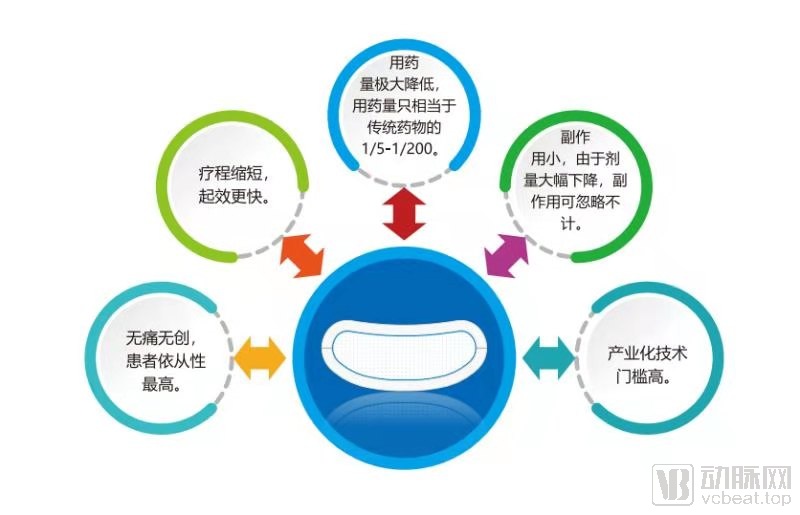
Characteristics of Microneedle Drug Delivery
Taking pediatric medication as an example, children’s bodies are not yet fully developed and differ significantly from adults in physiological terms. There are marked differences between children and adults in hepatic and renal drug metabolism capabilities and tolerance to adverse reactions. Therefore, dosing for pediatric patients is more challenging to manage than for adults. Microneedle patch-based drug delivery systems enable “application-as-administration,” allowing drug delivery to commence immediately upon application and cease promptly upon removal.
Dissolvable microneedle technology enables direct transdermal drug delivery, allowing medications to reach bodily fluids or the bloodstream directly to exert therapeutic effects. This approach not only avoids gastrointestinal mucosal toxicity associated with oral absorption and bypasses hepatic first-pass metabolism, but also significantly reduces dosage requirements, thereby lowering drug-induced hepatotoxicity.
According to Dr. Jiang Lin, the principle of dissolving microneedle transdermal drug delivery involves microneedles penetrating the stratum corneum to reach the epidermis, where they dissolve and release their payload after absorbing interstitial fluid. The drug components are then delivered to the lesion site for treatment via the interplay between lymphatic and blood circulation, representing a novel drug administration technology and method.
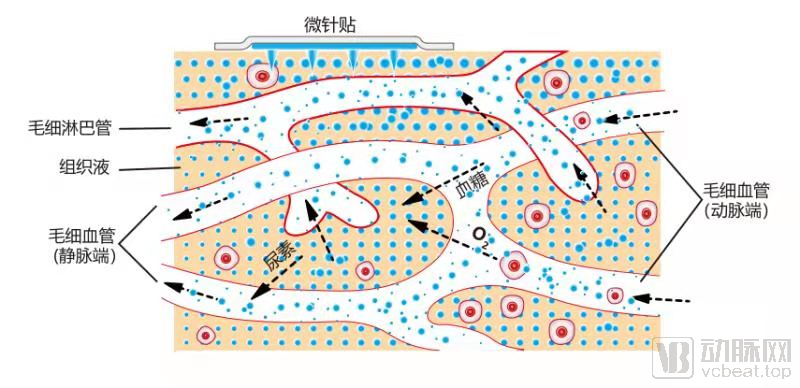
Principle of Microneedle Drug Delivery
Given the numerous advantages of dissolving microneedle drug delivery, why are there so few soluble microneedle drug delivery products available on the market?
It turns out that although the principle of microneedle drug delivery was proposed by American scientists as early as 1959, research in this field remained scarce due to various technical limitations. Even by 1979, when the patent for microneedle drug delivery had expired, only a handful of researchers were engaged in related studies.
Dr. Jiang Lin stated, "Dissolving microneedles capable of achieving transdermal drug delivery are inherently paradoxical. In the early stages, suitable pharmaceutical materials were unavailable, manufacturing processes were immature, and necessary equipment was lacking; thus, the concept remained purely theoretical and was difficult to implement in practice."Soluble Microneedle Drug DeliveryTo achieve the desired efficacy, it is essential toToConquering 3 Key ChallengesTechnologyChallenges: First, formulate the drug into microneedles; these needles mustMechanical puncture capability,Sufficient strength,only by penetrating the stratum corneum can they have the opportunity to enter the human body for drug administration;Secondly,, this injectionIt should have sufficient hygroscopicity,Only after penetrating the stratum corneum can it be rapidly absorbed into the interstitial fluid (body fluid) for dissolution;Third,This needle must be able toAfter absorbing tissue fluid, capable ofDissolutionandRapidDiRelease of active pharmaceutical ingredients.“These three points are extremely challenging; they can only be achieved by integrating comprehensive support across materials, manufacturing processes, equipment, molds, and other aspects required for microneedle formulation development.”
Unlike the biotechnology sector, which focuses on overcoming technical hurdles, the primary challenge for soluble microneedle drug delivery products lies in their manufacturability at scale.
“The largest annual microneedle production capacity in the United States, Europe, and South Korea is 1 million patches. Japanese microneedlesMaximum mass production capacity can reach per single line8 million tablets/year.”Dr. Jiang Lin told VCBeat,Qinglan Bio’s current monthly output from a single production line reaches 4 million patches, which is four times the annual production volume in the United States.
As early as 2019, Dr. Jiang Lin led his research team to pioneer the successful industrialization of dissolving microneedle technology. Following two years of integrated process engineering research and development of industrialization technologies, Dr. Jiang Lin founded Qinglan Bio in July 2020, assembling a team with extensive R&D and industrialization experience in the biopharmaceutical sector both domestically and internationally.
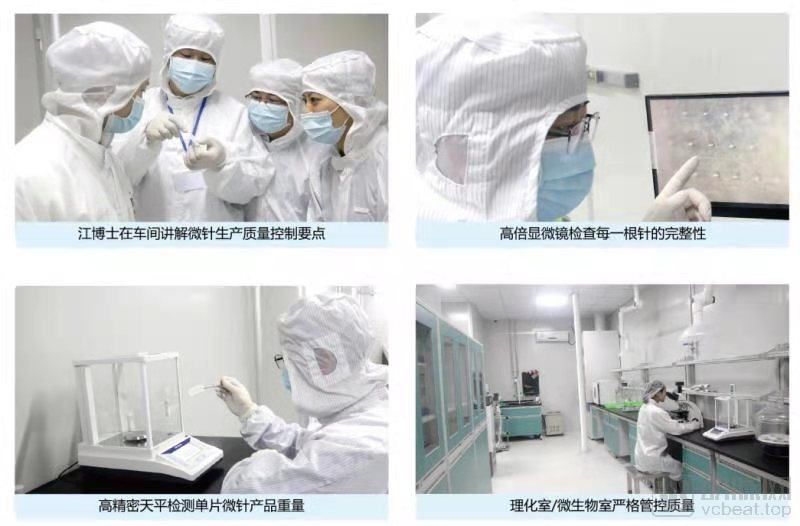
According to Dr. Jiang Lin,Microneedle Drug DeliveryTechnologyThe underlying technology is MEMS technology.。By establishing a collaboration with Harbin Institute of Technology (HIT), Qinglan Bio has leveraged HIT’s superior design capabilities in integrated circuits. According to Dr. Jiang, Professor Zhang Haifeng from HIT is an expert in MEMS technology. Following the establishment of this partnership, Qinglan Bio rapidly developed its own molds, resulting in a significant increase in production capacity and a swift expansion of its product portfolio.
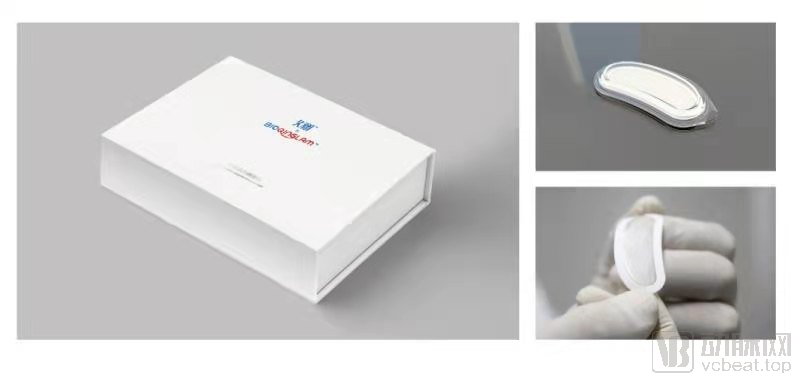
Qinglan Bio Product Images
Currently, Qinglan Bio has achieved large-scale mass production of products such as dissolving microneedle weight-loss patches and dissolving microneedle hair-growth patches, with these products widely distributed through cosmetic sales channels, including beauty salons. By the end of 2020, consumers in certain provinces and regions were already able to purchase the company’s microneedle products at local hospitals. As Dr. Jiang Lin stated, “Our product launches are essentially driven by market demand. For each product, we are able to identify its optimal formulation and commence mass production within approximately one to two months.”