

JunShine Pharma Appoints Dr. Leigh MacConell as Chief Development Officer, Entering Late-Stage Clinical Development in Its Second Decade

HighTide Therapeutics
Developer of Novel Drugs in the Field of Digestive System and Metabolic Diseases
Recently,Shenzhen Hightide Biopharmaceutical Ltd. (hereinafter referred to as “Hightide”) announced the appointment of Dr. Leigh MacConell as Chief Development Officer.Dr. MacConell has over 20 years of experience in drug research and development. He previously served as Senior Vice President of Clinical Development at Intercept Pharmaceuticals, a U.S. biopharmaceutical company, where he led the global clinical development of obeticholic acid (Ocaliva®). Upon joining, Dr. MacConell will report directly toDr. Liu Liping, Founder and CEO of the Company, leading the company’s global clinical development, regulatory submissions, and quality control to drive the advancement of its product pipeline.

Pictured is Dr. Leigh MacConell
HighTide is a clinical-stage biopharmaceutical company dedicated to the research and development of original innovative drugs, focusing onChronic Liver Disease, Gastrointestinal Disorders, and Metabolic FieldsAddressing Urgent Unmet Clinical Needs: Global Simultaneous Development of First-in-Class Innovative Drugs.
“2021 marks the tenth anniversary of HighTide’s establishment and will also be a pivotal year for the company’s transformation into a late-stage clinical R&D enterprise.”Dr. Liu Liping stated that Dr. MacConell brings extensive experience and leadership in new drug development, and her addition will significantly advance the clinical R&D of HighTide’s product pipeline.
On the path to growth, one must endure solitude. For future innovative drug R&D, attention should be paid not only to the Chinese market but also to the global market. Since its establishment in 2011, HighTide has been quietly cultivating the field of new drug development for ten years. Adhering to the principles of innovation and focus, HighTide has deeply engaged in the development of innovative drugs, and has now grown into a new drug R&D enterprise based in China and oriented towards the world.
Currently, one of HighTide's main product pipelinesHTD1801 has currently met both primary and secondary endpoints in its Phase 2 clinical trial for type 2 diabetes mellitus (T2DM) with non-alcoholic steatohepatitis (NASH), and has completed the Phase 2 clinical trial for the rare disease primary sclerosing cholangitis (PSC).According to HighTide, HTD1801 will soon be used to initiate clinical trials for another rare disease, primary biliary cholangitis (PBC). Within five years, the company hopes to have at least one drug approved for market launch.
VCBeat has learned that HighTide has currently obtainedTwo projects were approved under China’s “Major National Science and Technology Project for New Drug Innovation” during the 13th Five-Year Plan period, and the U.S. Food and Drug Administration (FDA) granted two Fast Track Designations (FTD) and one Orphan Drug Designation (ODD).Promising to accelerate drug approval.
With the continuous development and advancement of modern medicine, mortality rates from widely recognized conditions such as cardiovascular and cerebrovascular diseases, cancer, diabetes, and kidney disease have stabilized or declined. However, mortality rates from chronic liver disease and cirrhosis continue to rise year by year.
In chronic liver disease, the major viral hepatitis types (hepatitis B and hepatitis C) are now effectively controlled. HoweverMost non-viral chronic liver diseases, including non-alcoholic fatty liver disease and certain autoimmune liver diseases (such as primary sclerosing cholangitis and primary biliary cholangitis), currently lack safe and effective treatments, representing a clear unmet clinical need.
Take nonalcoholic steatohepatitis (NASH) as an example. NASH is a relatively common chronic liver disease that occurs not only in middle-aged individuals, those who are obese, insulin-resistant, diabetic, or hyperlipidemic, and women, but also in many other contexts, including exposure to certain medications, abnormal iron deposition, HFE gene mutations, men, and children aged 10–15 years.
NASH poses a significant threat to life and health: it is an independent risk factor for cardiovascular disease (increasing the risk of cardiovascular events by 1.64-fold over 5–10 years) and has a clear causal relationship with hepatocellular carcinoma (HCC). If the progression of NASH is not effectively controlled, it will ultimately lead to hepatic decompensation or HCC. NASH has surpassed hepatitis C as the leading cause of liver transplantation in the United States. Furthermore, it is associated with a higher prevalence of various conditions, including type 2 diabetes mellitus (T2DM), colorectal cancer, breast cancer, and chronic kidney disease.
The large patient population presents significant opportunities for the development of new drugs for non-alcoholic steatohepatitis (NASH), making it a global research hotspot. However, since Gilead’s Phase III clinical trial failure in February 2019, multiple NASH drug development programs have subsequently encountered major setbacks.
Insufficient early understanding of NASH was one of the primary reasons for project failures. Many previous projects focused on treating advanced fibrosis in NASH. However, the etiology and pathogenic mechanisms of NASH are, in fact, highly complex.Current research generally holds that the pathogenesis of NASH results from parallel interactions among multiple risk factors and various cell types/tissue organs, with metabolic dysregulation serving as the core driving force.New drugs for the treatment of NASH must comprehensively regulate multiple targets.
HTD1801, independently developed by HighTide, features a dual-active-center configuration and a multi-target, multi-pathway mechanism of action. Its high safety profile confers unique advantages to HTD1801 in the treatment of chronic liver disease.HTD1801 is a first-in-class new molecular entity, and HighTide has obtained patent authorization for this compound in major regions worldwide.
The primary pathways/mechanisms by which HTD1801 treats NASH include: metabolic regulation (including enhancing insulin sensitivity, regulating glucose and lipid metabolism, and reducing hepatic lipid levels); anti-inflammatory and antioxidant stress effects; modulation of gut microbiota and restoration of small intestinal barrier function; hepatoprotection and improvement of liver function; reduction of endotoxin-induced liver injury; and antifibrotic activity. In November 2018, HTD1801 was granted Fast Track designation by the U.S. FDA for the treatment of NASH.
Currently, HTD1801 has completed multiple overseas clinical trials:In 2017, Phase I clinical trials in healthy subjects and Phase Ib/IIa clinical trials in patients with hypercholesterolemia were completed in Australia. Subsequently, a Phase II clinical trial for NASH (across 17 centers) was completed in the United States, and a Phase II clinical trial for primary sclerosing cholangitis (PSC) (across 27 centers) was completed in Canada and the United States. Currently, a Phase II clinical study for primary biliary cholangitis (PBC) is being advanced in the United States.
In addition, HighTide has independently developed other products in the fields of gastrointestinal and metabolic diseases, including HTD4010 and HTD2802.The indications for HTD4010 primarily include acute pancreatitis and cytokine storm; the indications for HTD2802 are mainly targeted at inflammatory bowel disease.
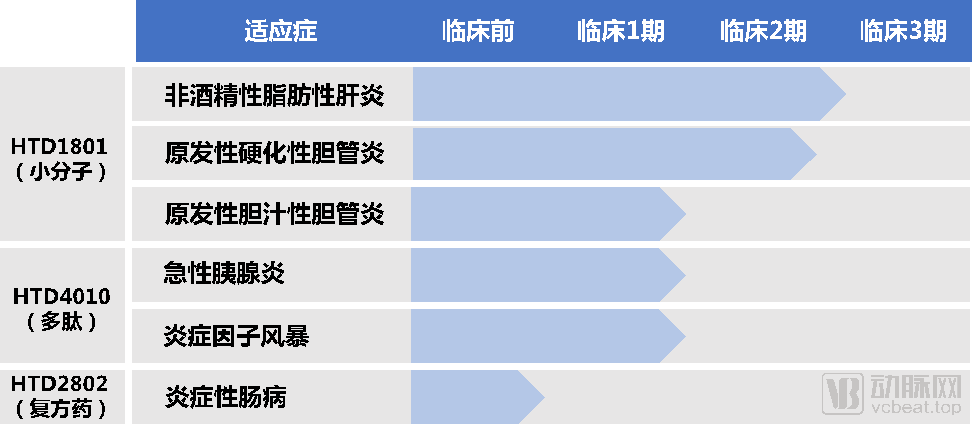
HighTide's Product Pipeline
HighTide's core management team comprises top-tier talents with extensive industry experience and a global perspective, honed through years of hands-on practice both in China and abroad.
Dr. Bisceglie, Chief Medical Officer (CMO) of HighTide, is a seasoned expert in the field of hepatology and served as President of the American Association for the Study of Liver Diseases (AASLD) in 2014. Cathryn, Vice President of Clinical Operations, brings over 25 years of experience in clinical research management. Dr. MacConell led the clinical development program at Intercept Pharmaceuticals that secured approval in the United States, the European Union, and Canada for obeticholic acid (Ocaliva®) in the treatment of primary biliary cholangitis (PBC). Dr. MacConell also previously served as Senior Director of Medical Research and Development at Amylin Pharmaceuticals. This highly capable team ensures the smooth advancement of HighTide’s global clinical development efforts.
When asked how HighTide has attracted such a large pool of outstanding international talent, company executives attributed it to the scientific and technical rigor of its projects. By adhering to the highest standards in its research endeavors, HighTide has built a highly competitive product pipeline, which has been the key factor in attracting top-tier experts across clinical trials, corporate operations, regulatory affairs, and business development.
Currently, HighTide has a wholly-owned subsidiary that has settled into the Johnson & Johnson Innovation – JLABS incubator in Shanghai.The company plans to expand its team in Shanghai by continuing to recruit professionals in clinical affairs, commercial operations, and business development, thereby increasing its global workforce from the current approximately 30 employees by one- to two-fold.
In addition, HighTide told VCBeat that the company hopes to have at least one drug approved for market launch within five years, and to obtain global approvals for indications in rare diseases, metabolic disorders, and NASH.
Since its inception, HighTide has been committed to innovation. Moving forward, HighTide will continue to strive tirelessly to develop safe and effective therapies for chronic liver diseases, as well as disorders in the digestive and metabolic fields, thereby benefiting patients worldwide.