

Appliance Giants Pivot to Healthcare: Seeking New Growth Beyond Home Appliances

WDM
Medical Imaging Device R&D Manufacturer

WanLiCloud
Medical Imaging Big Data Cloud Platform Provider

health 100
Medical Examination Service Provider

yuwell
Developer and Manufacturer of Basic Medical Devices
Last March, witnessing the shortage of medical supplies in China during the epidemic, Dong Mingzhu, Chairwoman of Gree Electric Appliances, made a bold declaration in a live stream, vowing to invest RMB 1 billion into the healthcare industry regardless of costs or benefits, thereby fulfilling the social responsibility of a major enterprise. Prior to this announcement, Gree’s wholly-owned subsidiary, Gejian Medical, had already been quietly established in February. Based on business registration information and Gree’s subsequent actions, it is evident that Gree intends to focus on epidemic prevention-related businesses, such as masks and ventilators.
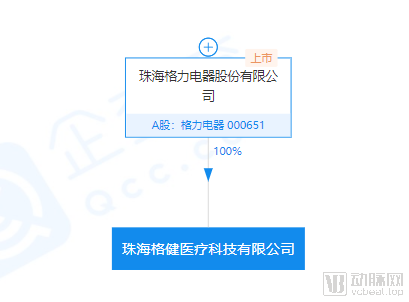
However, after the initial fanfare and widespread speculation surrounding its establishment subsided, Gejian Medical ceased to disclose any further information to the outside world. In retrospect, the containment of the COVID-19 pandemic and the influx of diverse players crossing over into mask production have stripped Gree’s medical business of any unique distinction. Compared with Haier Pharmaceutical under Haier, Hisense Medical under Hisense, and TCL Medical Imaging Group under TCL, Gree’s operations appear to lack technological sophistication. The global trend of “home appliance giants entering the healthcare sector” has failed to generate significant momentum through Gree’s entry.
An acquisition deal on the evening of February 2 has reignited this topic. Compared with Gree’s tentative entry into the sector, its long-time rival Midea has adopted a far more high-profile approach. That evening, WDM announced that Midea Group had acquired a 29.09% stake in its share capital, making Midea founder He Xiangjian the new actual controller of WDM. Based on the transfer price of RMB 14.6 per share, the transaction amounts to RMB 2.297 billion, representing an acquisition premium of over 40%.
Seemingly sensing the crisis, Midea had already made “self-restructuring” its core focus before the 2020 Lunar New Year celebrations had even concluded, initiating a multi-faceted strategic layout. This included taking a stake in WDM, acquiring Hitachi Lingwang Elevator, and establishing Meiken Semiconductor... Yet behind these myriad moves, Midea operates according to its own distinct logic.
The names involved in this transaction are largely household names in the medical industry. Following the acquisition, the shareholding of Yuyue Technology, the largest shareholder of WDM, decreased from 26.27% to 3.33%, while the shares held by director Wu Guangming were reduced to zero. Yu Rong, Chairman of Meinian Onehealth and another major shareholder, saw his stake halved from 12.67% to 7.67%. Midea Group, the acquirer in this deal, will hold 29.09% of WDM’s shares, becoming its controlling shareholder. On the day after the acquisition was completed, WDM’s stock price hit the daily upper limit as expected, closing at RMB 11.23 per share, whereas Midea’s stock price was barely affected, ending the trading session with a slight decline of 0.67%.
Based on Midea’s current healthcare layout, the fundamentals of Midea Healthcare are essentially those of WDM. As a leading domestic enterprise in large-scale imaging equipment, WDM is primarily engaged in the R&D and sales of imaging devices such as DR, MRI, DSA, and CT. Among these, DR constitutes WDM’s primary pillar product line, encompassing categories such as mammography DR, gastrointestinal DR, and mobile DR. This segment accounts for over 50% of sales and has maintained the number one market share in China for ten consecutive years. Mid-to-low-end MRI serves as WDM’s second pillar product line, contributing more than 30% of sales. Notably, WDM has achieved full in-house R&D of core components for its permanent magnet MRI systems, including permanent magnet assemblies, spectrometers, and coils. These two major product lines together generate nearly 90% of WDM’s total sales revenue.
For most companies, 2020 was not a favorable year, yet WDM still delivered a quite impressive performance. According to the semi-annual report, WDM’s operating revenue from January to June reached RMB 503 million, representing a year-on-year increase of 33.03%. The net profit attributable to shareholders of the listed company amounted to RMB 105 million, surging by 137.25% compared to the same period. These figures indicate that the pandemic-accelerated upgrade of primary healthcare medical equipment has significantly boosted WDM’s business growth.
Certainly, even without the pandemic, WDM has maintained solid growth in both revenue and profit in recent years. According to its 2019 annual report, WDM achieved a 2.92% year-on-year increase in operating revenue and a 10.14% rise in net profit for the full year of 2019.
Beyond its external performance advantages, WDM also possesses synergistic advantages across its industrial chain. Prior to its acquisition by Midea, WDM had long maintained a relationship of complementary strengths with its shareholders, yuwell and Meinian Onehealth. On one hand, WDM could procure equipment, consumables, and core components from yuwell to support its own operations; on the other hand, WDM could sell DR, MRI, CT, and other equipment to Meinian Onehealth’s third-party health examination centers. Data shows that equipment purchases by Meinian Onehealth accounted for only 3.4% of WDM’s revenue, with the specific figure for the full year 2019 being RMB 17 million.
Moving down the industrial chain, WanLiCloud Healthcare IT Co.,Ltd. (Beijing), controlled by WDM, has a different story to tell. When the independent imaging center model emerged in China in 2015, WanLiCloud, whose core business was informatization, began its transformation, pioneering entry into this sector and making substantial investments to build independent imaging centers. In 2016, AliHealth injected RMB 225 million into WanLiCloud. Following the transaction, WanLiCloud’s shareholders were WDM, holding a 75% stake, and AliHealth, holding a 25% stake.
Since then, WanLiCloud has been backed by four listed companies: Alibaba Health, WDM, yuwell, and Meinian Onehealth. Leveraging this advantage, WanLiCloud has built a big data cloud platform for medical imaging, providing remote medical imaging services and imaging cloud technology services, as well as establishing and operating offline third-party medical imaging centers.
In summary, following Midea's acquisition of WDM, WDM's imaging industry chain will lose some support from yuwell, but it has gained Midea's R&D capabilities. However, is this really a good deal?
Nearly every electrical giant has previously attempted to enter the healthcare sector, but the success of Philips and Siemens does not signify a cross-industry foray into healthcare.
Japan, its neighbor, undoubtedly offers the most valuable lessons. Since the advent of the internet era, former global giants in the electrical industry have suffered comprehensive defeats, with Toshiba, Sharp, Panasonic, and Sony all incurring massive losses. The development histories of these companies either illustrate the blueprint for Midea’s future success or foreshadow the failures it may face. If Midea likewise regards home appliances and healthcare as its future pillar businesses, then the journeys of these predecessors constitute essential material from which it must learn.
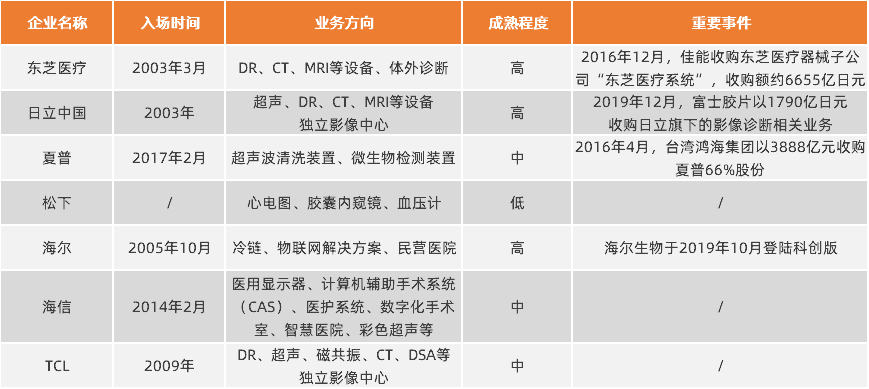
Toshiba (TOSHIBA) is a classic example of an electrical engineering company transitioning into the healthcare sector. A decade ago, the medical imaging equipment market was often referred to as “GPS-T,” with Toshiba standing alongside GE, Philips, and Siemens. However, as the medical imaging industry matured, with the “GPS” trio dominating the market and United Imaging Health rising rapidly from behind, Toshiba’s share in the CT market was steadily eroded, while sales of its other imaging products, such as MRI and DR systems, remained sluggish. Ultimately, Canon acquired Toshiba Medical Systems for RMB 39.5 billion, securing the position of the fourth-largest global player in medical imaging following the merger.
Hitachi and Toshiba followed similar development trajectories. After entering the Chinese market in 2003, Hitachi gradually established a core development strategy focused on imaging equipment as its primary R&D target, providing support in China for five product lines: ultrasound (US), magnetic resonance (MR), computed tomography (CT), near-infrared spectroscopy (NIRS), and X-ray (XR). According to 2018 data, Hitachi’s Healthcare Business generated revenue of JPY 186.1 billion, accounting for 29% of the group’s total revenue. However, high revenue does not necessarily translate into strong future prospects; Hitachi’s medical imaging business was no exception to the trend of decline. In December 2019, Hitachi sold its diagnostic imaging business to Fujifilm for JPY 179 billion (approximately USD 1.63 billion), thereby equipping Fujifilm with the capability to compete head-to-head with Canon.
Sharp entered the medical market relatively late. In April 2016, Taiwan’s Hon Hai Group acquired a 66% stake in Sharp for JPY 388.8 billion. A year later, Hon Hai, through its subsidiary Fabrigene Limited, invested USD 25 million (approximately NTD 750 million) to establish a joint venture with Sharp named Sharp Healthcare and Medical Company KY, aiming to capture share in the healthcare market. According to disclosed information from the target company, its product portfolio primarily includes ultrasonic cleaning devices and microbial sensors capable of automatically detecting airborne bacteria, which have gained certain recognition in the market.
Panasonic has yet to establish a systematic product portfolio in the medical sector, but it has made significant inroads into the consumer market. Judging from its current offerings, the home appliance giant’s approach to life sciences remains firmly rooted in the “home” concept, with products primarily targeting consumer-grade home medical devices such as blood pressure monitors, health indicator testers, home air purifiers, and smart bathroom fixtures. Behind these compact, well-designed products lies the vast consumer healthcare market.
Chinese giants have followed a similar trajectory. As the growth of the home appliance consumer market and overall economic development in China has lagged behind the pace seen in Japan and the United States, home appliance companies, despite enjoying two decades of growth dividends, now face saturation risks. Consequently, diversification has become an imperative, with healthcare emerging as one of their key strategic directions.
Haier is arguably the Chinese enterprise with the deepest understanding of the healthcare sector. Its “platform investment + biopharmaceutical industrial operations” strategy has enabled it to establish an initial ecosystem in the medical field. Haier Industrial Finance’s Healthcare Division has focused on the broader health industry, covering areas such as medical services, pharmaceutical distribution, pharmaceutical manufacturing, medical devices, and smart hardware, with a particular emphasis on non-public healthcare, primarily private hospitals. In 2018, the division proposed a three-phase plan: Phase I involved providing RMB 45 million in standard financial leasing products to upgrade pediatric outpatient clinics; Phase II entailed offering RMB 2 million in operating lease products to establish specialized departments and achieve differentiated regional competitive advantages; Phase III included acquiring a 10% equity stake, introducing equity capital to expand funding scale, and building a comprehensive health service chain spanning preventive care, medical treatment, rehabilitation, and elderly care through self-development, external acquisitions for controlling interests, and strategic investments, ultimately forming a regional health complex.
Haier Biomedical listed on the STAR Market in October 2019, with its core business focusing on biosafety hardware sales and IoT solutions. It provides cold chain logistics and storage and transportation services for pharmaceuticals, vaccines, and blood to institutions such as hospitals, pharmaceutical companies, and universities. Both business lines reflect echoes of Haier Group’s traditional operations, demonstrating a thorough leverage of its existing advantages.
Hisense Medical has expanded beyond its original business scope, with several years of development in health informatics and ultrasound imaging equipment. Over the past seven years, it has developed core products and solutions including medical-grade monitors, Computer-Assisted Surgery (CAS) systems, clinical care systems, digital operating rooms, smart hospital solutions, and color Doppler ultrasound systems. In these applications, Hisense’s Internet of Things (IoT) technology also plays a supportive role.
Changhong and Hisense share a similar strategic philosophy, but Changhong’s actual deployment is somewhat shallower, focusing on the popular internet healthcare route. Currently, Changhong’s market-ready product is a smart elderly care service system named “Tuotuoyi,” which provides data interconnectivity services between elderly care institutions and primary healthcare facilities.
Most noteworthy is TCL. Over the seven-year period from 2016 to 2019, its subsidiary, TCL Medical Imaging Group, focused on the R&D, production, and sales of high-end imaging equipment such as MRI and CT scanners. However, in 2017, the entire group began transitioning toward independent imaging centers, with multiple centers already in formal operation. Now that Midea holds stakes in WDM and WanLiCloud, TCL cannot help but feel a chill.
Among all the electrical giants that have crossed over into healthcare, the success of Philips and Siemens is evident to all. In particular, Philips’ healthcare business now contributes more than two-thirds of its revenue. However, both companies possessed world-class industrial foundations during their transitions, a key advantage that domestic home appliance giants lack.
So, do home appliance companies led by Midea still have the opportunity to overtake competitors on a bend?
If we were to turn back the clock 20 years, it would have been a sound strategic move for domestic appliance manufacturers to pivot toward medical imaging equipment. However, the market has since been thoroughly carved up. Earlier entrants into the medical imaging sector, such as Toshiba, Hitachi, and TCL, have gradually abandoned R&D on core devices, opting instead for mergers or complete exits. Consequently, even with Midea’s equity stake in WDM (Beijing Wandong Medical Technology Co., Ltd.), it remains difficult for the two companies to disrupt the current landscape of the large-scale medical imaging market.
Are Non-Imaging Medical Devices Reliable? Beyond Midea Healthcare’s Recent Aggressive Expansion, Midea Aims to Pioneer New Frontiers in Uncharted Territories. Consequently, the development paths of Panasonic, Sharp, and Hisense are unlikely to capture Midea’s interest. In this context, WDM’s RMB 500 million in revenue is merely a drop in the bucket for the consumer-oriented Midea, serving only as a stepping stone for market exploration.
Shifting Perspectives: If R&D Proves Challenging, Are There Opportunities in Business Model Innovation? As indicated by the table above, establishing private medical institutions presents a potential breakthrough. Data show that Hitachi, TCL, and Haier have all clearly demonstrated their determination to enter China’s private healthcare sector, already stirring significant interest. After all, among the various healthcare challenges currently facing China, advancements in medical devices alone cannot address public welfare issues, whereas business model innovation in private hospitals holds the potential to disrupt the existing landscape. Entering the market at this juncture is a strategic bet on future value.
Revisiting WanLiCloud, Soon to Be Owned by MideaIndependent imaging centers have been developing in China for merely six years. Infrastructure construction has only just begun, and the majority of patients have not yet been educated by the market. Choosing to deepen involvement in this sector at this juncture presents both risks and opportunities. Currently, WanLiCloud is gaining significant momentum; with Midea’s support, it may well pioneer new application scenarios.
It is difficult for Midea to follow the paths of Siemens and Philips to reinvent itself, but each step taken by these two companies may offer new insights for Midea. In September 2014, Siemens sold its home appliance business to Germany’s Bosch for RMB 3 billion. Recently, news that Philips is divesting its kitchen appliances and small home appliances businesses has also garnered significant attention. There have been numerous cases of European, American, Japanese, and South Korean home appliance companies exiting the Chinese market, spinning off their home appliance divisions, or selling them to Chinese counterparts. The underlying reasons lie both in the strong competitiveness of Chinese home appliance enterprises and in the increasingly saturated market space within the home appliance sector.
At this juncture, it is not just Midea; every home appliance giant must scrutinize its future development. After all, the home appliance market no longer boasts high technical barriers. In the internet era, what remains for these giants is largely their channel capabilities, which are inextricably linked to internet companies such as Alibaba and JD.com.
Midea Recognizes the Criticality of Barriers. On January 15, 2021, the Chairman and President of Midea Group stated at the annual meeting that in the new year, Midea must innovate, break through, and strategically position itself, daring to make disruptive investments. To regain control over its core competencies, whether in healthcare or semiconductors, Midea needs a clearer strategic logic.